

How to Work With a Dysregulated Nervous System
By Melody Wright, LMFT
You finally have a quiet moment.
Nothing needs your immediate attention. There’s nowhere you need to be. You sit down, maybe even with the intention of relaxing, but somehow your body doesn’t seem to understand that the day is over.
Your shoulders are still tense. You’re reaching for your phone without really thinking about it. Your mind keeps jumping to what you forgot, what needs to happen tomorrow, or whether you should get up and do that one last thing.
So, you try to relax harder. Maybe you take a few deep breaths, tell yourself everything is fine, or remind yourself that you’re safe. And sometimes that helps.
Other times, you’re still sitting there wondering why your body can’t seem to settle when there’s no obvious reason for it to be on edge.
This is often where conversations about nervous system regulation begin - with the question of how to make an uncomfortable feeling go away.
Instead of focusing on How do I make this uncomfortable feeling go away?, it can be helpful to get curious about what’s happening first: What is my nervous system doing right now, and what might actually support me?
What Does a Dysregulated Nervous System Feel Like?
When people hear the words nervous system dysregulation, they often picture something like anxiety, restlessness, racing thoughts, or that familiar feeling of being on edge.
And dysregulation can certainly feel that way. But sometimes it’s much quieter.
You might go blank in the middle of a difficult conversation, feel completely exhausted after something stressful, or find that even a simple decision suddenly feels weirdly difficult.
You might withdraw, procrastinate, feel numb, become irritable, or find yourself staring at your phone without really taking anything in.
Sometimes it feels like you have too much energy moving through you; other times, it can feel like you don’t have enough.
These responses are part of the nervous system’s attempt to help us respond to what’s happening around us. And they are influenced by far more than the situation directly in front of us. Sleep, hunger, sensory input, relationships, previous experiences, ongoing stress, physical health, and even how much we’ve already had to manage that day can affect our capacity in a particular moment.
That’s one reason the same situation may feel manageable one day and completely overwhelming another.
Understanding this can shift the question from Why am I reacting like this? to What has my system been carrying today?
And that gives us somewhere different to begin.
Nervous System Regulation Isn't Always About Calming Down
There are plenty of nervous system regulation tools that can help you feel more grounded in the moment. You’ve probably heard some of them before: deep breathing, cold water, meditation, putting your feet on the floor, going outside, or naming things you can see around you.
These practices aren't inherently good or bad. The more important question is whether a particular practice is actually supportive for your nervous system at that moment.
Because not every dysregulated nervous system needs more stillness.
If you feel restless, agitated, or like there is energy trapped inside your body, sitting quietly and trying to meditate may feel almost impossible. Walking, stretching, dancing, shaking out your arms, cleaning something, or simply moving your body may feel more accessible.
On the other hand, if everything already feels loud and overwhelming, adding more movement or stimulation may be the last thing you need. Dimmer lights, fewer sounds, a familiar blanket, a slower environment, or a few minutes without anyone asking anything from you might feel completely different.
And then there are the moments when what you need isn't necessarily quiet or movement at all. If you’re feeling disconnected or shut down, hearing a familiar voice, sitting beside someone you trust, spending time with a pet, receiving safe touch, or simply being around another person without needing to talk may help you feel more present.
This is why the goal isn't to memorize the “right” nervous system technique. It’s to become more familiar with yourself.
Learning to Notice Your Nervous System Before You're Overwhelmed
Most of us become aware that we're dysregulated once the feeling is already fairly loud. We realize we're overwhelmed when we're snapping at someone, notice we're anxious when our thoughts won't slow down, or recognize that we've shut down when we can't seem to make ourselves answer the text, start the task, or explain what we're feeling.
But your body may have been communicating long before that.
Maybe your jaw tightens or your breathing gets shallower. You might lose your appetite, start moving faster, become unusually sensitive to noise, stop making eye contact, or notice an urge to leave. For someone else, it might look like suddenly saying yes to everything because disappointing another person feels much harder to tolerate.
These earlier signals can be easy to miss, especially if you've spent a long time overriding them.
Part of working with your nervous system is slowly learning its language. Not so you can catch every reaction before it happens, but so there is a little more space between the first signal and the point where everything feels like too much.
That space can give you more choice.
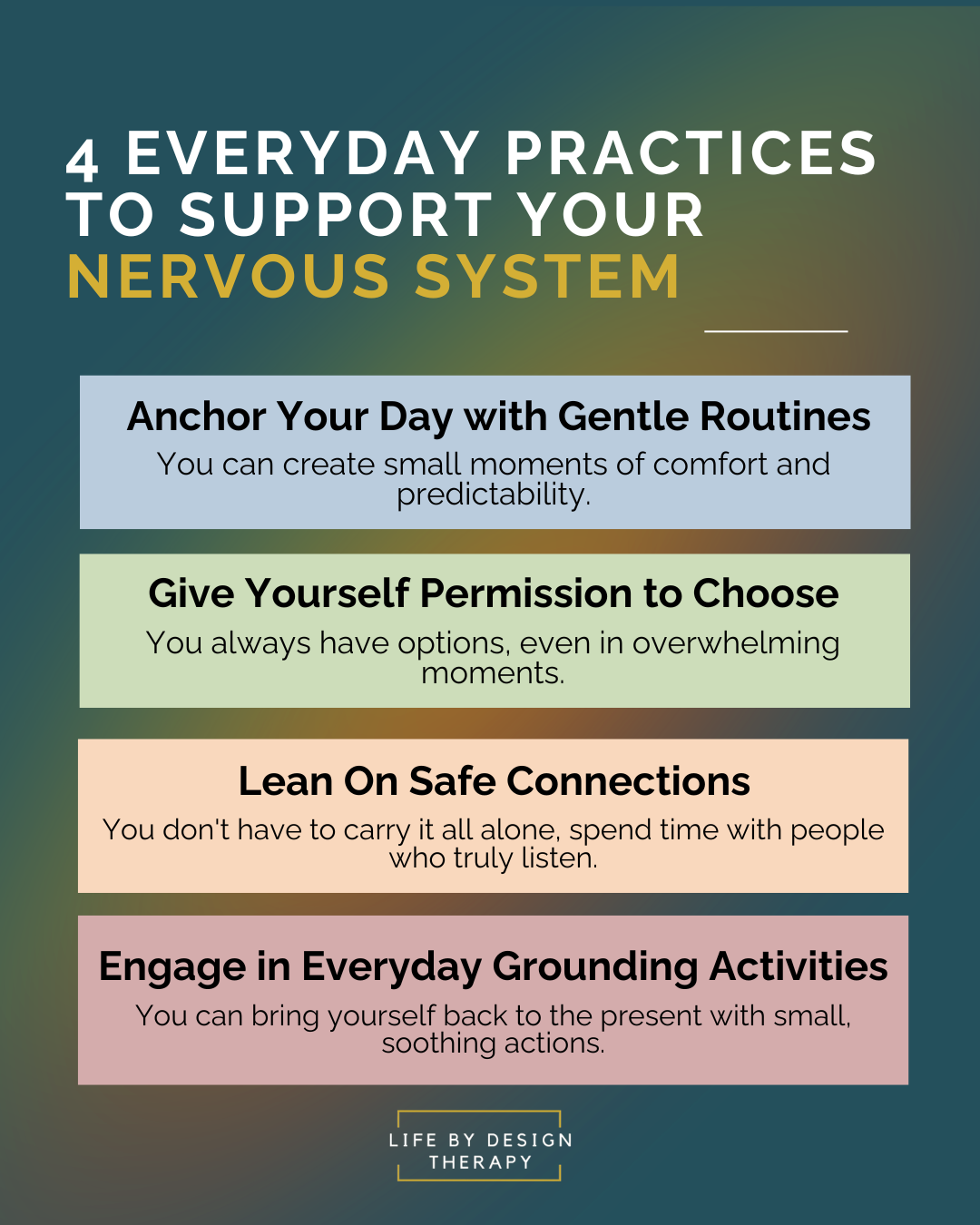
Supporting Your Nervous System Happens Outside of Dysregulated Moments, Too
We tend to think about nervous system regulation when something is already wrong. But your nervous system isn't only paying attention during a grounding exercise. It is responding to the rhythm of your everyday life.
This is where some surprisingly ordinary things can matter.
Routine, for example, isn't particularly exciting advice. But predictability can reduce some of the uncertainty your brain and body have to continually navigate. Knowing roughly when you'll eat, sleep, work, rest, or transition between parts of your day can create small points of familiarity.
That doesn't mean your life needs to run on a rigid schedule. Sometimes something as simple as drinking coffee in the same chair each morning, taking a walk after work, listening to the same playlist while making dinner, or having a familiar nighttime routine can become a small cue of I know what happens here.
Nervous system support can also happen through experiences that don't look like “nervous system work” at all. Massage or acupuncture might feel supportive for one person, while someone else finds that experience through gardening, swimming, lifting weights, cooking, sitting in the sun, or doing something with their hands.
It can also be found in moments that are harder to put into a wellness routine: laughing with someone who makes you feel like yourself, listening to music you’ve heard a hundred times, spending time somewhere you don't feel like you need to perform, or receiving a hug from someone you trust.
These aren't necessarily techniques for making your nervous system behave differently. They can simply be experiences where your body gets to encounter movement, pleasure, connection, predictability, rest, or safety.
And those experiences count, too.
Sometimes Regulation Is About Having More Choice
There's another part of nervous system regulation that doesn't always get as much attention: autonomy.
Imagine feeling overwhelmed at a crowded gathering. There's a difference between thinking, I have to stay here for three more hours, and knowing, I can step outside if I need to.
You may never actually leave. But knowing that you can changes something.
The same thing can happen in much smaller ways. Being able to say no, choosing where you sit, knowing when something will end, asking someone to stop, taking a break during a difficult conversation, deciding whether you want touch, or simply giving yourself permission to change your mind can all reinforce a sense that you have some choice in what happens next.
When we've had experiences where choice wasn't available, was ignored, or didn't feel safe to express, reconnecting with our own preferences can become an important part of nervous system work.
Sometimes support isn't about finding another way to calm your body. Sometimes it's about helping your body experience, I have options here.
Why Safe Relationships Can Help Regulate the Nervous System
We often talk about regulation as though it's something we're supposed to learn to do entirely by ourselves. But humans have always regulated in relationship with other humans.
Think about how different it can feel to receive difficult news alone versus sitting beside someone you trust. Or how your body can soften when someone speaks to you in a steady voice, listens without rushing you, or simply stays nearby when you're having a hard time.
This is sometimes referred to as co-regulation. It doesn't mean another person is responsible for managing your emotions, and it doesn't mean you should always need someone else in order to feel okay. It simply recognizes that connection can be one of the ways our nervous systems receive information about safety.
Over time, repeated experiences of being supported without being controlled, rushed, judged, or abandoned can matter.
And this is one reason the relationship itself can be such an important part of therapy.
How Somatic Therapy Can Help With Nervous System Regulation
Somatic therapy gives you an opportunity to pay attention not only to what we're thinking, but to what is happening in your body as we talk about our experiences.
A therapist might help you notice when your breathing changes, when tension appears, when you suddenly feel far away from what you're talking about, or when you feel an impulse to move, stop, turn away, or create more space.
The point isn't to analyze every sensation. It's to become more familiar with your own responses.
Therapy can also offer a supported space to experiment with what happens when you slow down instead of pushing through, or when you notice the urge to say no and become curious about what that feels like in your body. You might explore what helps you stay connected to yourself during a difficult conversation, or whether you can experience some discomfort without immediately needing to make it disappear.
Over time, these experiences can help build awareness and expand the range of responses available to you outside of therapy.
Because ultimately, the goal isn't for your therapist to regulate your nervous system for you. It's for you to understand yourself well enough that you have more ways to meet yourself when life happens.
You Don't Have to Be Regulated All the Time
There's an irony that can happen when we learn about nervous system regulation: we can become so focused on being regulated that dysregulation starts feeling like failure.
You might find yourself thinking, I know better than this. Why am I still getting triggered? I've done so much work—why does this still bother me?
Suddenly, regulation becomes another standard we're trying to meet.
But a healthy nervous system isn't one that stays calm all the time. Your nervous system is designed to respond.
There will be moments when you feel anxious, times when you become overwhelmed, conversations that activate something in you, and days when your capacity is simply lower than usual. The work isn't necessarily preventing those moments from happening.
It may look more like noticing sooner, understanding your patterns, having more choices available, knowing when you need support, and allowing yourself to respond differently. And when dysregulation does happen, you can find your way back without turning the experience into evidence that something is wrong with you.
Final Thoughts
Working with a dysregulated nervous system is less about mastering the perfect set of calming techniques and more about developing a relationship with your own responses.
Over time, you may begin to recognize what activation and shutdown feel like for you, what actually helps and what doesn’t, and what your body has been trying to communicate before the message becomes impossible to ignore. You may also start noticing the environments where you feel most at ease, the situations where you can be more fully yourself, and the people you feel safest and most connected around.
There may still be days when you don't catch it early, when the grounding exercise doesn't help, or when you realize what you needed three hours after you needed it.
That doesn't erase the awareness you're building.
Sometimes nervous system work is simply creating more opportunities to notice what’s happening within you, choose how you want to respond instead of moving on autopilot, receive support when you need it, and find your way back to yourself when things feel overwhelming.
And you don't have to learn how to do that alone.
At Life By Design Therapy™, our somatic and holistic approach to therapy creates space to explore how your experiences show up not only in your thoughts, but also in your body and nervous system. We offer holistic and somatic therapy in Berkeley, California, as well as online therapy through telehealth for clients throughout California.
If you're interested in learning more about somatic therapy and how it may support you, we invite you to connect with our team.
This Week's Affirmations
I don’t have to be calm all the time to be okay.
I am learning how to work with myself instead of against myself.
I am allowed to choose what feels supportive for me.
I can listen to my body without needing to immediately change what I feel.
I am learning to recognize what my nervous system needs.
Additional Resources
If you’re interested in understanding your nervous system, recognizing your own patterns of dysregulation, and learning what helps you feel more grounded and connected, the books below can be a helpful place to start.
In an Unspoken Voice: How the Body Releases Trauma and Restores Goodness by Peter A. Levine
The Body Keeps the Score: Brain, Mind, and Body in the Healing of Trauma by Bessel van der Kolk M.D
Polyvagal Theory in Therapy: Engaging the Rhythm of Regulation by Deb Dana
**Some product links are affiliate links, which means we'll receive a commission if you purchase through our link, at no extra cost to you. Please read the full disclosure here.


What Does a Dysregulated Nervous System Feel Like?
By Melody Wright, LMFT
I remember a season when I couldn’t quite explain what was happening to me.
Nothing was dramatically wrong. I was still answering messages, showing up, getting through the things that needed to get done. If someone had asked how I was, I probably would have said, “Fine,” because I didn’t have a better answer.
But I started to notice that I would stare at the same email for days, unable to make myself respond. I’d walk into a room and forget why I was there and even snap at people more easily. By the end of the day, if someone needed one more thing from me, I could feel my whole body resisting it.
What confused me most was when I would zoom out and look at the whole picture…none of these things seemed big enough to explain how overwhelmed I felt.
I wasn’t having panic attacks. I wasn’t falling apart in an obvious way. I was just having a harder time with ordinary life. Small things felt heavier than they should have, and I kept assuming I was simply tired, distracted, or not trying hard enough.
That’s part of what can make nervous system dysregulation so difficult to recognize. We tend to imagine it as something bigger, like panic, intense anxiety, or completely shutting down.
And truthfully, sometimes it does look like that.
But it can also look like an ordinary Tuesday when someone asks what you want for dinner, and that simple question can make you suddenly feel like you might cry.
Those more subtle shifts can be some of the hardest to recognize for what they are. So, let’s look at a few of the ways nervous system dysregulation can show up in everyday life.
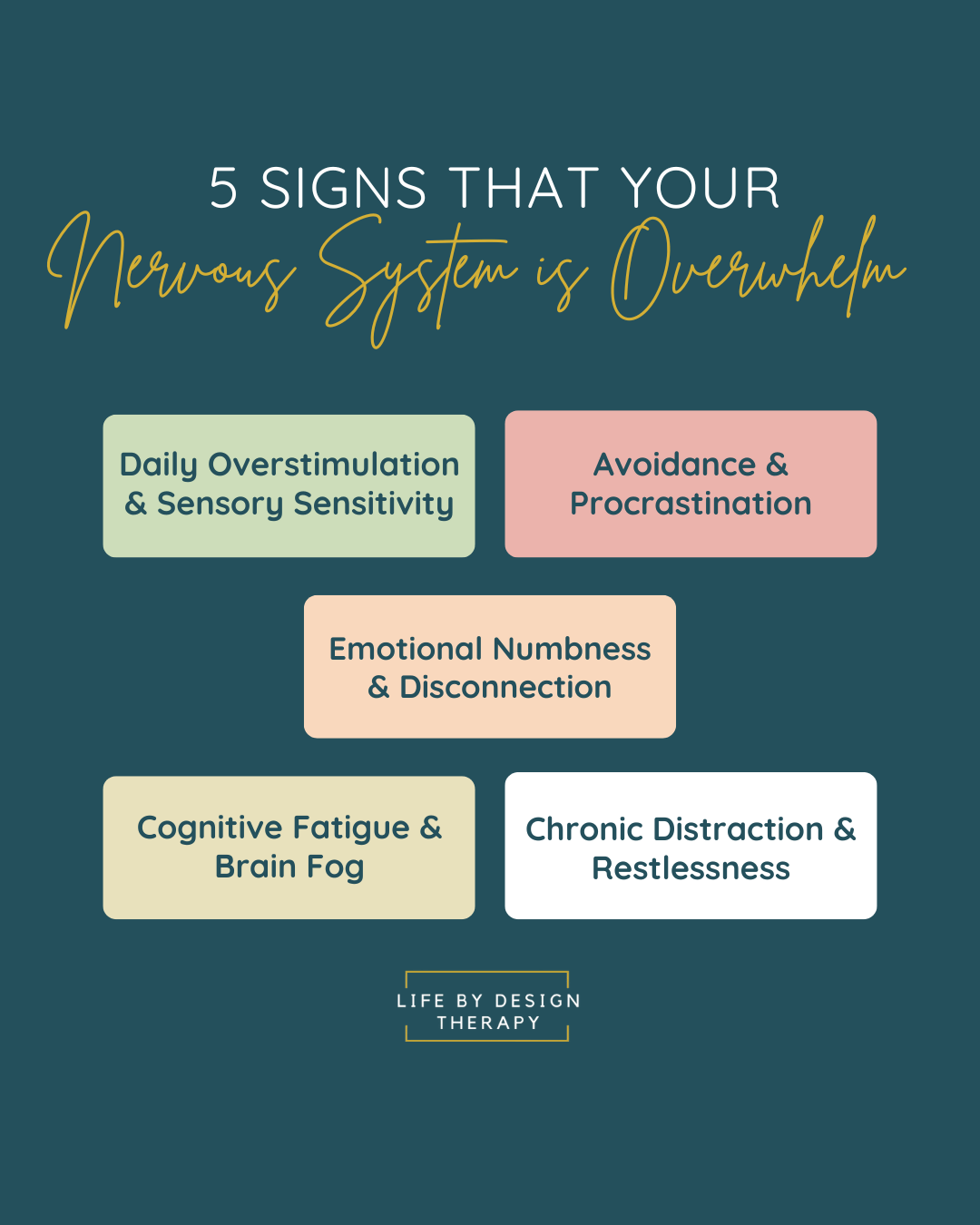
Overstimulation
For me, one of the biggest clues was how little tolerance I had for things that normally wouldn’t have bothered me.
It wasn’t necessarily one big thing. It was the TV being on while someone was talking to me. My phone buzzing when I was already struggling to concentrate. Someone gently touching my arm while I was in the middle of something.
Individually, these were such small moments that I almost felt silly for being bothered by them.
But together, they started telling me something.
I didn’t suddenly become an impatient person, and the world around me hadn’t suddenly gotten louder. I just didn’t have as much room for all of it.
And maybe you’ve felt some version of that, too, not necessarily in the same way, but in those moments when things that normally wouldn’t bother you suddenly feel like too much. Maybe certain sounds start getting under your skin. You raise your voice when you get frustrated. Clutter suddenly feels unbearable. Or a simple interruption brings up a much bigger reaction than you expected.
Sometimes the thing worth noticing isn’t what is bothering you, but that your threshold has changed.
Maybe you’re still moving through the same full days, but things are taking a little more out of you than they used to. You have less patience for interruptions, need more quiet at the end of the day, or notice that your emotions are closer to the surface. These shifts can be signals inviting you to pay attention to what your nervous system may be asking for.
Avoidance and Procrastination
Avoidance and procrastination can be subtle signs of overwhelm, which can make them easy to misread as something else.
You stop answering certain texts. There’s an appointment you keep meaning to make. An email sits unanswered even though you know it would only take a few minutes.
And maybe you start choosing what requires the least from you.
The same dinner. The familiar show. Staying home instead of making plans. Putting something off until tomorrow because today, for whatever reason, you just can’t make yourself deal with it.
From the outside, it can look like procrastination. From the inside, it can feel frustrating because you know these things aren’t actually that hard.
But when you’re already carrying a lot, sometimes even small things can feel like one decision, one conversation, one demand too many.
There can be something comforting about making life a little more predictable when you don’t have much capacity for anything else.
But sometimes it isn’t only our lives that start getting smaller. We can feel a little farther away from ourselves, too.
Feeling Disconnected From Yourself
This can be one of the harder shifts to put into words because nothing necessarily feels wrong.
You just feel...less like you.
Maybe you’re normally playful, but you haven’t felt very playful lately. Someone tells you something exciting, and you know you’re happy for them, but you can’t quite reach the feeling.
Or someone asks what you want.
What sounds good for dinner? Do you want to go out? What would feel good this weekend?
And your answer to everything seems to be, I don’t know.
Sometimes overwhelm isn’t only about feeling too much. It can also feel like temporarily losing access to things that usually come naturally—your preferences, humor, creativity, curiosity, affection, even your desire to connect with other people.
That can feel unsettling.
And when we don’t feel particularly connected to ourselves, it makes sense that we might look for something outside of ourselves to fill the space.
Needing Constant Distraction
It’s easy to get used to always having something going on in the background. A little noise, something to scroll through, one more thing to get done. After a while, you might not even notice how rarely you’re actually sitting in quiet.
The podcast is on while you shower. You scroll while watching TV. You finally sit down after a long day and, within a few minutes, find yourself getting back up to do something that absolutely could have waited.
Or maybe you pick up your phone, scroll for a while, put it down...and pick it up again without really knowing what you’re looking for.
There’s a lot of conversation about spending less time on our phones, being more present, and getting better at resting. And those conversations have their place.
But I think there’s another question worth asking: What does the distraction give me?
Maybe it gives your mind somewhere to go. Maybe constant activity feels more familiar than stillness. Maybe the moment everything gets quiet, you become aware of just how tired, restless, sad, angry, or overwhelmed you actually are.
That’s different from simply being “bad at relaxing.”
And sometimes, even with all that distraction, you notice your brain isn’t keeping up the way it usually does.
Brain Fog and Forgetfulness
You walk into another room and completely forget why you’re there.
You’re halfway through a sentence when the thought disappears.
You read the same paragraph three times. You lose something you just had in your hand. A simple decision somehow feels like it requires an unreasonable amount of thought.
We all do these things sometimes.
But when they start happening more often, it can create that nagging feeling of, What is going on with me lately?
When we’re overwhelmed, things like attention, concentration, memory, and decision-making can become harder.
And this is where curiosity becomes much more helpful than criticism.
Not, Why can’t I get it together?
But maybe, When did things start feeling this hard?
Understanding Your Own Signs of Nervous System Dysregulation
Of course, the signs we’ve talked about here don’t automatically point to nervous system dysregulation. An unanswered text, an irritated mood, or the need for a little more quiet can all be part of being human.
Sometimes you’re tired. Sometimes you’re distracted. Sometimes someone really is getting on your nerves.
And things like brain fog, sensory sensitivity, emotional numbness, and difficulty concentrating can have many different causes, including physical and mental health conditions.
This isn’t about turning everything you do into a symptom.
It’s about getting to know your patterns.
Maybe you know you’re carrying too much when sounds start bothering you. Maybe you withdraw. Maybe you become incredibly productive and can’t seem to stop. Maybe you lose your sense of humor or stop knowing what you want.
Your signs may not look like anyone else’s.
But the more familiar they become, the sooner you can recognize that something has shifted.
Nervous System Regulation Doesn’t Mean Being Calm All the Time
There’s a version of nervous system regulation online that can make it seem like the goal is to become someone who moves through life completely unbothered.
Calm. Grounded. Patient. Present.
Preferably while drinking tea and taking deep breaths.
But that’s not really how being human works.
Your nervous system is supposed to respond to your life. You will have days when you’re overwhelmed. You’ll get irritated. You’ll need space. Sometimes you’ll need everyone to stop talking to you for ten minutes.
Regulation isn’t about never getting knocked off center.
It’s about recognizing when you have and, over time, learning what helps you find your way back.
Final Thoughts
If you recognize yourself in some of what we’ve talked about, please don’t take this as an invitation to start picking yourself apart. Learning to recognize nervous system dysregulation isn’t about watching yourself for signs that something is wrong.
It’s really about getting to know yourself a little better.
Maybe you start noticing that your patience disappears before you consciously feel overwhelmed. Or that you stop answering people when you need more space. Maybe you realize that when you’re constantly reaching for distraction, what you actually need is somewhere to put everything you’ve been carrying.
Those small observations can tell you a lot.
You don’t have to catch every signal or understand exactly why you’re feeling the way you do. Sometimes simply being able to say, Oh, I know this feeling. I’ve been carrying a lot lately, can change the way you respond to yourself in that moment.
And over time, that awareness can help you recognize what you need before everything has to feel quite so loud.
If you’ve been noticing some of these patterns in yourself and want support understanding what your nervous system may be communicating, Life By Design Therapy™ offers somatic and holistic therapy that looks beyond symptoms to explore what’s happening within the whole person.
Our therapists support adults who want to understand their patterns better, reconnect with themselves, and find ways of moving through life that feel more supportive and sustainable.
Ready to explore what support could look like for you? Learn more about working with Life By Design Therapy™ or schedule a consultation with our team.
This Week's Affirmations
Having less capacity today doesn’t mean I’m failing.
I can be curious about my reactions instead of criticizing them
Not knowing what I need yet doesn’t mean I won’t find my way back to myself.
I’m learning to recognize the ways my body asks for my attention.
I’m allowed to need less noise, less input, and more space.
Additional Resources
If you’re interested in understanding your nervous system, recognizing your own patterns of dysregulation, and learning what helps you feel more grounded and connected, the books below can be a helpful place to start.
The Body Keeps the Score: Brain, Mind, and Body in the Healing of Trauma by Bessel van der Kolk M.D
Polyvagal Theory in Therapy: Engaging the Rhythm of Regulation by Deb Dana
In an Unspoken Voice: How the Body Releases Trauma and Restores Goodness by Peter A. Levine
**Some product links are affiliate links, which means we'll receive a commission if you purchase through our link, at no extra cost to you. Please read the full disclosure here.

The Real Reason Self-Compassion Feels Uncomfortable
By Melody Wright, LMFT
Imagine you're cooking dinner and accidentally grab the handle of a hot pan.
You feel the burn and immediately pull your hand away. You run it under cool water, find something to treat it, and you're probably a little more careful the next time you reach for that pan.
When we experience physical pain, we instinctively know that whatever is injured needs care and attention. However, when we experience emotional pain, we don’t always respond the same way – with care and attention.
For example, instead of responding to ourselves with care, our minds often begin looking for everything we did wrong, like:
Replaying a mistake that was made for the rest of the day.
Questioning what we could have done differently when we think we let someone down.
Focusing on everything we didn't finish after an exhausting week
If this were a burn on your hand, you wouldn't keep touching the hot pan to teach yourself a lesson. Yet when the pain is emotional, many of us do something surprisingly similar by returning to it again and again through criticism, shame, and overthinking.
Now I understand, being kind to yourself sounds like it should come naturally. But if you’ve ever found yourself in this position, you know it can be anything but easy.
What if I told you that there might be a reason for that…and it’s not your fault.
For a lot of us, self-criticism developed as a way of coping, protecting ourselves, or making sense of difficult lived experiences. Understanding where these patterns come from can help us make sense of why self-compassion sometimes feels so difficult. From there, we can begin to notice what gets in the way, how those patterns continue to show up in our lives, and what it might look like to respond to ourselves differently.
How Childhood Experiences Shape Negative Self-Talk
Self-criticism rarely develops out of nowhere. More often, it's something we learn over time.
As children, we naturally adapt to the environments we're growing up in. Over time, those early ways of coping can shape how we respond to ourselves when things feel hard.
For example:
A child who is frequently corrected may begin looking for their own mistakes before someone else points them out, hoping to avoid being corrected again.
A child growing up in a home where emotions often shifted without warning may learn to watch tone of voice, facial expressions, and mood changes, hoping to stay one step ahead.
A child whose family is already overwhelmed may avoid asking for help because they don’t want to add another problem. As they grow older, asking for help may feel selfish, and struggling may feel like something they should be able to handle on their own.
These aren't personality flaws. They're adaptations.
As children, those adaptations often make sense. They help us stay connected, avoid conflict, or find a sense of safety in the world around us.
As we grow older, though, those same adaptations can quietly become the rules we live by:
Don’t make mistakes.
Don’t ask for too much.
Keep everyone happy.
Take care of it yourself.
Over time, those rules can become the voice we hear inside our own heads.
That critical voice may be painful, but it isn’t pointless.
It's often trying to protect you from something it learned to fear, whether that's criticism, conflict, rejection, disappointment, or feeling like your needs were too much.
Sometimes that voice isn't even fully your own. It may sound a lot like the parent, caregiver, teacher, or other influential adult whose words or expectations became internalized over time. As children, we naturally absorb the messages we're given, especially when they feel connected to love, approval, or safety. Eventually, those messages can become the way we speak to ourselves.
That's why replacing self-criticism with a positive affirmation rarely creates lasting change, even though we may want it to. Before that critical voice can soften, it helps to understand where it came from, what it's trying to protect you from, and whether the messages it's repeating still belong in your life today.
Why Letting Go of Self-Criticism Can Feel Risky
If self-criticism has been part of your life for a long time, it's understandable that the idea of letting it go might feel uncomfortable.
You may even wonder, "If I'm not hard on myself anymore, what will keep me accountable?"
For so many of us, that critical voice has become tangled up with responsibility, motivation, and doing the right thing. So when we hear the words self-compassion, we might worry it means excusing harmful behavior, avoiding responsibility, or pretending everything is okay.
That isn't what self-compassion means in a therapeutic context.
Self-compassion allows us to look honestly at what happened without turning the experience into an attack on who we are.
So, it sounds less like, "It doesn't matter that I hurt someone," and more like, "I don't feel good about what happened. I want to understand it, repair what I can, and respond differently next time."
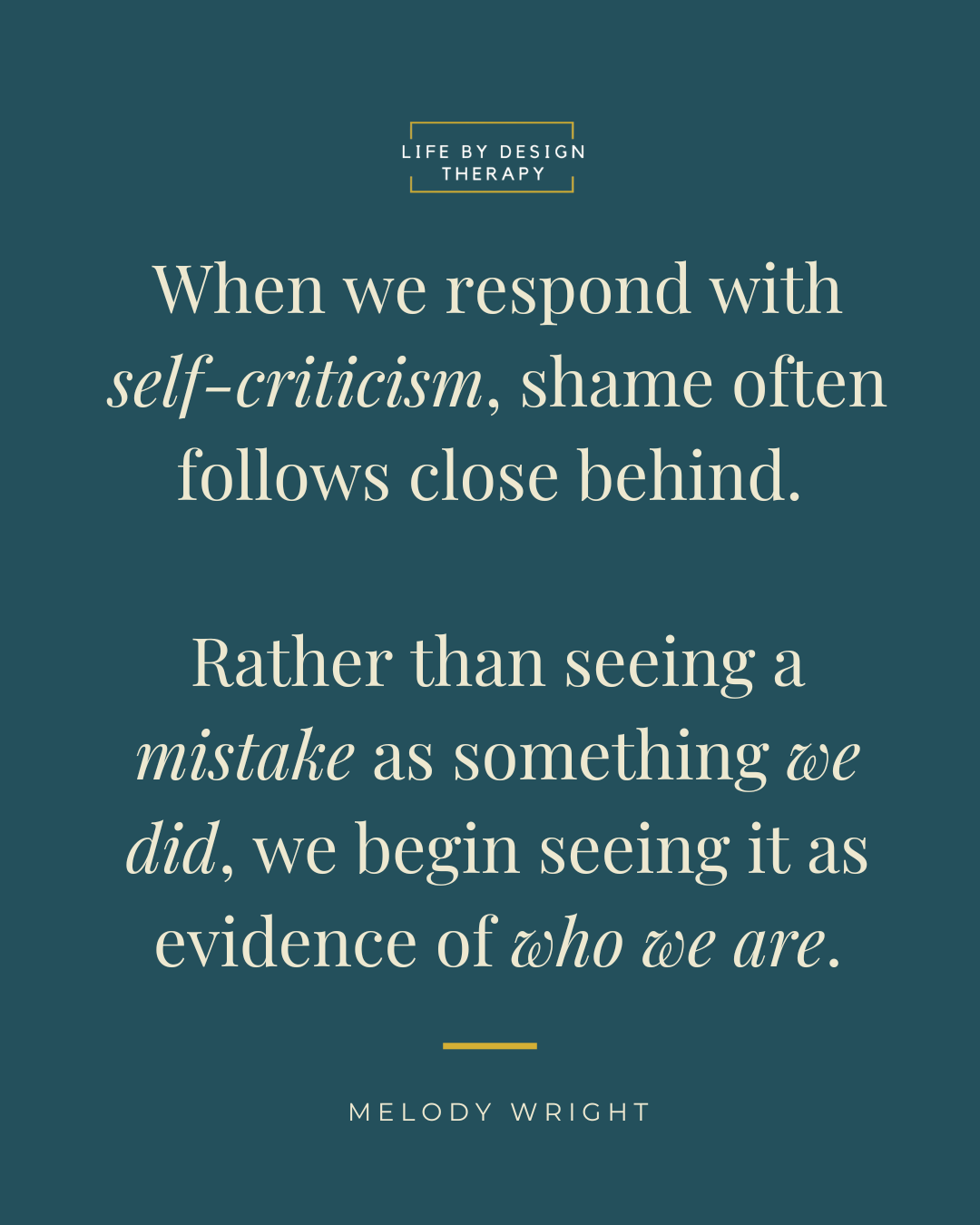
When we respond with self-criticism, shame often follows close behind. Rather than seeing a mistake as something we did, we begin seeing it as evidence of who we are.
Shame sounds like: “I made a mistake because there’s something wrong with me.”
Self-compassion makes room for a different response: “I made a mistake. What happened? What needs repair? What support would help me respond differently next time?”
Even when we understand that difference, choosing compassion over criticism can still feel risky.
You may be wondering what happens if you stop relying on the patterns that have helped you feel in control or keep moving forward.
If being hard on yourself is what pushes you to do better, what happens if you respond with compassion instead?
If anxiety is what reminds you to check everything three times, what happens when you relax?If guilt is what keeps you available to everyone, what happens if you stop carrying it?
And if these are the questions you’re asking yourself right now, they make sense. When these patterns have helped you feel productive, responsible, or in control, letting go of them can feel uncomfortable…even when you know they’re no longer serving you.
After all, these patterns may have helped you get through difficult moments, meet expectations, or feel more in control. At the same time, they may make it harder to rest without guilt, trust yourself without second-guessing, or let go of a mistake after you’ve already done what you can to repair it.
The goal isn't to stop caring, but rather it's to understand that caring and self-punishment aren't the same thing.
Why Self-Compassion Sometimes Brings Up Grief
One surprising thing about practicing self-compassion is that it doesn't always bring immediate relief. Sometimes, it brings grief.
It might seem surprising at first, but here's why.
As you begin responding to yourself with more compassion instead of criticism, you may start looking at your past through a different lens. Experiences you've always dismissed, justified, or blamed yourself for can begin to feel different.
In therapy, there are moments when someone suddenly realizes how young they were when they became responsible for a parent's emotions. They recognize that being "easy" often meant keeping their own needs private. They begin to understand that what they always thought of as independence may have developed because depending on other people didn't feel reliable.
Those realizations can be incredibly validating. They can also bring a deep sense of grief.
You may find yourself trying to hold more than one truth at the same time. My parents loved me, and there were ways they weren’t able to show up for me. They were struggling and doing the best they could, and I still needed more than they were able to give.
Holding those truths together can be painful. It can mean grieving the childhood, relationship, or experiences you needed but didn’t have. That grief doesn’t require you to decide that your parents were bad people or that nothing good existed. It means making space for the reality that something important may have been missing for you.
For many of us, our earliest relationships are where we first learn what love, safety, comfort, and care feel like. When some of those needs weren’t met, we can carry that with us into adulthood, including in the way we relate to and care for ourselves.
And sometimes, healing means learning to hold both: They may have done the best they could, and I can still acknowledge that I needed more.
These are questions therapists hear often, but the goal isn't to decide whether your parents were "good" or "bad." It's to make space for the full picture.
A caregiver may have loved you deeply and still been unable to consistently meet your emotional needs. They may have been doing the best they could with their own history, health, or circumstances. At the same time, you may still carry the effects of what their best couldn't provide.
Both of those things can be true.
Understanding their experience doesn't require you to minimize your own.
Sometimes self-compassion simply means allowing yourself to acknowledge the impact of what happened without immediately explaining it away, dismissing it, or telling yourself it shouldn't have mattered.
Practicing Self-Compassion When It Doesn't Feel Natural
Being compassionate toward yourself can sound simple: offering yourself the same patience, understanding, and care you might naturally extend to someone you love. But for many people, actually relating to themselves this way can feel surprisingly uncomfortable.
Instead of feeling reassuring, self-compassion may bring up tension, irritation, numbness, embarrassment, or even resistance. And often, that discomfort has less to do with whether you’re “doing it right” and more to do with what you’ve learned about how you’re supposed to respond to yourself.
From a somatic perspective, those reactions aren't something to push past; they're something to pay attention to.
Your body is always responding to what it has learned over time.
So, if warmth and care felt inconsistent growing up, receiving them (even from yourself) can feel unfamiliar. If being emotionally vulnerable was met with criticism, dismissal, or rejection, turning toward your feelings may cause your body to brace before your mind even realizes what's happening.
You might find yourself saying, "It's okay to rest," while noticing tightness in your chest or an urge to get up and be productive.
Intellectually, you might know you’re safe, but your nervous system may still be responding to what it learned a long time ago.
But please know that doesn't mean you're failing at self-compassion. It simply means your body learned a way of protecting you that once made sense.
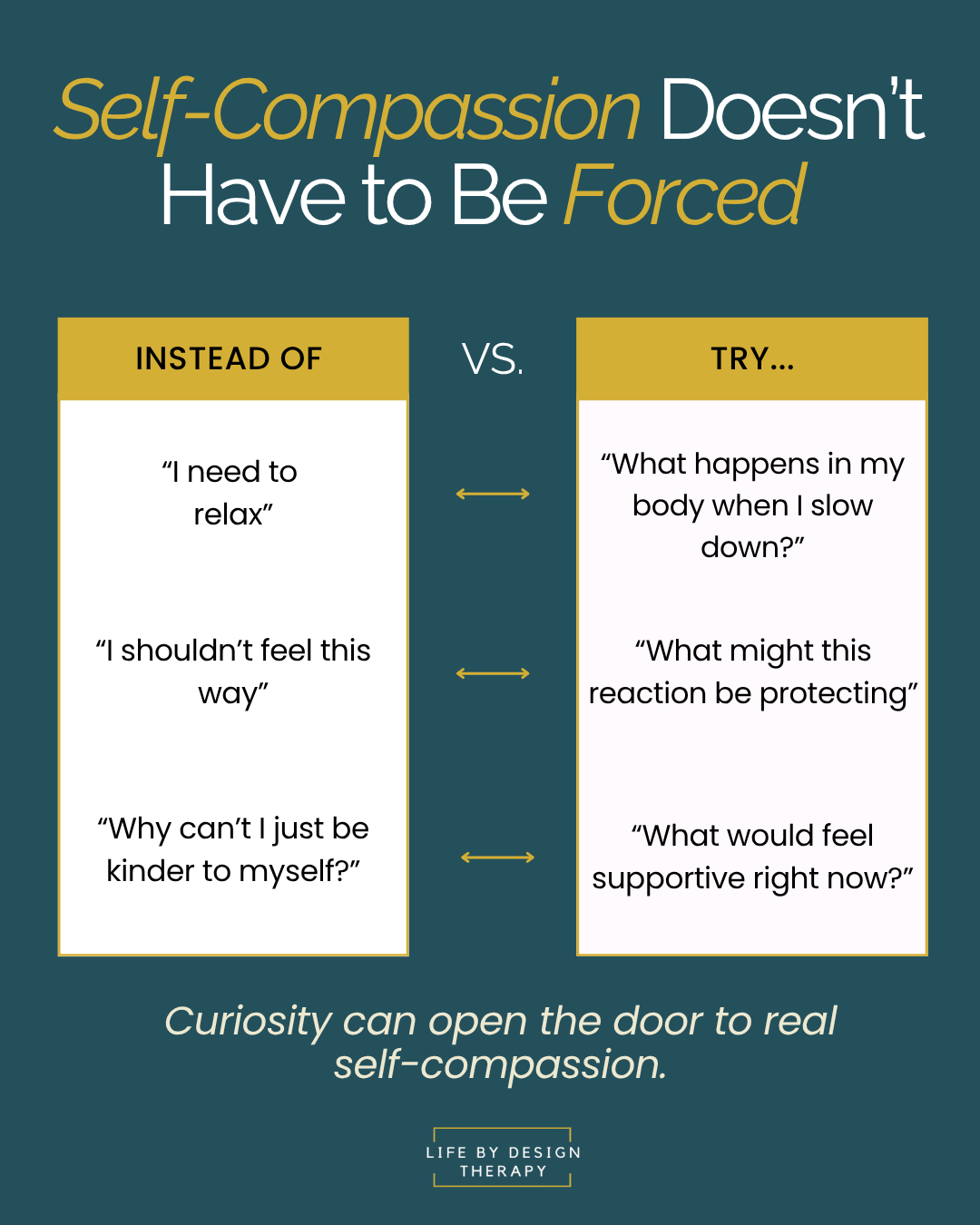
So rather than forcing yourself to relax or repeating a comforting statement until it feels true, you might begin with curiosity instead.
What happens when you slow down? Where do you notice the discomfort? Does your body feel safer keeping your eyes open? Moving around? Choosing words that feel less emotionally intense?
And honestly, sometimes the most compassionate response isn't pushing through the exercise. It's simply recognizing, "This doesn't feel supportive right now," and giving yourself permission to try a different approach.
Final Thoughts
If there's one thing I hope you take away from this, it's that self-compassion isn't about pretending things didn't happen or convincing yourself everything is okay.
It's about discovering that you can respond to yourself differently.
Over time, those small moments begin to give your mind and body a new experience. You can make a mistake without attacking yourself. You can disappoint someone without automatically assuming you've failed them. You can acknowledge your own needs without treating them as evidence that you're asking for too much.
Little by little, self-compassion becomes more believable. Not because you've found the perfect words, but because you're discovering that pain doesn't have to be followed by punishment.
If being kind to yourself still feels uncomfortable, that's okay. As we've explored throughout this blog, those patterns often developed for a reason. And just as they were learned, they can also be understood and, over time, gently reshaped.
If you'd like support as you begin that process, that's exactly the kind of work we do in therapy. At Life by Design Therapy, we offer holistic, trauma-informed, and somatic therapy to help people better understand these patterns and build new ways of relating to themselves. Whether you're looking for therapy in Berkeley or online therapy anywhere in California, we're here to support you. If you're ready to begin that journey, we'd love to connect.
This Week's Affirmations
I don’t have to force kindness; I can begin with honesty.
My needs are not an inconvenience.
I am allowed to rest before everything is finished.
Making a mistake does not mean there is something wrong with me.
I can listen to my inner critic without letting it control my choices.
Additional Resources
If you’re interested in exploring self-compassion, quieting your inner critic, and building a kinder relationship with yourself, the books below can be a helpful place to start.
Self-Compassion: The Proven Power of Being Kind to Yourself by Kristin Neff
Radical Acceptance: Embracing Your Life With the Heart of a Buddha by Tara Brach
The Untethered Soul: The Journey Beyond Yourself by Michael A. Singer
Emotional Intelligence: Why It Can Matter More Than IQ by Daniel Goleman
The Power of Now: A Guide to Spiritual Enlightenment by Eckhart Tolle
**Some product links are affiliate links, which means we'll receive a commission if you purchase through our link, at no extra cost to you. Please read the full disclosure here.

101 Ways to Practice Self-Compassion in Everyday Life
By Melody Wright, LMFT
It’s 8:17 in the morning, and somehow, you already feel behind.
You didn’t sleep well. The kitchen is a mess. There’s a message waiting for you that you haven’t answered, and you’re mentally rearranging the day before you’ve even had a chance to settle into it.
Then something small happens.
You forget an appointment. Spill your coffee. Lose your patience with someone you love. Whatever it is, the thought comes quickly:
“Why can’t I get it together?”
The moment passes, but the criticism follows you into the rest of your day.
Now you’re frustrated with yourself for being frustrated.
One difficult moment has turned into a running list of all the ways you should be doing better.
Sound familiar?
If a friend told you about the exact same morning, you’d probably notice how much they’ve been carrying. You’d remind them that they’re human and not decide that their entire personality is the problem.
But offering ourselves that same understanding can be much harder.
That’s where self-compassion comes in. Of course, self-compassion doesn’t mean avoiding responsibility or pretending everything is fine. It means being honest about what happened without adding another layer of shame. Therapy can help you step back and get to know that critical voice a little differently by understanding where it learned to speak that way, what tends to bring it forward, and why it believes being hard on you is the only way to keep you moving.
And did you know that self-compassion can show up in more ways than you might expect?
So, here are 101 simple ideas to help you explore what self-compassion can look like in real life. As you read through these 101 ideas, notice what feels comforting, what surprises you, and what brings up a little resistance.
There's no pressure to work through this entire list. Start with the ideas that feel most meaningful to you.
What Self-Compassion Can Look Like in Everyday Life
1. Notice how you speak to yourself.
Pay attention to what you say internally after a mistake or difficult moment. If the words feel cruel rather than helpful, try saying it again with more care.
2. Name what you’re feeling without judging it.
Try “I’m feeling overwhelmed” instead of “I’m being ridiculous.” Naming the emotion helps you understand your experience without making it a flaw.
3. Let yourself have a hard day.
Not every difficult day needs to be rescued, reframed, or made productive. Sometimes acknowledging that today is hard is enough.
4. Ask what you need before asking what you should do.
Before pushing through, pause and check whether you need food, rest, movement, support, space, or something else entirely.
5. Let “good enough” be enough.
Not everything requires your highest level of effort. Some things can simply be completed and released.
6. Stop using one mistake as evidence against yourself.
Forgetting something doesn’t make you irresponsible. Losing your patience doesn’t erase every loving moment that came before it.
7. Give yourself a moment before responding.
A few quiet seconds can help you notice what’s happening inside before reacting from stress, fear, or defensiveness.
8. Remember that your capacity can change from day to day.
What felt manageable yesterday may feel heavy today. Adjusting to your current capacity isn’t a failure.
9. Choose the easier option when you need it.
Make the simple dinner. Buy the shortcut. Take the direct route. You don’t have to make life harder to prove you’re trying.
10. Apologize without attacking your character.
You can say, “I’m sorry. I want to handle that differently next time,” without calling yourself a terrible person.
11. Rest before everything is finished.
Your need for rest doesn’t begin only after the entire list is complete.
12. Place a hand somewhere comforting on your body.
Rest it on your chest, stomach, arm, or face. A gentle touch can offer your nervous system a small cue of safety and support.
13. Let yourself feel disappointed.
You don’t have to minimize what mattered to you simply because someone else might not understand.
14. Notice when “I should” is creating shame.
Ask whether the expectation is realistic, necessary, or even yours.
15. Speak to yourself like someone worth helping.
Instead of asking, “What’s wrong with me?” try, “What would make this a little easier?”
16. Allow yourself to change your mind.
New information, changing needs, and personal growth can all lead you to make a different choice.
17. Stop explaining every boundary.
A simple no can be enough. You don’t always owe someone a detailed account of your limits.
18. Recognize when you’re overstimulated.
Irritability may be a sign that your system needs less noise, fewer demands, or a quieter environment, not proof that you’re difficult.
19. Eat before you’ve earned a break.
Food is a basic need, not a reward for finishing enough work.
20. Let yourself ask for reassurance.
Needing reassurance sometimes doesn’t make you needy. It makes you someone who benefits from connection.
21. Give yourself more time than you think you should need.
Healing, grieving, learning, and adjusting rarely follow the timeline we imagine for them.
22. Allow an uncomfortable feeling to exist.
You don’t have to fix every emotion immediately. Sometimes feelings need to be felt before they begin to shift.
23. Look beneath procrastination.
Before calling yourself lazy, ask whether the task feels confusing, overwhelming, emotionally loaded, or too large to begin.
24. Break the task into a smaller first step.
Self-compassion can be opening the document, washing one dish, or making one phone call instead of demanding that you do everything at once.
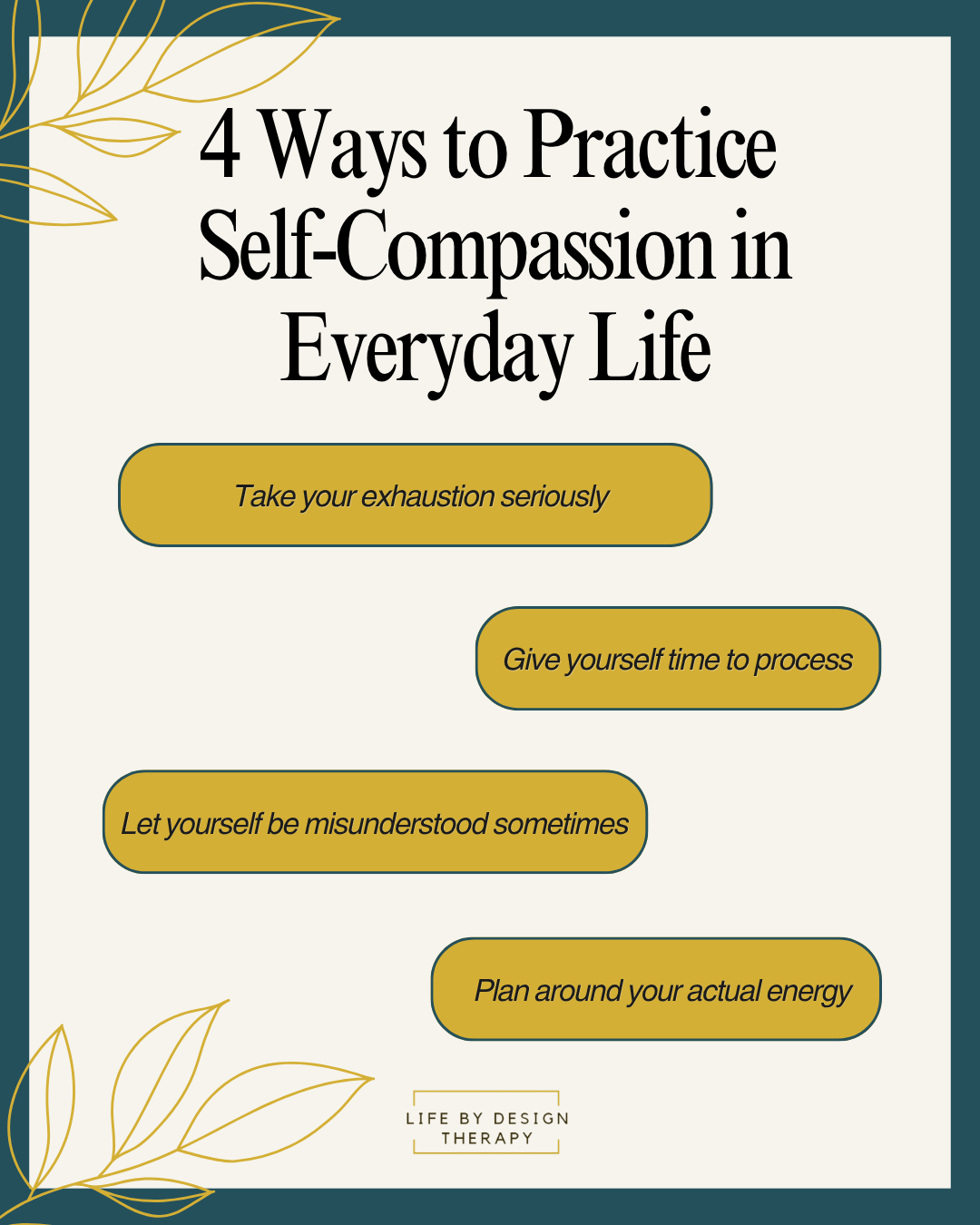
25. Take your exhaustion seriously.
You don’t have to wait until you’re completely depleted before responding to your need for rest.
26. Keep promises to yourself small and realistic.
A doable promise builds trust with yourself more effectively than an ambitious one you don’t have the capacity to keep.
27. Forgive yourself for not knowing then what you know now.
You made past choices with the awareness, resources, and support you had at the time.
28. Stop comparing your private struggles to someone else’s public life.
You rarely know what is happening outside the small piece another person chooses to share.
29. Unfollow accounts that leave you feeling inadequate.
You’re allowed to protect your emotional space, even when the content is labeled inspiring or helpful.
30. Notice when self-improvement becomes self-rejection.
Growth can come from care and curiosity. You don’t have to dislike yourself into becoming someone new.
31. Give yourself credit for what no one else sees.
The boundary you held, the reaction you interrupted, or the day you kept going gently still counts.
32. Allow yourself to be a beginner.
You are not supposed to be immediately good at something you’ve only just begun learning.
33. Pause before saying yes.
Give yourself time to check your energy, schedule, and actual desire before committing.
34. Let your body move without making it about punishment.
Stretch, walk, dance, or move in a way that feels supportive rather than trying to make up for what you ate.
35. Wear clothes that fit the body you have today.
You deserve to feel comfortable now, not only after your body changes.
36. Stop treating your body like a problem to solve.
Your relationship with your body can include listening, care, and respect, even when
loving every part of it feels out of reach.
37. Notice where you’re holding tension.
Unclench your jaw, lower your shoulders, or soften your hands. You may be bracing without realizing it.
38. Take a break from analyzing yourself.
Not every thought, reaction, or feeling needs to become a personal growth project.
39. Let yourself enjoy something without making it productive.
Read, garden, create, or rest because you like it…not because it improves you.
40. Make room for mixed emotions.
You can love someone and feel frustrated with them. You can be grateful for an opportunity and still feel overwhelmed by it.
41. Let yourself grieve the version you hoped for.
Even when a decision is right, you may still need to grieve what you wanted it to be.
42. Recognize when you need comfort before advice.
You don’t always need a strategy. Sometimes you need warmth, understanding, or someone willing to sit beside you.
43. Choose a more believable thought.
If a positive affirmation feels forced, try something gentler, such as, “I don’t know how this will turn out, but I can take the next step.”
44. Notice when shame is telling you to hide.
Consider sharing what you’re carrying with someone who has earned your trust.
45. Give yourself permission to do less.
Reducing your workload or expectations may be the most responsible response to a demanding period.
46. Let a boundary disappoint someone.
Another person’s disappointment doesn’t automatically mean you’ve done something wrong.
47. Stop volunteering for every emotional job.
You don’t have to fix every mood, mediate every conflict, or make sure everyone is comfortable.
48. Ask for help before you reach your breaking point.
Support doesn’t have to be your last resort.
49. Receive help without immediately repaying it.
Let someone care for you without turning the moment into another obligation.
50. Allow yourself to take up space in a conversation.
Your experiences don’t need to be shortened, softened, or made more convenient for everyone else.
51. Trust the discomfort that tells you something isn’t right.
You don’t need airtight evidence before paying attention to how a person or situation affects you.
52. Stop calling yourself “too sensitive.”
Sensitivity may be showing you where something hurts, matters, or needs attention.
53. Give yourself time to process.
You don’t have to know how you feel or what you want the moment someone asks.
54. Let yourself say, “I don’t know.”
Uncertainty isn’t a personal failure. Sometimes it’s the most honest answer available.
55. Make repairs without demanding perfection.
A healthy relationship isn’t one where no one makes mistakes. It’s one where there is room to acknowledge harm, listen, and reconnect.
56. Notice when you’re abandoning yourself to avoid conflict.
Pay attention to moments when you agree, stay quiet, or overextend yourself because someone else’s discomfort feels unbearable.
57 Let your “no” remain a “no”.
You don’t have to change your answer simply because someone asks again.
58. Stop apologizing for having a need.
Try stating what you need without beginning with “Sorry.”
59. Allow relationships to be mutual.
You deserve connections where care, interest, effort, and support don’t flow in only one direction.
60. Check in with yourself after spending time with someone.
Notice whether you feel grounded, depleted, anxious, guarded, or able to be yourself.
61. Step away from a conversation that has become harmful.
You’re allowed to pause and return later rather than forcing yourself to remain engaged while overwhelmed.
62. Let yourself be misunderstood sometimes.
You can communicate clearly and kindly without controlling the story someone chooses to tell about you.
63. Offer yourself care after setting a boundary.
Even a needed boundary can bring guilt, fear, or grief. Those feelings don’t mean the boundary was wrong.
64. Parent yourself through difficult moments.
Ask what a safe, steady adult might say or do for you right now.
65. Remember that struggling doesn’t make you a bad parent.
Parenting can bring exhaustion, overstimulation, anger, and doubt alongside deep love.
66. Repair after losing your patience.
A sincere apology teaches more about relationships than pretending caregivers never make mistakes.
67. Lower the bar on hard family days.
A simple meal, extra screen time, or an unfinished chore doesn’t define the quality of your care.
68. Give yourself space outside of caregiving.
You are still a person with needs, interests, and an identity beyond what you provide for others.
69. Notice when guilt appears simply because you chose yourself.
Guilt can come from breaking an old pattern—not necessarily from doing something harmful.
70. Allow yourself to celebrate without minimizing it.
You don’t have to follow good news with a disclaimer or point out all the ways it could have been better.
71. Acknowledge the effort, not only the outcome.
Something can matter even when it doesn’t turn out the way you hoped.
72. Celebrate what you've already accomplished.
Pause long enough to recognize what you’ve completed before deciding it still isn’t enough.
73. Separate your productivity from your worth.
A slow day doesn’t make you less valuable than a productive one.
74. Build breathing room into your schedule.
Leaving space between commitments is a way of respecting your nervous system and your limits.
75. Take your lunch break.
You don’t have to prove your dedication by ignoring your body throughout the workday.
76. Ask for clarification instead of pretending you understand.
You’re allowed to need more information, examples, or time.
77. Let yourself make a decision without making it the perfect one.
Many choices become clear only after you make them and begin moving forward.
78. Accept that you cannot prevent every mistake.
Hypervigilance may make you feel prepared, but no amount of overthinking can remove all uncertainty.
79. Stop rehearsing every possible outcome.
When you notice your mind trying to prepare for everything, gently return to what is actually happening right now.
80. Set a limit on how long you’ll revisit a decision.
Reflection can be helpful. Repeatedly reopening the same choice may only deepen anxiety.
81. Let yourself start again without turning it into a punishment.
You can return to a habit, goal, or routine without criticizing yourself for stepping away from it.
82. Create routines that support you rather than control you.
A routine should help your life feel more manageable, not become another standard you can fail.
83. Make your environment easier to live in.
Put reminders where you’ll see them, keep needed items accessible, and use tools that reduce the amount you have to remember.
84. Make life a little easier on yourself. If headphones, written instructions, timers, comfort items, or other supports help, you're allowed to use them without feeling like you have to justify it.
85. Plan around your actual energy.
Build your day for the person you are, not the endlessly productive version of yourself you think you should be.
86. Give yourself a transition between roles.
Take a few minutes between work, parenting, caregiving, or social time to let your body and mind shift gears.
87. Leave something unfinished on purpose.
Practice walking away when you’ve reached your limit, even if there is still more that could be done.
88. Begin the day without immediately evaluating yourself.
Before checking your appearance, productivity, or notifications, give yourself a moment simply to arrive.
89. End the day without conducting a performance review.
Notice what the day held without reducing it to everything you failed to finish.
90. Keep a list of what helped.
When you feel more grounded or supported, make a note of it. You may need the reminder when things feel harder.
91. Create a comfort plan before you need it.
Write down the people, places, practices, and sensory comforts that help you feel steadier.
92. Use humor gently.
Sometimes laughing at an awkward moment can release tension. Just make sure the joke isn’t another way of being cruel to yourself.
93. Let tears be a physical release.
Crying doesn’t mean you’re falling apart. It may be your body’s way of moving through something words haven’t reached.
94. Accept care in forms that work for you.
Self-compassion doesn’t have to look like meditation, journaling, or bubble baths. It should feel supportive to your actual nervous system and life.
95. Notice when a coping strategy is no longer helping.
Thank yourself for finding a way to survive, then consider whether you need a different kind of support now.
96. Speak honestly in therapy.
You don’t need to protect your therapist from your anger, confusion, embarrassment, or disappointment. Therapy can hold more than the polished version of your experience.
97. Look for the need beneath the behavior.
Instead of asking why you’re acting this way, ask what the behavior may be trying to protect, avoid, communicate, or soothe.
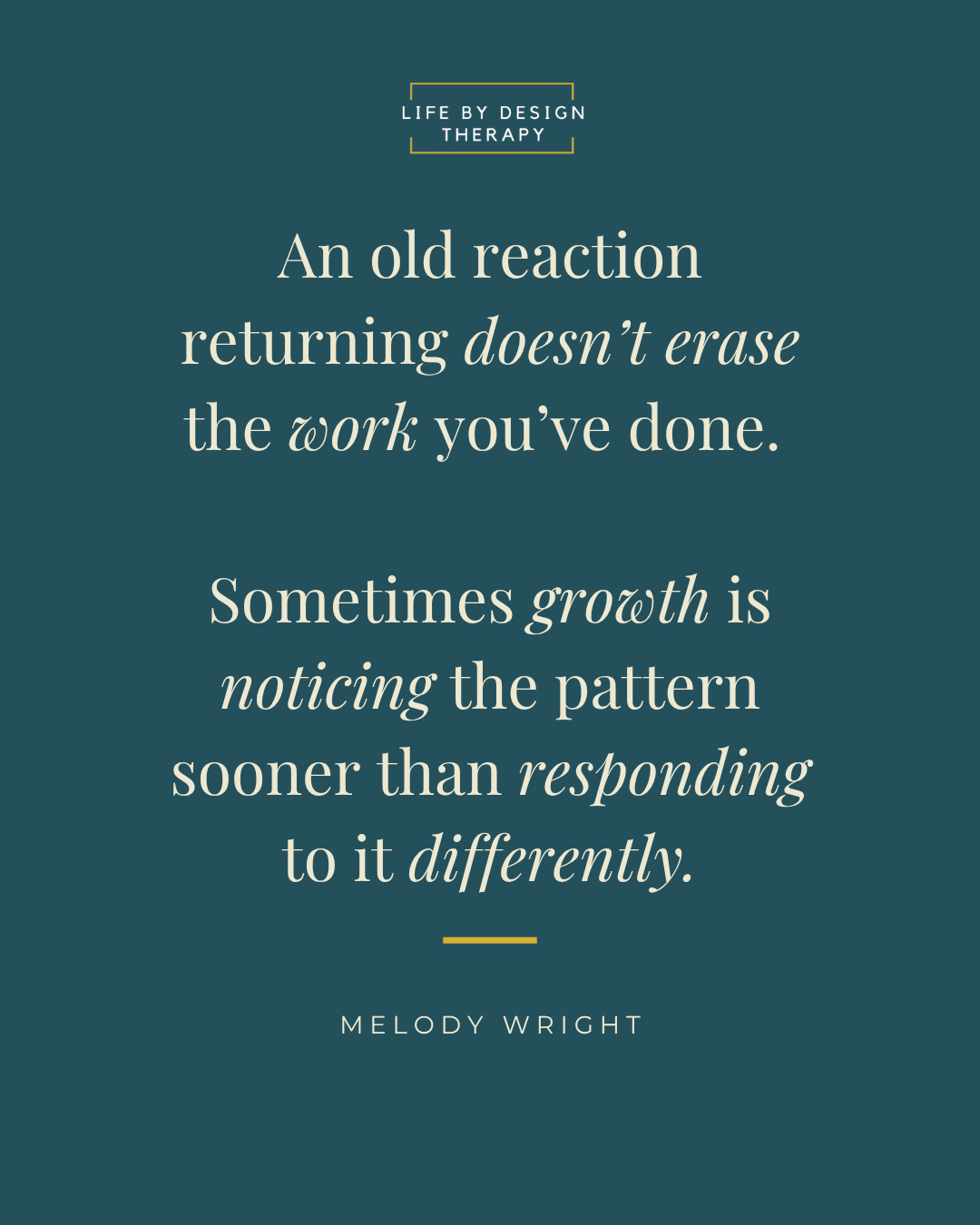
98. Remember that healing isn’t linear.
An old reaction returning doesn’t erase the work you’ve done. Sometimes growth is noticing the pattern sooner or responding to it differently.
99. Let yourself outgrow an old version of you.
You can appreciate who you needed to be while making room for who you’re becoming.
100. Compassion offered to the part of you that resists compassion.
If kindness feels uncomfortable, unsafe, or undeserved, don’t force it. Get curious about why receiving care, even from yourself, feels so difficult.
101.Begin again with one kind choice.
You don’t need to transform your entire relationship with yourself today. Start with the next moment and ask, What would it look like to be on my own side here?
Final Thoughts
My hope is that this list reminds you of one simple thing: that self-compassion doesn't have to be complicated. It can begin with one small choice.
And remember you don't have to try every idea here. Just choose one that feels doable today, and allow that to be enough. As those moments add up, you may begin to notice a kinder relationship with yourself taking shape.
And if that feels harder than it sounds, you're not failing. Sometimes self-criticism has deep roots. Therapy can help you understand where those patterns began and gently support you in building new ones.
Life by Design Therapy is a top-rated therapy center in Berkeley, California, offering holistic and somatic therapy for anxiety, trauma, relationship challenges, life transitions, and more. We provide in-person therapy in Berkeley and online therapy throughout California, helping you connect with your emotions, understand your patterns, and feel more supported within yourself.
If you’re ready to explore what self-compassion could look like in your own life, contact us to connect with a therapist.
This Week's Affirmations
My needs are worthy of my attention.
I can take responsibility without tearing myself down.
I can honor my limits without explaining or apologizing for them.
I am learning to speak to myself with patience and understanding.
One difficult moment does not define who I am.
Additional Resources
If you’re interested in exploring self-compassion, quieting your inner critic, and building a kinder relationship with yourself, the books below can be a helpful place to start.
Emotional Intelligence: Why It Can Matter More Than IQ by Daniel Goleman
The Power of Now: A Guide to Spiritual Enlightenment by Eckhart Tolle
Self-Compassion: The Proven Power of Being Kind to Yourself by Kristin Neff
Radical Acceptance: Embracing Your Life With the Heart of a Buddha by Tara Brach
The Untethered Soul: The Journey Beyond Yourself by Michael A. Singer
**Some product links are affiliate links, which means we'll receive a commission if you purchase through our link, at no extra cost to you. Please read the full disclosure here.

Why Anxiety Pulls You Out of the Present Moment (And How Grounding Helps You Come Back)
By Melody Wright, LMFT
Have you ever been sitting with your family, halfway through dinner, only to realize you haven't actually heard a word anyone has said for the last few minutes?
Your body is there, and you're physically present, but your mind is somewhere else entirely.
Maybe you're replaying a conversation from earlier in the day.
Maybe you're worrying about something happening next week.
Maybe you're mentally running through every possible outcome of a situation that hasn't even happened yet.
If you've experienced this, I’ve been there. One of the most frustrating parts of anxiety is that it has a way of pulling us away from the life happening right in front of us.
The hard part is that many people assume they're simply distracted, unfocused, or overthinking. But anxiety is doing something much deeper than that.
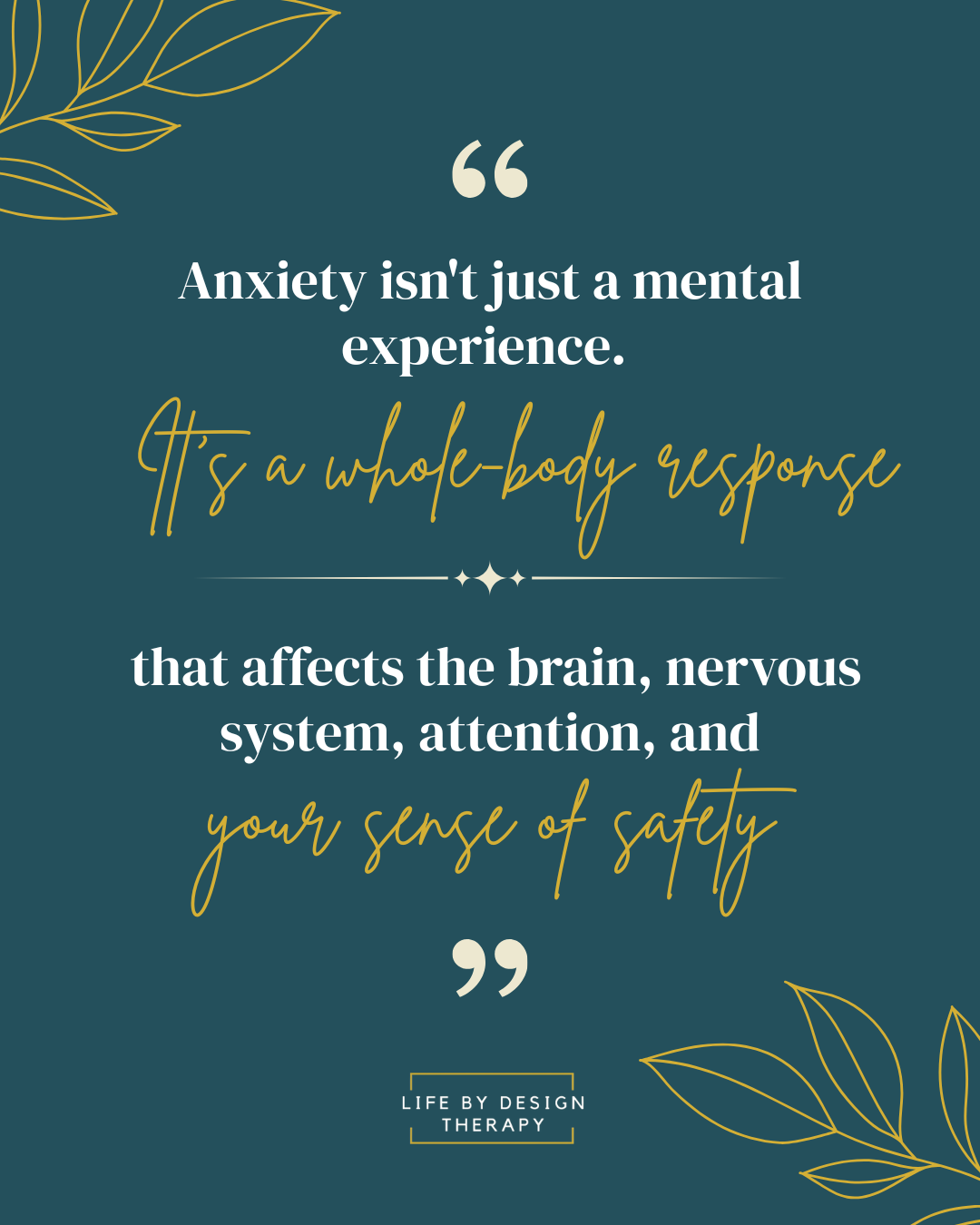
Anxiety isn't just a mental experience. It's a whole-body response that affects the brain, nervous system, attention, and your sense of safety.
And understanding what's happening can help explain why grounding techniques are often so effective.
What Anxiety Actually Does to the Brain and Body
At its core, anxiety is designed to protect us.
Your brain is constantly scanning for potential threats. Most of the time, this happens automatically and outside of your awareness. When your brain perceives something as potentially dangerous, your body's survival systems begin preparing you to respond.
The amygdala is the part of your brain that plays an important role in detecting threats and becomes more active. Stress hormones like cortisol and adrenaline are released. Your heart rate may increase, your muscles may tense, and your attention begins narrowing toward whatever feels threatening.
This response can be incredibly helpful in situations where danger is actually present.
The challenge is that our nervous systems don't always distinguish between a threat that is happening right now and a threat we imagine could happen in the future.
In both cases, your body may begin preparing for action.
This is why anxiety often shows up as:
Racing thoughts
Muscle tension
Restlessness
Difficulty concentrating
Trouble sleeping
Feeling "on edge"
A sense that you always need to be prepared
Your nervous system is just trying to keep you safe.
But in the process, it can become difficult to stay connected to the present moment.
Anxiety has a way of pulling our attention away from what's happening right now. Sometimes it keeps us replaying something that already happened. Other times it sends us racing ahead, trying to predict, prepare for, or prevent what might come next. Either way, our mind is no longer fully connected to the moment we're actually living.
Why Anxious Thoughts Pull Us Out of The Present Moment
Your brain is designed to look for patterns and keep you safe. So, when anxiety is active, that protective system can become overworked.
Instead of helping us respond to what's happening in front of us, it starts searching for problems that haven't happened yet, replaying situations that already ended, or scanning for signs that something is wrong. Your nervous system’s goal is protection, but the result is often exhaustion.
The more our attention is pulled away from the present, the harder it becomes to notice the things that actually help our nervous system settle: the chair supporting us, the sound of birds outside, the feeling of our feet on the floor, or the fact that, in this moment, we may be safe.
You might catch yourself thinking:
What if I fail?
What if something goes wrong?
What if I make the wrong decision?
What if I can't handle it?
If that sounds familiar, know that there's nothing wrong with you. These thoughts usually come from a place of wanting to feel safe. Your mind is trying to protect you by looking ahead and searching for answers.
The problem is that anxiety rarely settles for one answer. Even when you come up with a solution, it often responds with another question, another possibility, or another thing to worry about.
Before you know it, you've spent so much time living in "what if" that you've lost touch with what's actually happening right in front of you.
And when your attention is constantly being pulled toward the future, it can become really difficult to stay connected to the present moment.
Which brings us to another important piece of the puzzle.
How Anxiety Creates Disconnection From the Present Moment
When anxiety becomes loud enough, it can begin pulling us away from our actual experience.
You might find yourself driving somewhere and realizing you barely remember the drive.
You might struggle to enjoy a vacation because your mind keeps focusing on what needs to happen when you get home.
You might be spending time with people you love while simultaneously worrying about something that hasn't happened yet.
In many ways, anxiety hijacks attention. So, rather than allowing us to fully engage with what's happening around us, it continually redirects our focus toward potential threats, future problems, or worst-case scenarios.
Sometimes this can even create a sense of disconnection from your own body.
You may notice that you're living primarily in your thoughts.
Thinking.
Planning.
Analyzing.
Preparing.
But not fully experiencing the moment you're currently in, and this isn't because you're doing something wrong.
It's because anxiety is asking your nervous system to prioritize survival over presence.
The good news is that there are ways to gently help your mind and body reconnect.
And that's where grounding comes in.
Why Grounding Can Help
One of the biggest misconceptions about grounding is that it's supposed to instantly make anxiety disappear. That's a lot of pressure to put on any coping skill.
In reality, grounding is often less about getting rid of anxiety and more about helping your nervous system recognize that it is safe enough to return to the present moment.
When anxiety pulls your attention into future worries, grounding helps redirect your attention back to what's happening right now.
Back to your body.
Back to your environment.
Back to the information your senses are receiving in the present moment.
Research has shown that grounding practices can help interrupt spiraling thought patterns, increase present-moment awareness, and support nervous system regulation.
So, in other words, grounding helps create a bridge between where anxiety has taken you and where your life is actually happening.
Understanding why grounding works is one thing, but finding techniques that work for your specific nervous system is another.
If you're looking for practical ways to begin, check out our blog, 5 Body-Based Grounding Techniques, where we walk through several simple grounding exercises you can start using today. You can also download our free Mind-Body Toolkit for 50 exercises designed to help you reconnect with the present moment.
But while grounding can be incredibly helpful, it's important to remember that it isn't always addressing the reason anxiety showed up in the first place.
How Therapy Can Help Address the Root Causes of Anxiety
Grounding helps you come back to the present moment, but therapy can help you understand why your nervous system keeps getting pulled away from it.
For some people, anxiety is connected to chronic stress.
For others, it may be connected to trauma, attachment wounds, perfectionism, burnout, major life transitions, or experiences that taught the nervous system the world wasn't always predictable or safe.
Over time, therapy can help you identify these patterns, understand how they developed, and build new ways of relating to your thoughts, emotions, and body.
So, rather than constantly fighting anxiety, many people begin learning how to understand it.
And that understanding often creates more space for regulation, self-compassion, and lasting change.
Final Thoughts
Anxiety has a way of convincing us that our attention belongs somewhere else, in tomorrow's problems, yesterday's mistakes, or endless possibilities and unanswered questions. But your life isn't happening in any of those places. It's happening here, right now.
And sometimes the goal isn't to force yourself to stop worrying. Sometimes the first step is simply helping your nervous system find its way back to the present moment. Through a single breath, a sensation in your body, or a grounding exercise, you can begin reconnecting with what's happening around you instead of getting pulled into what might happen next.
But if anxiety is making it difficult to stay present, therapy can help you better understand what's happening beneath the surface and develop tools to support lasting change. Book a call today and learn how we can help you reconnect with yourself, your relationships, and the life happening right in front of you.
This Week's Affirmations
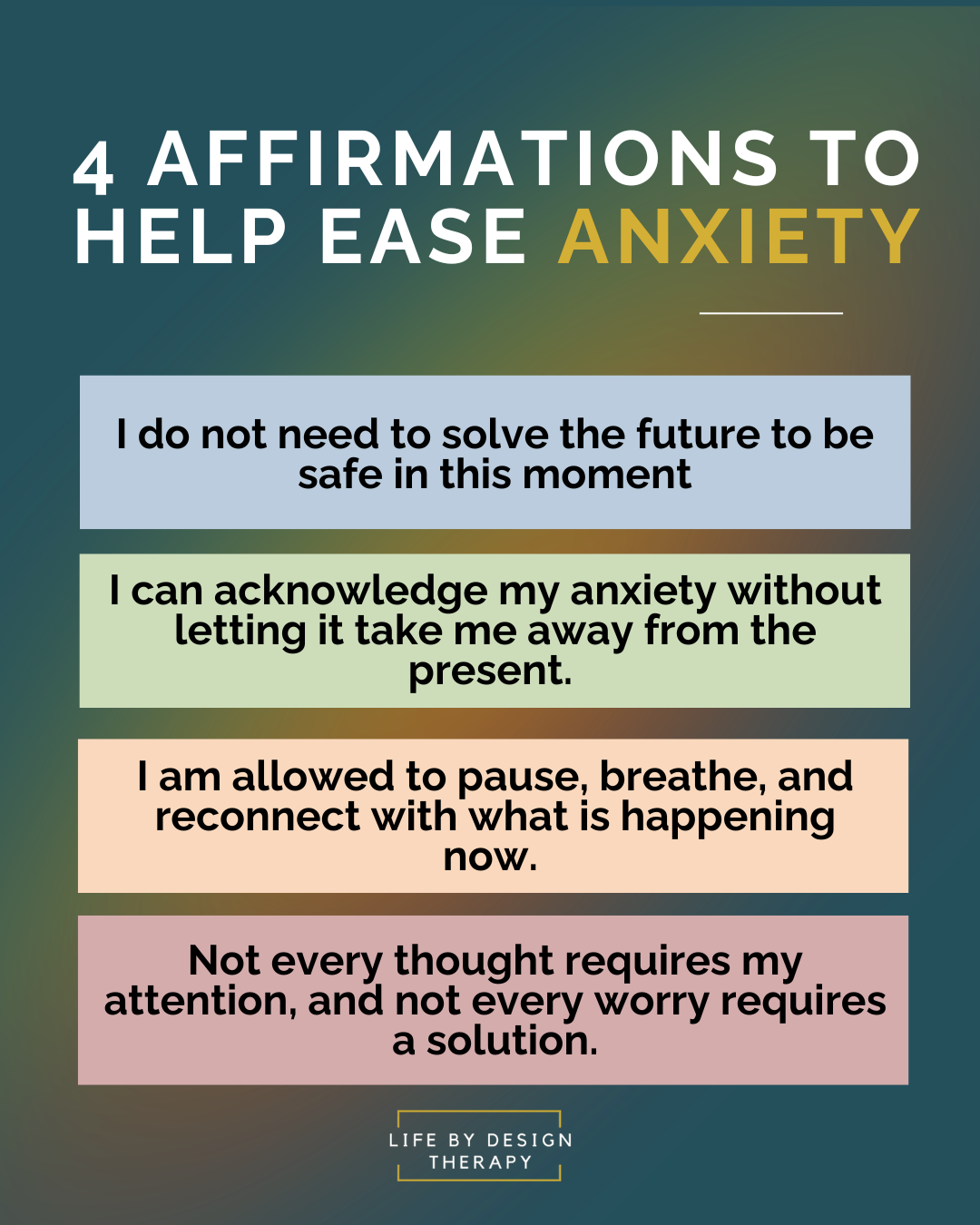
I do not need to solve the future to be safe in this moment.
I can acknowledge my anxiety without letting it take me away from the present.
I am learning to trust myself, even when uncertainty is present.
I am allowed to pause, breathe, and reconnect with what is happening now.
Not every thought requires my attention, and not every worry requires a solution.
Additional Resources
If you'd like to learn more about anxiety, grounding, nervous system regulation, and how anxiety can pull us away from the present moment, the books below offer helpful insights and practical tools to support your journey.
The Body Keeps the Score: Brain, Mind, and Body in the Healing of Trauma by Bessel van der Kolk M.D
Polyvagal Theory in Therapy: Engaging the Rhythm of Regulation by Deb Dana
The Power of Now: A Guide to Spiritual Enlightenment by Eckhart Tolle
Wherever You Go, There You Are: Mindfulness Meditation in Everyday Life by Jon Kabat-Zinn PhD
The Miracle of Mindfulness: An Introduction to the Practice of Meditation by Thich Nhat Hanh
Radical Acceptance: Embracing Your Life With the Heart of a Buddha by Tara Brach
**Some product links are affiliate links, which means we'll receive a commission if you purchase through our link, at no extra cost to you. Please read the full disclosure here.

13 Different Types of Boundaries and Why They Matter
By Melody Wright, LMFT
A lot of people don’t realize their nervous system has been asking for boundaries long before their mind ever catches up.
Sometimes it shows up as:
feeling emotionally exhausted after conversations
getting irritated more easily
feeling anxious every time your phone goes off
shutting down socially
struggling to rest
feeling overstimulated all the time
carrying tension in your body without fully knowing why
And honestly, many people assume this just means you’re stressed, too sensitive, bad at coping, or not managing life well enough.
But sometimes what’s actually happening is that your body is responding to a lack of boundaries. While boundaries are often thought of as something we set with other people, they also help create a sense of safety within ourselves
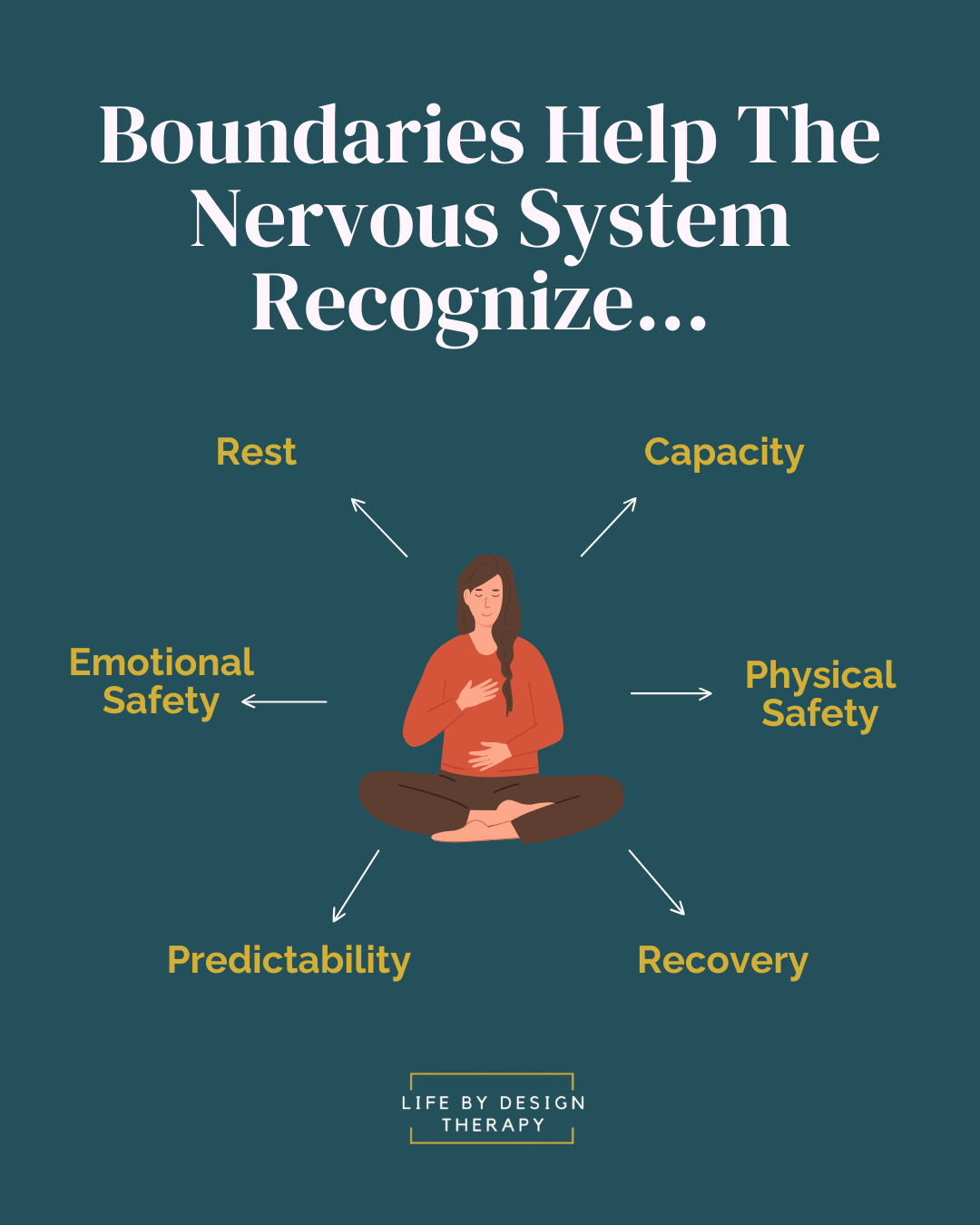
They help the nervous system recognize:
rest
separation
capacity
recovery
emotional safety
physical safety
predictability
And without them, the body can begin functioning as though it always has to stay alert, available, accommodating, or prepared for the next demand.
Why Boundaries Matter for Your Nervous System
A lot of people think boundaries are simply communication tools, but boundaries are also nervous system support tools.
Your body is constantly responding to:
interruptions
emotional demands
overstimulation
conflict
noise
emotional labor
constant accessibility
information overload
environments that don’t feel safe
And when your nervous system rarely gets a break from those things, it often starts showing up physically and emotionally.
Sometimes that looks like:
anxiety
burnout
emotional exhaustion
resentment
chronic tension
irritability
emotional shutdown
people pleasing
hypervigilance
fatigue after social interaction
difficulty relaxing
trouble sleeping
feeling emotionally numb
constantly feeling “on edge”
Sometimes burnout isn’t just about doing too much. It’s about the nervous system going too long without enough safety, rest, or protection to finally soften.
Signs Your Body May Be Asking for Stronger Boundaries
Sometimes the body notices missing boundaries long before the mind fully understands what’s happening.
A lot of people assume boundaries only become necessary once something becomes “bad enough.” But often, the nervous system starts signaling overload much earlier than that. The body begins communicating through tension, irritability, exhaustion, overstimulation, and emotional flooding without enough space to recover.
And honestly, many people become so used to functioning in survival mode that these signals start feeling normal. They normalize pushing through exhaustion, staying constantly available, overriding discomfort, ignoring resentment, and feeling emotionally responsible for everyone around them.
But the nervous system was never designed to function in a constant state of emotional accessibility, overstimulation, pressure, or hyper-alertness without consequences.
Here are some signs your nervous system may be asking for stronger boundaries:
chronic tension
irritability
emotional exhaustion after conversations
anxiety before responding to messages
resentment
feeling overwhelmed by small demands
difficulty relaxing
trouble sleeping
fatigue after social interaction
emotional numbness
overstimulation
people pleasing followed by shutdown
constantly feeling “on edge”
needing isolation after interactions
feeling emotionally flooded easily
Sometimes the nervous system responds by becoming anxious or overwhelmed. Other times, it responds by shutting down completely through numbness, avoidance, procrastination, disconnection, or mentally checking out altogether.
These are not character flaws; they’re signals that your nervous system may be carrying more than it was ever meant to hold alone.
13 Boundaries You Didn’t Know You Needed
Emotional Boundaries
A lot of people learned that being loving meant:
always listening
always helping
always fixing
always being emotionally available
But emotional boundaries help your nervous system recognize where your emotional responsibility ends, and someone else’s begins.
Examples of emotional boundaries:
Saying “I don’t have the emotional capacity right now”
Not taking responsibility for someone else’s emotions
Saying no to emotional dumping
Not becoming everyone’s unpaid therapist
Allowing people to be upset without rescuing them
Protecting vulnerable emotions from emotionally unsafe people
Not overexplaining your feelings
Choosing who gets emotional access to you
Sometimes the issue isn’t that you care too much.
It’s that your nervous system never learned where your emotional responsibility stops.
2. Time Boundaries
A lot of people are physically exhausted not simply because they’re busy, but because their nervous system never exits “go mode.”
There’s no pause.No decompression.No transition time.
Just constant accessibility. So implementing boundaries with your time is essential for nervous system regulation.
Examples of time boundaries:
Not responding immediately to every text or email
Protecting slow mornings
Scheduling alone time
Allowing transition time between activities
Leaving events early when needed
Protecting rest without guilt
Having designated offline hours
Not overcommitting your schedule
Allowing yourself to be unavailable sometimes
Rest becomes difficult when the nervous system never fully believes it’s safe to stop.
3. Physical Boundaries
Many people learned very early to disconnect from their body’s signals in order to stay liked, accommodating, or emotionally safe.
They learned to override discomfort. But your body notices boundary violations long before your mind fully explains them.
So, here are some examples of physical boundaries:
Saying no to touch
Needing personal space
Protecting your sleep
Leaving overstimulating environments
Taking sensory breaks
Saying “I’m touched out”
Limiting physical closeness when emotionally overwhelmed
Asking before touching others
Allowing your body to rest before collapse
Sometimes healing involves learning how to hear your body again after years of overriding it.
4. Digital Boundaries
Honestly, modern nervous systems were not built for the amount of constant input most people experience every day.
Notifications.
Emails.
Social media.
News cycles.
Constant scrolling.
For many people, this creates a kind of ongoing background activation in the nervous system where the body never fully feels off-duty. Even during moments of rest, part of the brain may still be anticipating the next notification, demand, interruption, or piece of emotional input, making it difficult for the nervous system to fully settle, soften, or recover.
Examples of digital boundaries:
Turning off notifications
Limiting social media use
Taking breaks from doomscrolling
Logging out of work apps after hours
Creating no-phone times
Not checking emails constantly
Curating your social media feed intentionally
Limiting upsetting content
Not feeling obligated to be reachable 24/7
A lot of people don’t realize how dysregulated they feel because their nervous system rarely experiences actual quiet anymore.
5. Mental Boundaries
Mental boundaries help protect your attention, thoughts, concentration, and emotional bandwidth.
And honestly, many people are mentally exhausted from constant information overload.
Examples of mental boundaries:
Saying no to debates you don’t want to have
Limiting exposure to chronic negativity
Limiting interruptions to support focus and presence
Taking breaks from distressing news cycles
Not constantly consuming self-help content
Refusing to engage in circular arguments
Choosing not to explain every decision
Allowing yourself to change your mind
Taking breaks from the constant productivity culture
Your nervous system deserves moments where it gets to simply exist instead of constantly processing input.
6. Energetic Boundaries
Energetic boundaries are about recognizing your nervous system’s actual capacity before burnout happens. This is the kind of boundary many people don’t notice until their body forces them to.
Examples of energetic boundaries:
Protecting recovery time after socializing
Limiting emotionally draining interactions
Allowing yourself solitude
Leaving environments that dysregulate you
Not carrying emotional labor for everyone
Recognizing when your body feels overloaded
Resting before complete exhaustion hits
Paying attention to how your body feels around certain people
Implementing energetic boundaries is simply listening to what your body has been trying to communicate for a long time.
7. Relationship Boundaries
Did you know that healthy and secure relationships still need boundaries? Actually, boundaries are what make emotional safety possible within your relationships.
Here are some examples of relationship boundaries:
Not tolerating disrespect disguised as humor
Saying no to manipulation
Asking for accountability and repair
Maintaining individuality
Speaking honestly instead of people-pleasing
Protecting your privacy as a couple
Taking space without emotionally disappearing
Not allowing emotional punishment or silent treatment dynamics
Having separate hobbies and interests
Remember that boundaries are not the opposite of connection; they actually help create healthier connections.
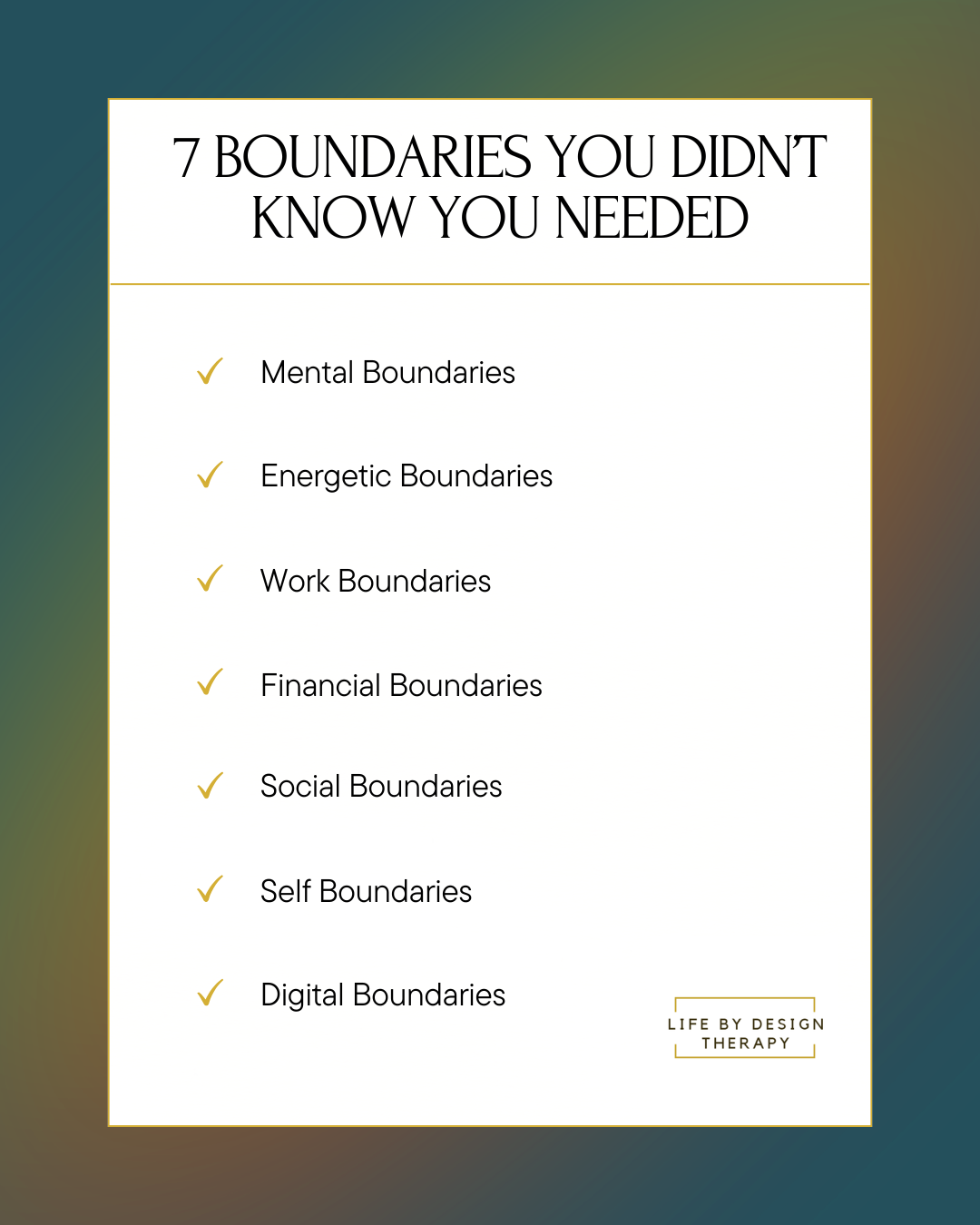
8. Family Boundaries
Family boundaries can feel especially difficult because many people were taught that boundaries with family are disrespectful. But family access does not erase nervous system limits.
Sometimes this can look like:
Limiting intrusive questions
Saying no to guilt-based expectations
Protecting your parenting choices
Not answering every phone call immediately
Refusing criticism disguised as concern
Ending conversations that become harmful
Saying “That topic isn’t open for discussion.”
Limiting access to your home
Protecting your children’s emotional safety
I want you to remember that protecting your nervous system is not selfish. Many of us were raised to believe that being available to everyone at all times was part of being a good family member, partner, or parent. In reality, healthy boundaries help create the safety and space your nervous system needs to rest, recover, and engage with others in a more grounded and connected way.
9. Work Boundaries
Some people’s nervous systems never fully soften because work stress follows them into every area of life.
Here are some ways you can establish work boundaries:
Not working off the clock
Saying no to unpaid labor
Protecting lunch breaks
Not answering emails at all hours
Taking sick days when needed
Refusing unrealistic workloads
Protecting vacation time
Separating your worth from productivity
Limiting emotional labor at work
Burnout is not always caused by doing too much. Sometimes it’s because your nervous system has been managing stress without enough protection for far too long.
Many people struggle to fully disconnect from work even after the workday ends because their nervous system never fully exits “go mode.” If this is something you’ve been experiencing, you may also enjoy reading our blog on How to Actually Disconnect After Work Hours.
10. Financial Boundaries
This is a boundary that people rarely talk about. We don’t realize how deeply financial stress can impact us, because finances are our way of life. However, it’s so important for you to increase your financial awareness to protect your nervous system.
Here is what financial boundaries can look like:
Saying no to lending money
Protecting financial privacy
Not overspending to please others
Setting spending limits
Protecting savings goals
Saying no to financial pressure
Not financially rescuing everyone around you
Choosing not to discuss income with everyone
Separating guilt from financial decisions
Financial safety affects emotional safety more than many people realize.
11. Social Boundaries
Human connection can be deeply healing for the nervous system.
But a connection that consistently requires shrinking yourself, staying hyperaware, or overriding your own needs can slowly become emotionally exhausting instead of restorative. So, social boundaries can support self-regulation and even healthier connections with others.
Here are a few examples of social boundaries:
Leaving gatherings early
Saying no without lengthy explanations
Not forcing yourself to socialize when depleted
Choosing smaller social circles
Protecting recovery time after social events
Saying no to peer pressure
Not attending every event you’re invited to
Choosing reciprocal relationships
Limiting access to your personal life
Sometimes protecting your peace means becoming more intentional about where your energy goes.
12. Self Boundaries
Honestly, some of the most important boundaries are the ones people set with themselves.
That can look like:
Resting before you experience burnout
Not consistently criticizing yourself
Limiting perfectionism
Taking breaks from overanalyzing
Not doom-spiraling late at night
Allowing yourself to enjoy things without earning them
Recognizing when you need support
Giving yourself permission to disappoint people sometimes
Choosing softness over constant survival mode
Sometimes, the deeper work is not setting boundaries with other people. It’s rebuilding the ability to listen to yourself before you automatically push past your own limits.
And honestly, self-boundaries are often deeply connected to self-compassion, because learning to honor your needs, limits, and capacity requires unlearning the belief that you always have to push through, overperform, or abandon yourself to be worthy. If this resonates with you, you may also enjoy reading our blog on Mindful Limits: The Connection Between Boundaries and Self-Compassion.
13. “Invisible” Boundaries People Rarely Think About
Honestly, some of the most important boundaries are the ones people don’t even realize they’re allowed to have.
Like:
You don’t have to answer every question someone asks you
You don’t have to explain every decision
You don’t have to stay emotionally available all the time
You don’t have to tolerate constant interruption
You don’t have to justify rest
You don’t have to respond immediately to texts
You don’t have to consume upsetting content constantly
You don’t have to stay in emotionally harmful conversations
You don’t have to be endlessly accessible to be a good person
You don’t have to override your body to keep others comfortable
For many people, boundaries are not about becoming less caring. They’re about finally creating enough safety for you to stay connected to yourself.
Because when you spend enough time pushing past your own limits, emotions, exhaustion, or discomfort, it becomes harder to recognize what your body is actually trying to tell you.
Boundaries help interrupt that pattern, not by shutting people out, but by helping you remember that connection should not require you to abandon yourself.
How to Start Setting Boundaries Without Guilt
If boundaries feel uncomfortable for you, that does not necessarily mean you’re doing them wrong.
For many people, boundaries feel emotionally exposing because their nervous system learned that:
Saying no created conflict
Having needs felt unsafe
Rest had to be earned
Pleasing others created belonging
Self-protection felt selfish
Remember, boundaries are not just mental shifts; they’re nervous system work too.
It’s completely okay to start small.
You might begin noticing:
Where resentment keeps showing up
What leaves your body feeling tense or depleted
Where you feel obligated instead of safe
What environments leave you dysregulated
Where your body feels like it never gets to exhale
Sometimes healthy boundaries sound like:
“I don’t have capacity right now.”
“I need quiet time.”
“I’m unavailable after work hours.”
“I’m not looking for advice right now.”
“I need time before responding.”
Please hear this: you are allowed to protect your peace without needing to earn permission first.
Final Reflections
Boundaries are not just about protecting your peace mentally. They’re also about helping your body finally feel safe. Because, as we talked about, when your nervous system spends years overextending, overaccommodating, staying hyper-alert, carrying emotional weight, overriding exhaustion, and remaining constantly accessible to everyone around you, eventually the body starts responding. But healthy boundaries help create the emotional and physical safety needed for healing, connection, regulation, and rest.
And honestly, beginning the process of setting boundaries can feel incredibly difficult at first. That’s why support can matter so much during this process. Therapy can help you better understand the emotional patterns, attachment dynamics, and nervous system responses underneath people-pleasing, emotional overwhelm, guilt, conflict avoidance, and difficulty setting boundaries so that boundaries begin to feel less like danger and more like safety.
At Life By Design Therapy™, we offer holistic and somatic therapy for individuals and couples throughout California, both online and in-person in Berkeley. Our therapists can help you better understand the nervous system patterns, emotional dynamics, and body-based responses underneath burnout, overwhelm, anxiety, people-pleasing, and difficulty setting boundaries so you can build healthier, more sustainable ways of relating to yourself and others.
If you’re ready to start or just learn more, CLICK HERE to book a free phone consultation.
This Week's Affirmations
Healthy boundaries help me stay connected to myself and others.
I can honor my capacity without abandoning myself in the process.
I can care deeply about others without carrying everything for them
Setting boundaries does not make me selfish, difficult, or unkind.
I am allowed to protect my peace, energy, and emotional well-being without guilt.
Additional Resources
If you’re interested in continuing to explore boundaries, emotional safety, attachment patterns, and the nervous system dynamics underneath relationship disconnection, the books below can be a helpful place to start.
Adult Children of Emotionally Immature Parents by Lindsay C. Gibson
The Seven Principles for Making Marriage Work by John Gottman
**Some product links are affiliate links, which means we'll receive a commission if you purchase through our link, at no extra cost to you. Please read the full disclosure here.

How to Start Trusting Yourself Again (When You’ve Been Second-Guessing Everything)
By Melody Wright, LMFT
If you've ever spent more time worrying about making the wrong decision than actually making the decision itself, you know how exhausting it can be. The mental back-and-forth, the constant weighing of options, and the fear of getting it wrong can leave you feeling stuck before you've even made a choice.
And if you’ve been second-guessing yourself lately…especially when it comes to making decisions…you’ve probably asked yourself some version of:
“Why can’t I just trust myself?”
“Why does everything feel so hard to decide?”
“Why do I feel like I’m going to get it wrong?”
And most advice will tell you to be more confident, to think it through, and to just go with your gut.
But if that actually worked, you wouldn’t still be here… going back and forth in your head. Because the problem usually isn’t that you don’t know how to make a decision.
It’s that you don’t trust yourself to handle what happens after you make one.
If this resonates with you, you may want to explore the deeper roots of these patterns. In our blog, The Hidden Reasons You Second-Guess Yourself, we take a closer look at how past experiences, nervous system responses, and learned survival strategies can shape self-doubt and make trusting yourself feel difficult. You can read it here: The Hidden Reasons You Second-Guess Yourself.
Why You Keep Second-Guessing Yourself
Remember, these patterns don’t come out of nowhere. It builds over time and often in ways that don’t feel obvious while they’re happening. But before we even talk about how to start trusting yourself again, it helps to understand where this comes from.
For a lot of people, second-guessing yourself is shaped by earlier experiences, like:
Being taught to rely on others over yourself
Having your needs or feelings dismissed or questioned
Being rewarded for being “easy,” “good,” or accommodating
Learning that getting it wrong had consequences
Time and time again, your nervous system adapts as a way to protect yourself, so instead of asking “What do I feel?”, you start asking “What’s the right decision?”
And that shift changes everything.
Because when your focus becomes getting it right instead of trusting yourself, decision-making can start to feel heavy. Even small choices can feel overwhelming, and it makes sense that you would start second-guessing yourself or looking outside of yourself for reassurance.
At some point, choosing stopped feeling simple and started feeling like a risk.
What Happens After a Decision Matters More Than the Decision Itself
You don’t learn to trust yourself by making the “right” decision every time. You learn to trust yourself by listening inward, making the best choice you can with the information you have, and discovering that you can handle what comes next.
In those moments where things don’t go the way you hoped…and your first instinct is to replay it, pick it apart, or tell yourself you should have known better. That’s usually the moment things start to break down. Not necessarily because of the decision itself, but because of how you respond to yourself afterward.
So rebuilding self-trust doesn’t mean getting better at choosing.
It means learning to respond differently when a choice doesn’t go as planned.
It looks like not turning against yourself. Not spiraling into “I messed this up,” not using it as proof that you can’t trust your own judgment, and not using it as proof that you can’t trust your own judgment.
And over time, something starts to shift.
Because your system begins to realize:
“Even if this doesn’t go perfectly… I’m still okay.”
“I’m not on my own in this.”
And that’s where trust actually starts to rebuild. Not when you get it right, but when you realize you can handle it, even if you don’t.
Building Self-Awareness as a Foundation for Self-Trust
Rebuilding self-trust doesn’t usually feel like a big, obvious shift. It’s usually subtle and comes from developing self-awareness.
So, it might look like one of those moments where you catch yourself right before you spiral into second-guessing… and instead of following it, you pause.
Or a moment where you notice what you’re feeling and, for once, you don’t immediately try to figure out the “right” decision, and you just sit with it for a second.
Maybe it’s choosing something small, like what you want or need, and not going back to question it five times after.
None of it feels dramatic, and you might even miss it if you’re not paying attention. But over time, implementing some small shifts can help you begin to change how you move through decisions.
So, if you’re starting to recognize this pattern in yourself, I want you to know that you don’t need to fix it overnight. You just need a place to begin.
If you'd like to explore that a little deeper, we recently wrote a blog called The Journey Within: 10 Ways to Conquer Self-Doubt. In it, we walk through practical ways to build self-awareness, challenge self-doubt, and reconnect with your own inner wisdom. You can read it here: The Journey Within: 10 Ways to Conquer Self-Doubt.
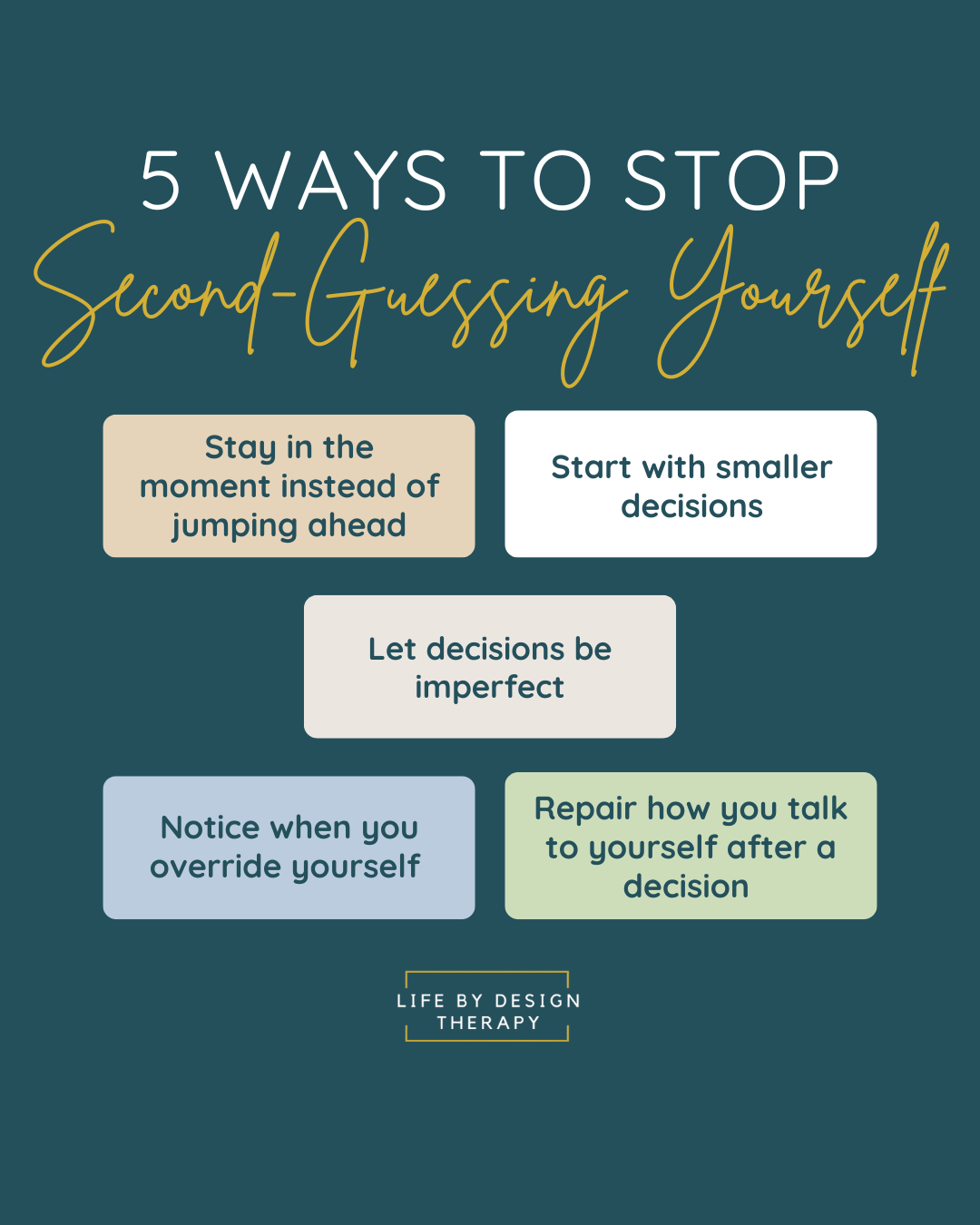
7 Ways to Stop Second-Guessing Yourself and Start Trusting Your Decisions
If you've been struggling to trust yourself or find yourself constantly questioning your choices, here are a few ways to help you begin rebuilding self-trust and easing some of that uncertainty.
1. Start noticing before you try to fix it - Pay attention to when you second-guess yourself, especially around decision-making, because awareness is what helps you start trusting yourself again.
2. Ask what you’re actually afraid of - Instead of asking “What’s the right decision?” ask: “What am I afraid will happen if I choose this?” Is it fear of embarrassment, disappointing someone, or maybe conflict? Naming it can change everything.
3. Stay in the moment instead of jumping ahead - Second-guessing often pulls you into the future, focusing on what could go wrong or what you might miss. Self-trust, however, is built in the present. As you're making decisions, gently notice what's happening in your body, your thoughts, and your emotions.
4. Start with smaller decisions - If trusting yourself feels hard, you don’t have to start big. You can build confidence in your decision-making with low-stakes choices.
5. Let decisions be imperfect - You don’t build self-trust by always getting it right. You build it by learning you can handle it when things don’t go as planned.
6. Notice when you override yourself - Pay attention to the moments you ignore what you feel. That’s where trust starts to break down.
7. Repair how you talk to yourself after a decision - This is the biggest one. If you tend to shame yourself after making a decision, that’s what keeps you stuck. Self-trust is built in how you respond to yourself afterward.
Learning to Trust Yourself Again
At first, it might not feel like much. You might still second-guess yourself when making decisions, and you might still feel unsure. And that's okay!
But as you start integrating these tools into your everyday life, you’ll start to notice shifts like more awareness or a more grounded internal space before responding.
And over time, this becomes your baseline for confidence and decision-making. Maybe not perfect certainty, but enough self-trust to make decisions without constantly questioning yourself, even when things don’t go the way you hoped.
Final Thoughts/Reflections
If you’ve been telling yourself that you’re bad at decision-making or that you can’t trust yourself, it makes sense why you might feel stuck. But that doesn’t mean you truly are stuck
Remember, you don’t learn to trust yourself by making perfect decisions. You build trust with yourself in the moments where things don’t go how you expected… and you don’t tear yourself apart for it afterward.
Sometimes the pattern of second-guessing yourself runs deeper, connected to past experiences, relationships, or a long history of feeling disconnected from your own needs. And in those moments, having support can make a real difference.
At Life By Design Therapy, we help clients rebuild self-trust and feel more confident in decision-making through somatic and holistic therapy by helping you reconnect with your body, your emotions, and your internal sense of safety.
Because trusting yourself isn’t about forcing confidence, it’s about creating enough safety within yourself that you can actually hear your own voice again.
This Week's Affirmations
I can make a decision and handle whatever comes next.
I don’t need to overthink to make a valid choice.
I can respond to myself with care, even when things don’t go as planned.
I don’t need to get every decision right to trust myself.
I am not defined by past decisions I regret.
Additional Resources
If you’re interested in continuing to explore your relationship with self-trust, the resources below can be a helpful place to start.
The Untethered Soul: The Journey Beyond Yourself by Michael A. Singer
Radical Acceptance: Embracing Your Life With the Heart of a Buddha by Tara Brach
Overcome Overthinking and Anxiety in Your Relationship By Robert J Charles
**Some product links are affiliate links, which means we'll receive a commission if you purchase through our link, at no extra cost to you. Please read the full disclosure here.

The Hidden Reasons You Second-Guess Yourself
By Melody Wright, LMFT
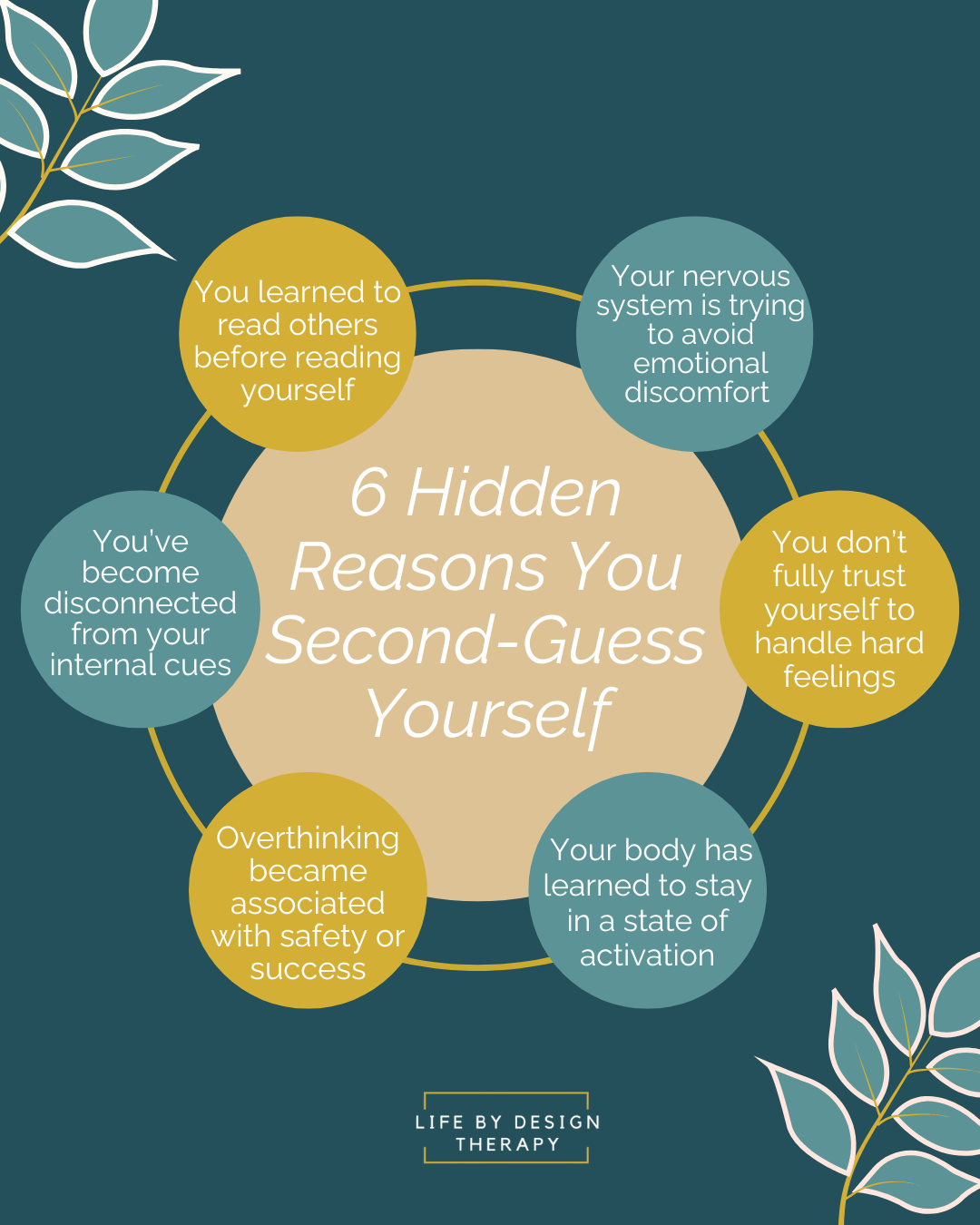
Have you ever found yourself second-guessing a decision that, for a moment, felt clear?
Like something in you quietly said, okay… this feels right…but then the doubt crept in.
Your chest tightens.
Your mind starts replaying every possible outcome.
You wonder if you missed something, overlooked a red flag, or made the “wrong” choice entirely.
And suddenly, the certainty you felt just moments ago feels hard to trust.
So you go back. You tweak it, rethink it, or maybe you ask someone else what they think, or you sit with it longer than you meant to.
And if you’re being honest, you’re probably tired of constantly going back and forth with yourself.
Tired of finally making a decision… only to start questioning it immediately. Wondering if you missed something, if you’re making a mistake, or if you can actually trust your own judgment.
That kind of mental back-and-forth can become exhausting after a while.
Because it’s not that you can’t make decisions, it’s that your mind keeps pulling you back into doubt. There always seems to be that quiet pull to double-check, to make sure, and to get it right.
And after a while, it starts to feel like something deeper is going on:
Why is this so hard for me?
Why can’t I just trust myself and move on?
If you’ve been stuck in that loop, it’s worth taking a closer look at what’s actually happening underneath it.
At first glance, what’s happening beneath the surface can be easy to misread. It might look like overthinking, self-doubt, or decision anxiety.
But what’s actually happening underneath usually follows a pattern, and when you begin to notice it, it starts to feel a little more understandable.
So keep reading if you want to know what's actually happening underneath the constant second-guessing… because there’s usually more going on than just “indecisiveness.”
What’s Actually Happening Beneath the Surface of Second-Guessing
When you go to make a decision, your brain isn’t just asking what do I want? It’s also quietly scanning for risk like...
Assessing for the safest option.
Trying to determine what will prevent the most discomfort.
Looking for the choice that leaves the least room for regret.
You see, a part of your brain called the amygdala is always scanning for potential threats. In today’s modern age, it protects you from things that could lead to pain, rejection, conflict, embarrassment, or emotional discomfort. And the tricky part is, your brain doesn’t just react to obvious danger. It can also react to subtle things, like tension in someone’s tone, feeling misunderstood, or sensing that someone is upset with you, and your brain starts keeping track of those experiences.
For example, maybe there was a time you trusted yourself, and someone criticized your decision afterward. Maybe you finally spoke up about what you wanted, and it created tension or conflict. Or maybe you made a choice that didn’t go the way you hoped, and you were left feeling embarrassed or blaming yourself afterward.
Your brain remembers that.
So eventually, decision-making can stop feeling like, What do I want? and start feeling more like, How do I avoid getting hurt, disappointing someone, or making the wrong choice?
And that’s usually when the overthinking kicks in.
The replaying.
The double-checking.
The trying to “figure out” the perfect decision before you make it.
Not because you’re incapable of making decisions, but because some part of your system has learned that decisions can carry emotional consequences.
That’s part of why decision-making can feel so exhausting, especially if you already struggle with anxiety, self-doubt, or feeling emotionally on edge a lot of the time.
I want you to know that this is not something you consciously choose, but it’s something your nervous system defaults to because it’s trying to protect you.
So, what starts as protection shapes how you move through your decisions in your day-to-day life.
The Pattern That Keeps Pulling You Back Into Overthinking & Second-Guessing
What started as your nervous system trying to protect you can slowly turn into a pattern of second-guessing yourself in your everyday life.
You make a decision, but instead of feeling settled afterward, your mind keeps circling back to the situation or decision by:
Replaying the conversation.
Re-reading the text.
Wondering if you said the wrong thing
Missing something important
Handling it badly somehow
Other subtle signs of a second-guessing pattern can look like:
Needing reassurance from other people by wanting someone to tell you that you made the “right” choice or responded the “right” way.
Changing your mind at the last minute, even when nothing actually changed except the doubt you started feeling inside.
And without even realizing it, that loop starts reinforcing itself.
What's really interesting about your brain is it’s always learning through repetition, through something called neuroplasticity. So, your brain and nervous system get more efficient at whatever you practice most. So if you repeatedly go back and question yourself after making a decision, your brain starts to learn: This is what we do when uncertainty shows up.
Over time, it can start feeling automatic, like second-guessing yourself is just part of your personality or “how your brain works.”
But usually, it’s not that simple.
Usually, there’s more underneath that pattern than people realize, and some of the reasons you second-guess yourself may not be as obvious as you think.
And truthfully, the loops of overthinking can be challenging to manage without the right tools. If you would like to learn how to support yourself when your mind won’t stay put, check out our blog, 6 Ways to Return to the Present When Your Mind Won't Stay Put.
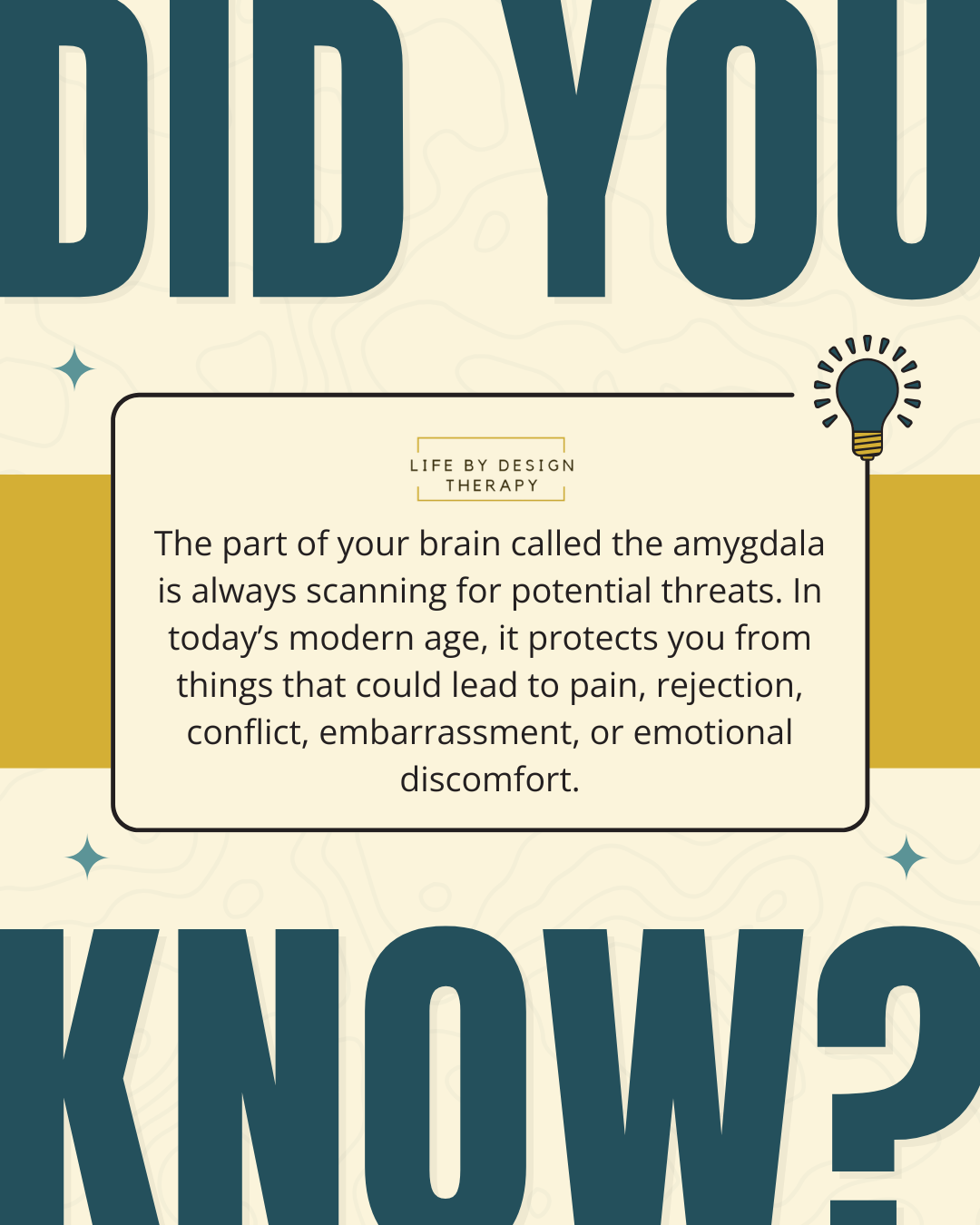
6 Hidden Reasons You Second-Guess Yourself
When you start to look at second-guessing through the lens of your nervous system, past experiences, and learned protective patterns, second-guessing begins to feel less random and more connected to the ways you’ve learned to move through the world.
It’s not just one thing. It’s usually a combination of patterns that have built over time, often in ways that are easy to miss.
Here are a few of the hidden reasons that might be showing up for you:
1. You learned to pay attention to everyone else’s emotional cues before your own internal ones
For some people, second-guessing starts with becoming highly attuned to other people’s emotions, reactions, and needs. This is especially common in anxious attachment, where your nervous system learns early on that connection and emotional safety may depend on staying aware of what other people are feeling.
So instead of feeling grounded in your own preferences, your attention automatically shifts toward managing the emotional environment around you.
You may notice yourself:
Softening your opinions to keep the peace.
Replaying conversations to make sure you didn’t upset someone.
Adjusting decisions based on how you think another person might react.
Feeling responsible for other people’s comfort, disappointment, or emotional responses.
Struggling to tell the difference between what you actually want and what feels safest relationally.
From a somatic perspective, this can become a form of hypervigilance, where your body stays focused on scanning for emotional cues, shifts in tone, or signs of disconnection. Over time, your attention becomes externally focused, which can make it harder to stay connected to your own internal cues, needs, and instincts.
And when your decisions are constantly filtered through other people’s emotional responses first, even simple choices can start to feel emotionally loaded.
2. Your nervous system is trying to avoid emotional discomfort
A lot of the time, the pressure behind second-guessing isn’t actually about the decision itself. It’s about the emotional experience your brain is trying to prevent afterward.
Feelings like:
Regret
Guilt
Embarrassment
Disappointment
Conflict
Feeling misunderstood
Your nervous system naturally wants to move away from experiences that feel emotionally painful or unsafe. So your mind keeps searching for the “right” choice, hoping it can find the one decision that prevents discomfort entirely.
But this is where people often get stuck: They learn to see certainty and avoiding conflict as the safest option.
And when your brain believes certainty is what keeps you emotionally safe, it becomes very hard to stop analyzing, replaying, or trying to predict every possible outcome before making a decision.
3. You don’t fully trust yourself to handle hard feelings
Sometimes the deeper fear underneath second-guessing isn’t actually: “What if I make the wrong choice?”
It’s: “What if I make the wrong choice and I can’t handle what comes next?”
That’s a very different kind of fear.
You see, self-trust is not just about trusting your decisions. It’s also about trusting your ability to navigate disappointment, grief, uncertainty, conflict, or repair if things don’t go as planned.
When that internal trust feels shaky, your nervous system will respond by trying to gain more control before acting. That can look like overanalyzing, freezing, reopening decisions repeatedly, or struggling to fully commit to a choice.
But this is not because you’re incapable, but because some part of you is trying to reduce emotional risk before moving forward.
4. Your body has learned to stay in a state of activation
If your nervous system is used to stress, pressure, overthinking, or constantly preparing for what could go wrong, calm can actually start to feel unfamiliar.
So when you finally make a decision, your body may not fully register it as “safe” to settle.
Instead, your system keeps searching.
You recheck
You rethink
You revisit the conversation
You look for reassurance
You reopen the decision again
From a somatic perspective, this often happens when the body becomes more familiar with activation than regulation. The mind interprets continued checking as productive or protective, but underneath it is a nervous system that has difficulty tolerating stillness, uncertainty, or completion.
So the loop continues, not necessarily because the decision is wrong, but because your body has learned that staying mentally activated feels safer than allowing uncertainty to exist.
5. Overthinking became associated with safety or success
For many people, overthinking started as an adaptive strategy.
Maybe you realized that being highly aware helped you avoid criticism. Maybe you thought that thinking through every possibility helped you stay prepared. Maybe anticipating problems helped you feel more in control growing up.
So your brain learned that overthinking keeps you safe.
And to be fair, sometimes it probably did help you survive certain environments or experiences.
But the nervous system doesn’t always recognize when a protective strategy is no longer helping in the same way. So even when constant analyzing starts creating stress, exhaustion, or disconnection from yourself, your brain may still interpret it as responsible, productive, or necessary.
6. You’ve become disconnected from your internal cues
Self-trust relies heavily on interoception, which is your ability to notice and interpret the internal signals coming from your body.
This feels off
I feel open here
I feel constricted here
This feels grounding
But if you’ve spent years overriding your needs, minimizing your feelings, prioritizing survival, or staying focused on everyone else around you, those internal signals can become harder to access. Instead of trusting how something feels, you keep searching for certainty through overthinking.
That’s part of why second-guessing can feel endless sometimes. Your mind is trying to solve something, and your nervous system is still learning how to feel safe enough to trust.
Grounding is a great way to begin learning how to reconnect with yourself and your internal cues. To learn more about how to do this, check out our blog, Grounding Techniques to Calm Your Nervous System.
Final Thoughts
If you’ve been struggling with overthinking, self-doubt, or difficulty trusting your decisions, I want you to know that these patterns are more common than you might think. It just means your brain and your body have learned ways to protect you, to anticipate, and to try to keep you safe.
And while those patterns may not feel helpful right now, they make sense when you look at where they came from.
Remember, the goal isn’t to force yourself to “just trust yourself” overnight, but rather to start understanding the patterns you’ve been moving through, and gently begin shifting them in a way that actually feels sustainable.
If this is something you’ve been struggling with, you don’t have to figure it out on your own. At Life By Design Therapy™, our Holistic & Somatic Therapists will support you in understanding the patterns behind second-guessing and help you develop more consistent, embodied self-trust over time.
If you’re ready to get started, CLICK HERE to book your free phone consultation.
This Week's Affirmations
I am learning to stay with my decisions, even when it feels uncomfortable.
I can move forward without having all the answers.
My first instinct is worth listening to.
It’s safe for me to let a decision be enough.
I can trust myself to handle whatever comes next.
Additional Resources
If you’re interested in continuing to explore your relationship with self-trust, the resources below can be a helpful place to start.
The Untethered Soul: The Journey Beyond Yourself by Michael A. Singer
Radical Acceptance: Embracing Your Life With the Heart of a Buddha by Tara Brach
Overcome Overthinking and Anxiety in Your Relationship By Robert J Charles
**Some product links are affiliate links, which means we'll receive a commission if you purchase through our link, at no extra cost to you. Please read the full disclosure here.

What Is Body Neutrality (And How Is It Different From Body Positivity)?
By Melody Wright, LMFT
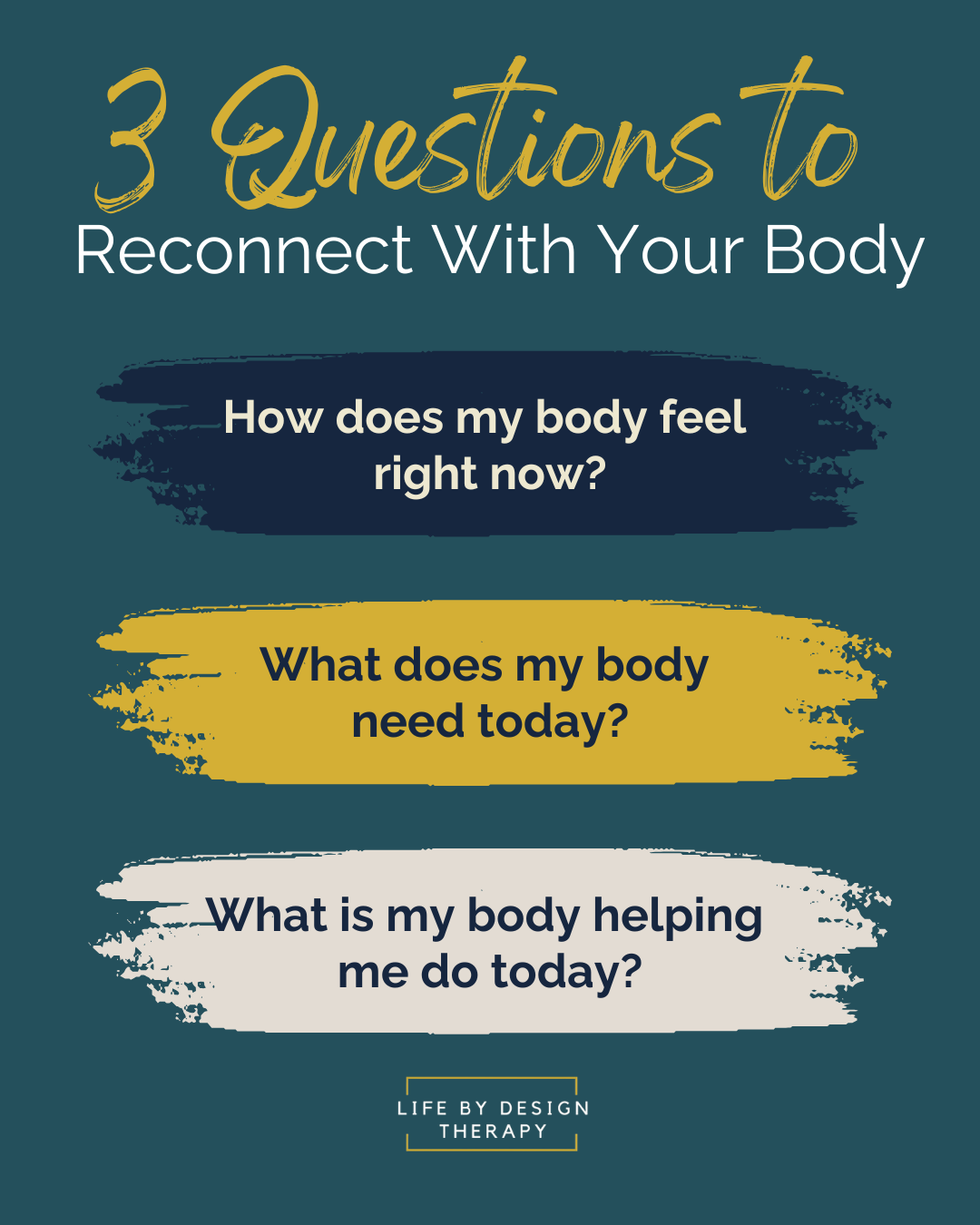
You didn’t wake up this morning planning to think about your body…but somehow, it still happened.
Maybe it was when you got dressed.
Or caught your reflection in the mirror.
Or saw someone online and, without even meaning to, started comparing.
And just like that, your body became something to evaluate again.
For a lot of people, this happens dozens of times a day, so automatically, they don’t even notice it anymore.
But over time, it can start to feel exhausting.
Because the message is everywhere.
An ad suggesting your skin could be smoother.
A post promising the “best shape of your life.”
A subtle before-and-after transformation that makes you wonder if you should be doing more.
It’s not always obvious. Sometimes it’s even framed as “wellness” or “self-improvement.”
But underneath it, there’s often the same message: You’re not quite there yet.
And when you’re surrounded by that every day, it slowly shapes how you relate to your body.
Instead of simply living in your body…you start monitoring it.
You notice how it looks.
You compare it to others.
You wonder what needs to change.
If you’ve ever felt stuck in that cycle, it makes sense given what you’re exposed to on a daily basis.
A lot of people don’t hate their bodies… but they don’t feel at ease in them either. They’re stuck somewhere in the middle between “I don’t like my body” and “I’m supposed to love it.”
And more people feel this than you’d think… they’re just not always talking about it. And it’s where a different approach starts to come into the conversation: Body neutrality.
Body neutrality is one of those phrases that’s been gaining a lot of attention lately… but it’s also often misunderstood.
Body neutrality is the practice of relating to your body without judgment, focusing on what your body does for you rather than how it looks. It removes the pressure to feel positive about your body at all times and instead focuses on what your body does for you and the role it plays in your life, rather than on how it looks.
It’s more like taking a step back from constantly judging it. Letting your body just be there, without needing to analyze or critique it all the time.
So, if you pause for a moment and notice your own internal dialogue, you might realize how often your body has been filtered through one core question:
“How does my body look right now?”
For a lot of us, that question didn’t just come out of nowhere. It was shaped over time through comments, media, comparisons, and subtle messaging that taught us our bodies were something to monitor, improve, or fix.
And that’s exactly where body neutrality begins to help shift things.
Not by demanding you suddenly love your body…but by gently offering different questions like:
How does my body feel right now?
What does my body need today?
What is my body helping me do today?
It might not seem like a major difference, but it changes the direction of your attention from the outside… back to the inside.
Where Did Body Neutrality Come From?
What’s interesting is that body neutrality didn’t emerge on its own.
It began gaining traction in the early 2010s, largely as a response to the body positivity movement, which, while incredibly important, didn’t always feel accessible for people who were still struggling to feel at home in their bodies.
Body positivity, popularized through fat acceptance activism and voices like Connie Sobczak and Elizabeth Scott, encouraged people to love their bodies as they were. And for many, that message was powerful and needed.
But for others, it felt… out of reach.
If you’ve spent years feeling disconnected from or critical of your body, jumping straight to love can feel overwhelming or maybe even inauthentic. That’s where body neutrality started to take shape as a kind of middle ground.
It wasn’t a rejection of body positivity, but rather an expansion of the conversation. From a Body Neutral perspective, you don’t have to love your body today. You don’t even have to like it.
But what if you could stop fighting it?
Over time, body neutrality has grown into more of a quiet movement—one that’s been shaped by therapists, dietitians, and advocates who focus on reducing body obsession and reconnecting people with their lived experience.
And this is where it naturally overlaps with somatic work.
Because at its core, somatic therapy is also about shifting out of constant observation and into experience.
Instead of analyzing your body from the outside, you begin to notice it from within.
Sensations. Needs. Signals. Capacity.
In that way, body neutrality isn’t just a mindset shift. It’s a different relationship with your body. And if this way of relating feels unfamiliar… that makes sense. Most of us were never taught to experience our bodies this way. We were taught to look at them, compare them, and judge them.
So learning to simply be in your body, without constantly evaluating it, can feel like a completely new language at first. But it’s one that your body already understands.
Why Body Neutrality Can Feel More Realistic Than Body Positivity
The body positivity movement has done a lot of important work.
For many people, it’s been empowering and healing. But for others, it can feel like a really big leap.
Because if your relationship with your body has been shaped by years of criticism, comparison, or pressure…suddenly loving it can feel out of reach.
You might find yourself thinking:
I don’t hate my body… but I don’t exactly love it either.
And sometimes, even that can feel heavier than it should.
This is where body neutrality can feel like a relief.
It removes the pressure to feel a certain way about your body.
You don’t have to love it every day.
You don’t have to feel confident all the time.
You don’t have to force positivity when it’s not there.
Your body is simply allowed to exist… without constant judgment.
And for many people, that’s where things start to feel a little easier.
How to Practice Body Neutrality in Everyday Life
Body neutrality isn’t about making a drastic shift.
It starts with small, intentional changes. Like noticing when your focus goes to appearance and redirecting it toward what your body is experiencing instead
You might start to notice small changes in how you relate to your body.
You notice how your body feels after a full night of sleep, not because it looks different, but because you have more energy and feel more like yourself.
You start paying attention to how movement affects your energy, even if your appearance hasn’t changed.
You recognize when your body is hungry, thirsty, or overstimulated instead of ignoring it.
You begin to notice how stress shows up physically—tight shoulders, a heavy chest, or a clenched jaw.
Instead of automatically asking, “How do I look?”
You might catch yourself asking, “What’s going on in my body right now?”
At first, this can feel a little unfamiliar, and you might not be used to paying attention in this way. But over time, it can change how you relate to your body. Not because you forced yourself to feel differently about it. But because you stopped focusing on fixing it all the time.
The Real-Life Benefits of Body Neutrality
As you start to build a more stable and supportive relationship with your body, you may begin to notice small shifts.
One of the first changes is often awareness.
You’ll begin noticing what’s going on in your body without immediately judging it or trying to fix it.
You might start to become more aware of when you’re tired, when your body feels tense, when something feels off, or when you feel more settled.
Instead of evaluating how your body looks, you begin paying attention to how it feels and what it needs.
You might start to prioritize your needs in a different way.
You rest when you notice you’re tired.
You eat when your body is actually hungry.
You pay attention to stress earlier, instead of pushing through it.
And over time, that can help you feel more connected to your body again.
Not because everything suddenly feels positive, but because you’re noticing your body more and actually responding to it.
Final Thoughts
If loving your body feels like too big a step right now, that’s okay.
For a lot of people, it is a big step, especially if your relationship with your body has been shaped by years of criticism or pressure.
So instead of trying to jump straight to confidence or self-love, body neutrality offers something more realistic.
It gives you a place to start without having to force how you feel.
You don’t have to convince yourself that you love your body. You don’t have to pretend things feel better than they do.
You just start relating to your body a little differently, with more awareness and a bit more responsiveness to what it actually needs. And over time, that can start to change things in a way that feels more natural. For many people, body image struggles aren’t just about appearance.
They’re connected to deeper experiences like stress, comparison, past criticism, or patterns that have been building over time. And working through that alone can feel overwhelming.
At Life By Design Therapy™, we take a holistic and somatic approach to this work. That means we don’t just explore how you think about your body, we also explore how you experience it.
Together, we help you reconnect with your body in a way that feels safer, more grounded, and more supportive over time. If you’ve been feeling stuck in the cycle of constantly thinking about your body, you don’t have to navigate that alone.
You can learn more or schedule a consultation HERE.
This Week's Affirmations
I can focus on how my body feels instead of how it looks.
I am learning to listen to my body and respond to what it needs.
I don’t have to fix my body to take care of it
My body is allowed to exist without being judged or evaluated.
My needs are valid, and I’m allowed to prioritize them.
Additional Resources
**If you're interested in continuing to explore your relationship with your body, the books below can be a helpful place to start.
Intuitive Eating by RDN Evelyn Tribole, MS and RDN Elyse Resch, MS
Self-Compassion: The Proven Power of Being Kind to Yourself by Kristin Neff
Body Kindness: Transform Your Health from the Inside Out by Rebecca Scritchfield
The Body Keeps the Score: Brain, Mind, and Body in the Healing of Trauma by Bessel van der Kolk M.D
**Some product links are affiliate links, which means we'll receive a commission if you purchase through our link, at no extra cost to you. Please read the full disclosure here.

Why Loving Your Body Feels So Hard (Even When You Want To)
By Melody Wright, LMFT
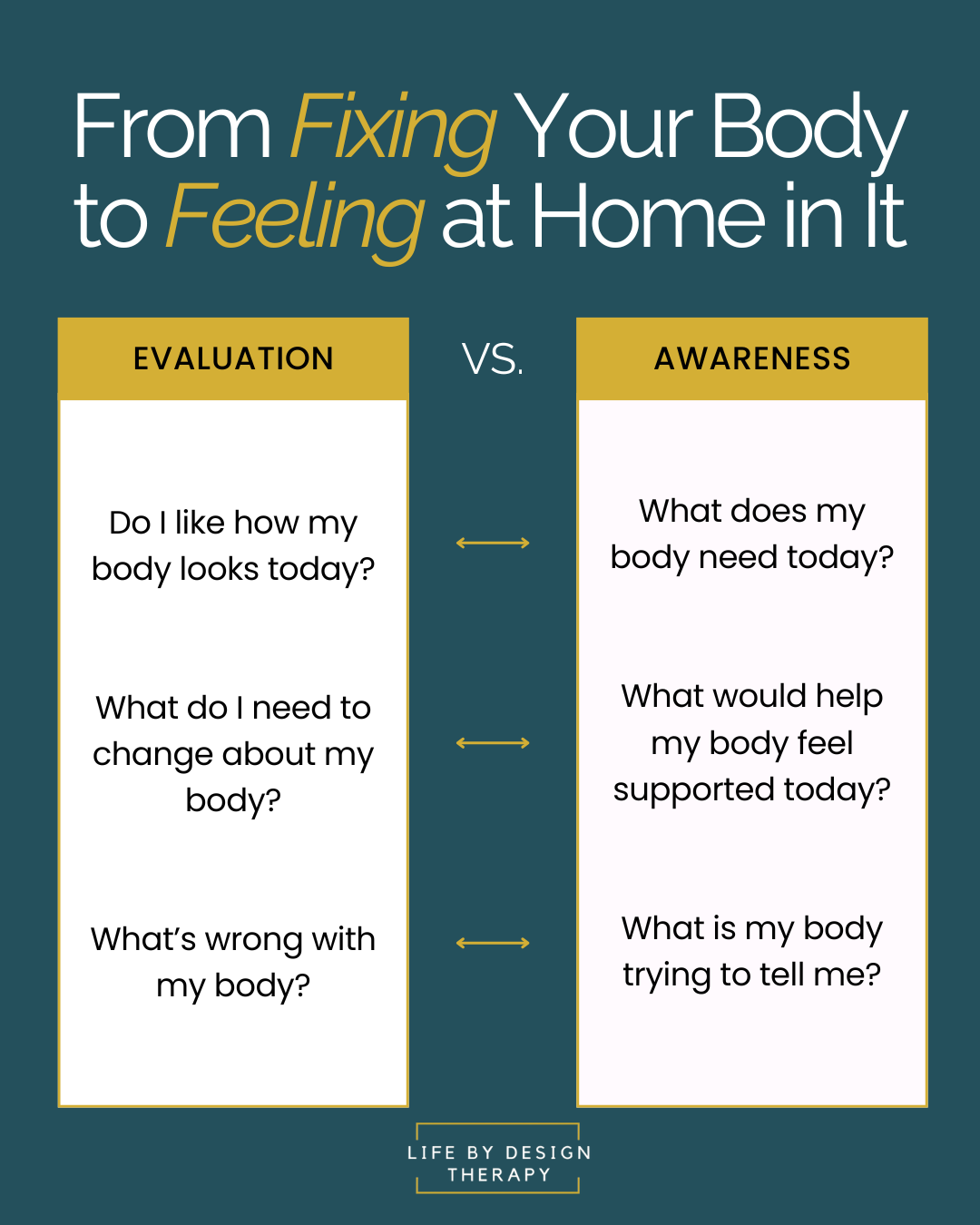
There’s a lot of messaging out there about loving your body. You’ve probably heard some version of it before.
“Be confident in your skin.”
“Learn to love yourself.”
“Try focusing on the things you like about your body.”
And while those ideas sound nice, they may not feel very helpful when your experience with your body has been more complicated than that. If you’ve spent years noticing what you wish looked different… comparing yourself to others… or feeling critical of your body in small, constant ways… being told to simply love it can feel impossible.
You might even find yourself thinking something like:
Why is this still so hard for me?
Why can’t I just feel confident like everyone else?
If that’s where you are, I want you to know something important. Feeling comfortable in your body is something that takes time, especially when your experiences have shaped how you relate to it. If that’s where you are right now, it makes a lot of sense.
So how does this relationship with our body develop in the first place?
Most people don't wake up one day and suddenly decide to be critical of their bodies. Instead, the way we relate to our bodies is something we learn over time. And often, the shift isn’t about trying to love your body more. It’s about changing the way you relate to it altogether.
Not from the outside, where it’s about looks or comparisons. But from the inside, and how it actually feels to live in your body.
This isn’t your typical body image conversation. And the shift we’re going to explore offers a different way of relating to your body. So keep reading if you’re ready to build a more grounded, compassionate relationship with your body.
Why Body Image Struggles Are More Common Than You Might Think
Take a moment to reflect on the messages you’ve received about your body over the years, and you may begin to see a pattern.
For most of us, our bodies were never something we were taught to simply live in. Instead, it was something to improve, monitor, and evaluate.
You may have learned to notice weight changes early.
You may have compared your body to other people’s bodies growing up.
You may have become aware of how you look in photos, mirrors, or certain clothes.
In fact, research has found that the majority of people, especially women, engage in frequent body checking or monitoring throughout the day, often without even realizing it.
And over time, this hyperawareness settles in and becomes a lens through which you begin to see yourself.
Instead of simply living in your body, your attention slowly shifts toward keeping track of it. You start noticing how it looks, how it compares, and how it might appear to other people. You might catch your reflection, immediately start evaluating what you see, adjust your clothing to hide certain parts of your body, or look at a photo and notice your appearance before anything else.
For many people, it can feel like a small part of your mind is always scanning your body.
And carrying that level of awareness all the time can be exhausting.
And if you’ve struggled with body image, you may have noticed something else that feels confusing about it.
It doesn’t always show up the same way every day.
Why Your Body Image Can Change From Day to Day
You might have days when you feel relatively comfortable in your body.
You get dressed.
You move through your day.
Your body isn’t at the center of your attention.
But other days might feel very different. Suddenly, you might find yourself noticing things you didn’t notice before.
You feel more self-conscious.
You may even find yourself thinking, Why do I suddenly hate how I look today?
It can feel confusing. But there’s an important reason this happens. Your body image isn’t just about how you look.
It’s also deeply connected to your nervous system and emotional state.
Did you know that when you’re stressed, overwhelmed, tired, or feeling vulnerable, your brain naturally becomes more critical? It starts scanning for problems or threats. And because your body is always with you, it can easily become the place where that criticism lands.
A 2023 study found that higher levels of emotional distress were significantly associated with greater body dissatisfaction. So when you have a difficult body image day, it doesn’t mean your body suddenly changed. It often means your system is holding more stress than usual, and that can shift how you see yourself.
In those moments, it’s not just your body you’re reacting to, it’s how your system is experiencing it. For many people, that unpredictability can create another layer of frustration. You might start wondering why this still affects you at all.
Why You Might Feel Like You Should Be “Over This By Now”
There’s another layer that many people don’t talk about very often, the quiet embarrassment of still struggling with body image. If you’ve ever struggled with body image, you might find yourself thinking:
Why does this still affect me?
I should be more confident by this point in my life.
Why do I still care about this so much?
For many people, this thought shows up alongside a sense of frustration or even embarrassment.
Especially if you’re someone who has grown in many other areas of your life.
You may have developed more self-awareness.
You may handle stress better than you used to.
You may feel more grounded in who you are.
And yet, when it comes to your body, that old critical voice can still show up. This disconnect can make body image struggles feel even more confusing. But honestly, body image isn’t something most people simply grow out of.
The way you relate to your body is shaped over many years, through culture, comparison, experiences, and the way you’ve learned to talk to yourself. Those patterns tend to run deeper than people realize.
Which means struggling with body image doesn’t say anything about your maturity, your confidence, or your personal growth. It simply means your relationship with your body has been shaped by a lot of influences over time. The encouraging part is that those patterns can change. And that change often starts in a different place than you might expect.
How You Can Start Improving Your Relationship With Your Body
In therapy, we often begin by shifting the focus away from how the body looks and toward how the body is experienced.
Instead of focusing on loving the body right away, we start by changing the relationship you have with it.
One shift that can be especially helpful is moving from:
Body evaluation → Body awareness
Instead of asking yourself:
Do I like how my body looks today?
You might gently ask:
What does my body need today?
Do you need rest? Movement? Food? A slower pace? A few moments to breathe?
Questions like these bring your attention back inside your body, rather than constantly observing it from the outside. And that’s where a new relationship with your body can begin to grow. That shift might sound simple, but it can be harder than you expect at first. Especially if you’ve spent years relating to your body through evaluation instead of awareness.
Small Ways You Can Reconnect With Your Body
One of the biggest misconceptions about body image healing is that it requires big, dramatic changes.
In reality, it often begins in small, everyday moments. Moments that help your nervous system remember that your body isn’t just something to judge, but rather something you live in.
You might start by noticing simple things like:
• Taking a slow breath and allowing your shoulders to soften
• Stretching your body because it feels relieving
• Stepping outside and noticing the air on your skin
• Paying attention to hunger, fullness, or fatigue cues
• Taking a moment to apply lotion and simply noticing the feeling of it on your skin
These experiences may seem small, but they help rebuild a sense of trust and connection with your body. As that connection grows, the way you relate to your body often begins to change, too.
Final Thoughts
Many people assume that healing body image means learning to love how their body looks.
But that’s rarely where the work begins.
More often, the shift starts with changing the way you relate to your body.
For many people, body image struggles aren’t just about appearance. They’re shaped by years of messaging, comparison, expectations, and the subtle ways you’ve learned to judge yourself.
That’s why improving body image often involves something deeper than positive thinking. It involves learning how to reconnect with your body differently, with more awareness, patience, and understanding.
Over time, that shift can begin to change the way you experience your body altogether. Not because you forced yourself to love it. But because the relationship with it became less critical, less tense, and more supportive.
If body image struggles are something you’ve been carrying for a long time, you don’t have to figure it out on your own.
At Life By Design Therapy™, our therapists take a holistic and somatic approach to this work. That means we explore not only how you think about your body, but also how you experience it, helping you rebuild a positive, more connected relationship with your body over time.
If you’re curious about what that kind of support could look like for you, you can schedule a free consultation here → BOOK A CALL. We have an office in Downtown Berkeley and offer online therapy throughout California for those looking for somatic and holistic support.
This Week's Affirmations
I don’t have to love my body every day to treat it with care.
My body carries me through life, and that deserves appreciation.
My worth is not defined by how my body looks.
I am learning to listen to my body instead of criticizing it.
My body deserves respect, even on the days I struggle with it.
Additional Resources
If you're interested in continuing to explore your relationship with your body, the books below can be a helpful place to start.
Intuitive Eating by RDN Evelyn Tribole, MS and RDN Elyse Resch, MS
Self-Compassion: The Proven Power of Being Kind to Yourself by Kristin Neff
Body Kindness: Transform Your Health from the Inside Out by Rebecca Scritchfield
The Body Keeps the Score: Brain, Mind, and Body in the Healing of Trauma by Bessel van der Kolk M.D
**Some product links are affiliate links, which means we'll receive a commission if you purchase through our link, at no extra cost to you. Please read the full disclosure here.

What Happens in Your Nervous System When You Slow Down
By Melody Wright, LMFT
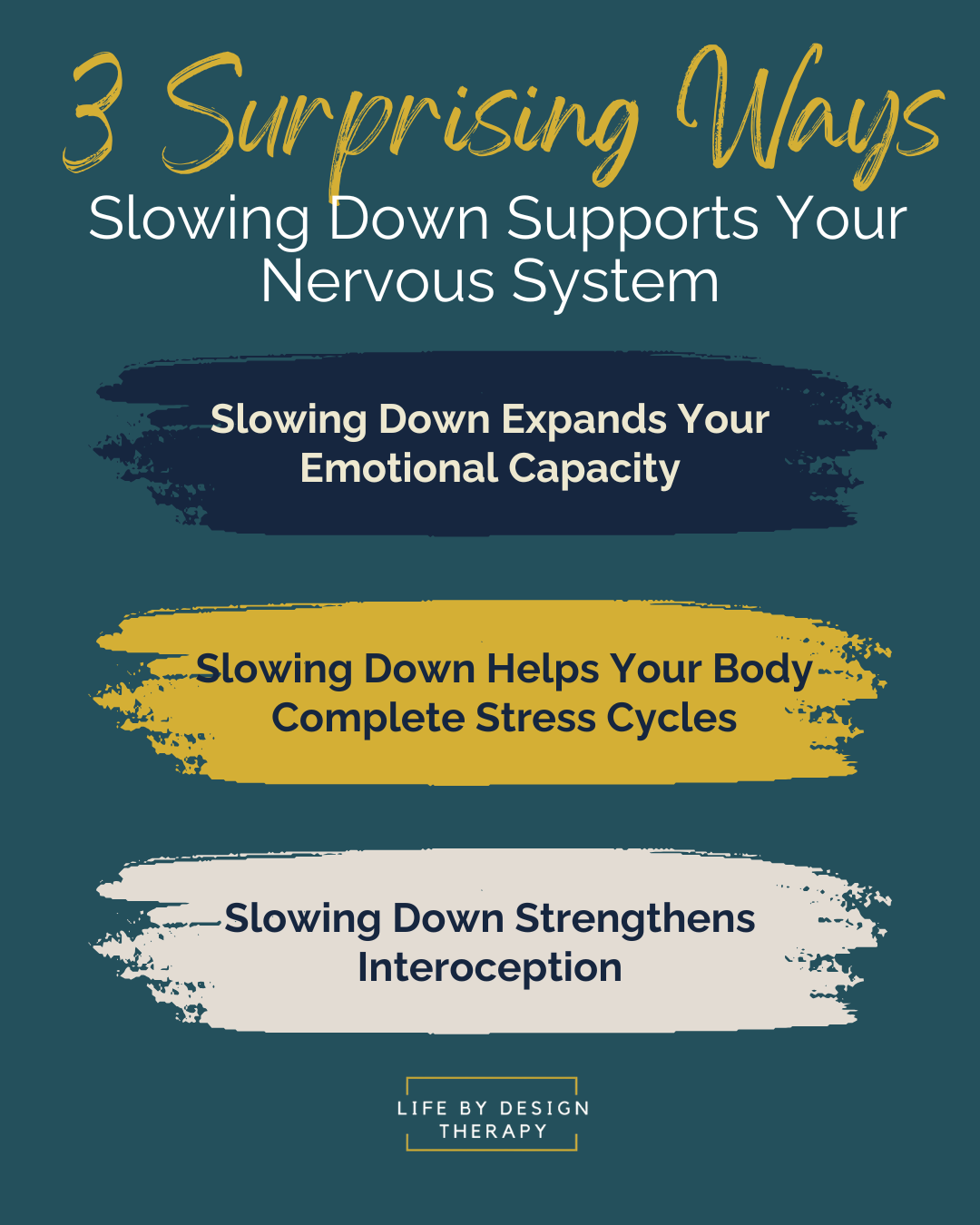
You may think slowing down is about getting more rest.
About sleeping more. Doing less. Taking breaks.
But what slowing down actually does goes much deeper than relaxation.
If you’ve been living in prolonged strain by managing responsibilities, solving problems, anticipating needs, and staying responsive, your body has likely adapted to sustain that level of output.
You may function well.
You may even feel most like yourself when there’s something to handle.
And yet, constantly being ready to respond has a real cost for your nervous system.
Your body is not designed to remain in effort indefinitely. It is designed for rhythm where there is both activation and recovery.
Slowing down isn’t about becoming less productive.
It’s about restoring rhythm by giving your nervous system the space it needs to recalibrate.
In this blog, we’ll explore some of the most impactful ways slowing down supports your nervous system and why creating space to slow your pace can change how your body experiences stress.
Slowing Down Expands Your Emotional Capacity
When you begin slowing your pace, something subtle but important starts to shift inside your body.
It’s not just about feeling calmer in the moment. Slowing down changes how your nervous system processes stress, emotion, and stimulation over time.
There are a few ways this happens in the body.
Your nervous system has a range where it can experience stress, emotion, stimulation, and relational intensity while still functioning well.
This range is often called your Window of Tolerance, a concept developed by psychiatrist Dr. Dan Siegel.
When you’re inside this window, your nervous system is activated enough to engage with what’s happening around you, but not so overwhelmed that your system shifts into survival mode. Your brain can still access reasoning, perspective, and problem-solving.
But when stress builds, or life starts moving faster than your system can process, it can push you outside of that window.
You might notice things like:
🌻 Feeling reactive or overwhelmed more quickly
🌻 Struggling to think clearly or communicate the way you want to
🌻 Feeling emotionally flooded, or on the other end, numb or disconnected
When this happens, it’s not a sign that something is wrong with you.
It’s often your nervous system doing exactly what it’s designed to do by shifting into protection when it senses too much pressure or stimulation.
This is where slowing down can make a difference.
In moments when your nervous system has been pushed outside its window, pausing, breathing, or gently regulating your body can help your system settle again. As your body settles, your brain can re-engage the parts responsible for reasoning, perspective, and emotional regulation.
Over time, regularly practicing this kind of slowing down can also help expand your window of tolerance.
That means your nervous system gradually becomes more capable of experiencing stress, emotion, or intensity without immediately tipping into overwhelm or shutdown.
In other words, slowing down doesn’t remove stress from life.
But it can help your nervous system become more flexible, more regulated, and better able to move through stress without getting stuck in it.
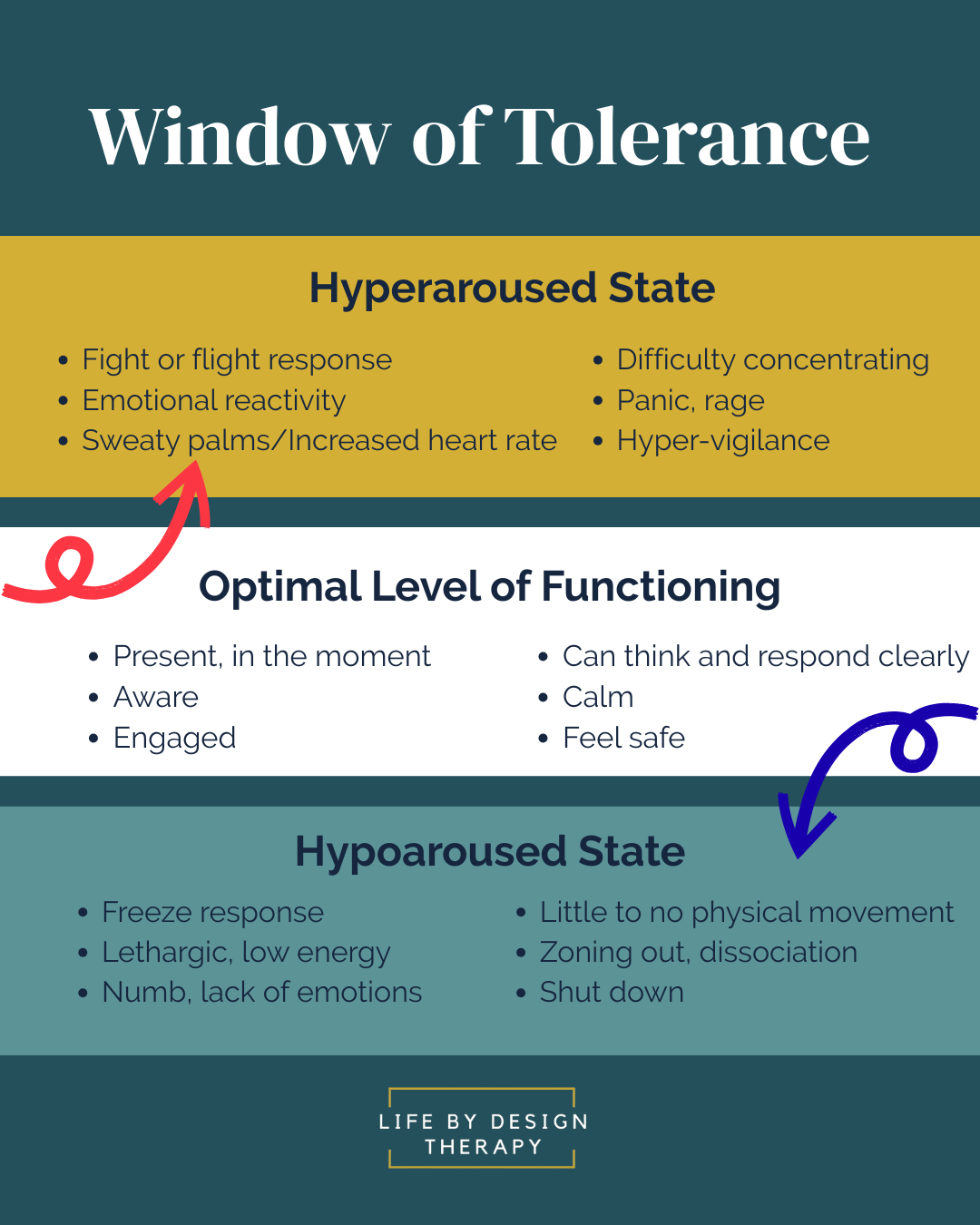
Slowing Down Helps Your Body Complete Stress Cycles
When something stressful happens, even if it’s small, your body mobilizes.
Your heart rate shifts. Muscles engage. Hormones rise. Your attention sharpens.
That response is what your body was built to do. It’s a way of protecting you.But if you move immediately into the next task, the next email, the next responsibility, your body often doesn’t get to finish what it started.
The activation remains partially unresolved.
You may recognize this as:
Feeling wired but exhausted.Tension that lingers even after the moment is over.Trouble sleeping despite being tired.A baseline irritability you can’t quite explain.
Your body began a stress response, but it didn’t complete it.
Slowing down reduces incoming demands long enough for your nervous system to assess whether the stress response is still necessary, and, if not, begin shifting toward regulation.
Sometimes that looks like a long exhale.
Sometimes it’s allowing your shoulders to drop when a conversation ends.
Sometimes it’s simply sitting still long enough for your system to settle before you reach for the next demand.
Completing the stress cycle is regulation.
Without regulation, your system accumulates unfinished activation, and with regulation, your body discharges what it no longer needs to carry.
Slowing Down Strengthens Interoception
When you’re focused outward with solving, managing, and producing, your internal signals become quieter.
Not because they disappear, but because your attention is trained elsewhere. In many ways, your system is scanning outward for what needs to be handled next.
But your body is always communicating with you.
Interoception is your ability to sense what’s happening inside your body, and it plays an important role in nervous system regulation. When your attention is constantly directed outward, those internal signals can become harder to notice.
When you slow down, your attention is no longer fully occupied by what’s outside of you, and internal signals that were previously muted can become more noticeable.
And, honestly, that can feel uncomfortable at first.
You may notice:
How tired you actually are.
That your jaw has been clenched all day.
A subtle heaviness in your chest.
Grief beneath your productivity.
Hunger or thirst you ignored.
This awareness isn’t something to override or power through. It’s a sign your body is still communicating with you.
Remember, you cannot soothe what you cannot sense.
The more connected you are to your internal signals, the earlier you can respond.
This allows you to choose how you respond and move through life.
Instead of burning out and then recovering, you can begin adjusting in real time.
What Slowing Down Actually Looks Like
Slowing down often happens in small, ordinary moments.
It doesn’t require a perfectly quiet morning or an uninterrupted hour.
More often, it shows up in the spaces you usually move through quickly.
It might look like:
Noticing the temperature of the water while you wash your hands instead of mentally rehearsing your next task.
Standing still for a few extra seconds after closing your laptop, feeling your feet on the ground before walking away.
Allowing your body to settle into the couch instead of immediately reaching for a distraction.
You may begin to notice how quickly your system wants to transition, how momentum pulls you forward before one moment has fully ended.
Slowing down, in its simplest form, is letting one moment end before starting another.
It might mean feeling your breath fully leave your lungs. Noticing that your heart rate has been elevated. Allowing your shoulders to drop without consciously trying to relax them.
These shifts are subtle and allow your nervous system to learn something new.
Final thoughts
Slowing down isn’t about doing less.
It’s about restoring balance to a system that has learned to sustain effort for a long time.
If your body feels unfamiliar with settling, that doesn’t mean you’re incapable of it. It may simply mean your nervous system has had more practice producing than recovering.
And practice shapes physiology.
The more often your system experiences moments of recovery, the more accessible regulation becomes. Not because you forced yourself to relax, but because your body has learned that it can move through stress and return to the present.
You don’t have to abandon your ambition.You don’t have to give up your responsibility.You don’t have to become someone less capable.
You’re simply expanding your capacity to carry what you already hold …without your body absorbing the full weight of it.
Slowing down isn’t the opposite of strength; it’s what makes strength sustainable.
If this resonates with you, you don’t have to navigate it alone. Working with a therapist can help you understand how your nervous system has adapted to stress and learn ways to support your body in finding steadiness again.
At Life By Design Therapy™, we offer holistic and somatic therapy designed to help you reconnect with your body, build regulation, and move through life with more capacity and ease.
If you’re curious about what that process might look like, schedule a free phone consultation to learn more.
This Week's Affirmations
My body does not have to carry stress indefinitely.
I am building the capacity to feel without becoming overwhelmed.
Recovery is not weakness — it is regulation.
I can listen to my body without being ruled by it.
Activation does not have to be my baseline.
Additional Resources
**If you’re interested in learning more about ways to support your nervous system, check out these books below:
In an Unspoken Voice: How the Body Releases Trauma and Restores Goodness" by Peter A. Levine
The Miracle of Mindfulness: An Introduction to the Practice of Meditation by Thich Nhat Hanh
Radical Acceptance: Embracing Your Life With the Heart of a Buddha by Tara Brach
The Untethered Soul: The Journey Beyond Yourself by Michael A. Singer
Silence: The Power of Quiet in a World Full of Noise by Thich Nhat Hanh
**Some product links are affiliate links, which means we'll receive a commission if you purchase through our link, at no extra cost to you. Please read the full disclosure here.

The Hidden Cost of Being the Capable One in Your Relationship
By Melody Wright, LMFT
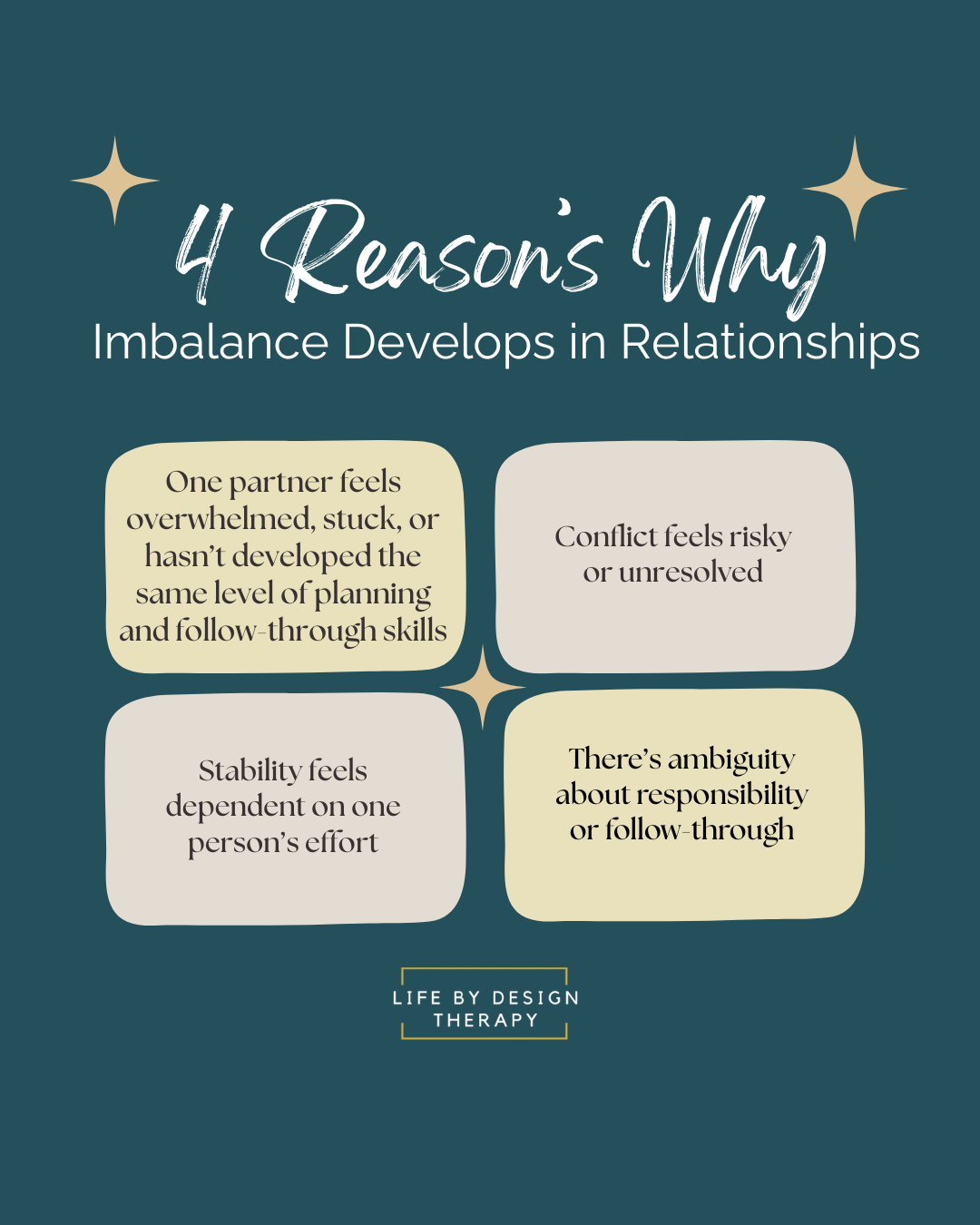
Most people don’t come into therapy saying, “I don’t know how to stop doing everything without things falling apart.”
They come in saying things like, “I’m exhausted,” or “I feel like I’m doing everything,” or “I don’t feel like I can lean on my partner.”
And as they start talking, a familiar story begins to take shape.
It usually sounds something like:
“I’m the one managing schedules, finances, emotional check-ins, and future planning… and I’m doing it without being asked.”
“My partner isn’t a bad person. They’re not uncaring. But it feels like they are not carrying the same weight.”
And somewhere along the way, the relationship begins to feel less like a partnership and more like a responsibility.
And when love starts to feel like labor, your nervous system doesn’t need a pep talk.
It needs support. And it makes sense that you’re exhausted without it.
When Being Capable Starts to Feel Like a Burden
One of the hardest parts about this dynamic is that it can look normal from the outside.
You’re planning.
You’re organizing.
You’re thinking ahead.
You’re doing what adults do.
And to be fair… none of that is inherently a problem.
In many relationships, one partner naturally takes the lead in certain areas.
One person may be more detail-oriented. More proactive. More comfortable planning ahead.
That difference alone isn’t the issue.
What becomes painful is when the relationship starts to feel heavy in a way you can’t quite name, and when your effort stops feeling like a choice and starts feeling like the only way things will keep running smoothly.
But at a certain point, it makes sense that your capability stops feeling like a strength and starts feeling more like a burden.
Not because you don’t love your partner.
Not because your partner is “bad.”
Not because you don’t want the relationship to work.
But because even strong, capable people eventually reach a limit.
And when support doesn’t feel consistent, whether it’s emotionally, practically, or both, your nervous system stays on alert.
And that’s not a personal failure; it's actually your body responding to the experience of carrying more than what feels sustainable.
What Relationship Imbalance Looks Like in Real Life
This pattern rarely starts as a problem.
It often begins as responsiveness. Awareness. Care.
And on a larger level, these are traits our culture tends to reward.
We praise the person who stays on top of everything.
The one who’s responsible, perceptive, organized, emotionally aware, and always thinking ahead.
In a world that values productivity, competence, and “keeping it together,” being dependable can look like a strength.
But over time, the role can solidify.
One partner becomes the planner, the organizer, the emotional barometer.
They hold the timeline, the to-do list, and the future vision.
They remember appointments, initiate conversations, anticipate needs, and quietly manage the parts of life that feel unstable.
And what no one talks about enough is the emotional cost of that.
Because what looks like “being capable” on the outside can start to feel like carrying too much on the inside.
And because this role is so normalized, you might not even realize how much it’s costing you at first.
It doesn’t always show up as one big breaking point.
It shows up in the quieter ways your body and your relationship start to respond.
🌻 You feel chronically tired, even when you technically get enough sleep.
🌻 You feel irritable… and then guilty for being irritable.
🌻 You can’t fully relax, even during calm moments, because part of you is still tracking what needs attention next.
🌻 And resentment might start to build, not because you don’t love your partner, but because love has started to feel one-sided.
If resentment has been building, it’s often a signal.
That’s often what happens when the weight in a relationship starts to feel unbalanced.
Why This Dynamic Develops
From a therapeutic perspective, when uncertainty shows up, whether emotionally, practically, or relationally, some people cope by increasing effort and responsibility.
You stabilize the environment by staying alert, involved, and prepared, which is a nervous system response.
While some might consider this “overfunctioning.” But for many people living it, it feels simple:
“If I don’t handle it, it won’t get handled.”
“If I don’t stay on top of it, we’ll fall behind.”
“If I stop doing, everything will fall apart.”
This dynamic might develop in relationships where:
One partner feels overwhelmed, stuck, or hasn’t developed the same level of planning and follow-through skills.
There’s ambiguity about responsibility or follow-through
Conflict feels risky or unresolved
Stability feels dependent on one person’s effort
Doing more becomes a way of preventing things from falling apart.
And for a while, it works.
Until it doesn’t.
The Attachment Roots of Carrying Too Much
If you’re the one who tends to carry more, there’s a good chance this didn’t start with your current partner.
For a lot of people, this is a role they learned early, often in childhood, as a way of staying connected and safe.
Maybe you grew up in an environment where being responsible was expected.
Where being mature was praised.
Where needing too much felt inconvenient.
Or maybe you learned something even more subtle:
The more tuned-in you were, the safer things felt.
If you could sense someone’s mood early, you could prevent conflict.
If you stayed one step ahead, you could keep the emotional temperature in the room from boiling over.
And sometimes, from an attachment perspective, it goes even deeper.
You might have learned to watch a caregiver’s emotional world closely because it affected you.
For example, your younger self might have felt things like:
“If I can make Mommy/Daddy feel better, then everything will be okay.”
“I have to be really good, so Mommy/Daddy doesn’t get mad.”
“Mommy/Daddy is happy when I help, so I’m going to do it before she asks.”
“If Mommy/Daddy is upset, I have to be extra quiet and careful.”
If any of that feels familiar, it makes sense that you became incredibly skilled at reading the room.
🌻 You became quick.
🌻 Responsible.
🌻 Helpful.
🌻 Highly attuned.
Your body learned how to stay safe and hypervigilant back then, but your body also knows that it’s doing too much now.
When The Dynamic Stops Feeling Sustainable
One of the ways you can tell the balance has shifted is when your effort starts to feel less like a choice and more like a necessity.
You’re no longer stepping in because you want to. You’re stepping in because it feels like you have to.
Because if you don’t…things won’t get done, conversations won’t happen, and the relationship won’t move forward.
At that point, effort turns into obligation.
Many people in this role carry a quiet belief: “If I don’t hold this together, no one will.”
And I want you to know something: You can love your partner and still feel completely worn down by this dynamic.
How This Impacts the Relationship
The more one partner manages, the less room there is for mutuality. The more one partner anticipates, the less space there is for shared responsibility to emerge naturally.
Over time, this can lead to:
Emotional distance
A parent–child dynamic rather than a partnership
Resentment that feels unsafe to express
A growing sense of loneliness, even inside the relationship
And what makes this dynamic so painful isn’t just the workload.
It’s what it can start to feel like over time.
Not because these beliefs are brand new… but because they’re familiar.
This dynamic can begin to activate beliefs you may have been carrying for a long time.
Beliefs like:
“I can’t rely on anyone.”
“If I need something, I’ll be disappointed.”
“I always end up alone in the hard parts.”
And those beliefs don’t just affect your relationship.
They affect how safe your body feels in connection with any relationship.
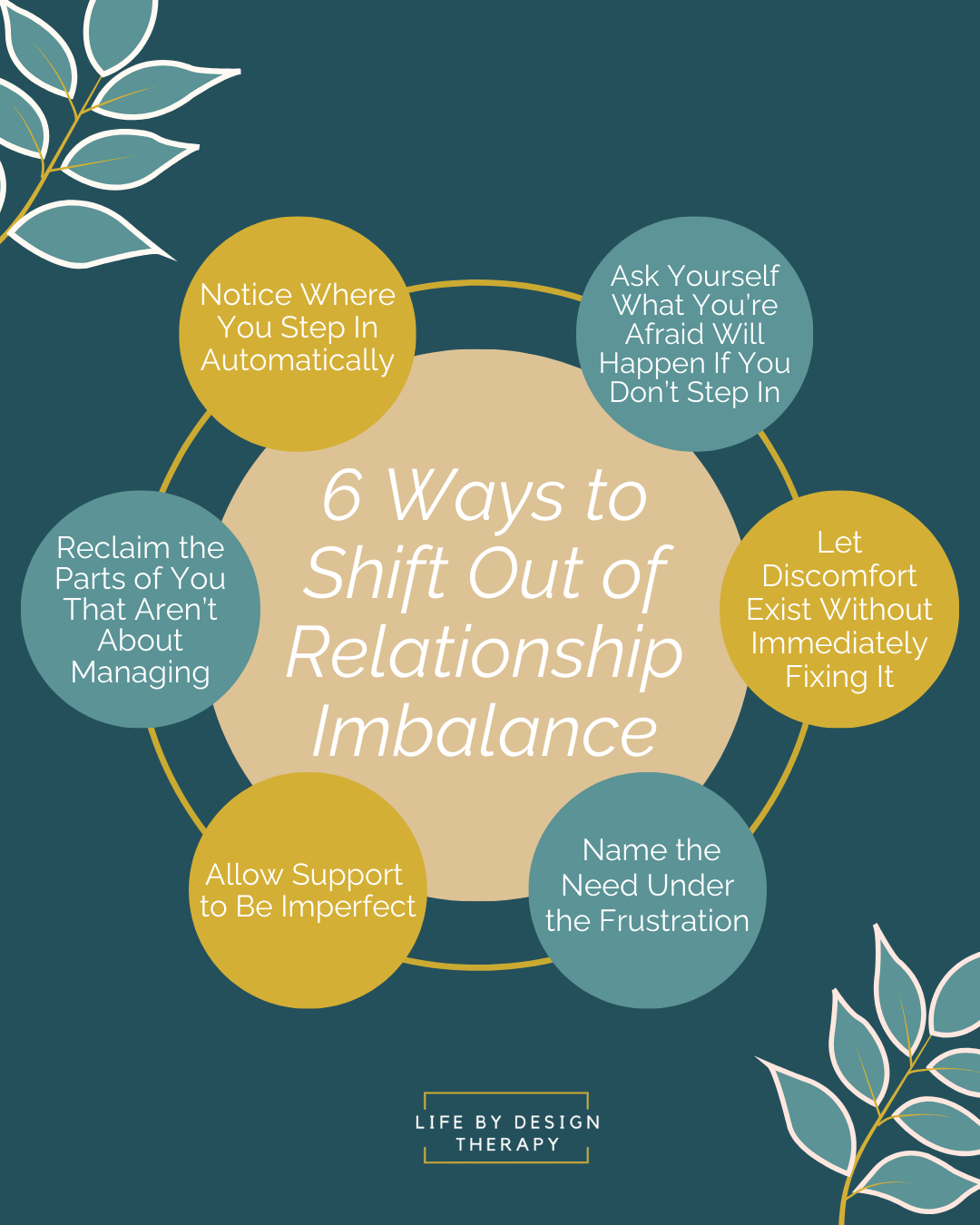
6 Ways to Restore Balance When You Feel Like You’re Carrying the Relationship
Restoring balance doesn’t mean pulling away or letting everything collapse.
It means bringing awareness and intention back into a role that has likely been running on autopilot.
Here are ways to start.
1. Notice Where You Step In Automatically
This dynamic often happens before conscious thought.
You fix. You remind. You follow up. You handle it. Sometimes, it’s before your partner even knows there was something to address.
Start by noticing:
Where you step in without being asked
Where it feels hard to sit back without doing something
Where responsibility feels assumed rather than chosen
This isn’t about stopping yourself right away. It’s about understanding and becoming aware of what your nervous system has learned to do to feel safe.
2. Ask Yourself What You’re Afraid Will Happen If You Don’t Step In
Instead of immediately stepping in, try pausing for a moment and asking yourself:
What’s actually driving me right now?
Is it anxiety?
Is it obligation?
Is it the quiet belief that if I don’t do this, no one else will?
Sometimes it is anxiety.
But sometimes it’s deeper than that.
Sometimes it’s the familiar pull of responsibility.
The part of you that feels more comfortable carrying something than risking it being dropped.
You might even notice a thought like:
“If I don’t handle this, it won’t get done.” Or, “It’s just easier if I take care of it.”
And becoming aware of what is driving that response matters, because when you understand what’s driving you, you have more choice in how you respond.
3. Let Discomfort Exist Without Immediately Fixing It
One of the hardest parts of restoring balance is tolerating some discomfort.
Because stepping back can feel like:
being irresponsible
being uncaring
risking conflict
But there’s a difference between neglect and space.
Space is what allows shared responsibility to grow.
This can look like:
Allowing tasks to be completed imperfectly, even when it’s uncomfortable
Initiating the hard conversations instead of smoothing them over
Stepping back enough for your partner to engage with responsibility in their own way
And yes, it will feel uncomfortable at first.
But discomfort here doesn’t mean you’re doing something wrong.
4. Name the Need Under the Frustration
When someone feels alone for a long time, frustration becomes the language of survival.
But underneath frustration is usually something softer. Try communicating with your partner:
“I’m overwhelmed and need help with this.”
“This has been feeling heavy for me.”
“I want to feel like we’re a team and need some additional support.”
You don’t need to justify your needs with a backstory. Needing support is enough to ask for it.
5. Allow Support to Be Imperfect
One of the hardest parts of restoring balance is tolerating differences.
Your partner may help differently than you would. Maybe they’re a little slower, less efficient, or less intuitive about what is needed.
Supporting yourself means allowing participation without controlling the outcome. Psst…this is okay 🙂
Shared responsibility doesn’t require sameness; it requires room for both people to show up in their own way.
And this is often where control and safety get tangled.
Because for many people, the desire to do it “right” is also a way of staying emotionally safe.
So if this part feels hard, it’s understandable.
6. Reclaim the Parts of You That Aren’t About Managing
When you feel like you’ve been carrying more for a long time, the scope of your world can shrink to what needs to be accomplished.
It’s important to reclaim parts of yourself that bring balance.
Restoring that balance means making room for:
Rest that isn’t earned
Pleasure that isn’t productive
Time that doesn’t serve anyone else
This isn’t indulgence. It’s nervous system regulation.
And a regulated nervous system doesn’t need to carry everything to feel safe. ♥️
Final Thoughts
If you’ve been the one who holds it all together… the capable one… the one who keeps things steady…
There’s a reason this pattern developed.
It helped you adapt.
It helped you care.
It helped you hold things together when things felt uncertain.
And it may have even been the way you stayed emotionally safe in your earliest relationships.
But patterns that once helped can become heavy when they’re no longer needed.
The goal isn’t to stop caring. It’s to stop trying to do it all alone.
And that shift is often where balance begins, because you deserve to feel regulated.
You deserve to feel more balanced in your body and in your life.
And you deserve a life that doesn’t require you to carry everything to feel safe.
This Week's Affirmations
I don’t have to carry everything to be a good partner.
I am allowed to pause without things falling apart.
Supporting my partner does not require sacrificing myself.
I can ask for support without overexplaining or apologizing.
Balance begins when I stop doing this alone.
Additional Resources
**If you’re interested in learning more about ways to support your relationship, check out these books below:
Beyond Codependency: And Getting Better All the Time by Melody Beattie
Hold Me Tight: Seven Conversations for a Lifetime of Love by Dr. Sue Johnson
Radical Acceptance: Embracing Your Life With the Heart of a Buddha by Tara Brach
The Disease to Please: Curing the People-Pleasing Syndrome by Harriet B. Braiker
Set Boundaries, Find Peace: A Guide to Reclaiming Yourself by Nedra Glover Tawwab
Nonviolent Communication: A Language of Life by Marshall B. Rosenberg
**Some product links are affiliate links, which means we'll receive a commission if you purchase through our link, at no extra cost to you. Please read the full disclosure here.

How to Not Lose Yourself When Supporting an Unmotivated Partner
By Melody Wright, LMFT
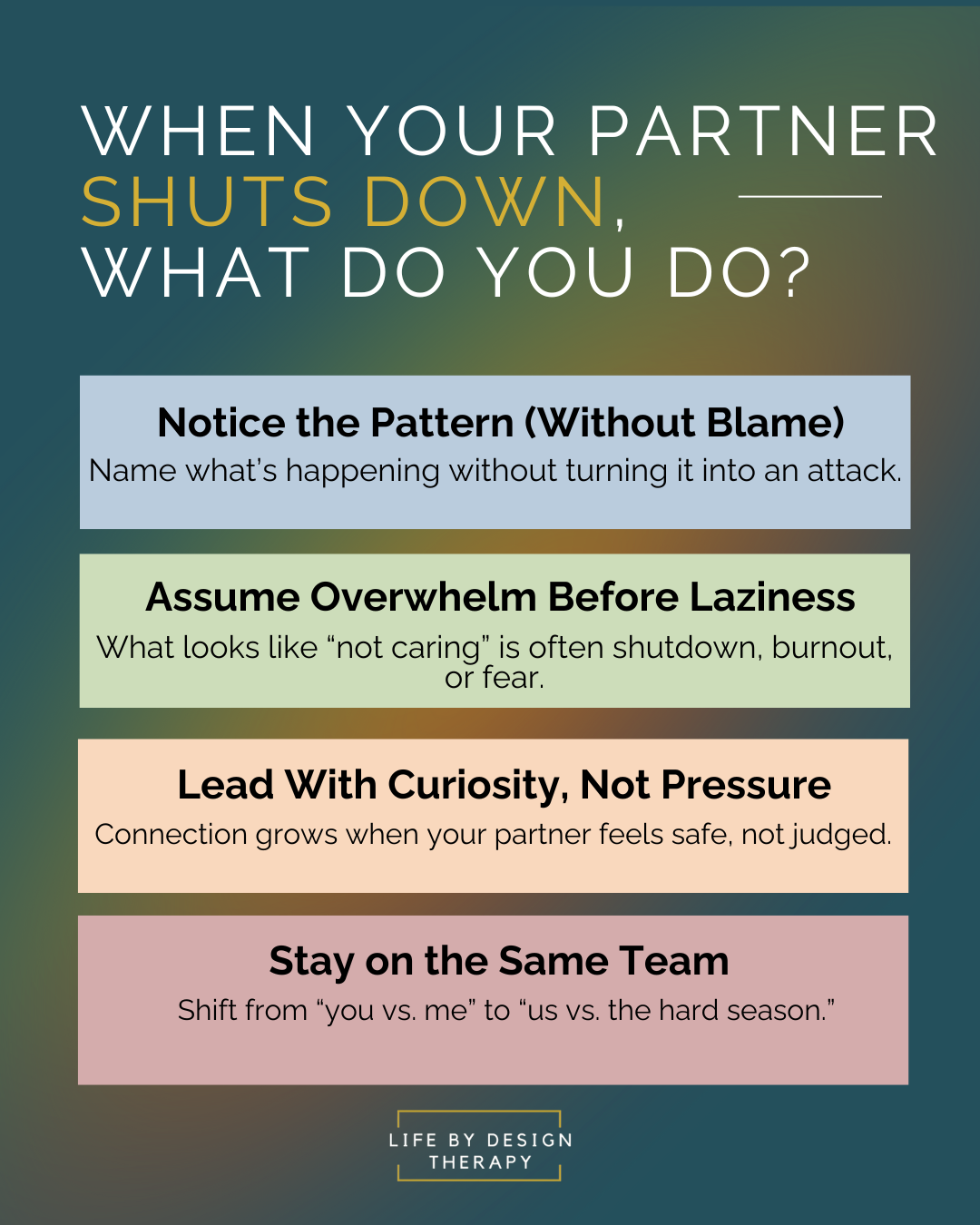
This is something I see come up again and again in my work with couples.
One partner feels stuck, unmotivated, disengaged, or emotionally checked out. The other partner feels frustrated, overwhelmed, and increasingly alone in carrying the emotional weight of the relationship.
Whether one partner isn’t working or they’re just not showing up emotionally, it can feel confusing and painful, especially when they’re physically there but emotionally unreachable.
If you’re the one who’s been carrying more lately, emotionally, practically, or both, you might watch your partner scroll on their phone, sleep in, avoid conversations, or say they’ll “figure it out later”… while you’re silently calculating everything that still has to get done.
And the hardest part is that you don’t always know what you’re looking at.
Are they depressed?
Are they giving up?
Are they shutting down?
Do they believe it’s not their job to help?
You might have this growing sense of, “We’re in the same relationship, but it doesn’t feel like we’re on the same team.”
Over time, you start carrying more…more planning, more worrying, more emotional labor.
And you get stuck in that exhausting middle space:
👉 “Should I say something… or stay quiet?”
👉 “Should I ask for help… or just do it myself because I already know they won’t?”
👉 “Should I push… or will that make them shut down even more?”
And with that, resentment starts to creep in like a slow tide. Not because you don’t love them, but because loving someone who feels stuck can be really hard, and sometimes exhausting.
After some time, you may notice your thoughts might shift to:
“Why does it feel like I care more?”
“Why am I the one holding everything together?”
“What’s wrong with them, or what’s wrong with us?”
These thoughts don’t mean you’re judgmental or unkind. They’re often a sign that something deeper is happening and that your brain is starting to assign meaning to what you’re seeing and feeling.
Because when we move from noticing a behavior (“they’re on the couch all day”) to attaching a story (“they don’t care about me”), your inner dialogue can start to shape the relationship in ways that quietly pull you further apart.
And that’s where this stops being about motivation and starts being about relationship dynamics.
The Overfunctioning Role (And Why It's So Exhausting)
When we care deeply about someone, it’s natural to want to fix what we see. To encourage more effort. To push gently, or not so gently, toward change.
But when someone is already overwhelmed, burned out, or unsure of themselves, pressure can backfire. Even well-intentioned motivation can land as criticism, disappointment, or proof that they’re falling short.
This is often when the “lazy” narrative might start to show up.
From a therapeutic perspective, what gets labeled as laziness is often something else entirely, like burnout, shutdown, fear of failure, depression, or not knowing where to start.
When those experiences go unnamed, both you and your partner may end up feeling alone, one feeling judged, the other feeling unsupported.
Rather than focusing on how to get your partner to change, it can be more helpful to ask, “How do we stay connected while we’re navigating something hard together?”
How to Support Your Partner Without Losing Yourself
When one partner feels stuck, and the other is carrying more, your instinct might be to push for change.
You bring it up again, try to explain it a different way, or hope that if you say it just right, something will finally click.
But you might find that approach creates the same cycle: one partner feels pressured, the other shuts down, and both can end up feeling more alone.
So instead of pushing harder, I want to invite you to try a different approach, one that starts with slowing down. Not to ignore what’s happening or pretend it doesn’t matter, but to pause long enough to check in with yourself first.
As the partner who’s carrying more, you might actually be holding more than just the responsibilities.
Maybe you’re holding things like fear, disappointment, loneliness, and the constant mental load of wondering, “What if this never changes?”
And when you’re carrying all of that, it makes sense that you’d default into a role that might feel familiar, like the one who handles it, the one who stays steady, the one who keeps things moving, the one who doesn’t ask for much.
But over time, that role can become exhausting and can cause resentment to build. Not just because your partner isn’t showing up, but because you feel like you’re showing up alone.
So, instead of the first step being confrontation, I want to encourage you to regulate first.
What this looks like is taking a moment to get honest with yourself about what’s really happening inside.
✔️ What are you feeling right now?
✔️ What story are you starting to tell yourself about what this means?
✔️ What do you need that you haven’t said out loud?
From there, the goal is to share with your partner what’s true in a way that doesn’t attack.
That might sound like:
✔️ “I’ve been having a hard time lately, and I don’t want to blame you, but I feel disconnected.”
✔️ “I’ve been watching you struggle, and I’ve felt really stuck on how to talk about it without making things worse.”
✔️ “I want to support you, and I also need support too.”
✔️ “I’ve been feeling stressed and alone, and I don’t want resentment to keep building between us.”
Because here’s what’s important to remember: your partner’s disengagement is rarely about a lack of care. More often, it’s their way of protecting themselves from the struggles they are dealing with.
For example, when something feels overwhelming, the nervous system doesn’t move toward it; it moves away from it.
But avoidance is not the same as laziness.
Sometimes it’s the body saying, “This feels too hard. I don’t know how to do this safely.”
And while you may be longing to feel like you’re still in this together, they may be sitting with shame…feeling like they’re letting you down, and not knowing how to show up without making things worse.
That’s why the path forward usually isn’t “try harder.” It’s slowing down enough to name what’s happening, soften what feels like a threat, and find your way back to each other as a team.
And from there, you can acknowledge what you’re noticing, without turning it into a fight.
How To Talk To Your Partner Without Starting a Fight
Staying connected doesn’t mean ignoring what you see. It means naming it in a way that keeps the relationship intact.
That might sound like:
“I hear you saying you want things to change, and I notice it’s been hard to take steps. I’m wondering how you’ve been feeling lately.”
“I miss feeling close to you. I want to talk about how we can find our way back to each other.”
This approach centers the relationship rather than assigning fault.
From there, curiosity becomes essential. Not interrogation. Not problem-solving.
Genuine curiosity about what’s actually happening internally for your partner.
Because if you and your partner are feeling stuck, isolation tends to deepen the problem, not solve it.
Staying on The Same Team
One of the most important shifts couples make is moving away from the idea that something is “wrong” with one partner.
Instead, the focus becomes: How are we navigating a difficult season together?
This requires awareness of your own internal narratives, especially the ones that sound like “They don’t care” or “I’m carrying everything.” Those stories often point to real pain, but they aren’t always the full picture.
Staying on the same team doesn’t mean dismissing your frustration. It means holding it alongside curiosity and care, rather than letting it turn into judgment.
I want you to remember that connection doesn’t require perfect language or immediate answers.
It requires a willingness to stay present, honest, and open, even when things feel uncomfortable.
Final Thoughts
Loving someone who feels stuck, whether they’re unemployed, burned out, emotionally withdrawn, or overwhelmed, can be difficult.
And it can be especially painful when you’re trying so hard to stay connected, but you still feel like you’re carrying it alone.
This dynamic is challenging, and it affects both partners, even if it shows up differently for each of you. One person may feel pressure, shame, or defeat. The other may feel lonely, resentful, or emotionally exhausted.
When couples stay connected while talking about hard things, the conversation itself becomes safer, and movement happens more naturally over time.
You don’t have to solve everything at once. You don’t have to say it perfectly. Staying present, curious, and willing to talk about what’s actually happening is often where change begins.
If you’re reading this and thinking, “Yep… this is us,” couples therapy can really help.
Couples therapy can help you slow down, understand the cycle you’re stuck in, and rebuild connection in a way that feels safe for both of you.
At Life By Design Therapy™, we support couples who feel disconnected, stuck in resentment, or caught in the push–pull of overfunctioning and shutdown. If you’re ready to feel like a team again, we’d be honored to support you.
This Week's Affirmations
I can care deeply about my partner and acknowledge when this is hard for me.
I don’t have to fix my partner to stay connected to them.
Supporting my partner does not mean carrying everything alone.
I am allowed to move at a pace that protects the relationship and myself.
Connection matters more than getting it right.
Additional Resources
**If you’re interested in learning more about ways to support your relationship, check out these books below:
The Five Love Languages: The Secret to Love that Lasts by Gary Chapman
Nonviolent Communication: A Language of Life by Marshall B. Rosenberg
Hold Me Tight: Seven Conversations for a Lifetime of Love by Dr. Sue Johnson
**Some product links are affiliate links, which means we'll receive a commission if you purchase through our link, at no extra cost to you. Please read the full disclosure here.

Grounding Techniques to Calm Your Nervous System
By Melody Wright, LMFT
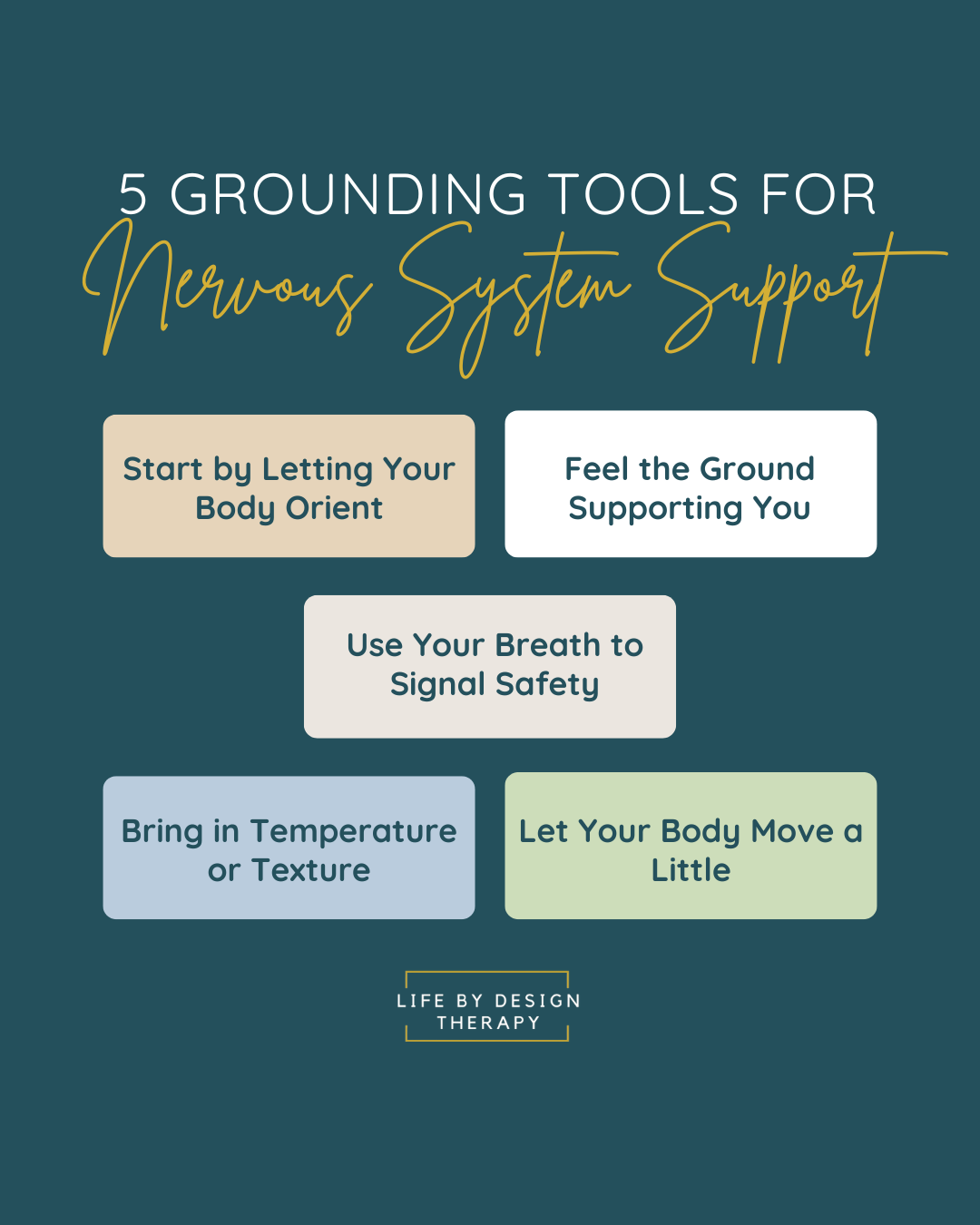
There’s a moment many people don’t talk about enough, in my opinion.
The moment when nothing is technically wrong, but your body won’t settle.
Work is over, yet your chest feels tight. You finally sit down, and your mind starts racing. You’re exhausted, but rest feels out of reach.
If this sounds familiar, it doesn’t mean you’re bad at managing stress. It usually means your nervous system has been carrying more than it knows how to put down, and it’s asking for support.
Not in the form of advice.
Not in the form of “just relax.”
But in a language your body actually understands.
That’s where grounding techniques come in.
Why Your Nervous System Won’t Just “Calm Down”
Your nervous system’s job is protection. It’s constantly scanning for danger and safety, even when you’re not aware of it.
When stress, burnout, anxiety, or unresolved experiences stack up, your body can get stuck in survival mode—fight, flight, or freeze. This is why you might feel:
Anxious for no clear reason
On edge, irritable, or overwhelmed
Disconnected or numb
Tense, restless, or unable to relax
Tired but wired at the same time
You might feel like your body is overreacting, but it’s actually responding exactly the way your nervous system should when it’s been under pressure for too long.
Grounding techniques help by gently reminding your body: You’re here, you’re safe. And you can soften now.
How Grounding Works in the Nervous System
Grounding techniques are somatic tools or body-based practices that can calm the nervous system by bringing your awareness into the present moment.
If you’ve ever explored the idea of mindful living, grounding is one of the most practical ways to do that in your body. If you’d like to explore this connection between presence and healing more deeply, check out our blog, The Art of Mindfulness: Harnessing the Power of the Present Moment.
Unlike coping strategies that focus on talking yourself out of how you feel or trying to “think positively,” grounding doesn’t ask you to analyze your emotions or change your thoughts.
Instead, it works by engaging your senses, breath, and physical body.
This matters because when your nervous system is activated, logic isn’t what it needs first…safety is.
Grounding is one of the ways you can begin offering that sense of safety to both your mind and body.
5 Grounding Techniques to Calm Your Nervous System (That Don’t Feel Forced)
Now, before you start making a mental checklist or grading yourself on how well you’re doing this…I want you to pause for a second.
You don’t need to do all of these. You don’t even need to do them perfectly. Think of these as open invitations rather than rigid assignments.
1. Start by Letting Your Body Orient
Before anything else, let your body take in where you are.
Slowly look around the room.
Notice the walls, the light, the objects near you.
Let your eyes land on something neutral or comforting.
You might quietly think:
“This is where I am right now.”
This simple act, called orienting, helps your nervous system update itself from past or future stress back into the present.
2. Feel the Ground Supporting You
So much anxiety comes from feeling like you have to hold everything together on your own.
As silly as it might sound…let the ground help.
Notice your feet against the floor, or the chair supporting your weight.
Place a hand on your legs or chest if that feels calming.
In this moment, you don’t need to focus on relaxing or changing anything. Just let yourself notice that you’re being held, and that, for this moment, you don’t have to hold everything on your own.
For many people, this alone starts to reduce nervous system activation.
3. Use Your Breath to Signal Safety
Breathing techniques can be a huge support to your nervous system, even in the middle of a stressful moment.
It doesn’t need to be deep breathing or anything special. Even small, simple practices can help.
Here’s a simple exercise you can try:
Inhale through your nose
Exhale slowly through your mouth
Let the exhale be just a little longer than the inhale - think inhale for 4 counts, exhale for 6 counts.
Even a few slow breaths can tell your body that it’s safe to start relaxing.
This is one of the most effective grounding techniques for anxiety and stress because it directly engages your parasympathetic nervous system, helping your body move out of fight, flight, or freeze and back into a state of safety.
4. Bring in Temperature or Texture
When thoughts feel overwhelming, sensation can help anchor you.
Notice:
The warmth of a mug
The coolness of water on your hands
The soft texture of a blanket
Focus on the sensation itself and quietly name what you notice—warm, cool, soft, solid.
Doing this helps your body stay anchored in the present, rather than trailing elsewhere.
5. Let Your Body Move a Little
Although we often associate grounding with stillness, sometimes the energy you’re experiencing needs a different direction. In those moments, your body may need movement instead of quiet.
And that’s okay.
In these moments, try gentle movement:
Rolling your shoulders
Stretching your arms
Rocking slightly side to side
Movement can help release stored stress or anxious energy and bring your body back into a state of calm and regulation.
Follow what feels natural; there’s no right way or wrong way to do this.
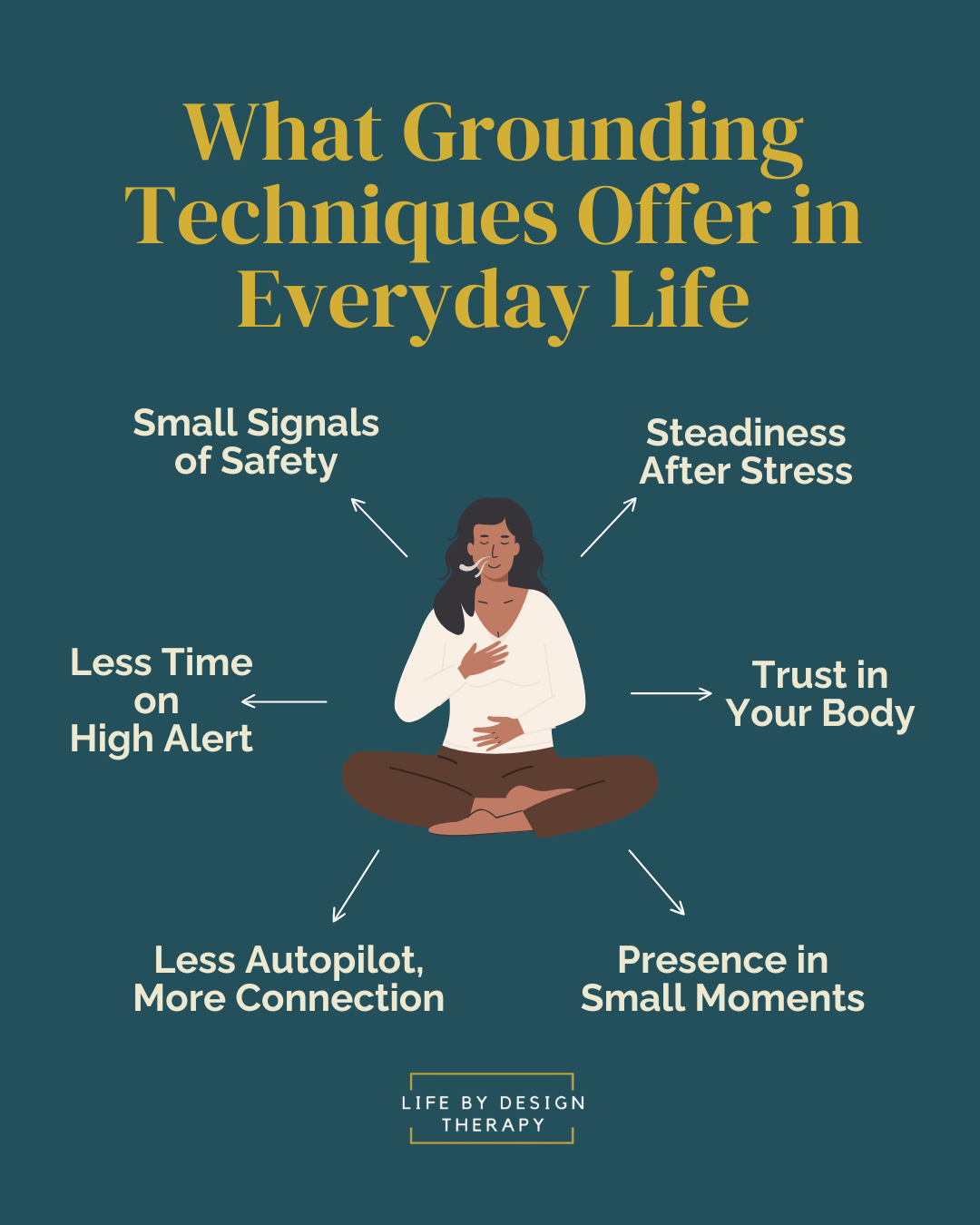
Why Grounding Techniques Can Feel Hard
For some people, especially those with trauma or chronic stress, slowing down can feel uncomfortable at first. This is completely normal!
If that’s you, here are a few tips:
Keep grounding brief, even one minute can be enough
Focus on external cues (what you see or touch)
Choose movement-based grounding over stillness
Your nervous system learns safety slowly, and that’s okay.
This is also why somatic therapy can be so helpful. You don’t have to navigate nervous system regulation alone.
What Grounding Techniques Offer in Everyday Life
Grounding techniques aren’t meant to erase emotion or make life feel easy, and they’re not about forcing calm, positive thinking, or trying to override what you’re feeling.
Instead, grounding works at the level of the nervous system.
When you practice grounding, you’re sending your body small, repeated signals that it’s safe enough to slow down. Over time, your nervous system learns that it doesn’t have to stay on high alert all the time and that it can soften without losing control or awareness.
This is how nervous system regulation happens: not in big breakthroughs, but in quiet moments of noticing support, sensation, and presence.
With practice, grounding becomes something you naturally return to throughout the day.
Not just when anxiety spikes or stress feels overwhelming, but in ordinary moments, like while sitting at your desk, washing your hands, or taking a breath between tasks.
These small check-ins help you stay connected to your body instead of pushing through on autopilot.
And slowly, that connection builds trust; not in the sense of forcing yourself to feel better, but in learning that your body can experience emotions, respond to stress, and still come back to a place of steadiness.
That’s the real work of grounding, not constant calm, but a nervous system that knows how to find its footing again.
Final Thoughts
If you’ve been feeling anxious, overwhelmed, disconnected, or exhausted, it’s understandable. Given the pace of life, the pressure to keep up, and how little space we’re given to rest or process, these feelings are often a natural response, not a sign that anything is “wrong” with you.
And if you’ve ever found yourself wondering why you feel this way or blaming yourself for it, that’s a really common place to go.
These experiences aren’t a personal flaw, they’re often signs of a nervous system that has been working overtime to try to keep you safe.
Your body has been doing its best, and those patterns can be exhausting, but they come from protection, not weakness.
Grounding techniques are one way to begin supporting your nervous system. They help your body find moments of steadiness and relief in everyday life.
But sometimes, support needs to go deeper, especially when stress, anxiety, or past experiences have been living in your body for a long time.
That’s where somatic and holistic therapy can be especially powerful.
At Life By Design Therapy™, we focus on more than just talking through symptoms. Our somatic and holistic approach helps you understand how your nervous system has adapted, and gently supports your body in learning that safety is possible again.
“Therapy becomes a place where you don’t have to push through or explain everything, and your body is part of the healing process.”
There’s no pressure to rush or “fix” yourself. Healing happens slowly, in relationship, and at a pace your nervous system can trust.
You deserve support that meets you where you are.
This Week's Affirmations
My body is doing its best to protect me, and I can meet it with care.
In this moment, I am safe.
Support is available to me, and I am allowed to receive it.
I don’t need to force calm for healing to happen.
I am learning to trust my body again.
Additional Resources
**If you’re interested in learning more about ways to regulate your nervous system, check out these books below:
The Body Keeps the Score: Brain, Mind, and Body in the Healing of Trauma by Bessel van der Kolk M.D
Polyvagal Theory in Therapy: Engaging the Rhythm of Regulation by Deb Dana
Wherever You Go, There You Are: Mindfulness Meditation in Everyday Life by Jon Kabat-Zinn PhD
Radical Acceptance: Embracing Your Life With the Heart of a Buddha by Tara Brach

How to Actually Disconnect After Work Hours
By Melody Wright, LMFT
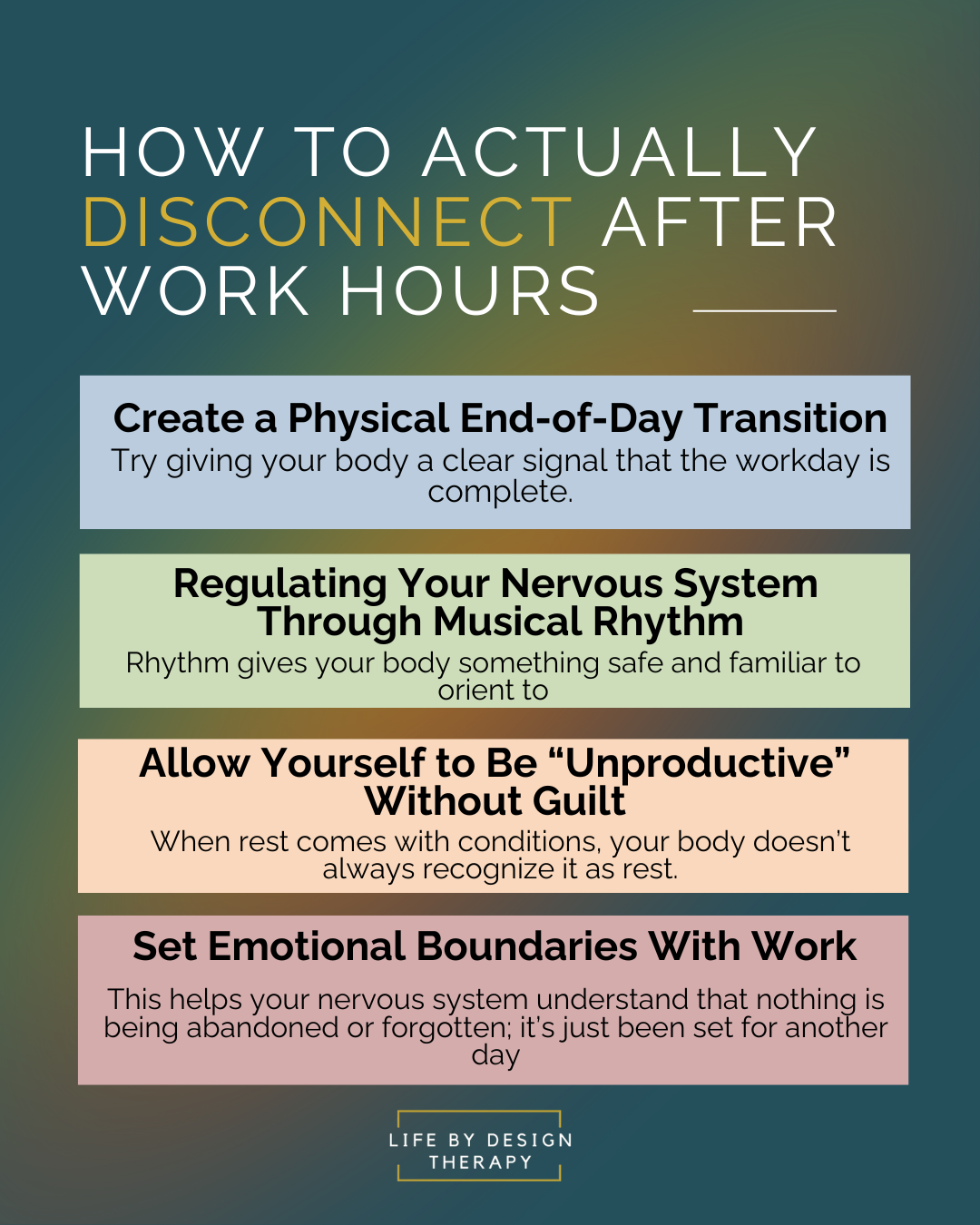
I used to think disconnecting after work meant closing my laptop.
Logging off.
Turning notifications to silent.
And jumping into the next duty of parenthood and partnership.
But…my body didn’t get the memo.
I’d be physically home, but mentally replaying emails.
Emotionally bracing for tomorrow.
Sometimes I’d find myself tense for no obvious reason and snapping at the people I loved most.
If you’re anything like me, you may relate to the feeling that your workday has ended, but your nervous system is still bracing like it hasn’t.
And that’s a very different problem.
If this sounds familiar, I understand, and here are a few tools that can support your nervous system out of work mode.
Why You Still Feel Stressed After Work Ends
From a somatic, and body-based perspective, it’s not that you don’t know how to relax. Your nervous system simply hasn’t shifted out of work mode yet.
Throughout the day, your body is responding to things like:
The steady stream of emails, texts, and notifications
Being interrupted just as you start to focus
The phone ringing when your brain already feels full
A to-do list that never seems to end
Holding multiple things in your head at once, just in case you forget
Even if you enjoy your job, your nervous system is working hard behind the scenes by tracking expectations, responsibility, and performance.
So when work ends abruptly, or without an intentional transition, your body doesn’t automatically power down. Instead, it stays activated.
That’s why, after work, you might:
Feel wired but exhausted
Notice your jaw or shoulders stay tense into the evening
Scroll endlessly, hoping it will help you unwind, but feeling just as wired after
Struggle to be fully present with your family
Lie in bed feeling tired, but unable to sleep
Many of my clients tell me they have a hard time relaxing and decompressing after work, which makes it difficult to be present with whatever comes next in their day.
As a somatic therapist, I’ve learned that this happens because your stress response hasn’t had a chance to settle yet.
Understanding what’s happening can help, but regulation happens through the body, not just the mind. You see, your body settles through felt safety, rhythm, and physical cues.
Think of it this way:
Work winds your system up. Actually disconnecting means helping it settle, not just giving it something else to focus on.
Netflix, social media, or a glass of wine might temporarily numb the stress, but they don’t help your body release it. To actually disconnect after work, your nervous system needs support transitioning from:
“I’m responsible and alert.” → “I’m safe and supported.”
Until that shift happens in the body, stress tends to linger long after the workday ends. So here are tips that I use to disconnect after work, and feel present again.
5 Ways That Actually Help You Disconnect After Work
1. Create a Physical End-of-Day Transition
Try giving your body a clear signal that the workday is complete.
This could look like:
Changing clothes immediately after work
Washing your hands or face slowly and intentionally
Stepping outside for 2–5 minutes
Putting your work bag or laptop in a closed drawer
As you do this, try silently saying:
“Work is done for today.”
Not to convince yourself, but to help your body register that the workday has ended.
If you want a deeper understanding of why transitions matter so much, learn more in our blog, 5 Intentional Transitions for a Regulated Mind & Body.
2. Discharge the Day From Your Body (Before You Try to Rest)
Before rest can happen, activation needs somewhere to go.
Here are a few grounding activities to try for 1–5 minutes:
Gentle shaking (arms, legs, shoulders)
A slow walk without headphones
Stretching your neck, jaw, and hips
Standing and pushing your palms into a wall
Rather than thinking of it as exercise, approach it as a way to intentionally release built-up energy, staying connected to your body as it moves, so that energy doesn’t remain stuck.
Remember, your body has been holding things all day. So, let it empty the load.
3. Regulating Your Nervous System Through Musical Rhythm
If you’re someone who goes from “go, go, go” and expects to drop straight into stillness, I have something gentle for you to try.
Instead of forcing your body to stop, offer some rhythm instead.
Gentle, predictable rhythm helps your nervous system release activation gradually, rather than dropping it into silence all at once. You might try:
Cooking or cleaning with music playing at a steady pace
Walking while matching your steps to a song or beat
Rocking, swaying, or moving gently in time with music
Humming or singing quietly, letting your breath follow the rhythm
Rhythm gives your body something safe and familiar to orient to, signaling that it’s okay to soften and settle now.
4. Set Emotional Boundaries With Work (Not Just Time Boundaries)
Even when work is over, your emotional system may still feel responsible for staying alert, responsive, and available.
Try asking yourself:
What am I still carrying that I can save for tomorrow?
What can I set aside so I can be more present right now?
You might even visualize placing unfinished tasks away somewhere safe, like on a shelf, in a box, behind a door, until the next workday.
This helps your nervous system understand that nothing is being abandoned or forgotten; it’s just been set for another day.
Setting boundaries like this is a form of nervous system care and self-compassion. If you want to dive deeper, read more in our blog, Mindful Limits: The Connection Between Boundaries & Self-Compassion.
5. Allow Yourself to Be “Unproductive” Without Guilt
I want to pause here for a moment, because I know this part can feel uncomfortable for some people.
If you’re someone who struggles to slow down or feels uneasy when you’re not being productive, I completely understand.
For many high-functioning people, rest has quietly become something you earn after doing enough, giving enough, or holding everything together.
When rest comes with conditions, your body doesn’t always recognize it as rest.
Even when you stop working, part of you may stay tense waiting for the next task, the next responsibility, or the moment you “should” be doing something again.
What actually helps isn’t proving you’ve earned a break, but allowing your body to experience rest as something safe and allowed.
You are allowed to:
Do nothing
Be quiet
Move slowly
Be human
Your worth doesn’t disappear when work ends. And rest isn’t something you have to justify to deserve.
If You Can’t Disconnect No Matter What You Try
If evenings feel consistently overwhelming, disconnected, or emotionally heavy, it may not just be work stress.
Many people are unknowingly carrying:
Chronic stress patterns
Trauma responses
Caretaking roles that never turn off
Survival-based productivity
Somatic therapy helps explore why your nervous system stays on high alert and how to teach it that rest is safe again.
This isn’t about forcing calm or doing it “right.” It’s about slowly learning how to trust your body and its needs.
Final Thoughts
Disconnection is a skill, not a switch that you can turn off and on.
In a culture that praises productivity and minimizes nervous system health, many of us are doing the best we can with tools that were never designed for long-term regulation.
This dynamic is a major contributor to chronic work stress and burnout. To learn more, read our blog on how to manage stress and prevent burnout in the workplace.
Disconnecting isn’t about doing more self-care.
It’s about allowing your body to release what it’s been holding all day.
And that’s something you can learn, gently, safely, and at your own pace.
This Week's Affirmations
Rest is not a reward to achieve. Rest is a need.
I can be present without being responsible for everything.
I am supported as I transition from work mode into rest.
My workday is over, and my body is allowed to rest now.
My worth does not depend on how much I accomplish today.
Additional Resources
**If you’re interested in learning more about ways to prioritize your mental health in and out of the workplace, check out these books below:
The Body Keeps the Score: Brain, Mind, and Body in the Healing of Trauma by Bessel van der Kolk M.D
Wherever You Go, There You Are: Mindfulness Meditation in Everyday Life by Jon Kabat-Zinn PhD
Self-Compassion: The Proven Power of Being Kind to Yourself by Kristin Neff
The End of Burnout: Why Work Drains Us and How to Build Better Lives by Jonathan Malesic
No Hard Feelings: The Secret Power of Embracing Emotions at Work by Liz Fosslien & Molly West Duffy
**Some product links are affiliate links, which means we'll receive a commission if you purchase through our link, at no extra cost to you. Please read the full disclosure here.

The Post-Holiday Slump: Why You Feel Off After the Holidays (and How to Recover)
By Melody Wright, LMFT
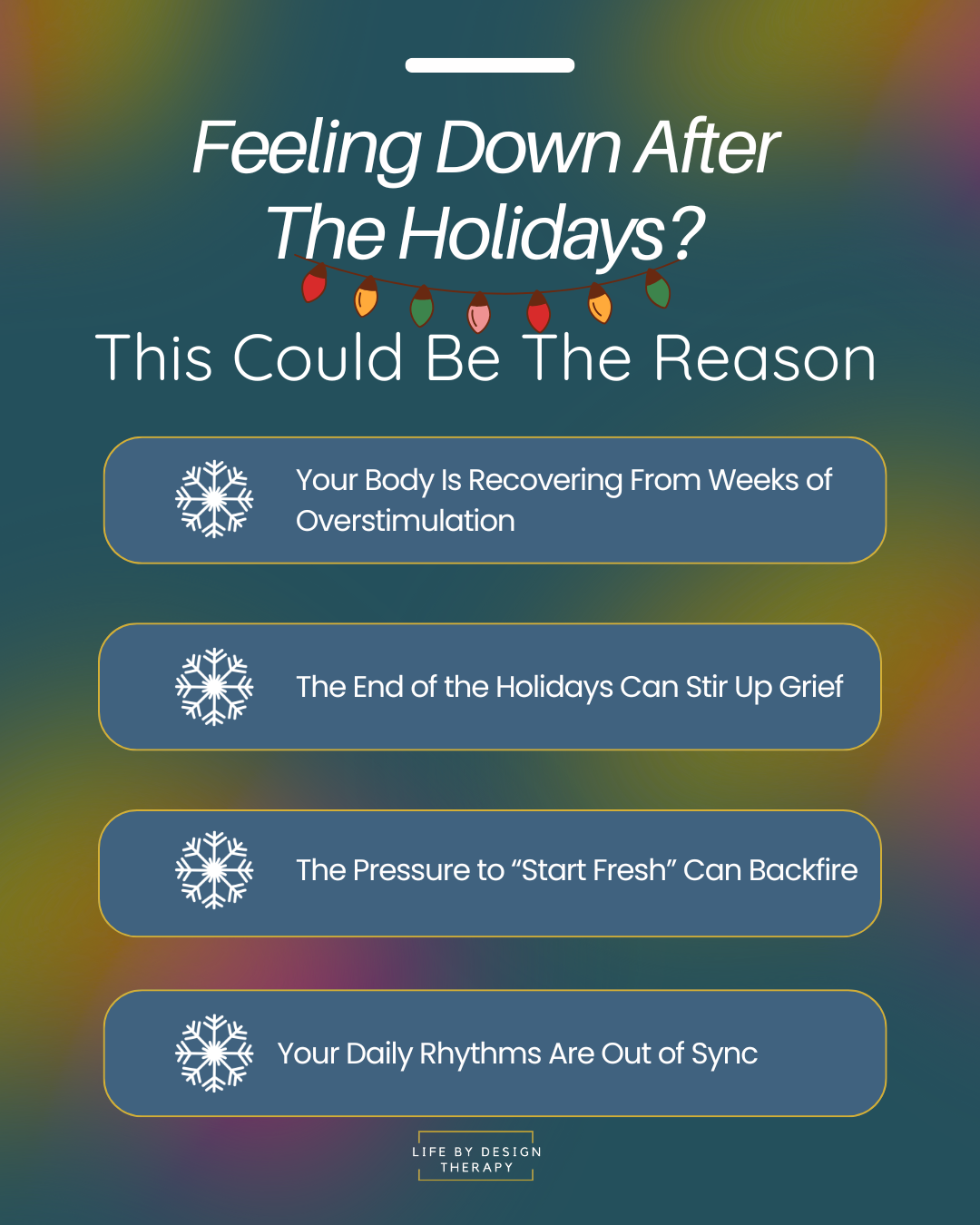
There’s something about the quiet after the holidays that can feel both peaceful and heavy.
The lights come down, the house feels still, and all that energy that carried you through December starts to fade.
You might notice a dip in motivation or find yourself feeling flat, restless, or even a little lost. And you might have caught yourself wondering, Why do I feel this way after such a joyful time?
Many people experience what’s often called the post-holiday slump, which is an emotional crash that follows after weeks of anticipation, connection, and constant stimulation.
After running on adrenaline and social energy, your nervous system is simply recalibrating.
So don’t worry about starting the year off wrong. Instead, remember that you’re actually coming back into the normal rhythm of everyday life.
However, understanding why you feel off can help you meet yourself with compassion instead of pressure.
Here are seven reasons this slump happens and how to recover with gentleness and care.
1. Your Brain Is Coming Down From a Dopamine High
The holidays are filled with anticipation: the planning, socializing, connecting, giving, and receiving. Each of these moments triggers dopamine, the “feel-good” neurotransmitter responsible for motivation and excitement.
When the celebrations end, the dopamine rush fades. Without all the novelty and anticipation, your brain’s reward system quiets down, leaving you feeling emotionally flat or unmotivated.
Therapist Tip: Reintroduce smaller, sustainable forms of pleasure. Seek natural light, move your body, listen to music, or create something. Simple joys help your brain rebalance without overstimulation.
2. Your Body Is Recovering From Weeks of Overstimulation
Even when the holidays are filled with love and joy, they’re also full of stimulation: travel, crowds, sugar, disrupted sleep, and heightened emotion. For weeks, your nervous system has been in “go mode.”
When everything slows down, your body finally has space to process that energy. You might feel exhausted, irritable, or foggy, and it’s not necessarily because something’s wrong, but because your body is trying to return to regulation.
Therapist Tip: Gently regulate your nervous system. Try slow breathing, mindful movement, or grounding exercises that help your body shift from survival to safety.
3. Emotional Whiplash Is Real
Your body keeps track of rhythm and energy, and the holidays can feel like an emotional rollercoaster. Between joy, stress, nostalgia, and sensory overload, your system spends weeks riding emotional highs and lows.
When it’s suddenly quiet, your body doesn’t know what to do with all that leftover energy. You might feel restless, uneasy, or even a little sad, not because anything is wrong, but because your body is trying to find equilibrium again.
Therapist Tip: Let your emotions settle without judgment. Gentle movement, breathwork, or even a slow walk can help your body release stored emotional energy and return to balance.
4. The End of the Holidays Can Stir Up Grief
Even good endings can stir up grief. A new year has a way of making you think about who’s not here, what’s shifted, or what didn’t turn out the way you hoped. For some, being around family or friends can also trigger old emotional patterns that linger after the gatherings end.
What you’re feeling is your body integrating the emotional weight of the season.
Therapist Tip: Let yourself name what you’re feeling, whether it’s sadness, nostalgia, relief, or even emptiness. Acknowledging those emotions allows them to move through instead of getting stuck.
If you’re noticing waves of sadness or reflection surface this time of year, read our blog All About Grief: 6 Ways to Care for Yourself While Grieving

5. The Pressure to “Start Fresh” Can Backfire
The cultural push for “New Year, New You” arrives at the exact time your body is asking for rest. When energy is low, the pressure to set big goals or reinvent yourself can feel discouraging.
Your body doesn’t need a productivity plan; it needs recovery. Pushing for change when your system is tired often leads to burnout before February.
Therapist Tip: Think of January as an integration season. Focus on small, grounding habits, consistent sleep, nourishment, and gentle structure, before chasing new goals.
6. Your Daily Rhythms Are Out of Sync
Holiday schedules often mean staying up later, eating differently, and moving less. Those changes affect hormones, digestion, sleep, and mood, all key parts of emotional regulation.
When your body’s rhythms are disrupted, it can make everything feel just a little harder.
Therapist Tip: Re-establish consistency wherever you can. Go to bed and wake up at regular times, eat balanced meals, hydrate, and get natural light. Routine brings your nervous system back into balance.
If getting back into rhythm feels harder than it should, that’s okay. You don’t need to overhaul your life; just begin with one small, steady habit at a time. Read How to Build a Daily Routine to Support Overwhelm for ways to create structure that supports your nervous system and helps you feel more grounded day to day.
7. Your Low Mood Might Be Pointing to Something Deeper
Sometimes what starts as post-holiday fatigue lingers longer than expected. If you notice persistent sadness, loss of interest, or changes in appetite or sleep, it might be more than a seasonal dip.
Therapist Tip: Ask for help. Having support is a way to honor your needs. Therapy can help you understand what your body is communicating and teach tools for grounding and emotional regulation.
At Life By Design Therapy™, our somatic and holistic therapy approach helps clients reconnect to their bodies, regulate their nervous systems, and rebuild emotional balance.
Final Thoughts
If you’re feeling off after the holidays, it doesn’t mean you’ve lost your spark; it means your body and mind are finding balance again.
The truth is, we’re not meant to live in constant motion. The quieter pace of the new year isn’t a setback; it’s an invitation, giving you a chance to exhale after the rush, to listen more closely to what you need, and to rebuild your rhythm one gentle step at a time.
Remember to give yourself permission to rest, reflect, and move slowly into what’s next.
Healing and regulation aren’t born from pressure; they grow from presence.
This Week's Affirmations
I am allowed to slow down without losing momentum.
I honor the pace my body needs to recover.
I choose presence over perfection as I move into this new season.
I can hold both gratitude and sadness without judging either.
My body knows how to find its rhythm again.
Additional Resources
**If you’re looking for gentle ways to care for your mind and body as you ease into the new year, these books offer thoughtful insight and comfort.
Wintering: The Power of Rest and Retreat in Difficult Times by Katherine May
Self-Compassion: The Proven Power of Being Kind to Yourself by Kristin Neff
Radical Acceptance: Embracing Your Life With the Heart of a Buddha by Tara Brach
The Power of Now: A Guide to Spiritual Enlightenment by Eckhart Tolle
The Body Keeps the Score: Brain, Mind, and Body in the Healing of Trauma by Bessel van der Kolk M.D
Burnout: The Secret to Unlocking the Stress Cycle by Emily Nagoski and Amelia Nagoski
When the Body Says No: The Cost of Hidden Stress by Gabor Maté
The Untethered Soul: The Journey Beyond Yourself by Michael A. Singer
**Some product links are affiliate links, which means we'll receive a commission if you purchase through our link, at no extra cost to you. Please read the full disclosure here.

10 Ways to Prioritize Your Mental Health During the Holidays
By Melody Wright, LMFT
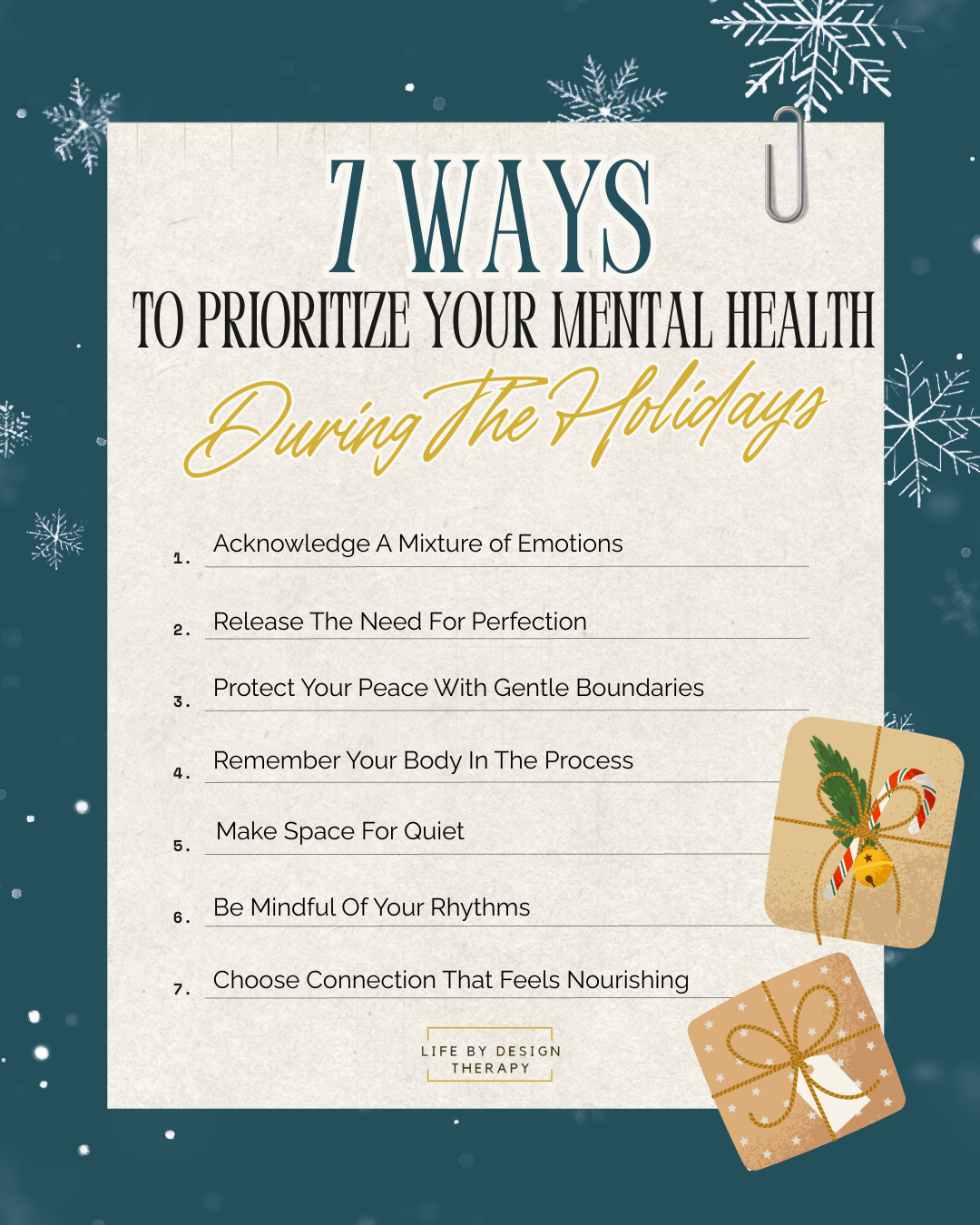
Every year, it sneaks up on you. One moment you’re lighting a candle or hanging the first ornament, and the next, your mind is already spinning with the gifts to buy, people to please, and plans to finalize.
You tell yourself you’ll slow down after all the boxes are checked on your list, but “after” never seems to come.
You want to feel present, grateful, even, but underneath the to-do lists and family dynamics, something feels off. Maybe you’re holding grief that no one talks about.
Maybe you’re stretched thin trying to make things “special.” Or maybe you just feel disconnected from the joy everyone else seems to be having.
If that’s you, I want you to know it makes sense.
The holidays tend to amplify everything we’re already holding. Not just the love and nostalgia, but also the exhaustion, the loneliness, and the ache for things to be different.
This year, instead of pushing through, what if you cared for yourself the way you care for everyone else?
So, keeping the busy you in mind, here are ten gentle ways to tend to your mental health this season. And guess what, it’s not by doing more, but rather by slowing down to check in with your mind and body.
10 Ways to Prioritize Your Mental Health During the Holidays
1. Acknowledge A Mixture of Emotions
The holidays can stir up mixed emotions like joy that your family is together, sadness that it doesn’t look like it used to, gratitude for what you have, or even grief for what’s missing.
Maybe you’re celebrating with friends, but secretly miss the way your childhood home smelled of cinnamon and pine. Maybe you’re surrounded by people but still feel lonely.
Both can be true.
Feeling conflicting emotions doesn’t mean you’re ungrateful; it means you’re emotionally aware.
Our brains are wired for duality; we can hold warmth and sadness, love and loss, hope and fatigue all at once.
Naming what’s here (“I feel grateful and tired”) helps your nervous system relax. It reminds your body it’s safe to feel both without needing to choose one or fix the other.
2. Release The Need For Perfection
We all carry invisible scripts about what the holidays “should” be, whether that be the perfectly decorated home, the happy family photo, or the sense of magic and meaning.
But those expectations often clash with real life: schedules, grief, stress, and fatigue.
When we chase perfection, we disconnect from presence.
Let “enough” be the new goal. If you’re running behind on dinner, if the gifts end up in bags instead of perfectly wrapped, or if you keep some traditions simple this year, I want you to know that it’s okay.
The people who love you don’t need the curated version of you; they need the one who can laugh at the burnt cookies and still enjoy the moment.
Releasing perfection isn’t giving up; it’s coming back to what matters: connection, calm, and authenticity.
3. Communicate Gentle Boundaries to Protect Your Peace
The holidays can pull you in every direction. The family gatherings, work parties, and obligations that sound good on paper but can leave you drained in reality.
It’s okay to say no.
You’re not selfish for needing rest or for skipping an event that feels more stressful than joyful.
“Boundaries make it possible to show up for people in a way that feels good, not draining.”
They sound like:
“I can come for an hour, but I’ll need to head home early.”
“I’d love to help, but I don’t have the bandwidth this week.”
“That topic feels a little heavy for me right now. Can we come back to it tomorrow when I’ve been able to process this longer?”
Each boundary is a small act of nervous system regulation, a reminder that you can stay connected without abandoning yourself.
If you’d like to explore this more deeply, read our blog, Mindful Limits: The Connection Between Boundaries and Self-Compassion, a guide to creating boundaries that protect your peace without disconnecting from the people you love.
4. Remember Your Body In The Process
Your body experiences the holidays just as much as your mind does: the travel, the sugar, the noise, the lights, the constant stimulation.
When your system is overstimulated, your body shifts into protection mode. You might notice tight shoulders, shallow breathing, or zoning out when things get too loud.
To come back to safety, try:
Taking a long exhale (it tells your vagus nerve you’re safe).
Pressing your feet down and feeling the support under your feet.
Looking around the room and naming five things you see.
These small grounding moments bring you back to your body, and your body back to the present.
5. Make Space For Quiet
Stillness can feel foreign when life is busy, but it’s often the medicine your body needs most.
Remember, you don’t have to fill every moment with conversation or tasks.
Give yourself permission to have quiet mornings, slow walks, and maybe a few hours away from your phone.
Making intentional space for quiet moments allows your mind and body to rest and recalibrate.
6. Choose Connection That Feels Nourishing
Not every relationship feels good during the holidays. Some gatherings are filled with love; others might leave you feeling small or misunderstood.
This year, choose depth over obligation. Spend time with people who see you, rather than those who drain your energy.
If you’re alone this season, connection can look different. Try volunteering, attending a community event, or simply sitting in a cozy café surrounded by quiet company.
Loneliness often softens when we’re witnessed, even by strangers.
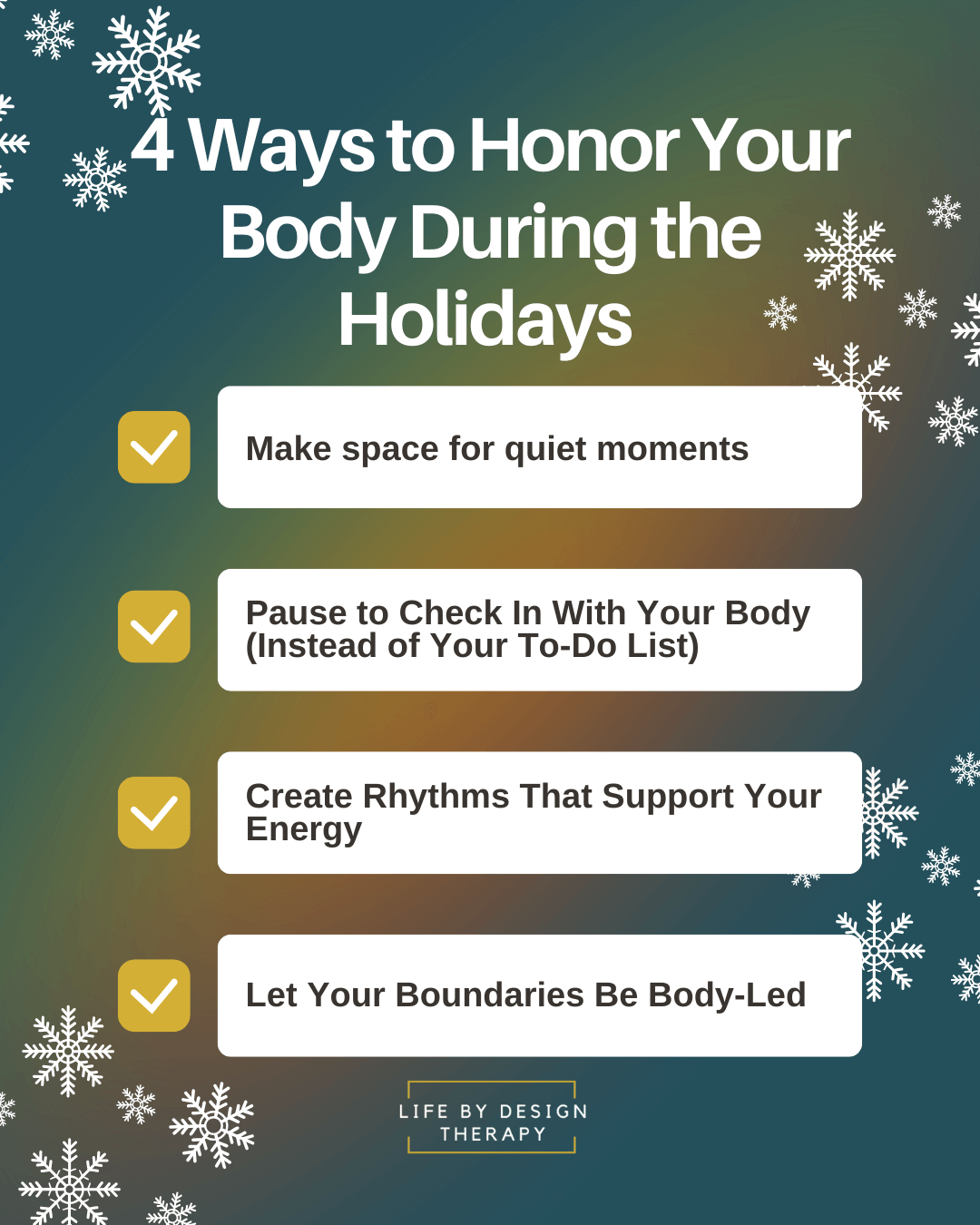
7. Honor The Grief That Lingers
Loss doesn’t take a holiday.
Whether it’s the loss of a person, a relationship, or simply a season of life that’s gone, it’s okay if joy feels tender.
Grief has a way of resurfacing in small ways like a song on the radio, a scent, an empty chair at the table.
If you feel yourself tearing up in the middle of something “happy”, that’s your heart remembering.
It’s okay to create space for remembrance. You can try lighting a candle, looking at photos, or carrying on a tradition. You’re not inviting sadness; you’re giving your love a place to land.
Grief doesn’t have to be something you carry alone.
If you’d like more support with this part of the season, read our blog on Navigating Grief During the Holidays, a compassionate guide to honoring your loss, tending to your emotions, and finding gentle moments of connection amid the pain.
8. Be Mindful Of Your Rhythms
During the holidays, it’s easy to slip out of the routines that support you. Late nights, heavy foods, skipped meals, or extra caffeine can all shift your mood and energy.
Instead of strict rules, focus on a gentle rhythm.
Get sunlight each morning.
Hydrate between gatherings.
Move your body in ways that feel good.
Prioritize sleep whenever possible.
Think of rhythm as nervous system hygiene; small ways to signal to your body that it is allowed to rest and recover, even when it’s busy.
9. Let Money Mirror Your Values, Not Your Stress
Financial stress can quietly erode holiday joy. The pressure to buy, decorate, or give beyond your means can come from comparison.
Ask yourself: What do I want this season to feel like? Then spend in alignment with that.
Maybe that means smaller gifts and more shared meals. Maybe it’s homemade items or acts of service.
Gifts rooted in meaning, not money, are the ones that linger.
10. Ask For Help Before You Hit The Wall
Many of us wait until we’re burned out to reach for help. But emotional overwhelm isn’t a sign of weakness; it’s a signal that your system has been doing too much for too long.
Support can look like therapy, a support group, or simply being honest with a trusted friend.
Sometimes the most healing thing you can do is admit that you can’t hold it all alone anymore.
You don’t have to. ❤️
Final Thoughts
Even though this might go against the grain of society, I want you to remember that as the year slows down, so can you.
You don’t have to earn your rest by running yourself into the ground.
You’re allowed to have a slower season, one that values peace over performance.
Caring for your mental health during the holidays isn’t selfish; it’s sacred and vitally important.
Because when you tend to your body and mind, you make room for a kind of calm that doesn’t depend on everything going right, it comes from feeling safe right where you are.
🌱 If you’re ready to create that kind of safety in your own life, therapy can help you reconnect with yourself in a deeper way.
Visit Life By Design Therapy™ to learn more about somatic and holistic therapy for nervous system regulation and stress recovery.
This Week's Affirmations
My worth isn’t measured by how much I give or do.
I release the need for perfection and return to what’s real.
My body deserves the same gentleness I offer to others.
It’s okay to move slower than the world around me.
I am allowed to create new traditions that fit who I am now.
Additional Resources
**If you’re interested in learning more about ways to prioritize your mental health, check out these books below:
Self-Compassion: The Proven Power of Being Kind to Yourself by Kristin Neff
Wherever You Go, There You Are: Mindfulness Meditation in Everyday Life by Jon Kabat-Zinn
The End of Burnout: Why Work Drains Us and How to Build Better Lives by Jonathan Malesic
**Some product links are affiliate links, which means we'll receive a commission if you purchase through our link, at no extra cost to you. Please read the full disclosure here.

How to Manage Stress and Prevent Burnout in the Workplace
By Melody Wright, LMFT

It started on a Wednesday.
I was sitting at my desk, halfway through a meeting, when I realized I hadn’t stopped all morning.
My inbox was overflowing, my shoulders ached, and my brain was locked on one thought: “Just get through the day.”
Sound familiar?
Workplace stress has become so normalized that many of us don’t notice how much it’s draining our energy and dysregulating our nervous system, until we’re completely depleted.
While many of us desire to be okay and live with a sense of purpose and peace, it’s hard to regulate and find those moments in the midst of hustle culture.
If this is resonating with you, I want to remind you that you cannot continue to push through and find that sense of peace.
Regulating comes from slowing down, creating space for rest, and allowing your body to return to balance.
The good news? You can learn to manage stress and prevent burnout from work.
If you’ve been struggling to manage stress during the work day, I have come up with 7 ways (grounded in psychology, holistic health, and my own lived experience) to support nervous system recovery and help you restore balance at work.
7 Ways To Manage Stress and Prevent Burnout at Work
1. Start your day with intention, not reaction
Before the day begins to pull you in a dozen directions, take a few minutes to decide how you want to move through it.
What kind of energy do you want to bring into your meetings, your emails, your interactions?
What words describe how you want to feel?
🌻Calm
🌻Present
🌻Grounded
🌻Open
🌻Focused
Starting your day with intention means consciously choosing how you want to show up, rather than reacting to whatever comes first.
That might involve:
Reviewing your schedule the night before
Prioritizing what matters most, or
Setting a gentle theme for the day (ex: “steady,” “patient,” or “clear.”)
When you orient your day around intention, you teach your nervous system what safety feels like before the chaos begins.
By starting your day with intention and direction, you’ll notice that your focus sharpens and your communication will feel smoother, helping your entire day flow more naturally.
2. Take mini-breaks to reset your nervous system
We often think rest requires a long pause, but your body can begin to reset in less than two minutes.
Try standing up, walking around the office, taking a quick stretch, or taking three slow breaths between meetings.
These short rests signal to your nervous system that the last task is complete and it’s safe to shift gears.
When you add in short moments of recovery throughout the day, you prevent stress from stacking up and give your body a chance to restore energy as you go.
“Sustaining your well-being at work isn’t about avoiding stress altogether; it’s about learning to recover in real time so you can stay steady and clear-headed through the day’s demands.”
3. Notice the stories your mind tells you
When something stressful happens, like a missed deadline, a hard conversation, or unexpected feedback, your body reacts first. You may notice your heart rate increase, your chest might tighten, and your brain might start creating a story to make sense of it.
Those thoughts might sound like:
💔 “I can’t handle this.”
💔 “I always mess up.”
💔 “They must be disappointed in me.”
These aren’t just random negative thoughts; they’re signs that your nervous system is activated and your brain is trying to protect you from perceived danger, including fear of failure, rejection, or perfectionism.
When you slow down and notice those stories with curiosity instead of judgment, you interrupt the thoughts that lead to stress, overwhelm, and burnout.
Try gently reframing the thought with compassion by saying:
“This is stressful, but I’m capable of working through it.”
“I made a mistake, but I can repair it.”
Meeting your thoughts this way helps your body feel supported instead of threatened.
You’ll find it’s easier to stay composed in difficult moments and to keep your day moving without carrying the emotional weight of every challenge that comes up in the workday.
4. Regulate your body, not just your calendar
No amount of color-coded scheduling can fix a dysregulated nervous system. Before diving into the next task or meeting, take a moment to return to your body.
Notice your posture, unclench your jaw, drop your shoulders, and take one deep breath.
Pay attention to the signals your body gives you, when your chest tightens or your breath shortens, pause and reconnect:
Press your feet into the ground
Exhale longer than you inhale
Look around the room and name what you see
These techniques are called grounding tools. They help your nervous system register safety, allowing focus, creativity, and clarity to return.
When your body feels steady, you’re able to think clearly, communicate effectively, and move through the workday with more ease.
If you would like more grounding tools for the office, check out our free download, 20 Calming Techniques You Can Do at Your Desk.
5. Protect your energy through clear boundaries
For many people, boundaries can feel uncomfortable, especially if you’ve spent years equating being dependable with saying “yes.”
You might worry that setting limits will disappoint others, create conflict, or make you seem less committed. Those feelings are valid. Boundaries can stir up a lot of vulnerability, especially in work cultures that reward constant availability.
But boundaries aren’t about pulling away; they’re about protecting your capacity, the energy that lets you show up fully and sustainably.
When you say “no” to what drains you, you’re saying “yes” to focus, presence, and longevity in the work you care about.
Start small. End your workday on time, pause before taking on a new task, or take your lunch break without multitasking.
“Each time you honor your limits, you signal safety to your nervous system, and you’ll notice how much clearer and more balanced you feel during your workday.”
If you would like to learn more about boundaries, check out our blog, Mindful Limits: The Connection Between Boundaries and Self-Compassion.

6. Reconnect with your purpose
There will be seasons when work feels more like survival than purpose; that’s just the ebbs and flows of life. But when your nervous system is in constant go-mode, it might be harder to connect to what matters, especially the moments when everything starts to feel like just another task to get through.
You might catch yourself thinking, “What’s the point?” or drifting through the day on autopilot.
It’s okay if you don’t feel inspired every day.
Sometimes reconnecting with purpose begins with noticing the smallest things that matter.
Maybe it’s the way your work supports your family.
Maybe it’s helping a client feel seen, finding a creative solution to a problem, or being part of a team that makes someone’s day easier.
Or maybe it’s the quiet pride of doing something well, even when no one’s watching.
Purpose doesn’t remove stress, but it gives your mind and body something to anchor to when things feel heavy.
When you reconnect to why you’re doing what you do, even in small ways, you bring meaning back into your workday and remind your nervous system that effort and purpose can coexist.
7. Lead with self-compassion
Managing stress isn’t built by being hard on yourself; it’s built by showing yourself compassion.
When you make a mistake, fall behind, or feel overwhelmed, notice how you speak to yourself.
Would you say those same words to a colleague or a friend?
I want you to try offering yourself the same understanding.
Self-compassion keeps your nervous system calm, which helps your brain recover, refocus, and stay adaptable.
Remember, when you treat yourself with kindness instead of criticism, your entire workday shifts. You’ll handle challenges with patience and end the day feeling grounded rather than drained.
Final Thoughts/Reflections
Work will always bring deadlines, challenges, and unpredictable moments, but the way you meet them determines how your body and mind experience the day.
Remember, managing stress and preventing burnout isn’t about doing more or toughing it out.
It’s about slowing down enough to notice what your body needs, creating space for recovery, and honoring your limits so you can sustain what truly matters: your peace, your purpose, and your capacity to show up fully.
Therapy can be a powerful support in this process.
At Life By Design Therapy™, our holistic and somatic therapists help high-achieving professionals and caregivers in California recover from burnout, manage work stress, and restore nervous system balance.
With the help of our holistic and somatic therapists, you don’t have to force yourself to feel okay. With the right support, your nervous system can relearn how to feel safe, calm, and grounded again.
This Week's Affirmations
It’s okay if I don’t feel inspired every day; I can still move through the day with intention.
My worth is not defined by how much I achieve.
I trust my body to tell me when I need to slow down.
My boundaries are acts of care, not rejection.
I can care deeply about my work without losing myself in it.
Additional Resources
**If you’re interested in learning more about building resilience, check out these books below:
Self-Compassion: The Proven Power of Being Kind to Yourself by Kristin Neff
No Hard Feelings: The Secret Power of Embracing Emotions at Work by Liz Fosslien & Molly West Duffy
Wherever You Go, There You Are: Mindfulness Meditation in Everyday Life by Jon Kabat-Zinn
The End of Burnout: Why Work Drains Us and How to Build Better Lives by Jonathan Malesic
**Some product links are affiliate links, which means we'll receive a commission if you purchase through our link, at no extra cost to you. Please read the full disclosure here.

5 Intentional Transitions for a Regulated Mind and Body
By Melody Wright, LMFT
I recently realized I had lost the ability to be still.
Waiting for the coffee to brew? I’d scroll my phone.
Walking to the car? I’d put on a YouTube video.
Five minutes before a meeting? I’d squeeze in emails.
Every corner of my day got filled with something, some kind of noise, some kind of input.
At first, I thought this was a good thing. I was being efficient, right?
Maximizing every spare moment. But beneath the surface, it felt different.
I started noticing a strange unease. Everything on my list felt urgent, but none of it felt meaningful.
I was moving through life on autopilot, checking boxes without truly experiencing anything.
That’s when it hit me: I had removed all the open space in my day.
And without those moments, there was no room left to think, to be present, or to feel grounded.
That realization led me to what I now call intentional transitions.

What Are Transitions?
Transitions are the the natural flow between moments, guiding us from one rhythm to the next. When we move through them with awareness, they become grounding points that help us stay connected to ourselves instead of being swept up in constant motion.
Think about the white space around words on a page; without it, the text overwhelms you. Or music; without rests, the notes blur together.
Intentional transitions offer the same in life.
They give us space to reset, regulate, and move forward with more intention.
Why Transitions Matter
When my days were crammed with constant input, I carried conversations from one meeting into the next. I reacted quickly instead of thoughtfully. My body felt tense, my mind restless, and my energy scattered.
When I began practicing intentional transitions, things shifted:
I noticed my own thoughts and feelings instead of drowning them out.
I processed what had just happened before jumping into something new.
My nervous system felt calmer, less like it was always in fight-or-flight.
I made decisions with more intention, instead of reacting on autopilot.
We’re taught that if we have open space in our day, we should fill it. But the truth is, without intentional transitions, everything runs together, and we end up burnt out.
These conscious transitions don’t slow you down. They help you see what matters most.
5 Ways to Be More Intentional In Your Daily Transitions
You don’t need a lifestyle overhaul to create more space. Just a few intentional transitions, practiced consistently, can change the way you move through the world.
Here are five that have made the biggest difference for me:
1. The Morning Transition
Instead of grabbing my phone first thing, I give myself ten quiet minutes. No input, no planning. Sometimes I just sit. This transition feels like stretching my mind awake before the day begins.
Therapist Tip: Place a hand on your chest and one on your belly. Notice your breathing. Without forcing anything, let your breath arrive naturally. This anchors your body before the noise of the day begins.
2. Daily Reset Rituals
I used to barrel straight from one thing to the next, project to project, call to call, errand to errand. Now I mark transitions with small rituals: washing my hands after work, lighting a candle before dinner, or taking three breaths at the door before walking inside.
Therapist Tip: End your workday with a simple closing ritual: clear your workspace, open a window, or speak a grounding phrase to yourself. These small acts help your nervous system recognize the shift and ease into the evening.
3. Pauses in Conversation
I used to meet every silence with words, afraid it meant something was missing. But I’ve learned that quiet moments in conversation carry their own kind of meaning. Letting a pause exist, without hurrying to fill it, lets me stay present, hear more fully, and trust the natural flow between people.
Therapist Tip: When someone is speaking, notice your urge to prepare your response. Instead, ground your feet into the floor, feel the weight of your body in the chair, and let yourself fully receive before answering.
4. Unscheduled Time
I now keep at least one block of unscheduled time in my day, even if it’s just 15–30 minutes in between tasks. Sometimes I nap, sometimes I journal, sometimes I just exist. This transition from doing to simply being is often where my best insights surface.
Therapist Tip: Use this unscheduled time to connect with your senses. Step outside and notice what you hear, smell, or feel on your skin. Presence in the body clears mental clutter and makes the pause more restorative.
5. Turning Off Notifications
I didn’t realize how much energy alerts were stealing from me until I turned them off. Without the interruptions, my brain feels spacious, and my body isn’t startled every few minutes by a ding or buzz. This transition, from reacting to every ping to responding when I choose, gave me back so much peace.
Therapist Tip: If you feel pulled toward your phone, place it in another room and do a quick grounding exercise like pressing your hands together firmly, or planting your feet and imagining roots growing into the floor. When your body senses safety, it can finally settle and help you stay present.

The Challenges (And What They Taught Me)
At first, transitions didn’t feel natural.
I felt guilty for not being “productive.” But that guilt reminded me how much I tie my worth to output.
I got restless during the silence. But that restlessness showed me how conditioned my nervous system was to constant input.
I worried others would be frustrated if I wasn’t instantly available. But that fear reminded me I had trained people to expect it—and that I had the power to retrain those expectations.
Every challenge became part of the lesson. The discomfort wasn’t a sign of failure; it was a sign I was reclaiming something I’d forgotten how to do.
Final thoughts
If your days feel too full, too fast, or too noisy, being mindful of your transitions might be what you’re missing.
You don’t need to overhaul everything at once. Start with one:
🌱Maybe it’s a morning pause.
🌱Maybe it’s a ritual between tasks.
🌱Maybe it’s turning off notifications for an afternoon.
Try it for a week. Notice how your body feels. Notice what surfaces in the stillness.
For me, transitions aren’t about emptiness. They’re about perspective. They help me see what really matters, and give me the capacity to live with more intention.
So I’ll leave you with this: Where could you create an intentional transition today? Remember, there’s no right or wrong way to begin. Every pause, no matter how small, is a step toward greater clarity.
This Weeks Affirmations
Moments of quiet are not wasted; they restore my body and mind.
Creating space in my life helps me live with greater purpose.
I give myself permission to pause.
I allow gaps to support my body, mind, and spirit.
I am grounded, centered, and open when I give myself room to breathe.
Additional Resources
**If you’re interested in learning more about ways to support your mental health, check out these books below:
Wherever You Go, There You Are: Mindfulness Meditation in Everyday Life by Jon Kabat-Zinn PhD
The Miracle of Mindfulness: An Introduction to the Practice of Meditation by Thich Nhat Hanh
Radical Acceptance: Embracing Your Life With the Heart of a Buddha by Tara Brach
The Untethered Soul: The Journey Beyond Yourself by Michael A. Singer
Silence: The Power of Quiet in a World Full of Noise by Thich Nhat Hanh
The Power of Now: A Guide to Spiritual Enlightenment by Eckhart Tolle
**Some product links are affiliate links, which means we'll receive a commission if you purchase through our link, at no extra cost to you. Please read the full disclosure here.

Is This Anxiety? The Subtle Signs You Might Be Missing
By Melody Wright, LMFT

Have you ever noticed your heart racing at random times, or your stomach tightening even when nothing is “wrong”?
Or maybe your thoughts always seem one step ahead of you, rehearsing conversations, preparing for worst-case scenarios, or circling around a worry you just can’t shake.
If so, you might wonder: Is this anxiety, or just stress?
I want you to know that anxiety doesn’t wear just one face, and it doesn’t always show up as panic attacks or uncontrollable worry.
Sometimes, it’s subtle, woven into your body, your thoughts, your emotions, in ways that can leave you feeling both restless and worn out at the same time.
Talk therapy can be a helpful way to slow things down. It gives you space to reflect, make sense of your experiences, and put words to the feelings that sometimes feel overwhelming.
Talking things through can bring clarity and can quiet the mental noise when anxiety shows up.
“But anxiety doesn’t always start in your thoughts. More often than not, the very first signs are happening in your body, before your mind even catches on.”
If you’re wondering if you may be struggling with anxiety, keep reading to learn how anxiety can show up in your body, mind, and emotions.
Anxiety in the Body
For many people, anxiety makes its first appearance through physical sensations. The nervous system reacts before the mind even has a chance to make sense of it. Tense shoulders, clenched jaw, or a racing heart, even while sitting still, are common signs your body is on alert.
Sometimes this shows up most clearly at night: you lie down tired and ready for rest, only to feel a knot in your stomach or a tightness in your chest that keeps you awake.
These sensations aren’t random; they’re signals from your body saying, “Something doesn’t feel right,” even if your logical mind knows you are safe.
Clinically, resources like the DSM-5 highlight these body-based symptoms, like muscle tension, restlessness, and difficulty sleeping, as key indicators of anxiety.
“In other words, your body picks up on anxiety long before your thoughts catch up”
🌻Therapist Tip: When you start to notice these patterns, it helps to give your nervous system a way to settle. Press your feet gently into the ground as if you’re rooting into the floor. Inhale for a count of 4, then exhale for 8. Even small shifts in your body can remind you that you’re safe.
Anxiety in the Mind
Anxiety doesn’t just live in the body; it often takes hold of the mind. Because the brain is wired to scan for threats, anxious thoughts can spin in circles by replaying conversations, anticipating the worst, or reminding you of everything you “should” have done differently.
Many people describe feeling pulled out of the present moment.
“ Anxiety can anchor you in the past, stuck on what already happened, or push you into the future, rehearsing every possible outcome. ”
Either way, the here and now feels just out of reach.
Excessive and hard-to-control worry is one of the hallmarks of anxiety. When your thoughts feel louder than your ability to quiet them, it’s a sign your mind is trying to protect you.
The good news is that there are simple ways to interrupt the cycle and remind your brain that it doesn’t have to stay stuck in worry.
🌻Therapist Tip: Cross your arms and give yourself gentle, alternating taps on your upper arms—left, then right. This rhythmic, bilateral input helps the brain settle and can bring balance when your thoughts feel stuck on repeat.
Emotional Symptoms of Anxiety
Did you know anxiety doesn’t just show up as racing thoughts or physical tension? It also weighs heavily on your emotions.
You might feel restless or on edge, like it’s hard to settle into calm. Irritability or frustration may surface more easily, not because you want it to, but because your emotional energy feels stretched thin.
For others, anxiety brings a sense of dread…or the opposite, a kind of numbness where joy and excitement feel just out of reach.
These shifts in mood are part of why anxiety can be so exhausting. When your mind and body are running on overdrive, your emotions follow.
Naming what you’re feeling is the first step toward easing it, and finding ways to release those emotions keeps them from building up inside.
If naming emotions feels hard, I completely understand. It might surprise you, but many of us were never taught how. I share more about recognizing and processing emotions in this blog on learning to connect with your feelings.
🌻Therapist Tip: Set a timer for five minutes, grab a notebook, and write without editing yourself. Start with the phrase, “Right now, I feel…” and let whatever comes spill onto the page. Don’t worry about spelling or grammar. Giving your emotions a safe outlet may help your body feel a little lighter.
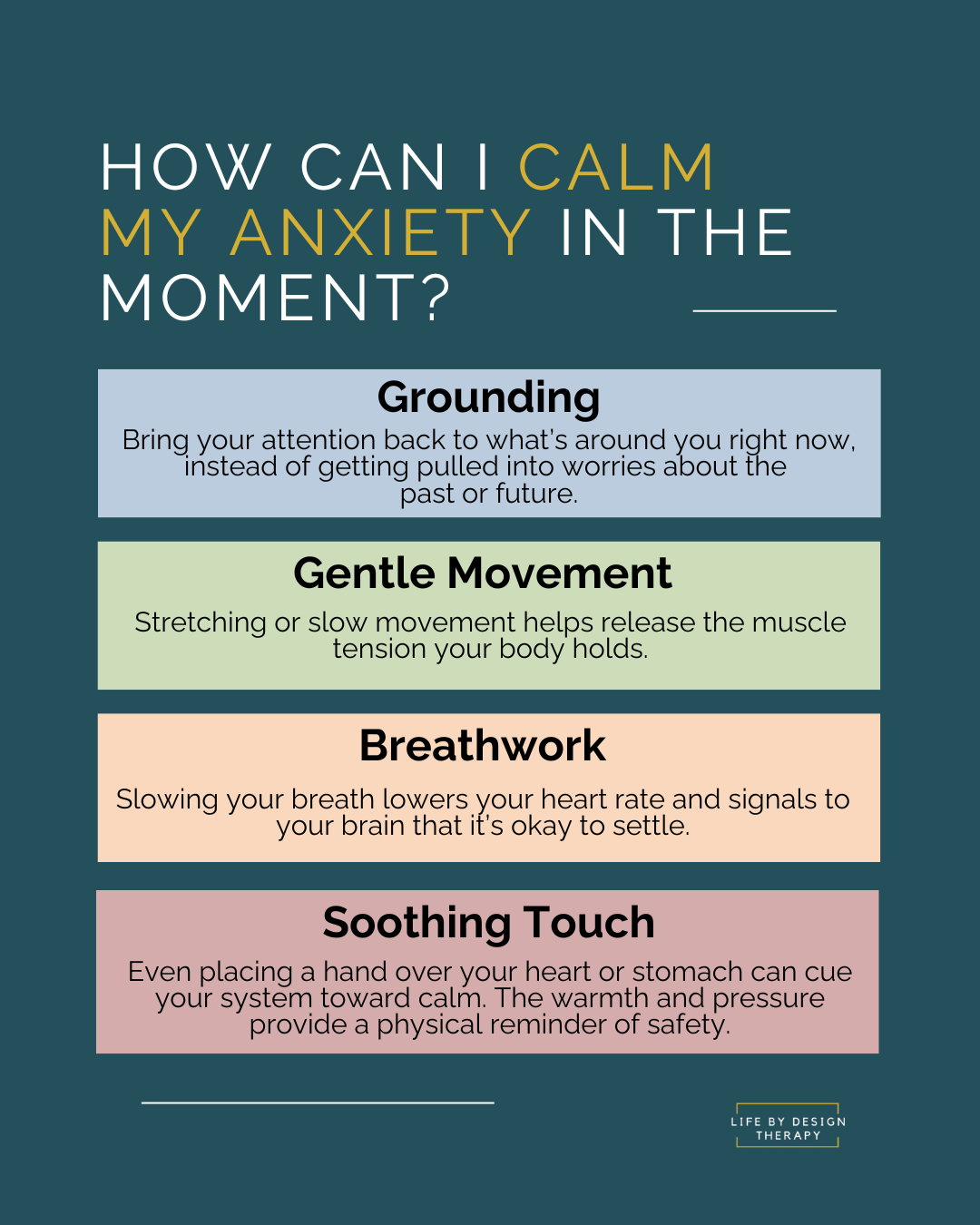
Questions You Might Be Asking Yourself
By now, you may be wondering some of the same questions many people ask when they’re trying to make sense of what they’re feeling:
1.“How do I know if this is really anxiety?”
One of the most confusing parts of anxiety is that it doesn’t always show up as panic attacks or obvious fear.
Sometimes it’s the nervous system stuck in a state of hyperarousal, like the gas pedal is pressed down, even when you’re just trying to rest.
Other times, it shows up as anticipatory stress, the sense that something bad is coming, even if nothing is happening at the moment.
According to the Diagnostic and Statistical Manual of Mental Disorders, Fifth Edition (DSM-5), Generalized Anxiety Disorder is characterized by:
Excessive anxiety and worry, occurring more days than not for at least 6 months, about a number of events or activities (such as work or school performance).
The individual finds it difficult to control the worry.
The anxiety and worry are associated with three (or more) of the following six symptoms (with at least some symptoms present more days than not for the past 6 months):
Restlessness or feeling keyed up or on edge
Being easily fatigued
Difficulty concentrating or mind going blank
Irritability
Muscle tension
Sleep disturbance (difficulty falling or staying asleep, or restless, unsatisfying sleep)
The anxiety, worry, or physical symptoms cause clinically significant distress or impairment in social, occupational, or other important areas of functioning.
The disturbance is not attributable to the effects of a substance (like drugs or medication) or another medical condition, and is not better explained by another mental disorder.
Please note: This list comes directly from the DSM-5 and is used by mental health professionals for clinical diagnosis. Reading these criteria can be helpful for self-understanding, but it’s not meant for self-diagnosis. If you recognize yourself in these symptoms, consider reaching out to a mental health provider for support and clarity.
What makes it anxiety is not just the symptoms themselves, but the persistence of them.
Stress usually comes and goes with a situation.
Anxiety, on the other hand, lingers.
It hangs around long enough to interfere with sleep, focus, or your sense of ease in daily life.
And here’s the important part: you don’t need to wait until your anxiety feels unbearable to reach out for support.
It’s not about how “bad” it looks from the outside; it’s about how it feels to you, and whether it’s stealing from your peace of mind.
2.“Why does it show up in my body?”
Anxiety isn’t just one thought; sometimes it can feel like your mind won’t stop racing. But anxiety doesn’t only stay in your mind; it shows up in your body, too, because anxiety involves your nervous system.
Your nervous system can sound the alarm even if you’re in a secure place, which is why you might feel it in your chest, stomach, or muscles just as much as in your mind.
Anxiety often comes from the body misreading cues as threats. For example, a tight deadline at work or a hard conversation with someone you care about might not be life-threatening, but your nervous system can still respond as though you’re in danger.
This is why your heart races, your breath quickens, or your muscles tense up; your body is preparing to protect you.
For many people, past trauma can make this response even stronger.
“When you’ve lived through situations that were overwhelming or unsafe, your nervous system learns to stay on guard. ”
Even years later, small reminders, or sometimes nothing obvious at all, can activate the same fight-or-flight response.
If you would like to learn about trauma and how it affects your well-being, check out our blog, 7 Signs of Unprocessed Trauma.
And when stress builds over long periods of time, your system doesn’t always get the chance to reset. Instead of returning to calm, your body can get stuck in a cycle of hypervigilance. That constant “on edge” state is what so many people recognize as anxiety.
3.“How Can I Calm My Anxiety in the Moment?”
While therapy can help you untangle the deeper roots of anxiety, there are also simple, body-based practices that can bring relief right away.
When your nervous system is activated, your body doesn’t respond well to logic alone. You can’t always “think” your way out of anxiety, but you can show your body that it’s safe. That’s where somatic tools come in.
Here are a few ways to calm your anxiety in the moment:
🌻 Grounding - Bring your attention back to what’s around you right now, instead of getting pulled into worries about the past or future.
🌻 Gentle Movement - Stretching or slow movement helps release the muscle tension your body holds when it’s braced for danger.
🌻 Breathwork - Slowing your breath lowers your heart rate and signals to your brain that it’s okay to settle.
🌻 Soothing Touch - Even placing a hand over your heart or stomach can cue your system toward calm. The warmth and pressure provide a physical reminder of safety.
These practices don’t erase anxiety entirely, but they give you small, accessible ways to interrupt the cycle in real time. And those small moments of relief matter.
They remind your nervous system that it has another option besides staying stuck in survival mode.
Final Reflections
If you see yourself in these words, I want you to know that there is hope.
Nothing about what you’re feeling makes you weak or less than. Anxiety isn’t a flaw in who you are; it’s your body and mind trying, sometimes a little too hard, to keep you safe.
I know it can feel easier sometimes to just keep pushing through, telling yourself you’ll deal with it later. But I want you to know that you don’t have to carry it all by yourself.
Anxiety feels heavy because it is heavy, and it wasn’t meant to be managed alone.
At Life By Design Therapy™, we take a holistic, somatic approach to anxiety. That means we don’t just sit and talk about what you’re going through; we also help you work with your body, so you can start to feel more grounded and safe in your own skin.
“Bit by bit, your system can learn what it feels like to actually exhale again.”
You don’t have to wait until things get worse to reach out. You deserve support now, exactly as you are. 💚
This Week’s Affirmations
Anxiety does not define me; it’s only one part of my experience.
This feeling is temporary; it will pass.
I am allowed to ask for help, even when I don’t have the words.
My body is not the enemy; it’s doing its best to protect me.
My body is allowed to feel what it feels, and I am safe right now.
Additional Resources
**If you’re interested in learning more about ways to support and heal depression, check out these books below:
Dare: The New Way to End Anxiety and Stop Panic Attacks Fast by Barry McDonagh
My Age of Anxiety: Fear, Hope, Dread, and the Search for Peace of Mind by Scott Stossel
Loving Someone with Anxiety: Understanding and Helping Your Partner by Kate N. Thieda MS LPCA NCC
**Some product links are affiliate links, which means we'll receive a commission if you purchase through our link, at no extra cost to you. Please read the full disclosure here.