
The Hidden Cost of Being the Capable One in Your Relationship
By Melody Wright, LMFT
Most people don’t come into therapy saying, “I don’t know how to stop doing everything without things falling apart.”
They come in saying things like, “I’m exhausted,” or “I feel like I’m doing everything,” or “I don’t feel like I can lean on my partner.”
And as they start talking, a familiar story begins to take shape.
It usually sounds something like:
“I’m the one managing schedules, finances, emotional check-ins, and future planning… and I’m doing it without being asked.”
“My partner isn’t a bad person. They’re not uncaring. But it feels like they are not carrying the same weight.”
And somewhere along the way, the relationship begins to feel less like a partnership and more like a responsibility.
And when love starts to feel like labor, your nervous system doesn’t need a pep talk.
It needs support. And it makes sense that you’re exhausted without it.
When Being Capable Starts to Feel Like a Burden
One of the hardest parts about this dynamic is that it can look normal from the outside.
You’re planning.
You’re organizing.
You’re thinking ahead.
You’re doing what adults do.
And to be fair… none of that is inherently a problem.
In many relationships, one partner naturally takes the lead in certain areas.
One person may be more detail-oriented. More proactive. More comfortable planning ahead.
That difference alone isn’t the issue.
What becomes painful is when the relationship starts to feel heavy in a way you can’t quite name, and when your effort stops feeling like a choice and starts feeling like the only way things will keep running smoothly.
But at a certain point, it makes sense that your capability stops feeling like a strength and starts feeling more like a burden.
Not because you don’t love your partner.
Not because your partner is “bad.”
Not because you don’t want the relationship to work.
But because even strong, capable people eventually reach a limit.
And when support doesn’t feel consistent, whether it’s emotionally, practically, or both, your nervous system stays on alert.
And that’s not a personal failure; it's actually your body responding to the experience of carrying more than what feels sustainable.
What Relationship Imbalance Looks Like in Real Life
This pattern rarely starts as a problem.
It often begins as responsiveness. Awareness. Care.
And on a larger level, these are traits our culture tends to reward.
We praise the person who stays on top of everything.
The one who’s responsible, perceptive, organized, emotionally aware, and always thinking ahead.
In a world that values productivity, competence, and “keeping it together,” being dependable can look like a strength.
But over time, the role can solidify.
One partner becomes the planner, the organizer, the emotional barometer.
They hold the timeline, the to-do list, and the future vision.
They remember appointments, initiate conversations, anticipate needs, and quietly manage the parts of life that feel unstable.
And what no one talks about enough is the emotional cost of that.
Because what looks like “being capable” on the outside can start to feel like carrying too much on the inside.
And because this role is so normalized, you might not even realize how much it’s costing you at first.
It doesn’t always show up as one big breaking point.
It shows up in the quieter ways your body and your relationship start to respond.
🌻 You feel chronically tired, even when you technically get enough sleep.
🌻 You feel irritable… and then guilty for being irritable.
🌻 You can’t fully relax, even during calm moments, because part of you is still tracking what needs attention next.
🌻 And resentment might start to build, not because you don’t love your partner, but because love has started to feel one-sided.
If resentment has been building, it’s often a signal.
That’s often what happens when the weight in a relationship starts to feel unbalanced.
Why This Dynamic Develops
From a therapeutic perspective, when uncertainty shows up, whether emotionally, practically, or relationally, some people cope by increasing effort and responsibility.
You stabilize the environment by staying alert, involved, and prepared, which is a nervous system response.
While some might consider this “overfunctioning.” But for many people living it, it feels simple:
“If I don’t handle it, it won’t get handled.”
“If I don’t stay on top of it, we’ll fall behind.”
“If I stop doing, everything will fall apart.”
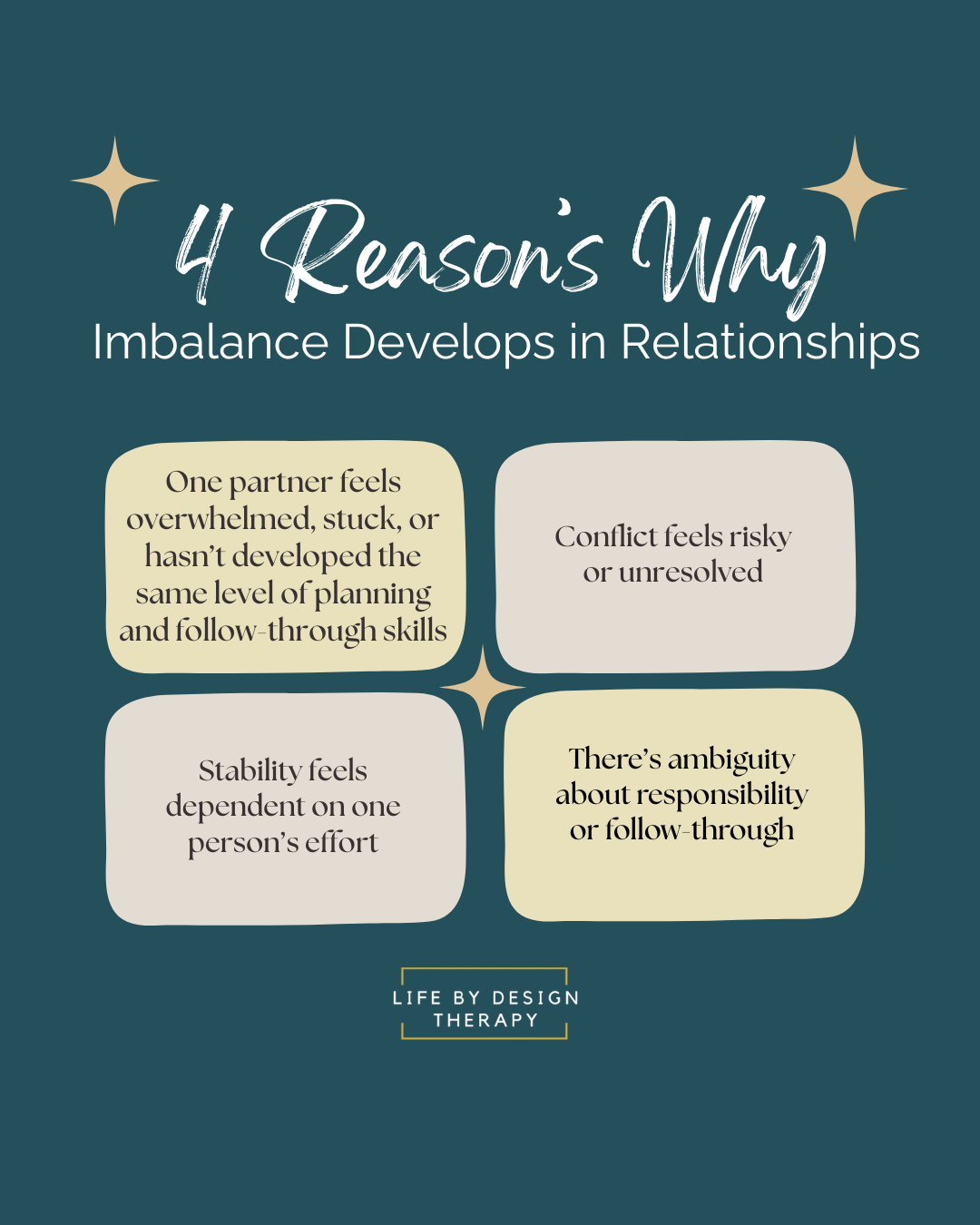
This dynamic might develop in relationships where:
One partner feels overwhelmed, stuck, or hasn’t developed the same level of planning and follow-through skills.
There’s ambiguity about responsibility or follow-through
Conflict feels risky or unresolved
Stability feels dependent on one person’s effort
Doing more becomes a way of preventing things from falling apart.
And for a while, it works.
Until it doesn’t.
The Attachment Roots of Carrying Too Much
If you’re the one who tends to carry more, there’s a good chance this didn’t start with your current partner.
For a lot of people, this is a role they learned early, often in childhood, as a way of staying connected and safe.
Maybe you grew up in an environment where being responsible was expected.
Where being mature was praised.
Where needing too much felt inconvenient.
Or maybe you learned something even more subtle:
The more tuned-in you were, the safer things felt.
If you could sense someone’s mood early, you could prevent conflict.
If you stayed one step ahead, you could keep the emotional temperature in the room from boiling over.
And sometimes, from an attachment perspective, it goes even deeper.
You might have learned to watch a caregiver’s emotional world closely because it affected you.
For example, your younger self might have felt things like:
“If I can make Mommy/Daddy feel better, then everything will be okay.”
“I have to be really good, so Mommy/Daddy doesn’t get mad.”
“Mommy/Daddy is happy when I help, so I’m going to do it before she asks.”
“If Mommy/Daddy is upset, I have to be extra quiet and careful.”
If any of that feels familiar, it makes sense that you became incredibly skilled at reading the room.
🌻 You became quick.
🌻 Responsible.
🌻 Helpful.
🌻 Highly attuned.
Your body learned how to stay safe and hypervigilant back then, but your body also knows that it’s doing too much now.
When The Dynamic Stops Feeling Sustainable
One of the ways you can tell the balance has shifted is when your effort starts to feel less like a choice and more like a necessity.
You’re no longer stepping in because you want to. You’re stepping in because it feels like you have to.
Because if you don’t…things won’t get done, conversations won’t happen, and the relationship won’t move forward.
At that point, effort turns into obligation.
Many people in this role carry a quiet belief: “If I don’t hold this together, no one will.”
And I want you to know something: You can love your partner and still feel completely worn down by this dynamic.
How This Impacts the Relationship
The more one partner manages, the less room there is for mutuality. The more one partner anticipates, the less space there is for shared responsibility to emerge naturally.
Over time, this can lead to:
Emotional distance
A parent–child dynamic rather than a partnership
Resentment that feels unsafe to express
A growing sense of loneliness, even inside the relationship
And what makes this dynamic so painful isn’t just the workload.
It’s what it can start to feel like over time.
Not because these beliefs are brand new… but because they’re familiar.
This dynamic can begin to activate beliefs you may have been carrying for a long time.
Beliefs like:
“I can’t rely on anyone.”
“If I need something, I’ll be disappointed.”
“I always end up alone in the hard parts.”
And those beliefs don’t just affect your relationship.
They affect how safe your body feels in connection with any relationship.
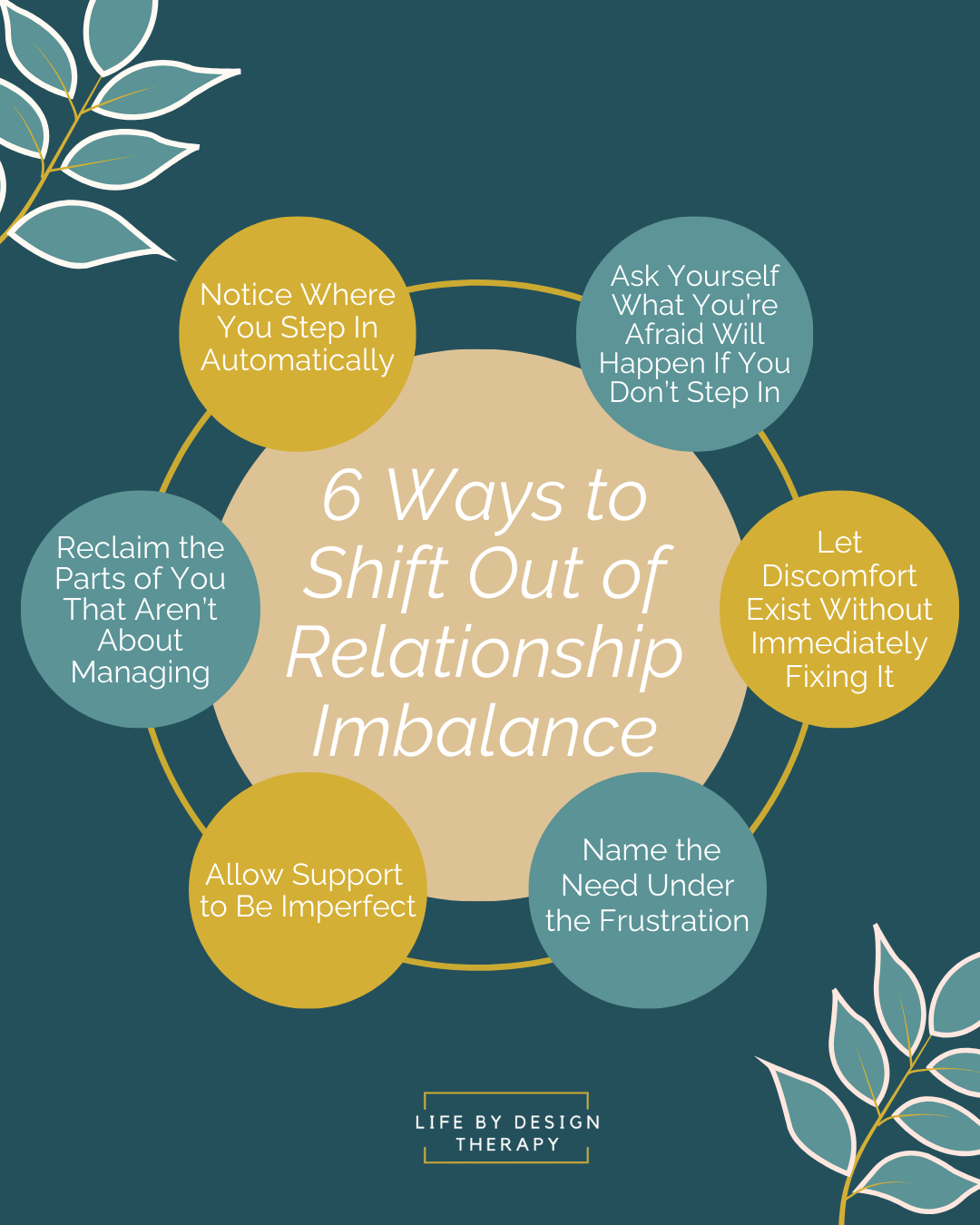
6 Ways to Restore Balance When You Feel Like You’re Carrying the Relationship
Restoring balance doesn’t mean pulling away or letting everything collapse.
It means bringing awareness and intention back into a role that has likely been running on autopilot.
Here are ways to start.
1. Notice Where You Step In Automatically
This dynamic often happens before conscious thought.
You fix. You remind. You follow up. You handle it. Sometimes, it’s before your partner even knows there was something to address.
Start by noticing:
Where you step in without being asked
Where it feels hard to sit back without doing something
Where responsibility feels assumed rather than chosen
This isn’t about stopping yourself right away. It’s about understanding and becoming aware of what your nervous system has learned to do to feel safe.
2. Ask Yourself What You’re Afraid Will Happen If You Don’t Step In
Instead of immediately stepping in, try pausing for a moment and asking yourself:
What’s actually driving me right now?
Is it anxiety?
Is it obligation?
Is it the quiet belief that if I don’t do this, no one else will?
Sometimes it is anxiety.
But sometimes it’s deeper than that.
Sometimes it’s the familiar pull of responsibility.
The part of you that feels more comfortable carrying something than risking it being dropped.
You might even notice a thought like:
“If I don’t handle this, it won’t get done.” Or, “It’s just easier if I take care of it.”
And becoming aware of what is driving that response matters, because when you understand what’s driving you, you have more choice in how you respond.
3. Let Discomfort Exist Without Immediately Fixing It
One of the hardest parts of restoring balance is tolerating some discomfort.
Because stepping back can feel like:
being irresponsible
being uncaring
risking conflict
But there’s a difference between neglect and space.
Space is what allows shared responsibility to grow.
This can look like:
Allowing tasks to be completed imperfectly, even when it’s uncomfortable
Initiating the hard conversations instead of smoothing them over
Stepping back enough for your partner to engage with responsibility in their own way
And yes, it will feel uncomfortable at first.
But discomfort here doesn’t mean you’re doing something wrong.
4. Name the Need Under the Frustration
When someone feels alone for a long time, frustration becomes the language of survival.
But underneath frustration is usually something softer. Try communicating with your partner:
“I’m overwhelmed and need help with this.”
“This has been feeling heavy for me.”
“I want to feel like we’re a team and need some additional support.”
You don’t need to justify your needs with a backstory. Needing support is enough to ask for it.
5. Allow Support to Be Imperfect
One of the hardest parts of restoring balance is tolerating differences.
Your partner may help differently than you would. Maybe they’re a little slower, less efficient, or less intuitive about what is needed.
Supporting yourself means allowing participation without controlling the outcome. Psst…this is okay 🙂
Shared responsibility doesn’t require sameness; it requires room for both people to show up in their own way.
And this is often where control and safety get tangled.
Because for many people, the desire to do it “right” is also a way of staying emotionally safe.
So if this part feels hard, it’s understandable.
6. Reclaim the Parts of You That Aren’t About Managing
When you feel like you’ve been carrying more for a long time, the scope of your world can shrink to what needs to be accomplished.
It’s important to reclaim parts of yourself that bring balance.
Restoring that balance means making room for:
Rest that isn’t earned
Pleasure that isn’t productive
Time that doesn’t serve anyone else
This isn’t indulgence. It’s nervous system regulation.
And a regulated nervous system doesn’t need to carry everything to feel safe. ♥️
Final Thoughts
If you’ve been the one who holds it all together… the capable one… the one who keeps things steady…
There’s a reason this pattern developed.
It helped you adapt.
It helped you care.
It helped you hold things together when things felt uncertain.
And it may have even been the way you stayed emotionally safe in your earliest relationships.
But patterns that once helped can become heavy when they’re no longer needed.
The goal isn’t to stop caring. It’s to stop trying to do it all alone.
And that shift is often where balance begins, because you deserve to feel regulated.
You deserve to feel more balanced in your body and in your life.
And you deserve a life that doesn’t require you to carry everything to feel safe.
This Week's Affirmations
I don’t have to carry everything to be a good partner.
I am allowed to pause without things falling apart.
Supporting my partner does not require sacrificing myself.
I can ask for support without overexplaining or apologizing.
Balance begins when I stop doing this alone.
Additional Resources
**If you’re interested in learning more about ways to support your relationship, check out these books below:
Beyond Codependency: And Getting Better All the Time by Melody Beattie
Hold Me Tight: Seven Conversations for a Lifetime of Love by Dr. Sue Johnson
Radical Acceptance: Embracing Your Life With the Heart of a Buddha by Tara Brach
The Disease to Please: Curing the People-Pleasing Syndrome by Harriet B. Braiker
Set Boundaries, Find Peace: A Guide to Reclaiming Yourself by Nedra Glover Tawwab
Nonviolent Communication: A Language of Life by Marshall B. Rosenberg
**Some product links are affiliate links, which means we'll receive a commission if you purchase through our link, at no extra cost to you. Please read the full disclosure here.

