
10 Ways to Prioritize Your Mental Health During the Holidays
By Melody Wright, LMFT
Every year, it sneaks up on you. One moment you’re lighting a candle or hanging the first ornament, and the next, your mind is already spinning with the gifts to buy, people to please, and plans to finalize.
You tell yourself you’ll slow down after all the boxes are checked on your list, but “after” never seems to come.
You want to feel present, grateful, even, but underneath the to-do lists and family dynamics, something feels off. Maybe you’re holding grief that no one talks about.
Maybe you’re stretched thin trying to make things “special.” Or maybe you just feel disconnected from the joy everyone else seems to be having.
If that’s you, I want you to know it makes sense.
The holidays tend to amplify everything we’re already holding. Not just the love and nostalgia, but also the exhaustion, the loneliness, and the ache for things to be different.
This year, instead of pushing through, what if you cared for yourself the way you care for everyone else?
So, keeping the busy you in mind, here are ten gentle ways to tend to your mental health this season. And guess what, it’s not by doing more, but rather by slowing down to check in with your mind and body.
10 Ways to Prioritize Your Mental Health During the Holidays
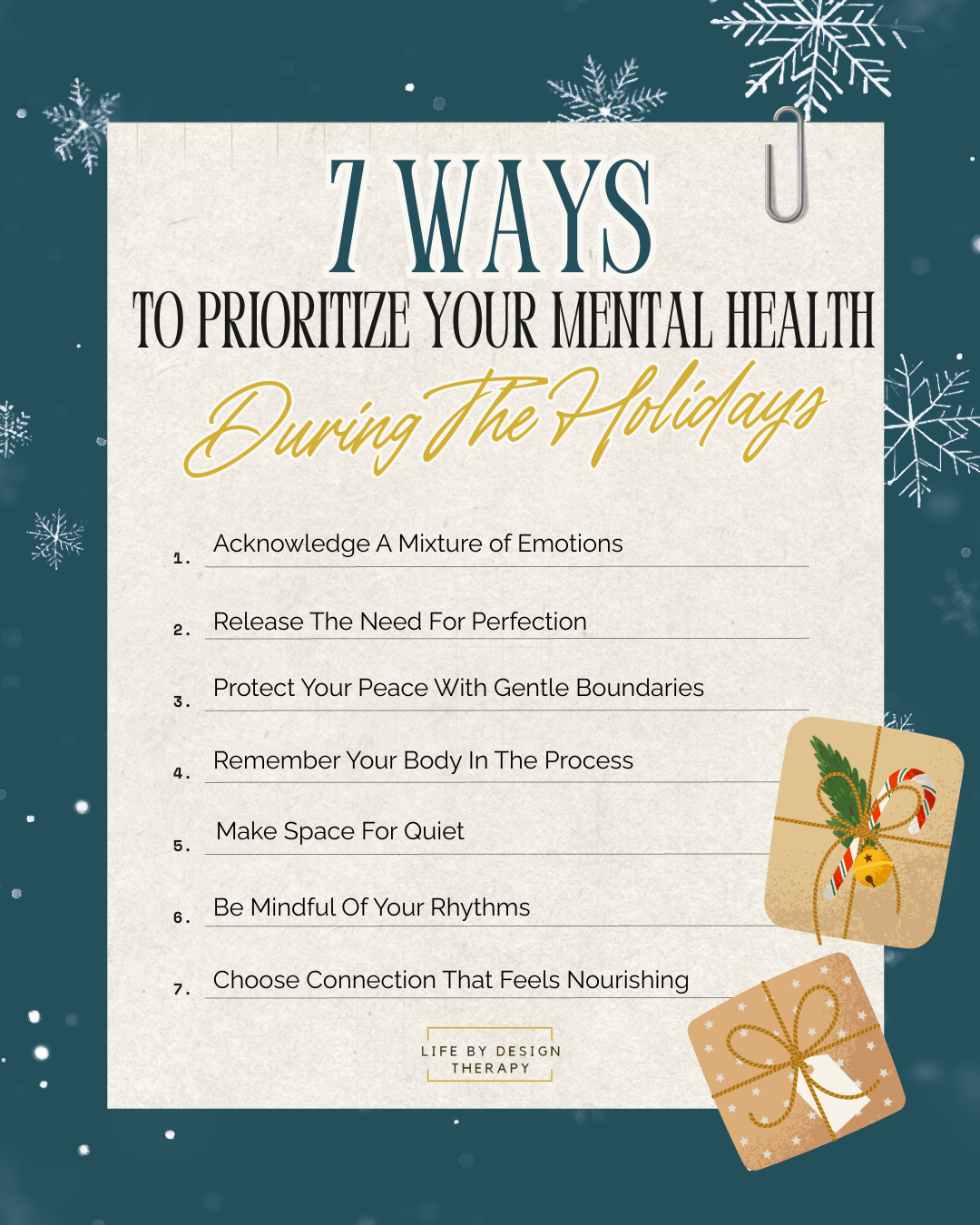
1. Acknowledge A Mixture of Emotions
The holidays can stir up mixed emotions like joy that your family is together, sadness that it doesn’t look like it used to, gratitude for what you have, or even grief for what’s missing.
Maybe you’re celebrating with friends, but secretly miss the way your childhood home smelled of cinnamon and pine. Maybe you’re surrounded by people but still feel lonely.
Both can be true.
Feeling conflicting emotions doesn’t mean you’re ungrateful; it means you’re emotionally aware.
Our brains are wired for duality; we can hold warmth and sadness, love and loss, hope and fatigue all at once.
Naming what’s here (“I feel grateful and tired”) helps your nervous system relax. It reminds your body it’s safe to feel both without needing to choose one or fix the other.
2. Release The Need For Perfection
We all carry invisible scripts about what the holidays “should” be, whether that be the perfectly decorated home, the happy family photo, or the sense of magic and meaning.
But those expectations often clash with real life: schedules, grief, stress, and fatigue.
When we chase perfection, we disconnect from presence.
Let “enough” be the new goal. If you’re running behind on dinner, if the gifts end up in bags instead of perfectly wrapped, or if you keep some traditions simple this year, I want you to know that it’s okay.
The people who love you don’t need the curated version of you; they need the one who can laugh at the burnt cookies and still enjoy the moment.
Releasing perfection isn’t giving up; it’s coming back to what matters: connection, calm, and authenticity.
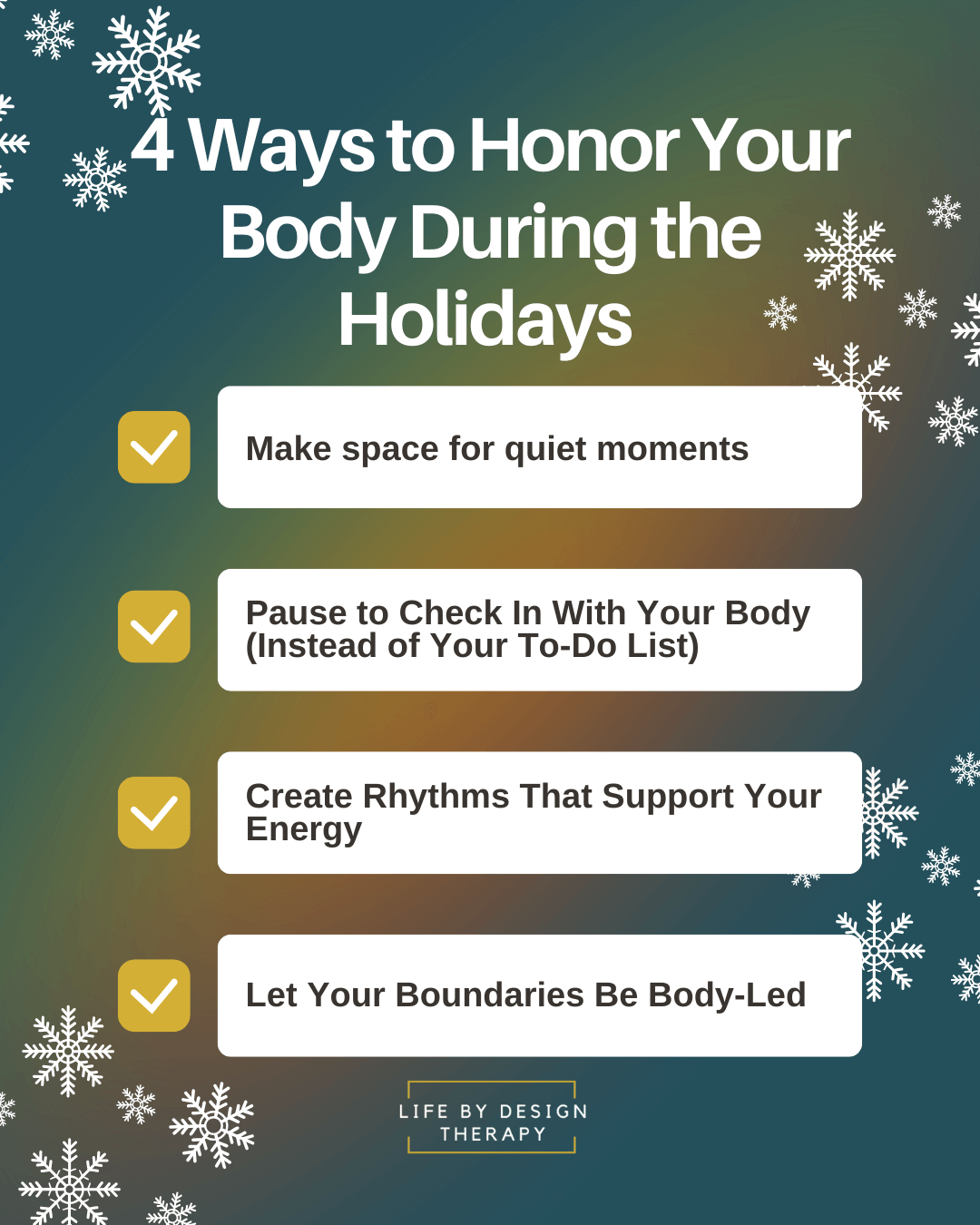
3. Communicate Gentle Boundaries to Protect Your Peace
The holidays can pull you in every direction. The family gatherings, work parties, and obligations that sound good on paper but can leave you drained in reality.
It’s okay to say no.
You’re not selfish for needing rest or for skipping an event that feels more stressful than joyful.
“Boundaries make it possible to show up for people in a way that feels good, not draining.”
They sound like:
“I can come for an hour, but I’ll need to head home early.”
“I’d love to help, but I don’t have the bandwidth this week.”
“That topic feels a little heavy for me right now. Can we come back to it tomorrow when I’ve been able to process this longer?”
Each boundary is a small act of nervous system regulation, a reminder that you can stay connected without abandoning yourself.
If you’d like to explore this more deeply, read our blog, Mindful Limits: The Connection Between Boundaries and Self-Compassion, a guide to creating boundaries that protect your peace without disconnecting from the people you love.
4. Remember Your Body In The Process
Your body experiences the holidays just as much as your mind does: the travel, the sugar, the noise, the lights, the constant stimulation.
When your system is overstimulated, your body shifts into protection mode. You might notice tight shoulders, shallow breathing, or zoning out when things get too loud.
To come back to safety, try:
Taking a long exhale (it tells your vagus nerve you’re safe).
Pressing your feet down and feeling the support under your feet.
Looking around the room and naming five things you see.
These small grounding moments bring you back to your body, and your body back to the present.
5. Make Space For Quiet
Stillness can feel foreign when life is busy, but it’s often the medicine your body needs most.
Remember, you don’t have to fill every moment with conversation or tasks.
Give yourself permission to have quiet mornings, slow walks, and maybe a few hours away from your phone.
Making intentional space for quiet moments allows your mind and body to rest and recalibrate.
6. Choose Connection That Feels Nourishing
Not every relationship feels good during the holidays. Some gatherings are filled with love; others might leave you feeling small or misunderstood.
This year, choose depth over obligation. Spend time with people who see you, rather than those who drain your energy.
If you’re alone this season, connection can look different. Try volunteering, attending a community event, or simply sitting in a cozy café surrounded by quiet company.
Loneliness often softens when we’re witnessed, even by strangers.
7. Honor The Grief That Lingers
Loss doesn’t take a holiday.
Whether it’s the loss of a person, a relationship, or simply a season of life that’s gone, it’s okay if joy feels tender.
Grief has a way of resurfacing in small ways like a song on the radio, a scent, an empty chair at the table.
If you feel yourself tearing up in the middle of something “happy”, that’s your heart remembering.
It’s okay to create space for remembrance. You can try lighting a candle, looking at photos, or carrying on a tradition. You’re not inviting sadness; you’re giving your love a place to land.
Grief doesn’t have to be something you carry alone.
If you’d like more support with this part of the season, read our blog on Navigating Grief During the Holidays, a compassionate guide to honoring your loss, tending to your emotions, and finding gentle moments of connection amid the pain.
8. Be Mindful Of Your Rhythms
During the holidays, it’s easy to slip out of the routines that support you. Late nights, heavy foods, skipped meals, or extra caffeine can all shift your mood and energy.
Instead of strict rules, focus on a gentle rhythm.
Get sunlight each morning.
Hydrate between gatherings.
Move your body in ways that feel good.
Prioritize sleep whenever possible.
Think of rhythm as nervous system hygiene; small ways to signal to your body that it is allowed to rest and recover, even when it’s busy.
9. Let Money Mirror Your Values, Not Your Stress
Financial stress can quietly erode holiday joy. The pressure to buy, decorate, or give beyond your means can come from comparison.
Ask yourself: What do I want this season to feel like? Then spend in alignment with that.
Maybe that means smaller gifts and more shared meals. Maybe it’s homemade items or acts of service.
Gifts rooted in meaning, not money, are the ones that linger.
10. Ask For Help Before You Hit The Wall
Many of us wait until we’re burned out to reach for help. But emotional overwhelm isn’t a sign of weakness; it’s a signal that your system has been doing too much for too long.
Support can look like therapy, a support group, or simply being honest with a trusted friend.
Sometimes the most healing thing you can do is admit that you can’t hold it all alone anymore.
You don’t have to. ❤️
Final Thoughts
Even though this might go against the grain of society, I want you to remember that as the year slows down, so can you.
You don’t have to earn your rest by running yourself into the ground.
You’re allowed to have a slower season, one that values peace over performance.
Caring for your mental health during the holidays isn’t selfish; it’s sacred and vitally important.
Because when you tend to your body and mind, you make room for a kind of calm that doesn’t depend on everything going right, it comes from feeling safe right where you are.
🌱 If you’re ready to create that kind of safety in your own life, therapy can help you reconnect with yourself in a deeper way.
Visit Life By Design Therapy™ to learn more about somatic and holistic therapy for nervous system regulation and stress recovery.
This Week's Affirmations
My worth isn’t measured by how much I give or do.
I release the need for perfection and return to what’s real.
My body deserves the same gentleness I offer to others.
It’s okay to move slower than the world around me.
I am allowed to create new traditions that fit who I am now.
Additional Resources
**If you’re interested in learning more about ways to prioritize your mental health, check out these books below:
Self-Compassion: The Proven Power of Being Kind to Yourself by Kristin Neff
Wherever You Go, There You Are: Mindfulness Meditation in Everyday Life by Jon Kabat-Zinn
The End of Burnout: Why Work Drains Us and How to Build Better Lives by Jonathan Malesic
**Some product links are affiliate links, which means we'll receive a commission if you purchase through our link, at no extra cost to you. Please read the full disclosure here.
