
What Happens in Your Nervous System When You Slow Down
By Melody Wright, LMFT
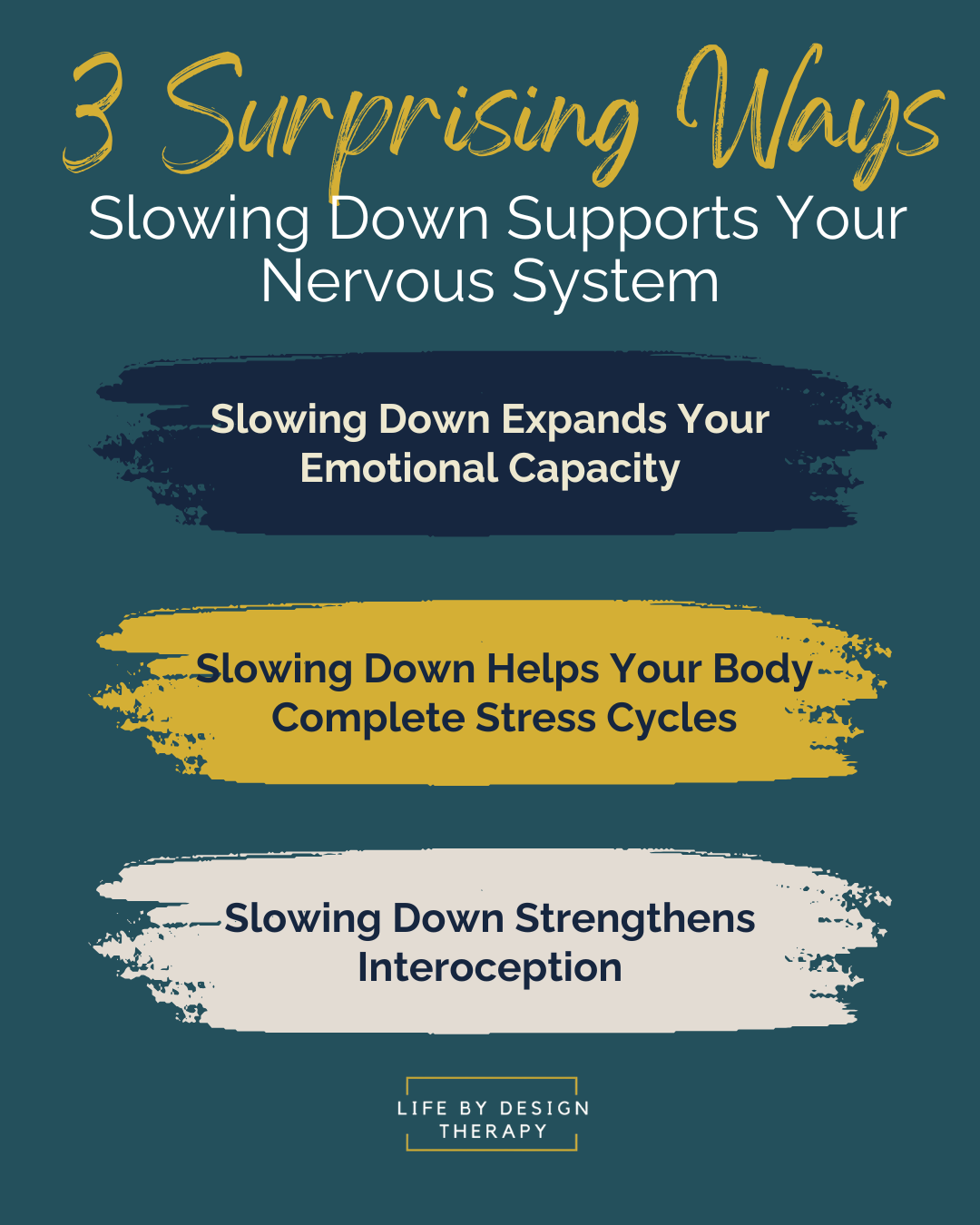
You may think slowing down is about getting more rest.
About sleeping more. Doing less. Taking breaks.
But what slowing down actually does goes much deeper than relaxation.
If you’ve been living in prolonged strain by managing responsibilities, solving problems, anticipating needs, and staying responsive, your body has likely adapted to sustain that level of output.
You may function well.
You may even feel most like yourself when there’s something to handle.
And yet, constantly being ready to respond has a real cost for your nervous system.
Your body is not designed to remain in effort indefinitely. It is designed for rhythm where there is both activation and recovery.
Slowing down isn’t about becoming less productive.
It’s about restoring rhythm by giving your nervous system the space it needs to recalibrate.
In this blog, we’ll explore some of the most impactful ways slowing down supports your nervous system and why creating space to slow your pace can change how your body experiences stress.
Slowing Down Expands Your Emotional Capacity
When you begin slowing your pace, something subtle but important starts to shift inside your body.
It’s not just about feeling calmer in the moment. Slowing down changes how your nervous system processes stress, emotion, and stimulation over time.
There are a few ways this happens in the body.
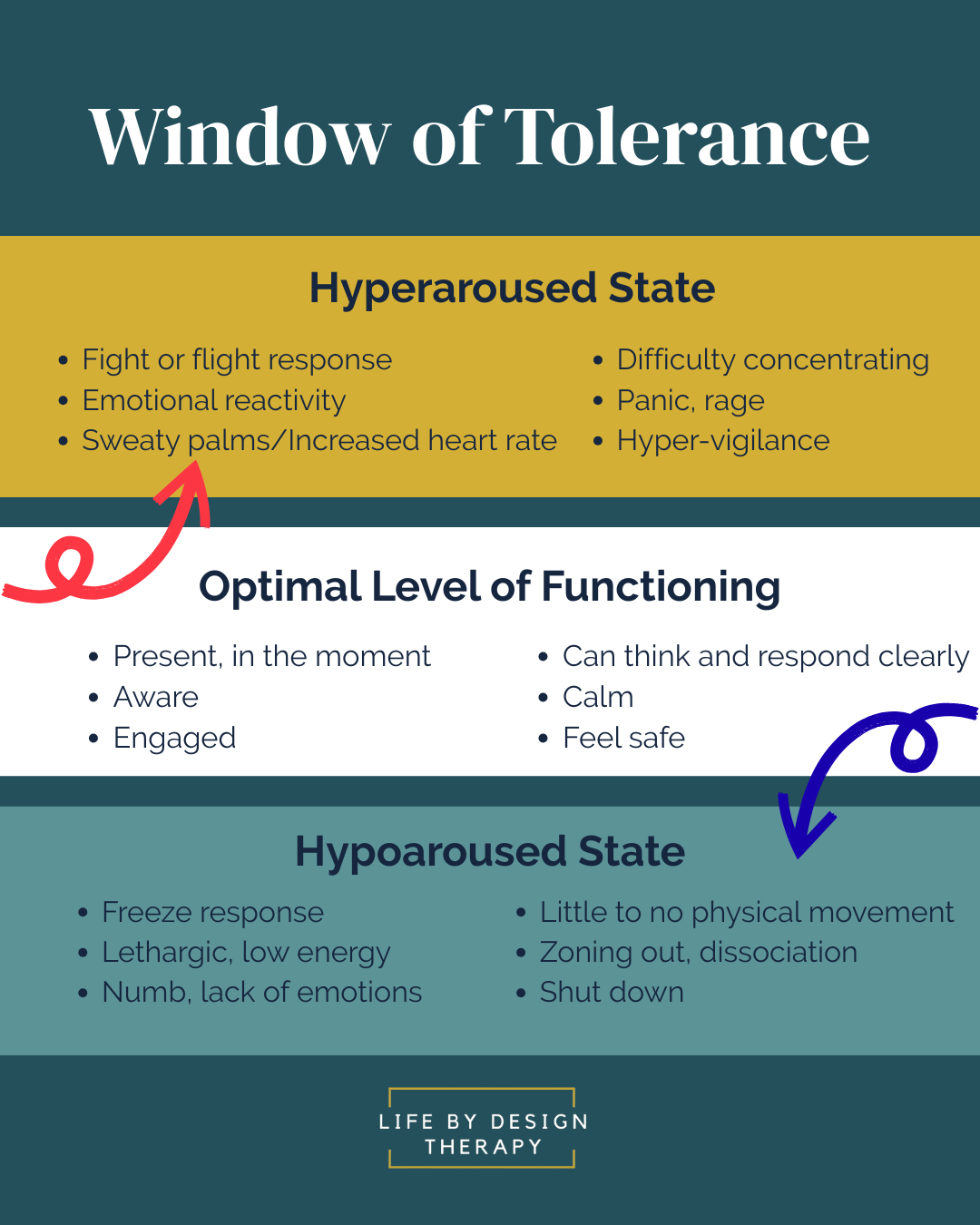
Your nervous system has a range where it can experience stress, emotion, stimulation, and relational intensity while still functioning well.
This range is often called your Window of Tolerance, a concept developed by psychiatrist Dr. Dan Siegel.
When you’re inside this window, your nervous system is activated enough to engage with what’s happening around you, but not so overwhelmed that your system shifts into survival mode. Your brain can still access reasoning, perspective, and problem-solving.
But when stress builds, or life starts moving faster than your system can process, it can push you outside of that window.
You might notice things like:
🌻 Feeling reactive or overwhelmed more quickly
🌻 Struggling to think clearly or communicate the way you want to
🌻 Feeling emotionally flooded, or on the other end, numb or disconnected
When this happens, it’s not a sign that something is wrong with you.
It’s often your nervous system doing exactly what it’s designed to do by shifting into protection when it senses too much pressure or stimulation.
This is where slowing down can make a difference.
In moments when your nervous system has been pushed outside its window, pausing, breathing, or gently regulating your body can help your system settle again. As your body settles, your brain can re-engage the parts responsible for reasoning, perspective, and emotional regulation.
Over time, regularly practicing this kind of slowing down can also help expand your window of tolerance.
That means your nervous system gradually becomes more capable of experiencing stress, emotion, or intensity without immediately tipping into overwhelm or shutdown.
In other words, slowing down doesn’t remove stress from life.
But it can help your nervous system become more flexible, more regulated, and better able to move through stress without getting stuck in it.
Slowing Down Helps Your Body Complete Stress Cycles
When something stressful happens, even if it’s small, your body mobilizes.
Your heart rate shifts. Muscles engage. Hormones rise. Your attention sharpens.
That response is what your body was built to do. It’s a way of protecting you.But if you move immediately into the next task, the next email, the next responsibility, your body often doesn’t get to finish what it started.
The activation remains partially unresolved.
You may recognize this as:
Feeling wired but exhausted.Tension that lingers even after the moment is over.Trouble sleeping despite being tired.A baseline irritability you can’t quite explain.
Your body began a stress response, but it didn’t complete it.
Slowing down reduces incoming demands long enough for your nervous system to assess whether the stress response is still necessary, and, if not, begin shifting toward regulation.
Sometimes that looks like a long exhale.
Sometimes it’s allowing your shoulders to drop when a conversation ends.
Sometimes it’s simply sitting still long enough for your system to settle before you reach for the next demand.
Completing the stress cycle is regulation.
Without regulation, your system accumulates unfinished activation, and with regulation, your body discharges what it no longer needs to carry.
Slowing Down Strengthens Interoception
When you’re focused outward with solving, managing, and producing, your internal signals become quieter.
Not because they disappear, but because your attention is trained elsewhere. In many ways, your system is scanning outward for what needs to be handled next.
But your body is always communicating with you.
Interoception is your ability to sense what’s happening inside your body, and it plays an important role in nervous system regulation. When your attention is constantly directed outward, those internal signals can become harder to notice.
When you slow down, your attention is no longer fully occupied by what’s outside of you, and internal signals that were previously muted can become more noticeable.
And, honestly, that can feel uncomfortable at first.
You may notice:
How tired you actually are.
That your jaw has been clenched all day.
A subtle heaviness in your chest.
Grief beneath your productivity.
Hunger or thirst you ignored.
This awareness isn’t something to override or power through. It’s a sign your body is still communicating with you.
Remember, you cannot soothe what you cannot sense.
The more connected you are to your internal signals, the earlier you can respond.
This allows you to choose how you respond and move through life.
Instead of burning out and then recovering, you can begin adjusting in real time.
What Slowing Down Actually Looks Like
Slowing down often happens in small, ordinary moments.
It doesn’t require a perfectly quiet morning or an uninterrupted hour.
More often, it shows up in the spaces you usually move through quickly.
It might look like:
Noticing the temperature of the water while you wash your hands instead of mentally rehearsing your next task.
Standing still for a few extra seconds after closing your laptop, feeling your feet on the ground before walking away.
Allowing your body to settle into the couch instead of immediately reaching for a distraction.
You may begin to notice how quickly your system wants to transition, how momentum pulls you forward before one moment has fully ended.
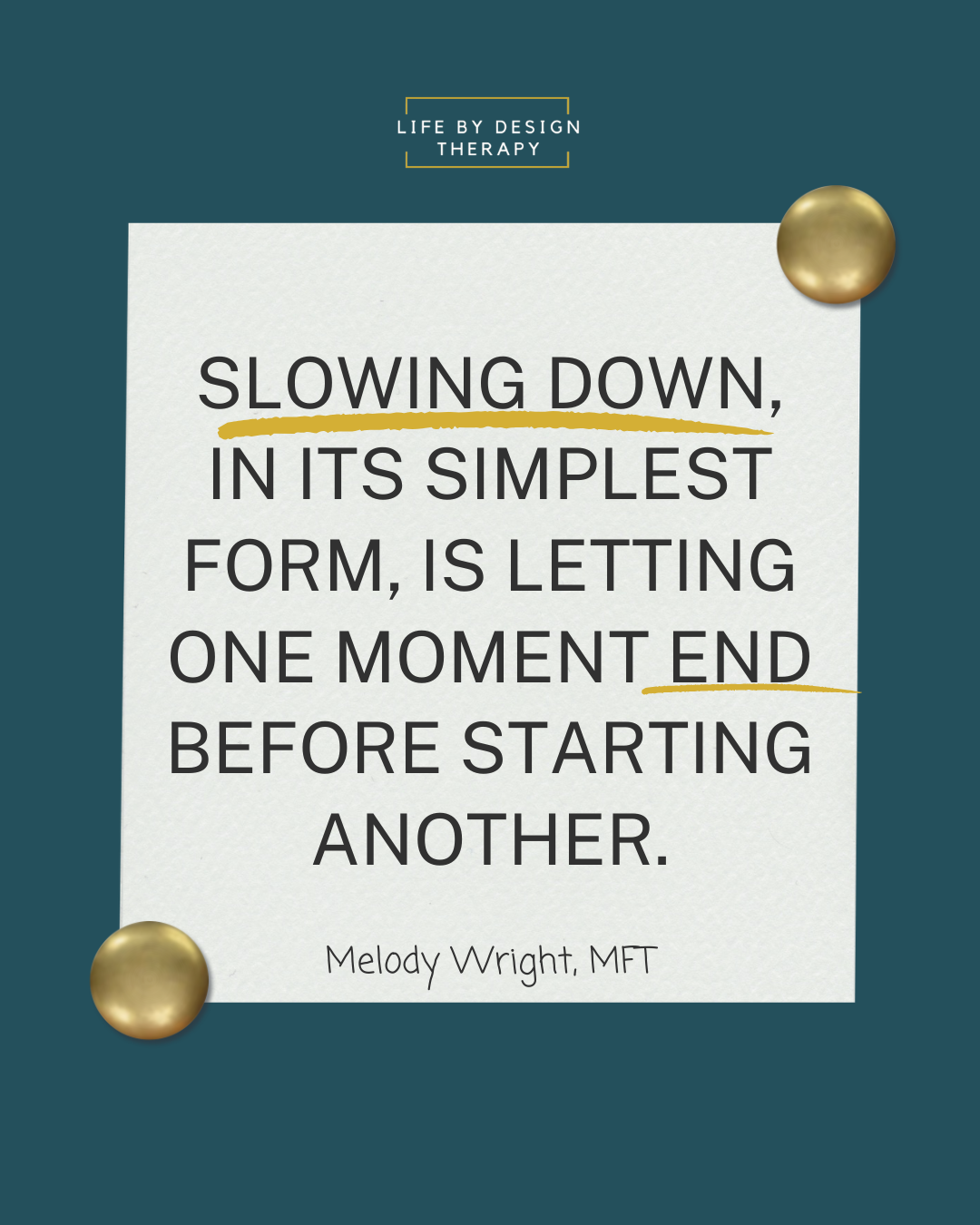
Slowing down, in its simplest form, is letting one moment end before starting another.
It might mean feeling your breath fully leave your lungs. Noticing that your heart rate has been elevated. Allowing your shoulders to drop without consciously trying to relax them.
These shifts are subtle and allow your nervous system to learn something new.
Final thoughts
Slowing down isn’t about doing less.
It’s about restoring balance to a system that has learned to sustain effort for a long time.
If your body feels unfamiliar with settling, that doesn’t mean you’re incapable of it. It may simply mean your nervous system has had more practice producing than recovering.
And practice shapes physiology.
The more often your system experiences moments of recovery, the more accessible regulation becomes. Not because you forced yourself to relax, but because your body has learned that it can move through stress and return to the present.
You don’t have to abandon your ambition.You don’t have to give up your responsibility.You don’t have to become someone less capable.
You’re simply expanding your capacity to carry what you already hold …without your body absorbing the full weight of it.
Slowing down isn’t the opposite of strength; it’s what makes strength sustainable.
If this resonates with you, you don’t have to navigate it alone. Working with a therapist can help you understand how your nervous system has adapted to stress and learn ways to support your body in finding steadiness again.
At Life By Design Therapy™, we offer holistic and somatic therapy designed to help you reconnect with your body, build regulation, and move through life with more capacity and ease.
If you’re curious about what that process might look like, schedule a free phone consultation to learn more.
This Week's Affirmations
My body does not have to carry stress indefinitely.
I am building the capacity to feel without becoming overwhelmed.
Recovery is not weakness — it is regulation.
I can listen to my body without being ruled by it.
Activation does not have to be my baseline.
Additional Resources
**If you’re interested in learning more about ways to support your nervous system, check out these books below:
In an Unspoken Voice: How the Body Releases Trauma and Restores Goodness" by Peter A. Levine
The Miracle of Mindfulness: An Introduction to the Practice of Meditation by Thich Nhat Hanh
Radical Acceptance: Embracing Your Life With the Heart of a Buddha by Tara Brach
The Untethered Soul: The Journey Beyond Yourself by Michael A. Singer
Silence: The Power of Quiet in a World Full of Noise by Thich Nhat Hanh
**Some product links are affiliate links, which means we'll receive a commission if you purchase through our link, at no extra cost to you. Please read the full disclosure here.

