
How to Work With a Dysregulated Nervous System
By Melody Wright, LMFT
You finally have a quiet moment.
Nothing needs your immediate attention. There’s nowhere you need to be. You sit down, maybe even with the intention of relaxing, but somehow your body doesn’t seem to understand that the day is over.
Your shoulders are still tense. You’re reaching for your phone without really thinking about it. Your mind keeps jumping to what you forgot, what needs to happen tomorrow, or whether you should get up and do that one last thing.
So, you try to relax harder. Maybe you take a few deep breaths, tell yourself everything is fine, or remind yourself that you’re safe. And sometimes that helps.
Other times, you’re still sitting there wondering why your body can’t seem to settle when there’s no obvious reason for it to be on edge.
This is often where conversations about nervous system regulation begin - with the question of how to make an uncomfortable feeling go away.
Instead of focusing on How do I make this uncomfortable feeling go away?, it can be helpful to get curious about what’s happening first: What is my nervous system doing right now, and what might actually support me?
What Does a Dysregulated Nervous System Feel Like?
When people hear the words nervous system dysregulation, they often picture something like anxiety, restlessness, racing thoughts, or that familiar feeling of being on edge.
And dysregulation can certainly feel that way. But sometimes it’s much quieter.
You might go blank in the middle of a difficult conversation, feel completely exhausted after something stressful, or find that even a simple decision suddenly feels weirdly difficult.
You might withdraw, procrastinate, feel numb, become irritable, or find yourself staring at your phone without really taking anything in.
Sometimes it feels like you have too much energy moving through you; other times, it can feel like you don’t have enough.
These responses are part of the nervous system’s attempt to help us respond to what’s happening around us. And they are influenced by far more than the situation directly in front of us. Sleep, hunger, sensory input, relationships, previous experiences, ongoing stress, physical health, and even how much we’ve already had to manage that day can affect our capacity in a particular moment.
That’s one reason the same situation may feel manageable one day and completely overwhelming another.
Understanding this can shift the question from Why am I reacting like this? to What has my system been carrying today?
And that gives us somewhere different to begin.
Nervous System Regulation Isn't Always About Calming Down
There are plenty of nervous system regulation tools that can help you feel more grounded in the moment. You’ve probably heard some of them before: deep breathing, cold water, meditation, putting your feet on the floor, going outside, or naming things you can see around you.
These practices aren't inherently good or bad. The more important question is whether a particular practice is actually supportive for your nervous system at that moment.
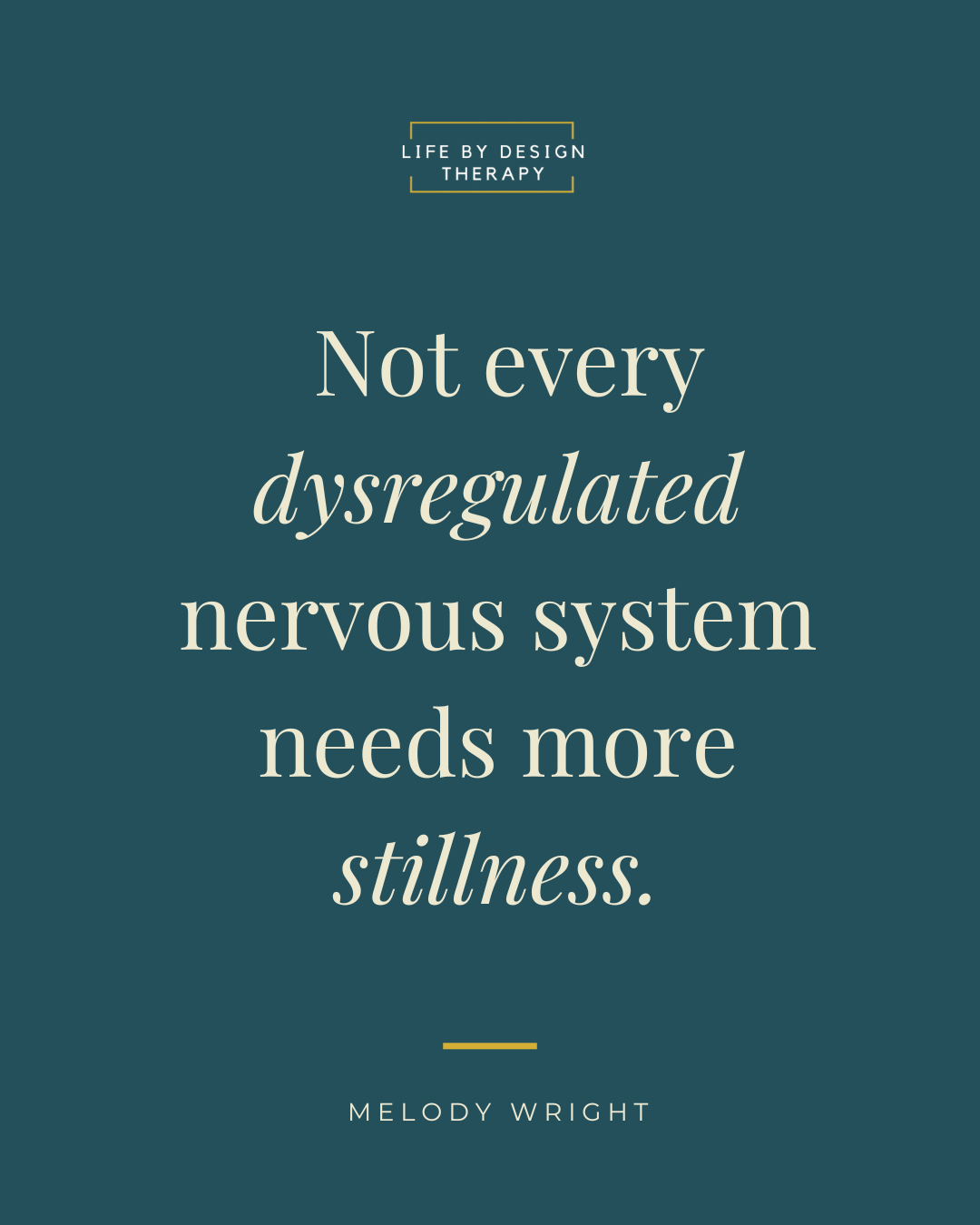
Because not every dysregulated nervous system needs more stillness.
If you feel restless, agitated, or like there is energy trapped inside your body, sitting quietly and trying to meditate may feel almost impossible. Walking, stretching, dancing, shaking out your arms, cleaning something, or simply moving your body may feel more accessible.
On the other hand, if everything already feels loud and overwhelming, adding more movement or stimulation may be the last thing you need. Dimmer lights, fewer sounds, a familiar blanket, a slower environment, or a few minutes without anyone asking anything from you might feel completely different.
And then there are the moments when what you need isn't necessarily quiet or movement at all. If you’re feeling disconnected or shut down, hearing a familiar voice, sitting beside someone you trust, spending time with a pet, receiving safe touch, or simply being around another person without needing to talk may help you feel more present.
This is why the goal isn't to memorize the “right” nervous system technique. It’s to become more familiar with yourself.
Learning to Notice Your Nervous System Before You're Overwhelmed
Most of us become aware that we're dysregulated once the feeling is already fairly loud. We realize we're overwhelmed when we're snapping at someone, notice we're anxious when our thoughts won't slow down, or recognize that we've shut down when we can't seem to make ourselves answer the text, start the task, or explain what we're feeling.
But your body may have been communicating long before that.
Maybe your jaw tightens or your breathing gets shallower. You might lose your appetite, start moving faster, become unusually sensitive to noise, stop making eye contact, or notice an urge to leave. For someone else, it might look like suddenly saying yes to everything because disappointing another person feels much harder to tolerate.
These earlier signals can be easy to miss, especially if you've spent a long time overriding them.
Part of working with your nervous system is slowly learning its language. Not so you can catch every reaction before it happens, but so there is a little more space between the first signal and the point where everything feels like too much.
That space can give you more choice.
Supporting Your Nervous System Happens Outside of Dysregulated Moments, Too
We tend to think about nervous system regulation when something is already wrong. But your nervous system isn't only paying attention during a grounding exercise. It is responding to the rhythm of your everyday life.
This is where some surprisingly ordinary things can matter.
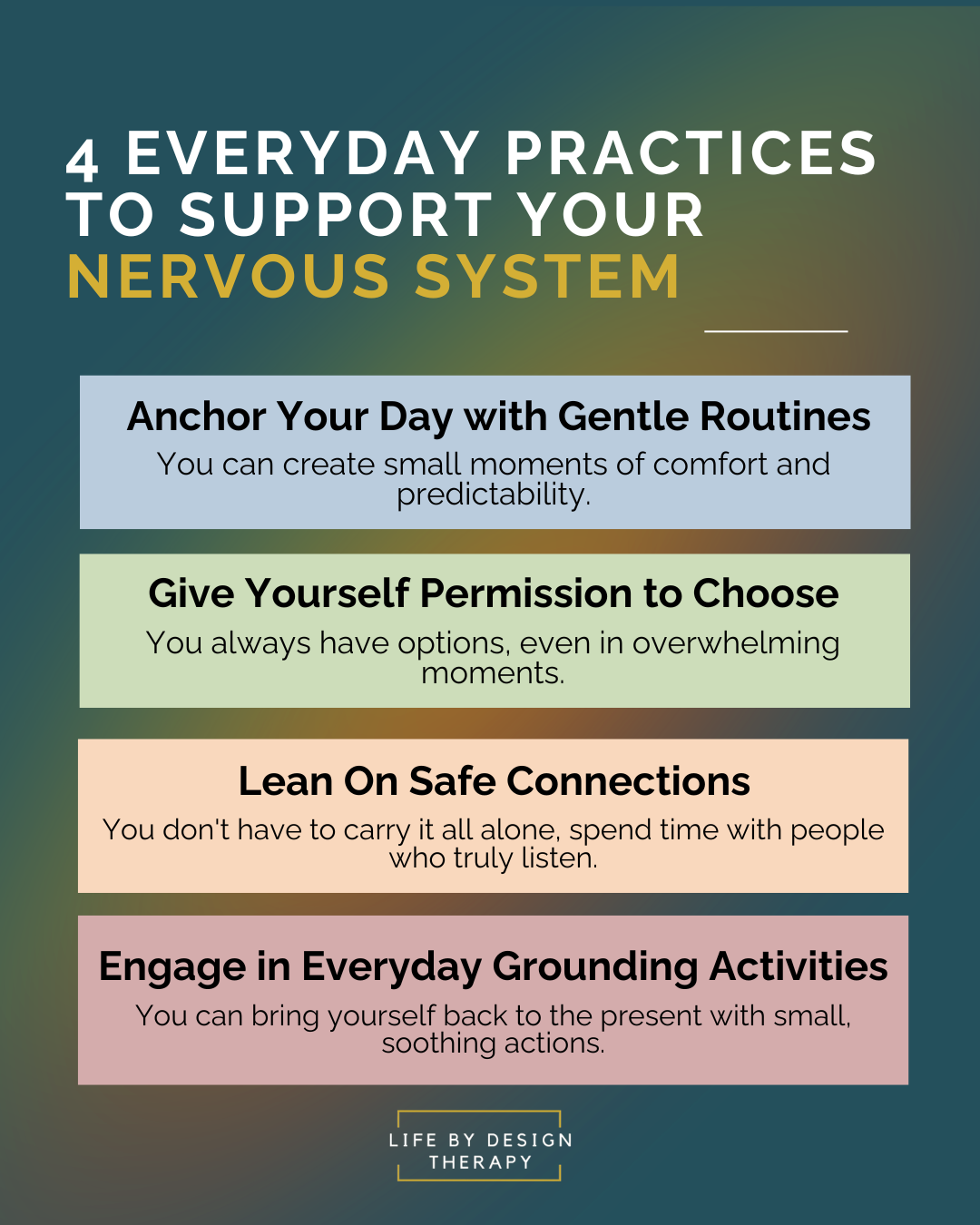
Routine, for example, isn't particularly exciting advice. But predictability can reduce some of the uncertainty your brain and body have to continually navigate. Knowing roughly when you'll eat, sleep, work, rest, or transition between parts of your day can create small points of familiarity.
That doesn't mean your life needs to run on a rigid schedule. Sometimes something as simple as drinking coffee in the same chair each morning, taking a walk after work, listening to the same playlist while making dinner, or having a familiar nighttime routine can become a small cue of I know what happens here.
Nervous system support can also happen through experiences that don't look like “nervous system work” at all. Massage or acupuncture might feel supportive for one person, while someone else finds that experience through gardening, swimming, lifting weights, cooking, sitting in the sun, or doing something with their hands.
It can also be found in moments that are harder to put into a wellness routine: laughing with someone who makes you feel like yourself, listening to music you’ve heard a hundred times, spending time somewhere you don't feel like you need to perform, or receiving a hug from someone you trust.
These aren't necessarily techniques for making your nervous system behave differently. They can simply be experiences where your body gets to encounter movement, pleasure, connection, predictability, rest, or safety.
And those experiences count, too.
Sometimes Regulation Is About Having More Choice
There's another part of nervous system regulation that doesn't always get as much attention: autonomy.
Imagine feeling overwhelmed at a crowded gathering. There's a difference between thinking, I have to stay here for three more hours, and knowing, I can step outside if I need to.
You may never actually leave. But knowing that you can changes something.
The same thing can happen in much smaller ways. Being able to say no, choosing where you sit, knowing when something will end, asking someone to stop, taking a break during a difficult conversation, deciding whether you want touch, or simply giving yourself permission to change your mind can all reinforce a sense that you have some choice in what happens next.
When we've had experiences where choice wasn't available, was ignored, or didn't feel safe to express, reconnecting with our own preferences can become an important part of nervous system work.
Sometimes support isn't about finding another way to calm your body. Sometimes it's about helping your body experience, I have options here.
Why Safe Relationships Can Help Regulate the Nervous System
We often talk about regulation as though it's something we're supposed to learn to do entirely by ourselves. But humans have always regulated in relationship with other humans.
Think about how different it can feel to receive difficult news alone versus sitting beside someone you trust. Or how your body can soften when someone speaks to you in a steady voice, listens without rushing you, or simply stays nearby when you're having a hard time.
This is sometimes referred to as co-regulation. It doesn't mean another person is responsible for managing your emotions, and it doesn't mean you should always need someone else in order to feel okay. It simply recognizes that connection can be one of the ways our nervous systems receive information about safety.
Over time, repeated experiences of being supported without being controlled, rushed, judged, or abandoned can matter.
And this is one reason the relationship itself can be such an important part of therapy.
How Somatic Therapy Can Help With Nervous System Regulation
Somatic therapy gives you an opportunity to pay attention not only to what we're thinking, but to what is happening in your body as we talk about our experiences.
A therapist might help you notice when your breathing changes, when tension appears, when you suddenly feel far away from what you're talking about, or when you feel an impulse to move, stop, turn away, or create more space.
The point isn't to analyze every sensation. It's to become more familiar with your own responses.
Therapy can also offer a supported space to experiment with what happens when you slow down instead of pushing through, or when you notice the urge to say no and become curious about what that feels like in your body. You might explore what helps you stay connected to yourself during a difficult conversation, or whether you can experience some discomfort without immediately needing to make it disappear.
Over time, these experiences can help build awareness and expand the range of responses available to you outside of therapy.
Because ultimately, the goal isn't for your therapist to regulate your nervous system for you. It's for you to understand yourself well enough that you have more ways to meet yourself when life happens.
You Don't Have to Be Regulated All the Time
There's an irony that can happen when we learn about nervous system regulation: we can become so focused on being regulated that dysregulation starts feeling like failure.
You might find yourself thinking, I know better than this. Why am I still getting triggered? I've done so much work—why does this still bother me?
Suddenly, regulation becomes another standard we're trying to meet.
But a healthy nervous system isn't one that stays calm all the time. Your nervous system is designed to respond.
There will be moments when you feel anxious, times when you become overwhelmed, conversations that activate something in you, and days when your capacity is simply lower than usual. The work isn't necessarily preventing those moments from happening.
It may look more like noticing sooner, understanding your patterns, having more choices available, knowing when you need support, and allowing yourself to respond differently. And when dysregulation does happen, you can find your way back without turning the experience into evidence that something is wrong with you.
Final Thoughts
Working with a dysregulated nervous system is less about mastering the perfect set of calming techniques and more about developing a relationship with your own responses.
Over time, you may begin to recognize what activation and shutdown feel like for you, what actually helps and what doesn’t, and what your body has been trying to communicate before the message becomes impossible to ignore. You may also start noticing the environments where you feel most at ease, the situations where you can be more fully yourself, and the people you feel safest and most connected around.
There may still be days when you don't catch it early, when the grounding exercise doesn't help, or when you realize what you needed three hours after you needed it.
That doesn't erase the awareness you're building.
Sometimes nervous system work is simply creating more opportunities to notice what’s happening within you, choose how you want to respond instead of moving on autopilot, receive support when you need it, and find your way back to yourself when things feel overwhelming.
And you don't have to learn how to do that alone.
At Life By Design Therapy™, our somatic and holistic approach to therapy creates space to explore how your experiences show up not only in your thoughts, but also in your body and nervous system. We offer holistic and somatic therapy in Berkeley, California, as well as online therapy through telehealth for clients throughout California.
If you're interested in learning more about somatic therapy and how it may support you, we invite you to connect with our team.
This Week's Affirmations
I don’t have to be calm all the time to be okay.
I am learning how to work with myself instead of against myself.
I am allowed to choose what feels supportive for me.
I can listen to my body without needing to immediately change what I feel.
I am learning to recognize what my nervous system needs.
Additional Resources
If you’re interested in understanding your nervous system, recognizing your own patterns of dysregulation, and learning what helps you feel more grounded and connected, the books below can be a helpful place to start.
In an Unspoken Voice: How the Body Releases Trauma and Restores Goodness by Peter A. Levine
The Body Keeps the Score: Brain, Mind, and Body in the Healing of Trauma by Bessel van der Kolk M.D
Polyvagal Theory in Therapy: Engaging the Rhythm of Regulation by Deb Dana
**Some product links are affiliate links, which means we'll receive a commission if you purchase through our link, at no extra cost to you. Please read the full disclosure here.

