
5 Body-Based Grounding Techniques When Breathing Exercises Aren't Enough
By Melody Wright, LMFT
A while back, I was talking with someone who was feeling incredibly overwhelmed.
Their anxiety was high. Their thoughts were racing. Their chest felt tight. They were doing everything they had been told to do.
Deep breathing.
Box breathing.
Belly breathing.
The breathing app on their phone.
And finally they looked at me and said:
"I swear, if one more person tells me to take a deep breath..."
And honestly? I understood exactly what they meant.
Because while breathing exercises can be incredibly helpful, they're not always the right tool for every person or every moment.
Sometimes focusing on your breath helps you slow down. Sometimes it helps you feel more present. And sometimes it just makes you more aware of how anxious you already feel.
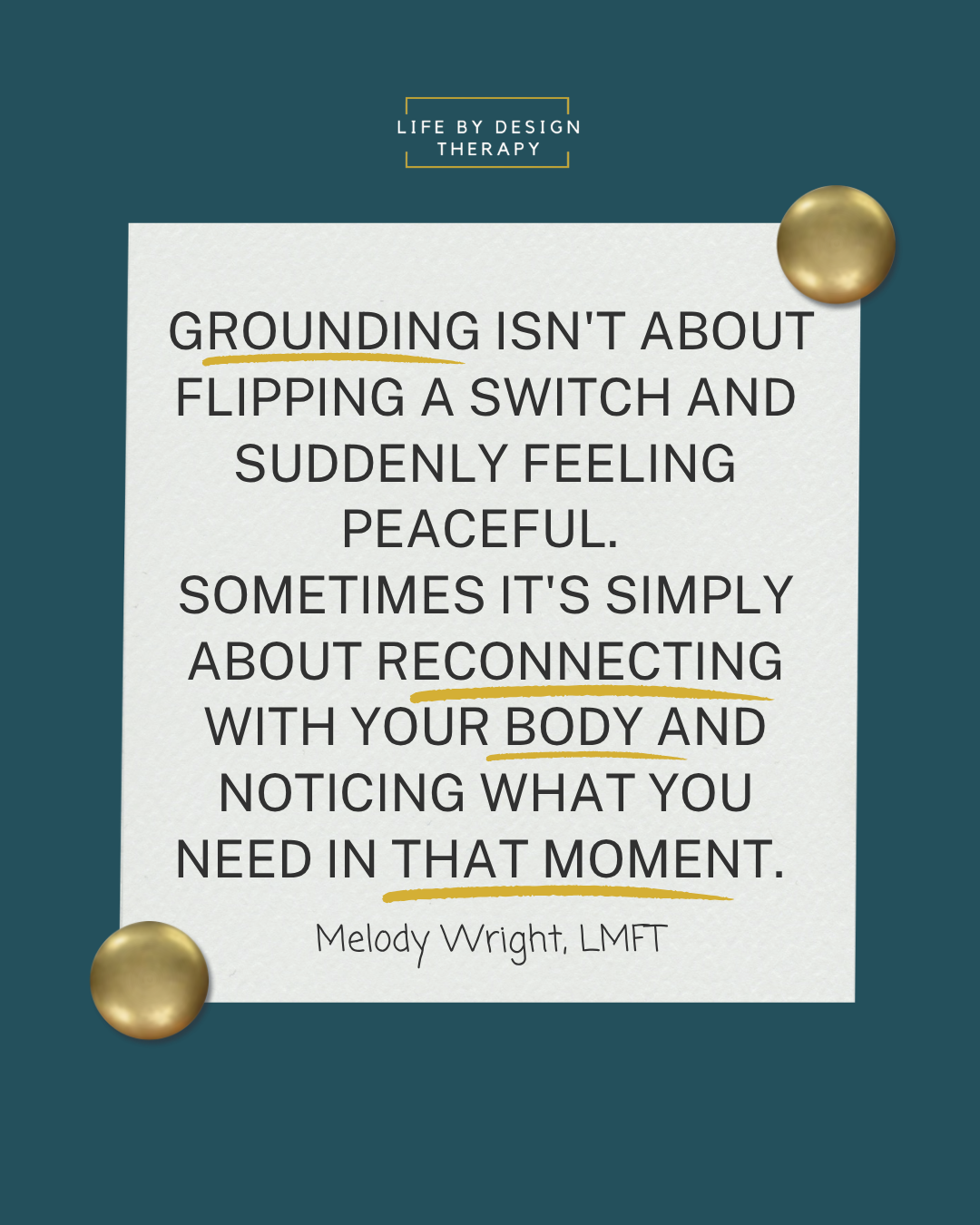
If you've ever found yourself paying attention to your breathing only to become more aware of your racing heart, tight chest, dizziness, or panic, you're not doing it wrong. In fact, becoming more aware of those sensations can be part of the process. Grounding isn't about flipping a switch and suddenly feeling peaceful. Sometimes it's simply about reconnecting with your body and noticing what you need in that moment.
People often assume grounding means sitting quietly, taking deep breaths, and trying to relax.
But grounding is really about helping your nervous system reconnect with the present moment, and there are a lot of ways to do that.
Sometimes it can be through breathing, but other times you can use movement, sensation, and so much more.
Before we get into a few body-based grounding techniques, let's talk about why breathing exercises don't always work in the first place. Understanding the "why" can help you find the tools that actually work for your body.
Why Breathing Exercises Don't Always Work
Before we go any further, I want to be clear about something: I'm not against breathing exercises.
In fact, I think your breath is one of the most powerful tools you have. It's always with you, it's free, and it's something I regularly help clients connect with in session. Slowing down and noticing your breath can help bring you back to the present moment and create a greater sense of connection with your body.
But here's the part we don't talk about enough.
Sometimes taking a few deep breaths doesn't help. Sometimes it even makes you more aware of your anxiety. If that's happened to you, it doesn't mean you're doing it wrong, and it doesn't mean breathing exercises don't work.
It simply means your nervous system may need something different in that moment.
That's why I encourage people to build a toolbox of grounding strategies rather than relying on just one. The more options you have, the easier it becomes to respond to what your body needs instead of trying to force the same tool to work every time.
When we're anxious, overwhelmed, or stressed, our nervous system shifts into protection mode. You may have heard this described as fight, flight, freeze, or fawn, your body's built-in survival response.
🌻 A difficult conversation.
🌻 Financial stress.
🌻 Relationship conflict.
🌻 An overwhelming workload.
🌻 Uncertainty about the future.
None of these are emergencies in the traditional sense, but your body can still respond as though it needs to protect you. Your heart rate may increase. Your muscles might tense. Your thoughts may begin racing as your nervous system prepares you to respond.
This is one of the reasons breathing exercises are so often recommended. Research shows that slow, intentional breathing can activate the parasympathetic nervous system, the part of your nervous system that supports rest, recovery, and regulation.
But here's the piece that doesn't get talked about enough.
When your nervous system is highly activated, it may not be ready to access calm through breathing alone.
Think about it this way. If your house alarm is blaring, someone quietly whispering, "Everything is okay," probably isn't going to be enough to help your body settle.
Sometimes your nervous system needs a different kind of input.
🌻 Something it can feel.
🌻 Something it can touch.
🌻 Something it can physically engage with.
That's where body-based grounding tools can be so helpful. They give your nervous system another way to reconnect with the present moment, especially when breathing doesn't feel accessible yet.
5 Grounding Tools to Add to Your Nervous System Toolbox
(+ 1 Bonus Technique Most People Don't Think About)
1. Orienting to Your Environment
One of the simplest grounding techniques I teach often feels almost too simple.
It's called orienting.
And before you roll your eyes and think, "There's no way looking around the room is going to help me," stay with me.
When anxiety shows up, our brains become incredibly focused on scanning for problems. For example, your brain might look for what could go wrong, what you forgot, and what you need to fix, which can cause your attention to narrow.
Orienting does the opposite.
Instead of looking inward at the anxiety, you gently begin looking outward.
Try it now. Take a slow look around the room you're in.
Notice the colors.
Notice the lighting.
Notice the textures.
Look for something pleasant like a plant, photograph, cozy blanket, or a favorite coffee mug.
As simple as it sounds, this practice helps your nervous system gather updated information about the environment around you.
It begins recognizing that this moment is different from the danger it may be preparing for.
I've had clients tell me they can literally feel their shoulders drop after doing this for a minute or two.
Not because they forced themselves to relax, but because their body finally got the memo that it wasn't currently under attack.
If you're curious about why your nervous system can sometimes react so strongly even when you're objectively safe, our blog Why Understanding Your Window of Tolerance is Essential to Manage Overwhelm & Stress takes a deeper look at how the nervous system responds to stress, overwhelm, and perceived threat.
2. Grounding Through Your Feet
Have you ever noticed how anxiety can make you feel like you're living entirely in your head? One minute you're trying to focus on what you're doing, and the next you're replaying an awkward conversation, worrying about tomorrow, or imagining every possible thing that could go wrong.
When we're anxious, it's easy to lose connection with our bodies altogether. That's why I love grounding through the feet.
It's simple, discreet, and can be done almost anywhere.
All you need to do is stand with both feet flat on the floor. Press them down gently and notice where your weight naturally falls.
Then shift your weight slightly from side to side, paying attention to the feeling of the ground supporting you.
One variation I especially like is imagining that you're gently pushing the floor away from you.
That tiny bit of muscle engagement often helps people feel more connected to their body and less consumed by what's happening in their head.
It's not magic, but sometimes reconnecting with the physical support underneath you is exactly what your nervous system needs.
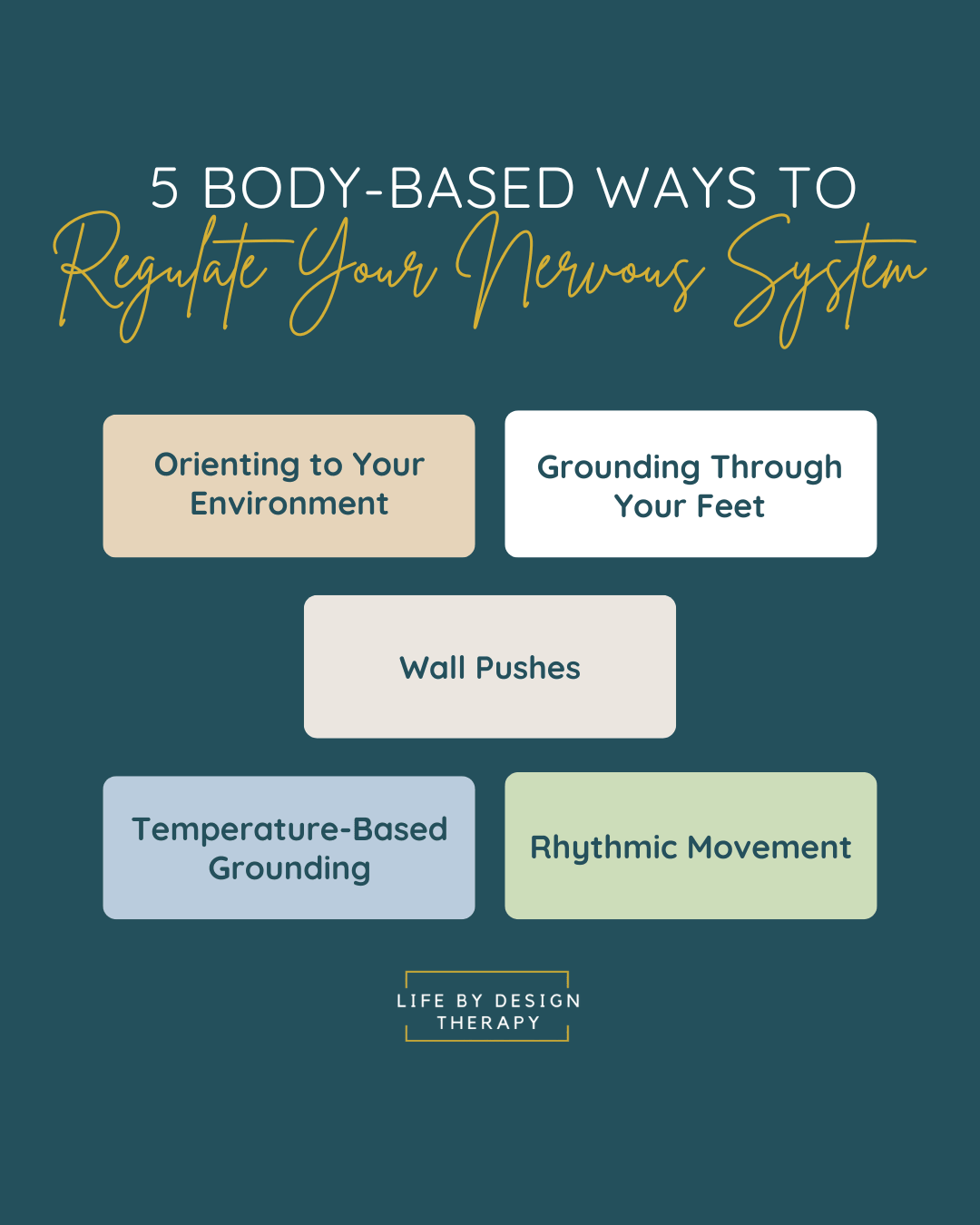
3. Wall Pushes
If you've ever felt like anxiety was buzzing through your body, this one's for you.
You know that feeling where your thoughts are racing, you can't sit still, your shoulders are tight, your jaw is clenched, and you feel like you need to do something, but you don't know what.
That's because fight-or-flight energy is designed for action.
The problem is that most of us aren't actually running from danger.
We're sitting in traffic.
Answering emails.
Trying to fall asleep.
Having difficult conversations.
So, the energy gets activated, but it never has a chance to go anywhere.
Wall pushes can help.
Place your hands against a wall.
Push firmly for 10 to 20 seconds.
Engage your arms, shoulders, and core.
Then slowly release.
And here's the important part:
Pause afterward and notice what changed.
Maybe your breathing shifted.
Maybe your shoulders softened.
Maybe you feel warmth or tingling.
Sometimes people expect grounding to happen during the exercise. In reality, the regulation often happens in the moments after as you become more aware of the present moment.
4. Temperature-Based Grounding
One of my favorite things about the nervous system is that it's constantly taking in information through our senses.
This means we can intentionally use sensory experiences to help interrupt anxious spirals, and temperature is one of the easiest ways to do that.
Think about how quickly your attention shifts when you splash cold water on your face, or wrap your hands around a warm mug of tea, or even step outside on a chilly morning.
Suddenly, you're not entirely focused on your thoughts anymore.
You're noticing sensations.
You're noticing your environment.
You're noticing the present moment.
Ways to use temperature-based grounding can look like
Holding a cold glass of water.
Run cool water over your hands.
Wrapping up in a warm blanket.
Stepping outside and paying attention to the temperature of the air against your skin.
And instead of rushing through the experience, get curious.
Notice where you feel the change in temperature.
Pause for a moment and pay attention to where you feel it in your body.
Stay with that sensation for a few moments.
What do you notice? Remember, there's no right or wrong answer. Just allow yourself to experience whatever is there.
The goal isn't distraction. The goal is reconnection with your body and current surroundings.
5. Rhythmic Movement
There is a reason babies are rocked to sleep, and people sway to music.
There is a reason a walk can sometimes feel more regulating than sitting still and trying to meditate.
Humans are wired for rhythm, and rhythm can be incredibly calming for your nervous system.
When we're anxious, stillness isn't always what we need. Sometimes movement is…like predictable, gentle, and repetitive movement.
For example:
A walk around the block.
Rocking in a chair.
Stretching.
Slow dancing in your kitchen while making dinner.
Marching in place.
Cross-body movements like touching opposite knees.
As you do these movements, notice how different that feels than trying to force yourself to sit perfectly still when your nervous system may be begging for movement.
Sometimes regulation looks less like meditation and more like movement with intention.
6. BONUS TIP: Grounding Through Movement & Pressure
[Heavy Work]
This might be my favorite technique on the list because most people don't even realize they're doing it.
Occupational therapists often use the term "heavy work" to describe activities that provide proprioceptive input. Things like pushing, pulling, carrying, or lifting. These movements give your nervous system clear feedback about where your body is in space, which can help you feel calmer, more regulated, and more grounded.
For example, have you ever had a stressful day and suddenly found yourself deep-cleaning the kitchen? Pulling weeds in the garden? Reorganizing a closet? Or carrying every grocery bag into the house in a single trip?
Believe it or not, there may be a nervous system reason for that.
When anxiety is high, the body often feels full of energy that has nowhere to go, and heavy work gives that energy a job.
Some examples include:
Carrying laundry baskets
Digging in soil
Raking leaves
Moving boxes
Using a weighted blanket
Lifting weights
Unlike some grounding techniques that focus on slowing down, heavy work allows the body to engage first.
For people who feel restless, physically activated, or unable to sit still when anxious, this can be a much more accessible place to start.
Sometimes your nervous system doesn't need less movement. Sometimes it needs purposeful movement.
Of course, even the most effective grounding techniques aren't meant to eliminate anxiety on command. They're tools for supporting your nervous system, and different tools work for different people at different times.
That's one of the reasons I encourage people to build a variety of grounding tools rather than relying on a single technique. The more options you have, the easier it becomes to meet your nervous system where it is on any given day. If you'd like even more ideas, check out our blog on Grounding Techniques to Calm Your Nervous System, where we share additional ways to reconnect with the present moment and support regulation when stress or anxiety feels overwhelming.
Final Thoughts
If you've ever tried a grounding exercise and thought, "Well, that didn't do anything," I want you to know that's a completely normal response.
Grounding isn't a magic trick. It's not a way to instantly erase anxiety. It's not about forcing yourself to feel calm. As we talked about above, it's about helping your nervous system reconnect with the present moment.
And sometimes that takes time. Especially if you've been carrying chronic stress, anxiety, burnout, grief, or trauma for a long time, think of grounding less like flipping a light switch and more like building a relationship.
The more consistently you practice these skills, the more familiar they become.
Over time, your nervous system starts recognizing these experiences as signals of safety and support.
But if anxiety, stress, burnout, or overwhelm are making it difficult to feel grounded in your daily life, therapy can help. At Life By Design Therapy™, we work with people who want to better understand their nervous system, build practical coping skills, and create lasting emotional well-being. If you're ready for support, we'd be honored to walk alongside you. Reach out today to learn more about our therapy services and schedule a consultation.
This Week's Affirmations
My body is giving me information, not trying to work against me.
I am safe enough to slow down and reconnect with my body.
I can feel overwhelmed and still be grounded in the present moment.
My body deserves compassion, not criticism, as it moves through stress.
I don't have to fix everything right now. I only need to focus on this moment.
Additional Resources
If you'd like to continue learning about anxiety, nervous system regulation, grounding, and the connection between your mind and body, the books below can be a helpful place to start.
The Power of Now: A Guide to Spiritual Enlightenment by Eckhart Tolle
Wherever You Go, There You Are: Mindfulness Meditation in Everyday Life by Jon Kabat-Zinn PhD
The Miracle of Mindfulness: An Introduction to the Practice of Meditation by Thich Nhat Hanh
Radical Acceptance: Embracing Your Life With the Heart of a Buddha by Tara Brach
The Body Keeps the Score: Brain, Mind, and Body in the Healing of Trauma by Bessel van der Kolk M.D
Polyvagal Theory in Therapy: Engaging the Rhythm of Regulation by Deb Dana
**Some product links are affiliate links, which means we'll receive a commission if you purchase through our link, at no extra cost to you. Please read the full disclosure here.

