

10 Ways to Prioritize Your Mental Health During the Holidays
By Melody Wright, LMFT
Every year, it sneaks up on you. One moment you’re lighting a candle or hanging the first ornament, and the next, your mind is already spinning with the gifts to buy, people to please, and plans to finalize.
You tell yourself you’ll slow down after all the boxes are checked on your list, but “after” never seems to come.
You want to feel present, grateful, even, but underneath the to-do lists and family dynamics, something feels off. Maybe you’re holding grief that no one talks about.
Maybe you’re stretched thin trying to make things “special.” Or maybe you just feel disconnected from the joy everyone else seems to be having.
If that’s you, I want you to know it makes sense.
The holidays tend to amplify everything we’re already holding. Not just the love and nostalgia, but also the exhaustion, the loneliness, and the ache for things to be different.
This year, instead of pushing through, what if you cared for yourself the way you care for everyone else?
So, keeping the busy you in mind, here are ten gentle ways to tend to your mental health this season. And guess what, it’s not by doing more, but rather by slowing down to check in with your mind and body.
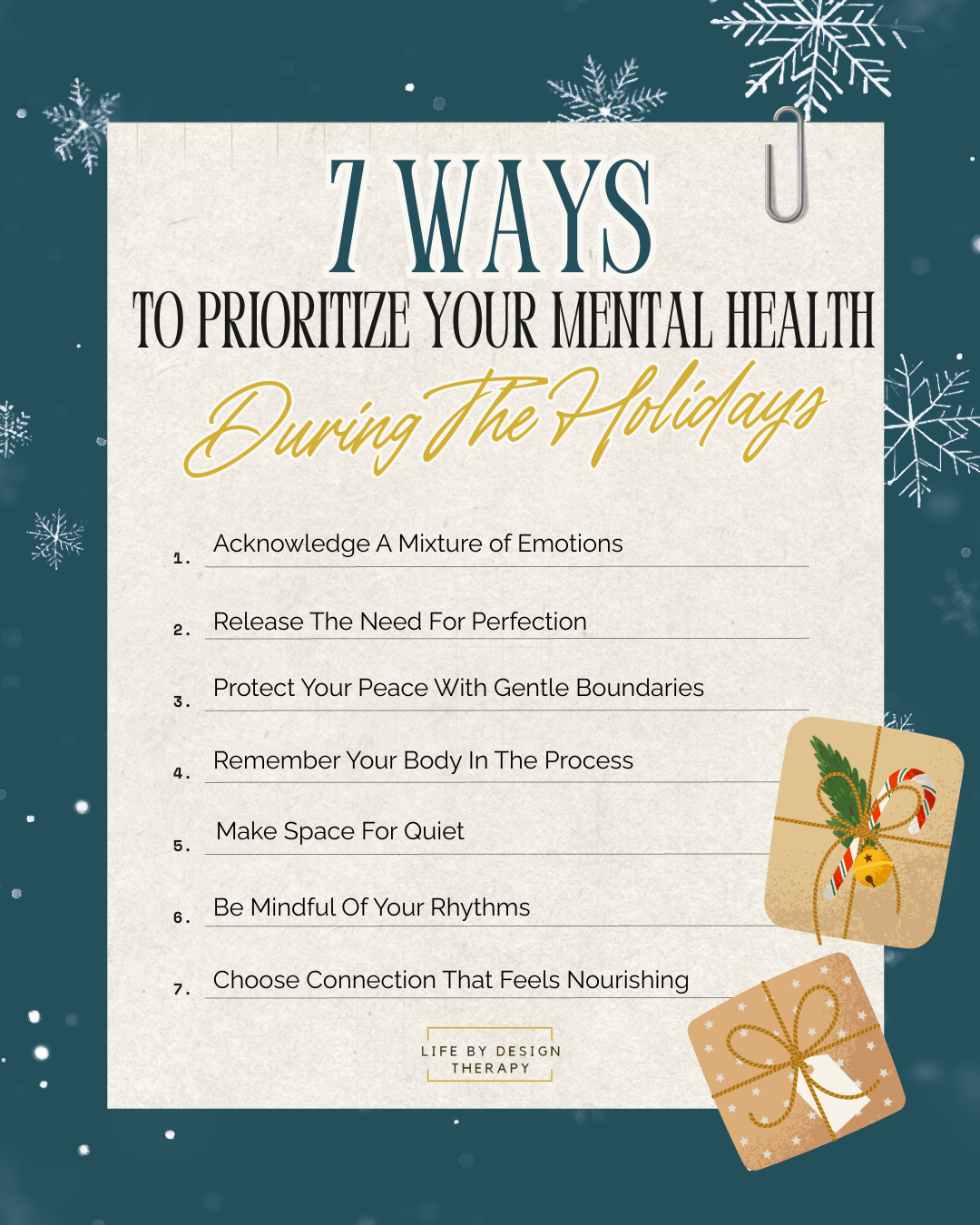
10 Ways to Prioritize Your Mental Health During the Holidays
1. Acknowledge A Mixture of Emotions
The holidays can stir up mixed emotions like joy that your family is together, sadness that it doesn’t look like it used to, gratitude for what you have, or even grief for what’s missing.
Maybe you’re celebrating with friends, but secretly miss the way your childhood home smelled of cinnamon and pine. Maybe you’re surrounded by people but still feel lonely.
Both can be true.
Feeling conflicting emotions doesn’t mean you’re ungrateful; it means you’re emotionally aware.
Our brains are wired for duality; we can hold warmth and sadness, love and loss, hope and fatigue all at once.
Naming what’s here (“I feel grateful and tired”) helps your nervous system relax. It reminds your body it’s safe to feel both without needing to choose one or fix the other.
2. Release The Need For Perfection
We all carry invisible scripts about what the holidays “should” be, whether that be the perfectly decorated home, the happy family photo, or the sense of magic and meaning.
But those expectations often clash with real life: schedules, grief, stress, and fatigue.
When we chase perfection, we disconnect from presence.
Let “enough” be the new goal. If you’re running behind on dinner, if the gifts end up in bags instead of perfectly wrapped, or if you keep some traditions simple this year, I want you to know that it’s okay.
The people who love you don’t need the curated version of you; they need the one who can laugh at the burnt cookies and still enjoy the moment.
Releasing perfection isn’t giving up; it’s coming back to what matters: connection, calm, and authenticity.
3. Communicate Gentle Boundaries to Protect Your Peace
The holidays can pull you in every direction. The family gatherings, work parties, and obligations that sound good on paper but can leave you drained in reality.
It’s okay to say no.
You’re not selfish for needing rest or for skipping an event that feels more stressful than joyful.
“Boundaries make it possible to show up for people in a way that feels good, not draining.”
They sound like:
“I can come for an hour, but I’ll need to head home early.”
“I’d love to help, but I don’t have the bandwidth this week.”
“That topic feels a little heavy for me right now. Can we come back to it tomorrow when I’ve been able to process this longer?”
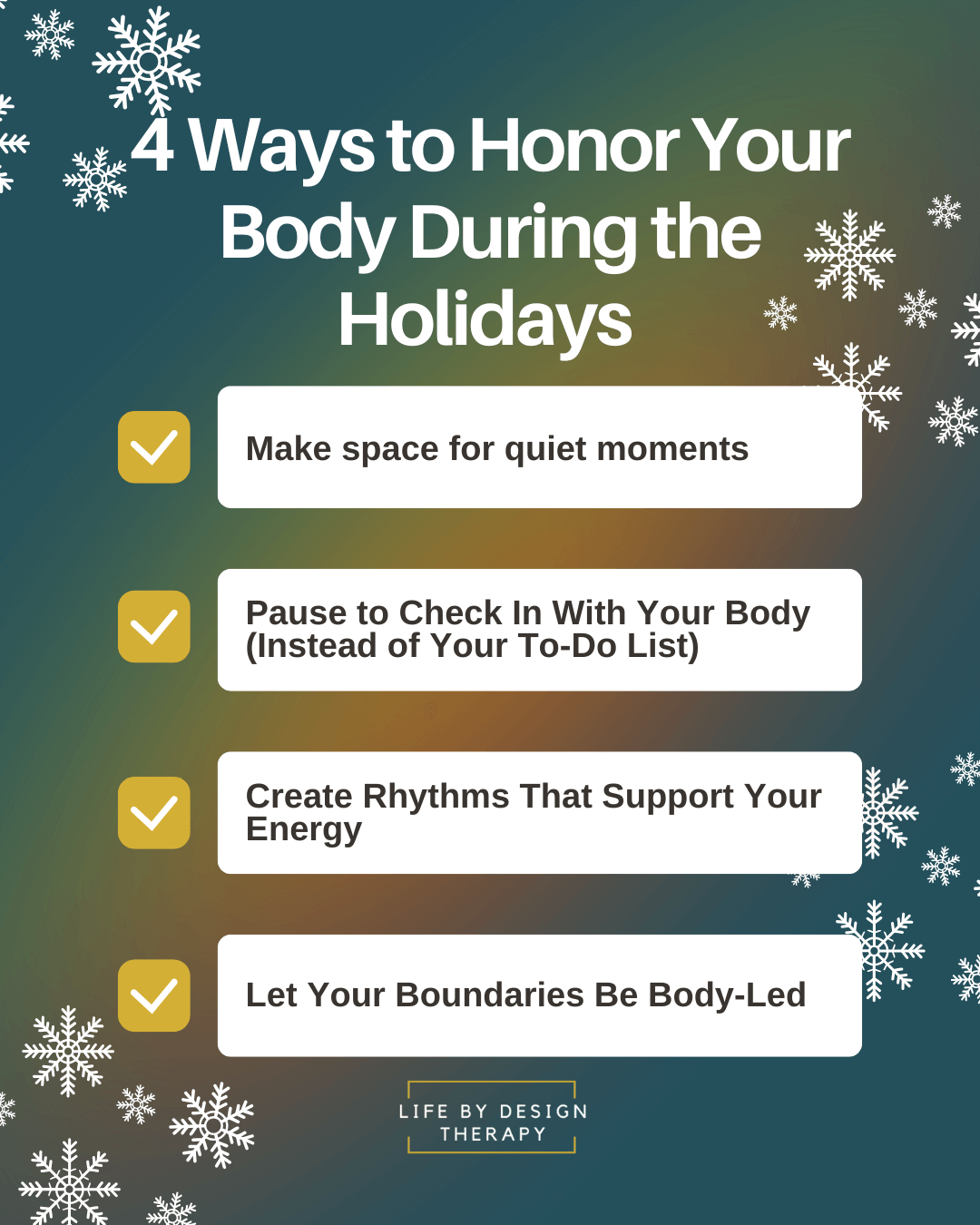
Each boundary is a small act of nervous system regulation, a reminder that you can stay connected without abandoning yourself.
If you’d like to explore this more deeply, read our blog, Mindful Limits: The Connection Between Boundaries and Self-Compassion, a guide to creating boundaries that protect your peace without disconnecting from the people you love.
4. Remember Your Body In The Process
Your body experiences the holidays just as much as your mind does: the travel, the sugar, the noise, the lights, the constant stimulation.
When your system is overstimulated, your body shifts into protection mode. You might notice tight shoulders, shallow breathing, or zoning out when things get too loud.
To come back to safety, try:
Taking a long exhale (it tells your vagus nerve you’re safe).
Pressing your feet down and feeling the support under your feet.
Looking around the room and naming five things you see.
These small grounding moments bring you back to your body, and your body back to the present.
5. Make Space For Quiet
Stillness can feel foreign when life is busy, but it’s often the medicine your body needs most.
Remember, you don’t have to fill every moment with conversation or tasks.
Give yourself permission to have quiet mornings, slow walks, and maybe a few hours away from your phone.
Making intentional space for quiet moments allows your mind and body to rest and recalibrate.
6. Choose Connection That Feels Nourishing
Not every relationship feels good during the holidays. Some gatherings are filled with love; others might leave you feeling small or misunderstood.
This year, choose depth over obligation. Spend time with people who see you, rather than those who drain your energy.
If you’re alone this season, connection can look different. Try volunteering, attending a community event, or simply sitting in a cozy café surrounded by quiet company.
Loneliness often softens when we’re witnessed, even by strangers.
7. Honor The Grief That Lingers
Loss doesn’t take a holiday.
Whether it’s the loss of a person, a relationship, or simply a season of life that’s gone, it’s okay if joy feels tender.
Grief has a way of resurfacing in small ways like a song on the radio, a scent, an empty chair at the table.
If you feel yourself tearing up in the middle of something “happy”, that’s your heart remembering.
It’s okay to create space for remembrance. You can try lighting a candle, looking at photos, or carrying on a tradition. You’re not inviting sadness; you’re giving your love a place to land.
Grief doesn’t have to be something you carry alone.
If you’d like more support with this part of the season, read our blog on Navigating Grief During the Holidays, a compassionate guide to honoring your loss, tending to your emotions, and finding gentle moments of connection amid the pain.
8. Be Mindful Of Your Rhythms
During the holidays, it’s easy to slip out of the routines that support you. Late nights, heavy foods, skipped meals, or extra caffeine can all shift your mood and energy.
Instead of strict rules, focus on a gentle rhythm.
Get sunlight each morning.
Hydrate between gatherings.
Move your body in ways that feel good.
Prioritize sleep whenever possible.
Think of rhythm as nervous system hygiene; small ways to signal to your body that it is allowed to rest and recover, even when it’s busy.
9. Let Money Mirror Your Values, Not Your Stress
Financial stress can quietly erode holiday joy. The pressure to buy, decorate, or give beyond your means can come from comparison.
Ask yourself: What do I want this season to feel like? Then spend in alignment with that.
Maybe that means smaller gifts and more shared meals. Maybe it’s homemade items or acts of service.
Gifts rooted in meaning, not money, are the ones that linger.
10. Ask For Help Before You Hit The Wall
Many of us wait until we’re burned out to reach for help. But emotional overwhelm isn’t a sign of weakness; it’s a signal that your system has been doing too much for too long.
Support can look like therapy, a support group, or simply being honest with a trusted friend.
Sometimes the most healing thing you can do is admit that you can’t hold it all alone anymore.
You don’t have to. ❤️
Final Thoughts
Even though this might go against the grain of society, I want you to remember that as the year slows down, so can you.
You don’t have to earn your rest by running yourself into the ground.
You’re allowed to have a slower season, one that values peace over performance.
Caring for your mental health during the holidays isn’t selfish; it’s sacred and vitally important.
Because when you tend to your body and mind, you make room for a kind of calm that doesn’t depend on everything going right, it comes from feeling safe right where you are.
🌱 If you’re ready to create that kind of safety in your own life, therapy can help you reconnect with yourself in a deeper way.
Visit Life By Design Therapy™ to learn more about somatic and holistic therapy for nervous system regulation and stress recovery.
This Week's Affirmations
My worth isn’t measured by how much I give or do.
I release the need for perfection and return to what’s real.
My body deserves the same gentleness I offer to others.
It’s okay to move slower than the world around me.
I am allowed to create new traditions that fit who I am now.
Additional Resources
**If you’re interested in learning more about ways to prioritize your mental health, check out these books below:
Self-Compassion: The Proven Power of Being Kind to Yourself by Kristin Neff
Wherever You Go, There You Are: Mindfulness Meditation in Everyday Life by Jon Kabat-Zinn
The End of Burnout: Why Work Drains Us and How to Build Better Lives by Jonathan Malesic
**Some product links are affiliate links, which means we'll receive a commission if you purchase through our link, at no extra cost to you. Please read the full disclosure here.


How to Manage Stress and Prevent Burnout in the Workplace
By Melody Wright, LMFT

It started on a Wednesday.
I was sitting at my desk, halfway through a meeting, when I realized I hadn’t stopped all morning.
My inbox was overflowing, my shoulders ached, and my brain was locked on one thought: “Just get through the day.”
Sound familiar?
Workplace stress has become so normalized that many of us don’t notice how much it’s draining our energy and dysregulating our nervous system, until we’re completely depleted.
While many of us desire to be okay and live with a sense of purpose and peace, it’s hard to regulate and find those moments in the midst of hustle culture.
If this is resonating with you, I want to remind you that you cannot continue to push through and find that sense of peace.
Regulating comes from slowing down, creating space for rest, and allowing your body to return to balance.
The good news? You can learn to manage stress and prevent burnout from work.
If you’ve been struggling to manage stress during the work day, I have come up with 7 ways (grounded in psychology, holistic health, and my own lived experience) to support nervous system recovery and help you restore balance at work.
7 Ways To Manage Stress and Prevent Burnout at Work
1. Start your day with intention, not reaction
Before the day begins to pull you in a dozen directions, take a few minutes to decide how you want to move through it.
What kind of energy do you want to bring into your meetings, your emails, your interactions?
What words describe how you want to feel?
🌻Calm
🌻Present
🌻Grounded
🌻Open
🌻Focused
Starting your day with intention means consciously choosing how you want to show up, rather than reacting to whatever comes first.
That might involve:
Reviewing your schedule the night before
Prioritizing what matters most, or
Setting a gentle theme for the day (ex: “steady,” “patient,” or “clear.”)
When you orient your day around intention, you teach your nervous system what safety feels like before the chaos begins.
By starting your day with intention and direction, you’ll notice that your focus sharpens and your communication will feel smoother, helping your entire day flow more naturally.
2. Take mini-breaks to reset your nervous system
We often think rest requires a long pause, but your body can begin to reset in less than two minutes.
Try standing up, walking around the office, taking a quick stretch, or taking three slow breaths between meetings.
These short rests signal to your nervous system that the last task is complete and it’s safe to shift gears.
When you add in short moments of recovery throughout the day, you prevent stress from stacking up and give your body a chance to restore energy as you go.
“Sustaining your well-being at work isn’t about avoiding stress altogether; it’s about learning to recover in real time so you can stay steady and clear-headed through the day’s demands.”
3. Notice the stories your mind tells you
When something stressful happens, like a missed deadline, a hard conversation, or unexpected feedback, your body reacts first. You may notice your heart rate increase, your chest might tighten, and your brain might start creating a story to make sense of it.
Those thoughts might sound like:
💔 “I can’t handle this.”
💔 “I always mess up.”
💔 “They must be disappointed in me.”
These aren’t just random negative thoughts; they’re signs that your nervous system is activated and your brain is trying to protect you from perceived danger, including fear of failure, rejection, or perfectionism.
When you slow down and notice those stories with curiosity instead of judgment, you interrupt the thoughts that lead to stress, overwhelm, and burnout.
Try gently reframing the thought with compassion by saying:
“This is stressful, but I’m capable of working through it.”
“I made a mistake, but I can repair it.”
Meeting your thoughts this way helps your body feel supported instead of threatened.
You’ll find it’s easier to stay composed in difficult moments and to keep your day moving without carrying the emotional weight of every challenge that comes up in the workday.
4. Regulate your body, not just your calendar
No amount of color-coded scheduling can fix a dysregulated nervous system. Before diving into the next task or meeting, take a moment to return to your body.
Notice your posture, unclench your jaw, drop your shoulders, and take one deep breath.
Pay attention to the signals your body gives you, when your chest tightens or your breath shortens, pause and reconnect:
Press your feet into the ground
Exhale longer than you inhale
Look around the room and name what you see
These techniques are called grounding tools. They help your nervous system register safety, allowing focus, creativity, and clarity to return.
When your body feels steady, you’re able to think clearly, communicate effectively, and move through the workday with more ease.
If you would like more grounding tools for the office, check out our free download, 20 Calming Techniques You Can Do at Your Desk.
5. Protect your energy through clear boundaries
For many people, boundaries can feel uncomfortable, especially if you’ve spent years equating being dependable with saying “yes.”
You might worry that setting limits will disappoint others, create conflict, or make you seem less committed. Those feelings are valid. Boundaries can stir up a lot of vulnerability, especially in work cultures that reward constant availability.
But boundaries aren’t about pulling away; they’re about protecting your capacity, the energy that lets you show up fully and sustainably.
When you say “no” to what drains you, you’re saying “yes” to focus, presence, and longevity in the work you care about.
Start small. End your workday on time, pause before taking on a new task, or take your lunch break without multitasking.
“Each time you honor your limits, you signal safety to your nervous system, and you’ll notice how much clearer and more balanced you feel during your workday.”
If you would like to learn more about boundaries, check out our blog, Mindful Limits: The Connection Between Boundaries and Self-Compassion.

6. Reconnect with your purpose
There will be seasons when work feels more like survival than purpose; that’s just the ebbs and flows of life. But when your nervous system is in constant go-mode, it might be harder to connect to what matters, especially the moments when everything starts to feel like just another task to get through.
You might catch yourself thinking, “What’s the point?” or drifting through the day on autopilot.
It’s okay if you don’t feel inspired every day.
Sometimes reconnecting with purpose begins with noticing the smallest things that matter.
Maybe it’s the way your work supports your family.
Maybe it’s helping a client feel seen, finding a creative solution to a problem, or being part of a team that makes someone’s day easier.
Or maybe it’s the quiet pride of doing something well, even when no one’s watching.
Purpose doesn’t remove stress, but it gives your mind and body something to anchor to when things feel heavy.
When you reconnect to why you’re doing what you do, even in small ways, you bring meaning back into your workday and remind your nervous system that effort and purpose can coexist.
7. Lead with self-compassion
Managing stress isn’t built by being hard on yourself; it’s built by showing yourself compassion.
When you make a mistake, fall behind, or feel overwhelmed, notice how you speak to yourself.
Would you say those same words to a colleague or a friend?
I want you to try offering yourself the same understanding.
Self-compassion keeps your nervous system calm, which helps your brain recover, refocus, and stay adaptable.
Remember, when you treat yourself with kindness instead of criticism, your entire workday shifts. You’ll handle challenges with patience and end the day feeling grounded rather than drained.
Final Thoughts/Reflections
Work will always bring deadlines, challenges, and unpredictable moments, but the way you meet them determines how your body and mind experience the day.
Remember, managing stress and preventing burnout isn’t about doing more or toughing it out.
It’s about slowing down enough to notice what your body needs, creating space for recovery, and honoring your limits so you can sustain what truly matters: your peace, your purpose, and your capacity to show up fully.
Therapy can be a powerful support in this process.
At Life By Design Therapy™, our holistic and somatic therapists help high-achieving professionals and caregivers in California recover from burnout, manage work stress, and restore nervous system balance.
With the help of our holistic and somatic therapists, you don’t have to force yourself to feel okay. With the right support, your nervous system can relearn how to feel safe, calm, and grounded again.
This Week's Affirmations
It’s okay if I don’t feel inspired every day; I can still move through the day with intention.
My worth is not defined by how much I achieve.
I trust my body to tell me when I need to slow down.
My boundaries are acts of care, not rejection.
I can care deeply about my work without losing myself in it.
Additional Resources
**If you’re interested in learning more about building resilience, check out these books below:
Self-Compassion: The Proven Power of Being Kind to Yourself by Kristin Neff
No Hard Feelings: The Secret Power of Embracing Emotions at Work by Liz Fosslien & Molly West Duffy
Wherever You Go, There You Are: Mindfulness Meditation in Everyday Life by Jon Kabat-Zinn
The End of Burnout: Why Work Drains Us and How to Build Better Lives by Jonathan Malesic
**Some product links are affiliate links, which means we'll receive a commission if you purchase through our link, at no extra cost to you. Please read the full disclosure here.

How to Build a Daily Routine to Support Overwhelm

By Melody Wright, LMFT
“Buzzzz!” The alarm goes off. Another day begins, and you’re already counting down the hours until you can crawl back into bed.
Between work demands, rising costs, the heaviness of the news cycle, and the constant juggling of your family’s needs, your mind feels scattered, and your body is worn out.
Sound familiar?
“In the world we’re living in, overwhelm feels like it has become a baseline for the average American.”
We are under constant pressure to do more, respond faster, and hold it all together, even when it feels like too much.
We’ve gotten so used to pushing through that we’ve stopped listening to what our brain and body are trying to tell us, and then wonder why we feel so drained, disconnected, and run down.
However, overwhelm isn’t just about having too much on your plate.
It’s something your whole system feels…mentally, emotionally, and physically.
And when we slow down enough to understand what’s underneath it, we can start responding with intention instead of just coping.
Understanding Overwhelm: What is Your Body Trying to Tell You?
I used to wonder why simple things felt so hard.
Why getting through the day left me feeling drained, scattered, or numb…even when nothing “big” had happened.
What I didn’t realize then is that overwhelm isn’t just about having too much to do.
It’s what happens when my nervous system is carrying more than it has the capacity to hold.
The stress I felt wasn’t just in my mind; it was in my body, too.
I’ve learned that overwhelm can show up in a lot of different ways:
🌿 Anxiety – Your body is on high alert, anticipating what might go wrong. Your thoughts race, your breath shortens, and you can’t seem to slow down.
🌿 Depression – Everything feels heavy, even simple tasks. It’s hard to find momentum, and rest never feels quite restorative.
🌿 Unprocessed trauma – The nervous system stays stuck in patterns of protection—reacting to stress like it’s still happening, even when life is calm.
🌿 Burnout – Too many responsibilities and not enough recovery time wear down your system until you feel depleted, detached, or irritable.
What I used to see as “not trying hard enough” was really my body trying to protect me.
“Somatic therapy helped me understand that these responses weren’t weaknesses; they were messages.”
They were signals that indicated that I needed more regulation, more rest, more support.
And once I started listening to those signals instead of overriding them, I finally had space to breathe and slowly rebuild my capacity from the inside out.
Now, I’m sure you’re wondering how I was able to do this.
Spoiler alert! You can keep reading to find out. 😉
Why a Somatic Daily Routine Is Key to Managing Overwhelm
Once I began to understand that my overwhelm was rooted in my nervous system, not just my schedule, I realized I didn’t need more productivity hacks.
I needed more safety.
That’s where building a somatic daily routine came in.
This is not a rigid checklist or a perfectly timed planner, but rather a rhythm in my day I could return to.
I started to learn that predictability isn’t about control, it’s about creating cues of safety.
When my days had a more gentle structure, my nervous system didn’t have to stay on high alert, scanning for what was coming next.
Even simple things, like starting my morning with the same song or ending the day with a warm cup of tea, began to feel like anchors.
Not because they solved everything, but because they gave my body something familiar to lean on.
“What made the difference wasn’t how much I got done, it was how often I slowed down enough to check in with myself.”
That’s the heart of a somatic routine.
It’s not about “doing it right.”
It’s about asking: What helps me feel grounded? What helps me feel safe enough to show up for my life with compassion?
A daily rhythm became my way of practicing care, not control.
And over time, it helped me create more space between the urgency of the world and the steadiness I was learning to build within myself.
If you’re looking for more tips to manage overwhelm and restore focus, check out my blog, 6 Ways to Restore Your Focus By Reconnecting With Yourself.
6 Key Elements of a Body-Based Routine
When I first realized I needed a new kind of daily rhythm, I was already stretched thin.
I didn’t have the energy for a complicated routine or big lifestyle changes.
What I needed were simple, supportive practices that helped my body feel safe, one small moment at a time.
Here are the elements that have made the biggest difference for me, that I now offer to clients who are also learning how to care for their own nervous system.
Start With Grounding, Not Scrolling
For so long, I started my day by checking my phone, messages, news, and social media, and I didn’t realize how quickly that pulled my system into overdrive.
Now, I try to start the morning by grounding first. That might look like:
✔️ Placing a hand on my chest and one on my belly as I breathe
✔️ Gently stretching or swaying before getting out of bed
✔️ Looking around the room and naming what I see (a somatic practice called orienting)
These simple actions tell my nervous system to settle by reminding my body that the day can start with safety, not urgency.
Anchor Your Day With Regulation Breaks
Throughout the day, I build in small moments to pause and check in. I used to push through until I crashed. Now, I try to notice my body before it hits that wall.
A few practices I return to:
✔️ A 3-minute body scan to gently notice where I’m holding tension
✔️ A hand-over-heart pause between tasks
✔️ Looking outside and breathing deeply
These small breaks help my body reset. They remind me I don’t have to stay in survival mode just to keep going.
Move Your Body in Gentle, Consistent Ways
For a long time, I thought movement had to be intense to count. But when I was overwhelmed, those expectations made me freeze.
Somatic movement gave me a new way in. I started moving not to “burn calories,” but to release tension and reconnect with my body.
Some of my favorites:
✔️ Swaying side to side while standing or sitting
✔️ Shaking out my hands or legs to discharge built-up stress
✔️ Going for slow walks without a destination
This kind of movement tells my nervous system: you’re allowed to feel, and you’re safe to move through it.
Prioritize Safety Cues in Your Environment
What surrounds me matters more than I used to realize.
Personally, my body responds to light, sound, texture, and especially clutter.
So I started creating small areas of sensory safety wherever I could, including:
✔️ Soft lighting instead of harsh overhead lights
✔️ Music that calms or comforts me
✔️ Cozy blankets, warm tea, or grounding scents like lavender
✔️ Spaces that feel familiar and welcoming
Even when the outside world feels unpredictable, these little cues help my nervous system remember: I’m okay.
Include Transitions for Emotional Decompression
One of the biggest shifts for me was learning to honor transitions.
Instead of jumping from one role to the next like work, parenting, caretaking, and cleaning, I started giving myself time to shift.
A few practices that help:
✔️ Washing my hands as a symbolic “reset”
✔️ Changing into comfy clothes at the end of the workday
✔️ Taking five minutes to breathe in silence before dinner
✔️ Giving myself permission to release or shake off stress when I move from “doing” to “resting”
These rituals give my system space to release what it’s been holding, and prepare for what’s next without rushing.
End the Day With Co-Regulation or Self-Soothing
At the end of the day, I try to give my body what it’s really asking for, and that can look different every day.
So a part of this end-of-the-day ritual starts with allowing myself to tune in to what I’m needing.
Some evenings, I journal to let my thoughts out. Other nights, I’ll meditate or drink my favorite tea. Other times, I just sit in the quiet and feel the rhythm of my breath.
Sometimes, simply sitting with someone, without needing to say anything, can be enough.
These nighttime rituals help me shift out of “doing mode” and into rest-and-digest, the state where my body can finally exhale.
I often see clients make beautiful progress with their daily rhythms, only to hit a wall they can’t quite name. The overwhelm doesn’t go away, it just shifts.
That’s when we start to look beneath the surface.

Signs Your Overwhelm Is Coming From Trauma, Not Just Stress
Daily rhythms can be incredibly supportive, but for some, they aren’t the whole picture.
Even with grounding practices, nervous system check-ins, and gentle routines in place, sometimes it can still feel like you’re barely keeping your head above water.
And it’s not because you’re doing something wrong.
It’s often because the overwhelm you're experiencing isn’t just about today. It’s about what your body has been holding for far longer than a single day’s stress can explain.
In my work with clients, I’ve noticed that chronic or persistent overwhelm often points to deeper, unresolved needs within the nervous system.
Here are a few patterns I see again and again:
1️⃣ Unprocessed trauma –When the body isn’t able to fully process an experience, it doesn’t just disappear; it often shows up later as patterns like shutdown, hypervigilance, or a persistent sense of unease.
2️⃣ Lack of co-regulation – Many people have gone through life without ever truly feeling emotionally safe with others. Over time, their nervous system adapts, learning to stay alert, self-contained, and always prepared, often at the cost of deep exhaustion.
3️⃣ Emotional suppression or perfectionism – Whether it’s a belief that you have to be “the strong one” or a tendency to downplay your needs, these survival strategies create enormous inner pressure over time. Many times, this stems from growing up with emotionally unavailable caregivers. If you would like to learn more about this, check out my blog, How Growing Up with Emotionally Unavailable Parents Still Affects You and How to Heal.
When these patterns are in place, even a well-structured routine can only go so far. The body needs more than strategies; it needs repair, safety, and connection.
This is where somatic therapy can be so powerful.
Instead of trying to think or talk your way out of overwhelm, when you work with a Somatic Therapist, you work slowly, with the body. Together, you can build the capacity to feel what’s been held back, to rewire survival patterns, and to create a sense of grounded safety from the inside out.
“For many of my clients, this isn’t just about managing stress; it’s about reclaiming access to peace, rest, and emotional presence they didn’t even realize they were missing.”
Because sometimes, overwhelm isn’t something you can organize your way out of.
It’s something that asks to be listened to, held, and healed.
Final Thoughts
If there’s one thing I hope you take away from this, it’s this:
You don’t need to get it all right. You just need to feel safe enough to begin.
The goal isn’t to fix yourself, and it’s not to force structure onto an already stressed-out system.
It’s to offer your body moments of relief, rhythm, and reassurance throughout the day, so you can slowly rebuild capacity from the inside out.
Your routine doesn’t have to be impressive. It just has to be supportive.
That might mean starting the morning with three deep breaths instead of your phone, or pausing for one minute between tasks to feel your feet on the floor.
These moments add up.
They send quiet signals to your nervous system.
Because the more safety we feel, the more capacity we have to care for ourselves, to show up for others, and to meet life’s challenges with steadiness and grace.
You don’t need a perfect routine.
You need a rhythm that honors your humanity, holds your nervous system with care, and gives you space to just be. 💙
This Weeks Affirmations
I don’t have to push through; I can pause and care for myself.
It’s okay to need rest, routine, and regulation.
I am learning to listen to what my body needs.
I don’t need a perfect routine, just one that feels grounding.
I can offer myself gentleness, even when things feel heavy.
Additional Resources
**If you’re interested in learning more about ways to support stress and overwhelm, check out these books below:
The Power of Now: A Guide to Spiritual Enlightenment by Eckhart Tolle
Burnout: The Secret to Unlocking the Stress Cycle by Emily Nagoski and Amelia Nagoski
The Happiness Trap: How to Stop Struggling and Start Living by Russ Harris
Radical Acceptance: Embracing Your Life With the Heart of a Buddha by Tara Brach
**Some product links are affiliate links, which means we'll receive a commission if you purchase through our link, at no extra cost to you. Please read the full disclosure here.

How to Deal With Anxiety When the World Feels Like It’s Too Much
By Melody Wright, LMFT

I don’t know about you, but lately, it feels like the weight of the world is heavier than usual.
When checking the news, there’s something new to process, another shift, another crisis, another reason to feel uncertain about what’s ahead.
Maybe you feel it too.
Even when you step away, the heaviness lingers, making it hard to fully relax, hard to focus, hard to feel at ease.
That underlying tension in your body, the restless thoughts that make it difficult to unwind.
The constant push and pull between wanting to stay informed and needing a break.
Or maybe you’ve found yourself withdrawing, not because you don’t care, but because it’s all starting to feel like too much.
If so, I want you to know that you’re not alone, and you’re not imagining it.
The world feels overwhelming right now, and your feelings make sense.
Anxiety is a natural response to uncertainty, and when there’s so much we can’t control, it’s easy to feel unsteady.
But while we may not be able to change everything happening around us, we can find ways to support ourselves through it.
In this post, I want to offer you some reassurance, some understanding, and some practical ways to ease the weight you’re carrying.
Let’s take a deep breath and explore this together.
Why Anxiety Feels So Heavy Right Now
Anxiety thrives in uncertainty.
When things feel unpredictable, our nervous systems work overtime, trying to make sense of what’s happening and how to stay safe.
Right now, so much feels up in the air.
There are political changes, global events, and the ripple effects they may have on our daily lives.
It’s not just the big, obvious stressors, it’s the accumulation of everything, the constant hum of "what’s next?" in the background of our daily lives.
There are so many layers to this, and it’s no wonder it feels heavy. Let’s take a closer look at what’s adding to the weight.
1. There’s a lot we can’t control
Uncertainty can feel unsettling, especially when it comes to big issues like leadership changes, policies that affect our rights, or economic instability.
When we don’t know what’s coming next, our brains stay on high alert, trying to prepare for every possible outcome.
2. Constant exposure to difficult news
It’s never been easier to stay connected to what’s happening in the world.
With 24-hour news cycles and social media updates at our fingertips, we’re absorbing an overwhelming amount of information, often before we’ve had a chance to process the last thing we read.
This keeps our nervous systems in a state of stress, even when we’re trying to go about our day.
3. Compassion Fatigue & Emotional Overload
Caring deeply about what’s happening in the world is a beautiful thing.
But when we feel like we have to stay engaged all the time, it can start to feel exhausting.
The expectation to constantly be aware, informed, and active can make it difficult to step back and care for ourselves without guilt.
4. A Sense of Powerlessness
When the challenges feel bigger than us, it’s easy to feel like nothing we do will make a difference.
That feeling of helplessness can turn into anxiety, frustration, or even numbness, making it hard to know how to move forward.
If you’ve found yourself thinking, Why am I feeling this way? Or is it just me?, please know that you’re not alone.
Your nervous system is responding exactly as it’s meant to when things feel uncertain.
You are not overreacting.
You are not “too sensitive.”
Your body and mind are simply trying to navigate a world that feels unpredictable.
But while anxiety is a normal response, it doesn’t have to be your constant state.
There are ways to ease the tension, to find steadiness, and to take care of yourself without shutting down completely.
How to Support Yourself Through Anxiety
1. Start with Your Nervous System
Before trying to think your way out of anxiety, your body needs to feel safe. Small, simple practices can help.
Grounding exercises: When anxiety takes over, it often pulls us into the future, worrying about what might happen, replaying worst-case scenarios, or feeling overwhelmed by uncertainty.
Grounding exercises help bring you back to the present moment by reconnecting you to your body.
Example: Progressive Muscle Relaxation
Practice progressive muscle relaxation: choose a muscle group (such as your hands or legs) and tense those muscles for a few seconds.
Hold the tension, paying attention to how it feels.
Then, release the muscles and notice the contrast between the tension and the rest that follows. Feel how your body softens and relaxes as the stress melts away.
Repeat this process with other muscle groups, such as your shoulders, stomach, or feet, until you feel more grounded and relaxed.
The process helps create awareness of how physical tension feels, and by releasing it, you create a sense of calm and ease.
This practice can be especially helpful for people who hold stress in their bodies and need a tangible way to release that physical tension.
Breathwork: When we feel anxious, our breathing naturally becomes shallow and fast. This signals to the brain that something is wrong, reinforcing the stress response.
Breathwork is a way to interrupt this cycle and bring us back to a state of rest.
Example: The 4-7-8 Breathing Technique
This is a simple but effective way to calm your body:
Inhale deeply through your nose for 4 seconds.
Hold your breath for 7 seconds.
Exhale slowly through your mouth for 8 seconds.
Repeating this for just a few minutes can lower stress levels, reduce racing thoughts, and help you feel more in control.
Also please know that if the full 4-7-8 count feels difficult, you can adjust the timing. What matters most is slowing down your breath and extending the exhale, which signals to the brain that it’s safe to unwind.
Movement: Anxiety doesn’t just live in the mind, it shows up in the body too. Tight shoulders, a clenched jaw, restlessness, and stomach discomfort can all be physical signs that stress is being stored.
Movement helps release that pent-up energy and signals to your nervous system that it can shift out of fight-or-flight mode.
Example: Shaking Exercise for Stress Release
This may sound unusual, but shaking out your body, just like animals do after a stressful event, can be a simple way to discharge nervous energy.
Stand with your feet shoulder-width apart and let your arms hang loosely at your sides.
Start by gently shaking your hands, then your arms, letting the movement travel up through your shoulders.
Allow your whole body to join in, lightly bouncing on your toes, shaking out your legs, and even letting your head move.
Continue for 30 seconds to a minute, then take a deep breath and notice how your body feels.
This type of movement helps “reset” the nervous system, releasing excess tension and leaving you feeling calmer.
If shaking doesn’t feel right, gentle stretching, a short walk, or even rolling your shoulders can have a similar effect.

2. Set Gentle Boundaries with News & Social Media
Staying informed is important, especially when so much is happening in the world.
But there’s a difference between staying informed and being constantly immersed in distressing news.
The more we expose ourselves to a nonstop flow of upsetting headlines, the harder it becomes for our nervous system to regulate, leading to heightened anxiety, emotional exhaustion, and even a sense of hopelessness.
Setting boundaries with news and social media isn’t about ignoring reality, it’s about protecting your mental and emotional well-being so you can stay engaged without burning out.
Here are some practical ways to set these boundaries…
Checking the news at set times instead of throughout the day: Instead of letting news updates flood your entire day, try scheduling specific times to check reliable sources. For example, you might choose to check in once in the morning and once in the evening, rather than refreshing your feed constantly.
Unfollowing accounts that spike panic rather than provide thoughtful information: Ask yourself: Does this account or news source help me stay informed in a way that feels balanced, or does it send me into a spiral of fear and distress? If it’s the latter, it’s okay to mute or unfollow. You can still stay aware of important issues without consuming content that is designed to provoke panic.
Giving yourself permission to take breaks without feeling guilty: It’s okay to log off. It’s okay to turn off notifications. It’s okay to take a full day (or more) away from the news cycle. The world will still be there when you return, and taking time to reset your nervous system will help you engage in a healthier, more sustainable way.
3. Focus on What You Can Control
Feeling completely powerless can be paralyzing.
But when we take even small actions that align with our values, we remind ourselves that we do have influence over our own lives, our communities, and the way we show up in the world.
This shift in perspective can ease anxiety and bring a sense of stability, even in uncertain times.
Identify small, meaningful actions you can take: You don’t have to change the world overnight, but small steps matter. Ask yourself:
Can I support a cause I care about by donating, volunteering, or spreading awareness?
Are there conversations I can have with friends or family to bring awareness to an issue?
Can I make choices in my daily life (where I shop, who I support, how I spend my time) that align with my values?
Redirect your energy toward what feels grounding and meaningful: If you find yourself stuck in an anxiety spiral about things beyond your control, try gently shifting your focus to something tangible:
Engaging in hobbies that bring a sense of accomplishment (gardening, cooking, writing, etc.)
Spending time with loved ones and nurturing personal connections.
Setting small, achievable goals that bring a sense of progress.
Create daily habits that support emotional stability: Routines can provide a sense of normalcy in chaotic times. Ask yourself:
What habits help me feel my best—mentally, physically, or emotionally?
Can I create a morning or evening routine that brings comfort and structure?
Are there small rituals (journaling, meditation, reading) that help me feel more in control of my own experience?
By focusing on what is within our reach, we shift from helplessness to empowerment, allowing us to show up in the world with more clarity and resilience.
4. Make Room for Joy and Rest
Anxiety tells us that we have to be on high alert all the time and that if we relax, we might miss something important or fail to prepare for the worst.
But here’s the truth, constantly being on edge doesn’t make the world any safer.
It only drains our energy, making it harder to think clearly, take action, or find peace.
Joy, connection, and rest are not distractions.
They are essential for resilience.
By intentionally making space for joy and rest, you’re not ignoring your responsibilities, you’re replenishing your capacity to handle them.
Here are a few simple ways to invite more ease and balance into your day:
Step outside and take a deep breath of fresh air: Even a few minutes in nature, whether it’s a park, your backyard, or simply standing outside, can have a calming effect on the nervous system.
Listen to music that soothes or uplifts you: Music has a direct impact on our mood. Create a playlist of songs that bring you comfort, peace, or energy, depending on what you need at the moment.
Spend time with people who make you feel safe and supported: Connection is a powerful antidote to anxiety. Whether it’s a quick call, a heartfelt conversation, or simply sitting in the presence of a loved one, human connection can bring a sense of grounding and warmth.
Engage in something creative, even if it’s just doodling for a few minutes: Creativity shifts the brain out of stress mode and into a state of flow. Whether it’s painting, writing, playing an instrument, or cooking a new recipe, engaging in creativity can bring a sense of calm and enjoyment.
Joy doesn’t have to be big or extravagant.
Even small moments of peace can be enough to remind you that life still holds good things.
5. Reach Out for Support
You don’t have to navigate this alone.
Sharing your struggles with others can help lighten the emotional burden and, sometimes, just knowing someone else understands can be enough to take the edge off the anxiety.
Here are some ways to seek support…
Talk to a trusted friend or family member: Sometimes, saying our worries out loud helps us process them more clearly. Find someone who listens without judgment and reminds you that you’re not alone.
Consider therapy or support groups: If anxiety feels overwhelming, therapy can be a valuable space to explore what’s coming up for you and develop tools to manage it. Support groups, whether online or in person, can also be a great way to connect with others experiencing similar struggles. Reach out today to take the next step toward support and healing.
Engage in online communities that feel supportive, not draining:
The internet can be a double-edged sword. While some spaces increase anxiety, others can provide comfort, encouragement, and resources. Find communities that help you feel understood and empowered rather than overwhelmed.
Final Thoughts
The world is a lot to hold right now, and if you’re feeling anxious, overwhelmed, or emotionally exhausted, please know you are not alone.
Your feelings make sense.
You care deeply, and that’s a beautiful thing.
But remember you don’t have to carry everything on your own.
It’s okay to step back when you need to.
It’s okay to take care of yourself.
It’s okay to find peace, even when the world feels chaotic.
You are doing the best you can, and that is enough.
If you’re looking for expert support, Life By Design Therapy™ is here for you. As a top-rated therapy center, we provide personalized, holistic care to help you navigate anxiety and reclaim a sense of peace. Book a free phone consultation today and take the first step toward lasting relief. CLICK HERE to get started!
This Weeks Affirmations
I focus on what is within my control and release what is not.
I am resilient, and I will get through this.
My feelings are valid, and I am allowed to feel them without judgment.
I can stay informed without sacrificing my peace.
It’s okay to take a break; rest is not the same as giving up.
Additional Resources
**If you’re interested in learning more about anxiety and navigating world issues check out these books below:
It's Time to Talk (and Listen) by Anatasia S. Kim and Alicia del Prado
The Body Keeps the Score: Brain, Mind, and Body in the Healing of Trauma by Bessel van der Kolk M.D
Radical Uncertainty: Decision-Making Beyond the Numbers by John Kay & Mervyn King
The Power of Now: A Guide to Spiritual Enlightenment by Eckhart Tolle
The Art of Uncertainty: How to Live in the Mystery of Life and Love It by Dennis Merritt Jones
Grit: The Power of Passion and Perseverance by Angela Duckworth
Uncertainty: Turning Fear and Doubt into Fuel for Brilliance by Jonathan Fields
**Some product links are affiliate links, which means we'll receive a commission if you purchase through our link, at no extra cost to you. Please read the full disclosure here.

7 Strategies for Surviving Holiday Gatherings
By Melody Wright, LMFT

It’s hard to believe but the holidays are right around the corner.
For some, they are a time of joy and bliss, but for others, the holidays might bring unwanted stress.
I can’t tell you how many stories I’ve heard from people who look forward to the season but secretly dread the pressures that come with it.
Despite our best intentions, it can feel like those pressures bubble up year after year, especially during gatherings.
So, why does that happen? Why does the stress of holiday gatherings feel so overwhelming?
Part of it has to do with family dynamics, but our own stress often plays a big role, sometimes without us even realizing it.
Fortunately, once I understood the reasons behind this pattern, I discovered a few simple strategies that help manage the stress and bring a little more peace to the season.
Here’s what I’ve learned along the way.
Why Conflicts Escalate During the Holidays
If you’ve ever walked into a family gathering with a sense of dread, anticipating an awkward conversation or simmering argument, you’re not alone.
Holiday gatherings can amplify family tensions for many reasons.
However, the pressure we place on ourselves to make everything "perfect" contributes to as much stress as family dynamics do.
When we blend high expectations with old family tensions, the holidays can easily become a time of emotional strain.
Understanding the different stressors, both internal and external, can help us approach gatherings with less pressure, more patience, and a healthier mindset.
Are Your Holiday Expectations Set Too High?
During the holidays, many of us push ourselves to create the “perfect” experience. You know the experience of a beautifully decorated home, a festive meal, and the seamless gift exchanges.
Sometimes we hold an idealized picture of how it should all go, hoping for a flawless, joyous day. However, this high bar we set for ourselves can possibly become a double-edged sword.
When reality falls short of these expectations, it can be easy to feel like we’ve failed or missed the mark, and that frustration can spill over onto those around us.
Combined with family dynamics, this personal pressure can fuel misunderstandings, magnify small tensions, and create a sense of disappointment that leaves everyone feeling strained.
Are You Holding onto Old Grudges and
Unresolved Issues?
It’s no secret that family gatherings have a way of stirring up the past.
Maybe it’s an old argument that never quite got resolved or some long-standing sibling rivalry.
When we’re around family we haven’t seen in a while, those unresolved issues tend to come up, even when you least expect it.
It’s almost like the past sneaks into the present, and suddenly, small disagreements can spiral into something much bigger.
Are Stress and Exhaustion Weighing You Down?
The holidays are exhausting.
Between shopping, cooking, traveling, and trying to please everyone, you might find yourself running on fumes by the time the big family event rolls around.
And when you’re tired, it’s easy for your patience levels to wear thin.
Things that wouldn’t normally bother you, can feel like a much bigger deal than it might be.
Is Financial Pressure Adding to the Stress?
This one might be tough to talk about, but it’s real.
The financial strain of the holidays comes from buying gifts, hosting dinners, or traveling to see family and it can really add up.
It’s easy for those money worries to bleed into family interactions, even when we don’t mean for them to.
Are You Feeling Grief or Loneliness This Holiday Season?
For those of you who’ve lost someone, or are going through a breakup or divorce, the holidays can be especially hard.
When grief is present it might show up as irritability or withdrawal.
There might even be some years where grief makes this holiday harder than the last.
Grief is such a personal experience which makes it tough because not everyone understands what’s really going on inside.
Now that we've gone over why conflicts escalate during the holidays, lets explore way to manage the pressures and conflicts that occur during holiday gatherings.
7 Ways To Manage The Pressures Of The Holiday Gatherings
So, how do we handle all of this without letting the conflict take over? Here are a few strategies that can make a big difference as you navigate upcoming family functions:
Set Realistic Expectations
One thing we need to consider is where these expectations come from. Are they coming from us or the expectations of others?
Actionable Step: Pause and journal out your thoughts. What expectations are you putting on yourself? Where do they stem from? What expectations are coming from others and why do we feel it necessary to meet them?
The truth is, nothing is ever perfect, because everyone has a different perspective of what “perfect” is.
And that’s okay.
When we are able to release the pressure of meeting certain expectations, disappointment has the opportunity to fade away.
Remember, the holidays are about connection, not perfection, and keeping that in mind can really help lower your stress levels.
Recognize Responsibility
If you’re someone who considers yourself a people pleaser, the holidays might be especially tough.
I understand, you desire for everyone to be happy, and when family conflicts start, you might feel like it's on you to smooth things over.
I want to remind you that you are not responsible for the emotions of others.
If tensions flare or arguments break out, it’s not your job to fix everything.
You can’t control how others react, only how you respond.
Do your best to detach from the outcome of the conflict and focus on staying calm and centered.
Remind yourself that it’s okay to set boundaries and you’re not being selfish by taking care of your own mental and emotional well-being. Read Prioritize Your Mental Health During the Holidays.
This might be surprising, but you’ll actually be in a better position to contribute to a healthier, more peaceful atmosphere without taking on the weight of everyone else’s emotions.
This holiday season, give yourself permission to let go of the need to please everyone and remember that your peace is just as important as anyone else’s.
Practicing Active Listening
I’ve found that when tensions rise, listening is my best tool.
Not just listening to respond, but really listening to understand.
When someone else is upset, try to pause and listen without interrupting.
It’s amazing how much it can diffuse a situation just by allowing the other person to feel heard.
Often it’s not about solving the problem right away, but about giving people space to express themselves.
Take Breaks
When things start to feel tense, it’s okay to step away.
Actionable Step: Consider going for a walk or finding a quiet space for a few minutes.
For some powering through is what you’re used to doing, but I want to encourage you to give yourself permission to take a break.
When you’re able to reset you can come back feeling calmer and more patient.
Avoid Sensitive Topics
When things start to feel tense, it’s okay to step away.
Actionable Step: Consider going for a walk or finding a quiet space for a few minutes.
For some powering through is what you’re used to doing, but I want to encourage you to give yourself permission to take a break.
When you’re able to reset you can come back feeling calmer and more patient.
Avoid Sensitive Topics
Let’s be honest, with it being an election year it might be tougher to avoid sensitive topics, but every family has hot-button conversations that are better left alone.
Whether it’s politics, religion, or unresolved family issues, sometimes it is just best to steer clear of those topics during the holidays.
If you feel one starting, I’ll gently change the subject to something lighter. Sometimes, agreeing to disagree is the best way to keep the peace.
Actionable Step: Try preparing redirection phases before your family gathering. For example, “Oh, that’s a big topic, but I would love to hear what you’ve been up to lately, how’s ___ going?”
Address Issues Beforehand
If there’s a lingering issue between you and a family member, it might be better to address it before the holiday gathering.
By having a conversation ahead of time, even just a brief phone call, you can clear the air and prevent unresolved tension from turning into conflict during the holidays.
However, I know how intimidating that can be.
To feel more comfortable addressing issues beforehand, choose a calm, distraction-free time and approach the conversation with kindness, using "I" statements to focus on your feelings rather than blame.
Practicing what you want to say can boost your confidence, and starting with small, neutral topics can ease into more difficult discussions.
Remember that it's okay to set boundaries and pause the conversation if needed.
Try to end on a positive note, acknowledging the effort and focusing on the shared goal of having a peaceful, enjoyable holiday.
Let Go of the Small Stuff
Not everything is worth a fight.
I know sometimes it feels like we need to engage in every argument, but feeling the need to prove ourselves can be exhausting.
Remember this holiday, the goal is to keep our peace.
Embracing the idea of letting go of the little things can ensure that this happens for you.
In the grand scheme of things, does it really matter if you don’t win that debate or if someone has a different opinion?
Choosing to let go doesn’t mean giving up or being passive, it means valuing your inner self and the well-being of your family over being “right.”
It’s freeing to realize that not every disagreement needs to be resolved, and sometimes the best response is no response at all.

final reflections
The holidays can certainly be challenging, but with a bit of patience and a few thoughtful strategies, it’s possible to manage the stress while still enjoying the season.
It’s not about creating a picture-perfect holiday or avoiding every conflict, instead, it’s about finding ways to stay grounded and nurture meaningful connections with the people we care about.
What truly matters are those moments of laughter, shared meals, and quiet connections that bring us together.
Family conflicts may arise, and that’s okay.
They don’t have to define the season.
This Weeks Affirmations
I release the need to control the situation and focus on my own well-being.
I honor my emotions without letting them overwhelm me.
I choose connection and love over the need to be right.
I am capable of creating a joyful, peaceful holiday, no matter what comes my way.
I respond with kindness and patience, even when tensions rise.
Additional Resources
**If you’re interested in learning more about communication tips & managing stress check out these books below:
Nonviolent Communication: A Language of Life" by Marshall B. Rosenberg
Radical Acceptance: Embracing Your Life With the Heart of a Buddha by Tara Brach
The Power of Now: A Guide to Spiritual Enlightenment by Eckhart Tolle
Burnout: The Secret to Unlocking the Stress Cycle by Emily Nagoski and Amelia Nagoski
Where to Draw the Line: How to Set Healthy Boundaries Every Day by Anne Katherine
**Some product links are affiliate links, which means we'll receive a commission if you purchase through our link, at no extra cost to you. Please read the full disclosure here.

9 Strategies to Thrive in Uncertain Times
By Melody Wright, LMFT

With the state of the world, so many of us are experiencing a common issue…uncertainty.
Uncertainty can feel overwhelming.
We’ve all been there.
Standing at the edge of the unknown.
Wondering what to do, or what the next step should be.
Whether it’s about your job, your health, finances, economic strain, the upcoming election, or life simply not going according to plan. It’s no secret that facing uncertainty can stir up anxiety and leave you feeling powerless.
However, I want you to remember that you’re not alone in this.
There’s a part of our humanity that craves a sense of control.
In fact, we are wired for safety and predictability.
However, while you can’t predict the future, there are ways to handle uncertainty that can help bring peace and balance into your life.
You don’t have to have all the answers right now, but with the right strategies, you can navigate the unknown with a little more confidence—and hopefully a lot less stress.
Let’s dive into some practical ways to help you stay grounded, even when things feel unsteady.
9 Ways to Stay Grounded in Uncertainty
Acknowledge Your Feelings
Take a moment to think about how you’re feeling right now.
A good step to dealing with uncertainty is to acknowledge how you’re feeling.
Whether it’s fear, worry, or frustration, try not to push these emotions away. Embracing the discomfort allows you to better understand and manage the situation, rather than being controlled by it.
Actionable Step: Consider journaling, talking to a trusted friend, or simply sitting with your thoughts to help you process these feelings.
Focus on What You Can Control
Uncertainty often amplifies the sense of helplessness.
Instead of dwelling on what’s unknown or outside your control, redirect your focus to things you can manage.
This might include your daily routine, how you spend your time, or how you care for your mental and physical health.
Actionable Step: Small actions, like getting enough sleep, exercising, or scheduling a time to relax, can provide a sense of control in the chaos.
If you would like to learn more about the benefits of self-care, check out our blog Reclaim YOU: 8 Ways to Prioritize Your Well-Being.
Ask Yourself: What are some things that are in your control right now? What are some things you can let go of?
Practice Mindfulness
Mindfulness teaches us to stay grounded in the present moment, which can be a powerful tool when faced with uncertainty.
Instead of ruminating on worst-case scenarios or future anxieties, consider the present moment. Mindfulness encourages us to focus on what’s happening right now.
Techniques such as deep breathing, guided meditation, or simply taking a few minutes to observe your surroundings can help calm the mind and reduce stress.
Actionable Step: If you are struggling with anxiety building up, take a moment and find 5 things you can see, 4 things you can touch, 3 things you can hear, 2 things you can smell, and 1 thing you can taste. Practicing this mindfulness activity supports being present in the moment and engaging not only with your environment but also with your body.
If you would like additional mindfulness & grounding techniques, check out our free eBook, The Mind-Body Toolkit!
Embrace Adaptability
In times of uncertainty, it’s natural to feel a strong desire for control and predictability.
However, embracing adaptability can transform your experience.
Consider allowing yourself the grace to explore different outcomes and be open to adjusting your expectations as situations evolve.
For example, instead of viewing uncertainty as a source of fear, try seeing it as a canvas for new possibilities.
By permitting yourself to adapt, you can discover strengths you may not have known you had and find creative solutions to the challenges ahead.
Remember, it’s okay to take your time in this process—flexibility is a skill that develops over time.
Nurture Your Mind
With the constant updates and information thrown our way every day, it’s easy to feel overwhelmed by the noise.
While staying informed is important, it’s equally important to nurture your mental well-being.
Actionable Steps: Consider setting boundaries around how much information you consume each day. Take breaks from the news and social media to create space for things that bring balance and peace to your life.
Actionable Step: This might look like reading a comforting book, enjoying nature, or engaging in a hobby you love. Remember, it’s perfectly okay to step back and prioritize your mental health; you deserve moments of calm.
Cultivate Gratitude
Gratitude is a powerful antidote to anxiety.
When you regularly reflect on what you’re thankful for, your mindset shifts from lack to what’s abundant in your life.
This doesn’t mean ignoring real challenges but rather balancing them with the positives.
You might find it helpful to keep a gratitude journal or take a few moments each day to think of something you appreciate that can cultivate a more hopeful outlook.
Actionable Step: Consider starting your day off with your gratitude moment. It can shift your entire day toward peace and balance.
Focus on Growth, Not Perfection
So many of us struggle with uncertainty because we feel pressure to get everything right or have a clear path forward.
Take a moment to consider where this pressure might come from.
Are you carrying the pressure of someone else's expectations or are you connecting with what is best for you?
Remember that perfection is an illusion.
Everyone has their own idea of what "perfect" looks like, which makes it impossible to meet everyone's standards.
It’s important to release the need for perfection and instead focus on progress. Focusing on the progress will help you stay present and provide a sense of accomplishment.
Have a Plan, And Stay Open
It’s perfectly natural to set goals and make plans, even when life feels uncertain.
Having a sense of direction can provide comfort and purpose, helping to alleviate feelings of uncertainty.
However, it’s important to approach your plans with a sense of openness and curiosity.
By allowing yourself the flexibility to adapt when circumstances shift, you’ll be able to adjust your goals with ease as you navigate new experiences.
Stay Connected to Your Values
When everything feels uncertain, grounding yourself in your core values can offer a profound sense of purpose and stability.
Actionable Step: Take a moment to reflect on what truly matters to you.
Consider family, kindness, creativity, or integrity as examples.
By staying connected to your values and priorities, you can navigate decisions with clarity and confidence.

Final Thoughts
Dealing with uncertainty is never easy, but with the right tools, you can face it with more resilience and grace.
Acknowledging your feelings, staying connected to your values, focusing on what you can control, and embracing adaptability in your thinking all support stress management, anxiety, and the overwhelm of uncertainty.
Take a moment to reflect on how you manage uncertainty in your life.
Consider some of the strategies discussed here and incorporate them into your daily routine.
This Weeks Affirmations
Uncertainty is part of life, and I trust in my ability to move forward.
I trust myself to handle whatever challenges come my way.
I am resilient, adaptable, and capable of navigating the unknown.
I welcome flexibility and trust that everything will unfold as it should.
I allow myself to be present in this moment, free from fear of the future.
Additional Resources
**If you’re interested in learning more about overcoming uncertainty check out these books below:
Radical Uncertainty: Decision-Making Beyond the Numbers by John Kay & Mervyn King
The Power of Now: A Guide to Spiritual Enlightenment by Eckhart Tolle
The Art of Uncertainty: How to Live in the Mystery of Life and Love It by Dennis Merritt Jones
Grit: The Power of Passion and Perseverance by Angela Duckworth
Uncertainty: Turning Fear and Doubt into Fuel for Brilliance by Jonathan Fields
The Obstacle Is the Way: The Timeless Art of Turning Trials into Triumph by Ryan Holiday
My Age of Anxiety: Fear, Hope, Dread, and the Search for Peace of Mind by Scott Stossel
**Some product links are affiliate links, which means we'll receive a commission if you purchase through our link, at no extra cost to you. Please read the full disclosure here.

Self Care Checklist: 8 Ways to Replenish Your Mental and Emotional Reserves
By Melody Wright, LMFT

Are you feeling overwhelmed and stressed?
Maybe you’re even feeling like you’re at a breaking point where it’s difficult to focus or stay motivated throughout your day.
If this is you, I want to ask you a question.
What have you done for you lately?
Now, I’m not talking about those moments when you binge the latest TV series. I’m talking about intentional connection with yourself and well-being, check out our blog Reclaim YOU: 8 Ways to Prioritize Your Well-Being.
For many of us, this is a difficult thing to do. We live in a world where hustle culture is viewed as a success, and devoting all our time and energy to raising our kids is the model of a good parent. But what good is it if the hustle and bustle drains, overwhelms, and stresses us out? Imagine trying to water a garden with an empty watering can. No matter how much you want to help the plants grow, you can't give what you don't have.
First, please know that life doesn’t have to be this way.
Taking the time to nurture yourself and fill your cup will enhance your ability to cope with stress, improve your relationships, and cultivate a life you love. Let’s talk about some ways you can fill your cup and restore your well-being. Check our blogs on self-improvement.
8 Ways to Replenish Your Mental and Emotional Reserves
We’ve discussed why it’s important to make time for yourself but how or what can you do to engage in connecting with your internal self and experience a sense of balance?
Let’s talk about it.
Alone Time: When was the last time you spent intentional time alone? Spending time alone can help you recharge and reconnect with yourself. It allows you to reflect on your thoughts and feelings without external distractions. Whether it’s a solo walk, a quiet morning with your coffee, or an hour spent on a hobby, alone time is a great way to support a balanced and peaceful state of mind.
Nature: Connecting with nature has been shown to lower levels of anxiety and depression, making it a powerful tool for emotional well-being. Spending time outdoors, whether it's a walk in the park, a hike in the mountains, or simply sitting in your backyard, can significantly reduce stress and improve your mood. If you would like to learn more about how nature can support your mental health, check out our blog on Ecotherapy.
Creation: Engaging in creative activities can be very fulfilling and therapeutic in many ways. It can be anything from painting, cooking, writing, pottery, or playing an instrument. Creating something with your hands can boost your mood and provide a sense of accomplishment. Participating in creative activities allows you to express yourself, process emotions, and escape the daily stressors.
Nourishment: Yes, it’s true, you need more than a protein bar and a cup of coffee to fuel your body well. Eating a balanced diet can improve your energy levels and overall health. Nourishment directly impacts your mood, energy levels, and mental clarity, making it a key piece for both physical and emotional health. Also, don’t forget to drink your water!
Movement: Find ways to move your body that you enjoy! Whether it’s yoga, running, dancing, or simply walking, movement can reduce stress, and boost your mood. It releases endorphins, which are natural mood lifters and help reduce symptoms of stress and overwhelm. Remember, you don’t have to push yourself to the limit but find joy in the movement that you choose.
Connection: Human connection is vital! Building meaningful connections provides emotional support which can reduce feelings of loneliness, and enhance your overall happiness. Spend quality time with loved ones, whether it’s a family dinner, a coffee date with a friend, or a phone call with someone you care about. If you would like to read more about the importance of connection, check out our blog on Mindfulness & Relationships.
Reflection: Pausing to reflect can support you in understanding your emotions, learning from your experiences, and making more mindful decisions, which can contribute to better mental health. Journaling is a great way to take all the things in your mind and give it a different home. It can be a powerful tool, helping you process your emotions and gain insights into your life. Mindfulness and meditation practices can also aid in quieting your mind and enhancing self-awareness.
Rest: This is the cornerstone of self-care and self-love. Creating a good sleep routine can improve your overall sleep quality. You’ll want to aim for 7-9 hours of sleep each night. Remember, it’s okay to take a break and rest during the day if you’re feeling overwhelmed. There is nothing wrong with a nap to help rejuvenate your body and mind. Quality rest is crucial for maintaining mental clarity, emotional stability, and even physical health.

Final Thoughts
Remember, self-care is a personal journey, and what works for one person may not work for another. Listen to your body, honor your needs, and make self-care a priority in your life. When your reserves are replenished, you are better equipped to handle the challenges life throws your way. By allowing yourself the space to rest and reflect you’re giving yourself the opportunity to live a more balanced and fulfilling life. If you’re struggling with stress and feeling burnt out, consider choosing one of the strategies and do something that’s just for you!
This weeks affirmations
Reflection allows me to understand my emotions and make mindful decisions.
I deserve to take time for myself and recharge my mind and body.
Prioritizing my well-being helps me show up as my best self for my loved ones.
Spending intentional time alone helps me connect with my true self.
Resting and taking breaks are essential for my overall health and clarity.
Additional Resources
**If you’re interested in learning more about self-growth check out these books below:
Self-Compassion: The Proven Power of Being Kind to Yourself by Kristin Neff
Radical Acceptance: Embracing Your Life With the Heart of a Buddha by Tara Brach
The Untethered Soul: The Journey Beyond Yourself by Michael A. Singer
Emotional Intelligence: Why It Can Matter More Than IQ by Daniel Goleman
The Power of Now: A Guide to Spiritual Enlightenment by Eckhart Tolle
**Some product links are affiliate links, which means we'll receive a commission if you purchase through our link, at no extra cost to you. Please read the full disclosure here.