

How to Actually Disconnect After Work Hours
By Melody Wright, LMFT
I used to think disconnecting after work meant closing my laptop.
Logging off.
Turning notifications to silent.
And jumping into the next duty of parenthood and partnership.
But…my body didn’t get the memo.
I’d be physically home, but mentally replaying emails.
Emotionally bracing for tomorrow.
Sometimes I’d find myself tense for no obvious reason and snapping at the people I loved most.
If you’re anything like me, you may relate to the feeling that your workday has ended, but your nervous system is still bracing like it hasn’t.
And that’s a very different problem.
If this sounds familiar, I understand, and here are a few tools that can support your nervous system out of work mode.
Why You Still Feel Stressed After Work Ends
From a somatic, and body-based perspective, it’s not that you don’t know how to relax. Your nervous system simply hasn’t shifted out of work mode yet.
Throughout the day, your body is responding to things like:
The steady stream of emails, texts, and notifications
Being interrupted just as you start to focus
The phone ringing when your brain already feels full
A to-do list that never seems to end
Holding multiple things in your head at once, just in case you forget
Even if you enjoy your job, your nervous system is working hard behind the scenes by tracking expectations, responsibility, and performance.
So when work ends abruptly, or without an intentional transition, your body doesn’t automatically power down. Instead, it stays activated.
That’s why, after work, you might:
Feel wired but exhausted
Notice your jaw or shoulders stay tense into the evening
Scroll endlessly, hoping it will help you unwind, but feeling just as wired after
Struggle to be fully present with your family
Lie in bed feeling tired, but unable to sleep
Many of my clients tell me they have a hard time relaxing and decompressing after work, which makes it difficult to be present with whatever comes next in their day.
As a somatic therapist, I’ve learned that this happens because your stress response hasn’t had a chance to settle yet.
Understanding what’s happening can help, but regulation happens through the body, not just the mind. You see, your body settles through felt safety, rhythm, and physical cues.
Think of it this way:
Work winds your system up. Actually disconnecting means helping it settle, not just giving it something else to focus on.
Netflix, social media, or a glass of wine might temporarily numb the stress, but they don’t help your body release it. To actually disconnect after work, your nervous system needs support transitioning from:
“I’m responsible and alert.” → “I’m safe and supported.”
Until that shift happens in the body, stress tends to linger long after the workday ends. So here are tips that I use to disconnect after work, and feel present again.
5 Ways That Actually Help You Disconnect After Work
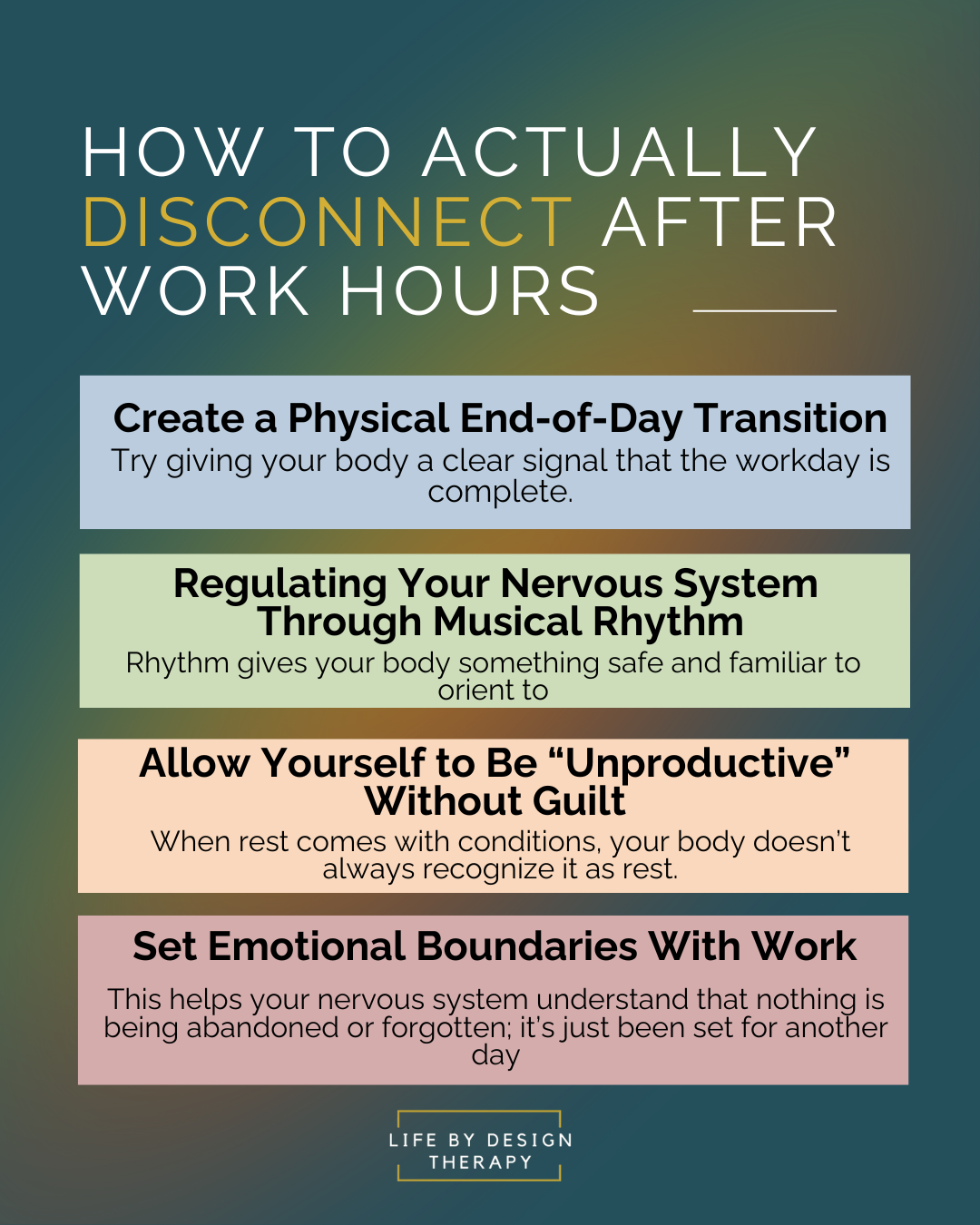
1. Create a Physical End-of-Day Transition
Try giving your body a clear signal that the workday is complete.
This could look like:
Changing clothes immediately after work
Washing your hands or face slowly and intentionally
Stepping outside for 2–5 minutes
Putting your work bag or laptop in a closed drawer
As you do this, try silently saying:
“Work is done for today.”
Not to convince yourself, but to help your body register that the workday has ended.
If you want a deeper understanding of why transitions matter so much, learn more in our blog, 5 Intentional Transitions for a Regulated Mind & Body.
2. Discharge the Day From Your Body (Before You Try to Rest)
Before rest can happen, activation needs somewhere to go.
Here are a few grounding activities to try for 1–5 minutes:
Gentle shaking (arms, legs, shoulders)
A slow walk without headphones
Stretching your neck, jaw, and hips
Standing and pushing your palms into a wall
Rather than thinking of it as exercise, approach it as a way to intentionally release built-up energy, staying connected to your body as it moves, so that energy doesn’t remain stuck.
Remember, your body has been holding things all day. So, let it empty the load.
3. Regulating Your Nervous System Through Musical Rhythm
If you’re someone who goes from “go, go, go” and expects to drop straight into stillness, I have something gentle for you to try.
Instead of forcing your body to stop, offer some rhythm instead.
Gentle, predictable rhythm helps your nervous system release activation gradually, rather than dropping it into silence all at once. You might try:
Cooking or cleaning with music playing at a steady pace
Walking while matching your steps to a song or beat
Rocking, swaying, or moving gently in time with music
Humming or singing quietly, letting your breath follow the rhythm
Rhythm gives your body something safe and familiar to orient to, signaling that it’s okay to soften and settle now.
4. Set Emotional Boundaries With Work (Not Just Time Boundaries)
Even when work is over, your emotional system may still feel responsible for staying alert, responsive, and available.
Try asking yourself:
What am I still carrying that I can save for tomorrow?
What can I set aside so I can be more present right now?
You might even visualize placing unfinished tasks away somewhere safe, like on a shelf, in a box, behind a door, until the next workday.
This helps your nervous system understand that nothing is being abandoned or forgotten; it’s just been set for another day.
Setting boundaries like this is a form of nervous system care and self-compassion. If you want to dive deeper, read more in our blog, Mindful Limits: The Connection Between Boundaries & Self-Compassion.
5. Allow Yourself to Be “Unproductive” Without Guilt
I want to pause here for a moment, because I know this part can feel uncomfortable for some people.
If you’re someone who struggles to slow down or feels uneasy when you’re not being productive, I completely understand.
For many high-functioning people, rest has quietly become something you earn after doing enough, giving enough, or holding everything together.
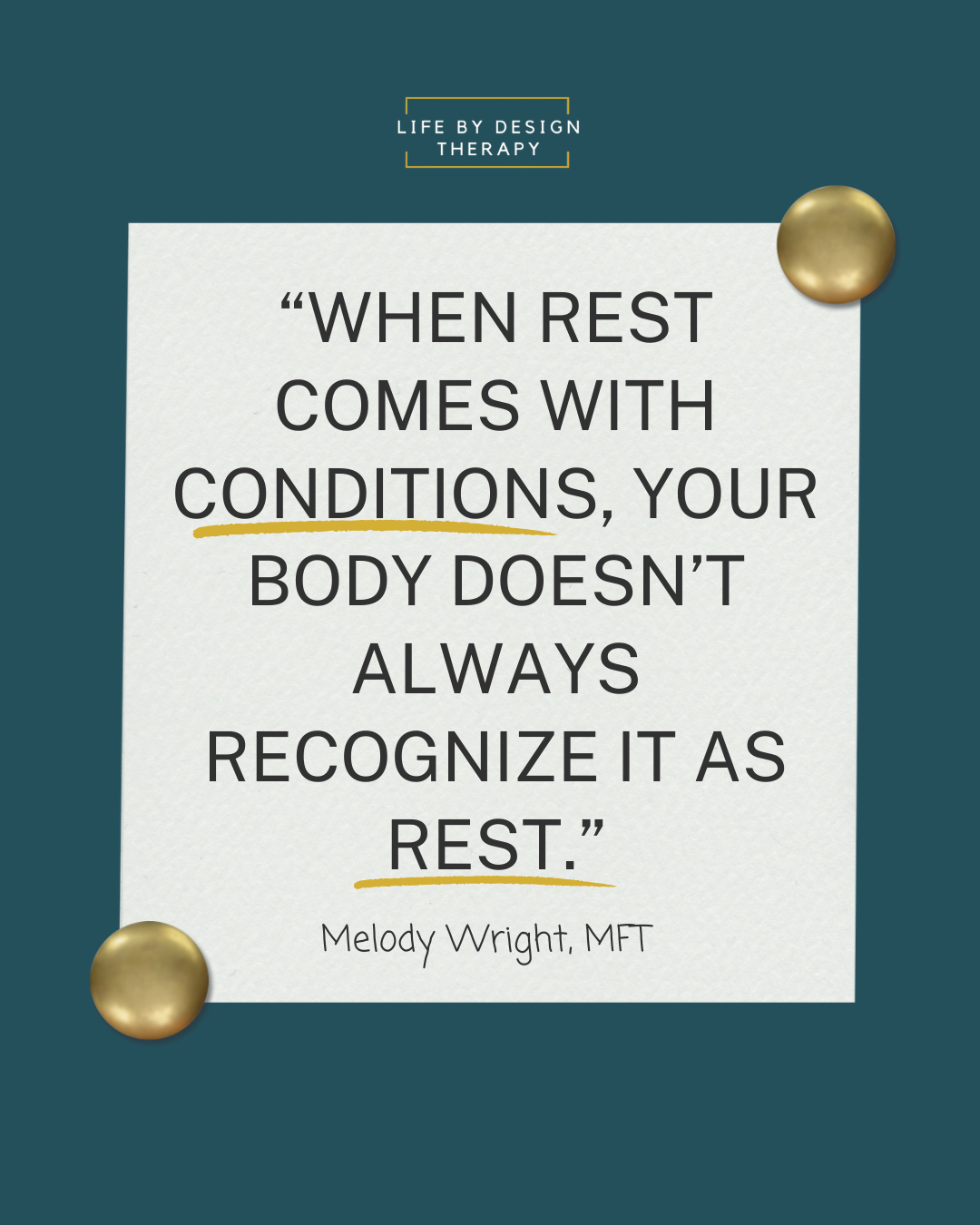
When rest comes with conditions, your body doesn’t always recognize it as rest.
Even when you stop working, part of you may stay tense waiting for the next task, the next responsibility, or the moment you “should” be doing something again.
What actually helps isn’t proving you’ve earned a break, but allowing your body to experience rest as something safe and allowed.
You are allowed to:
Do nothing
Be quiet
Move slowly
Be human
Your worth doesn’t disappear when work ends. And rest isn’t something you have to justify to deserve.
If You Can’t Disconnect No Matter What You Try
If evenings feel consistently overwhelming, disconnected, or emotionally heavy, it may not just be work stress.
Many people are unknowingly carrying:
Chronic stress patterns
Trauma responses
Caretaking roles that never turn off
Survival-based productivity
Somatic therapy helps explore why your nervous system stays on high alert and how to teach it that rest is safe again.
This isn’t about forcing calm or doing it “right.” It’s about slowly learning how to trust your body and its needs.
Final Thoughts
Disconnection is a skill, not a switch that you can turn off and on.
In a culture that praises productivity and minimizes nervous system health, many of us are doing the best we can with tools that were never designed for long-term regulation.
This dynamic is a major contributor to chronic work stress and burnout. To learn more, read our blog on how to manage stress and prevent burnout in the workplace.
Disconnecting isn’t about doing more self-care.
It’s about allowing your body to release what it’s been holding all day.
And that’s something you can learn, gently, safely, and at your own pace.
This Week's Affirmations
Rest is not a reward to achieve. Rest is a need.
I can be present without being responsible for everything.
I am supported as I transition from work mode into rest.
My workday is over, and my body is allowed to rest now.
My worth does not depend on how much I accomplish today.
Additional Resources
**If you’re interested in learning more about ways to prioritize your mental health in and out of the workplace, check out these books below:
The Body Keeps the Score: Brain, Mind, and Body in the Healing of Trauma by Bessel van der Kolk M.D
Wherever You Go, There You Are: Mindfulness Meditation in Everyday Life by Jon Kabat-Zinn PhD
Self-Compassion: The Proven Power of Being Kind to Yourself by Kristin Neff
The End of Burnout: Why Work Drains Us and How to Build Better Lives by Jonathan Malesic
No Hard Feelings: The Secret Power of Embracing Emotions at Work by Liz Fosslien & Molly West Duffy
**Some product links are affiliate links, which means we'll receive a commission if you purchase through our link, at no extra cost to you. Please read the full disclosure here.


10 Ways to Prioritize Your Mental Health During the Holidays
By Melody Wright, LMFT
Every year, it sneaks up on you. One moment you’re lighting a candle or hanging the first ornament, and the next, your mind is already spinning with the gifts to buy, people to please, and plans to finalize.
You tell yourself you’ll slow down after all the boxes are checked on your list, but “after” never seems to come.
You want to feel present, grateful, even, but underneath the to-do lists and family dynamics, something feels off. Maybe you’re holding grief that no one talks about.
Maybe you’re stretched thin trying to make things “special.” Or maybe you just feel disconnected from the joy everyone else seems to be having.
If that’s you, I want you to know it makes sense.
The holidays tend to amplify everything we’re already holding. Not just the love and nostalgia, but also the exhaustion, the loneliness, and the ache for things to be different.
This year, instead of pushing through, what if you cared for yourself the way you care for everyone else?
So, keeping the busy you in mind, here are ten gentle ways to tend to your mental health this season. And guess what, it’s not by doing more, but rather by slowing down to check in with your mind and body.
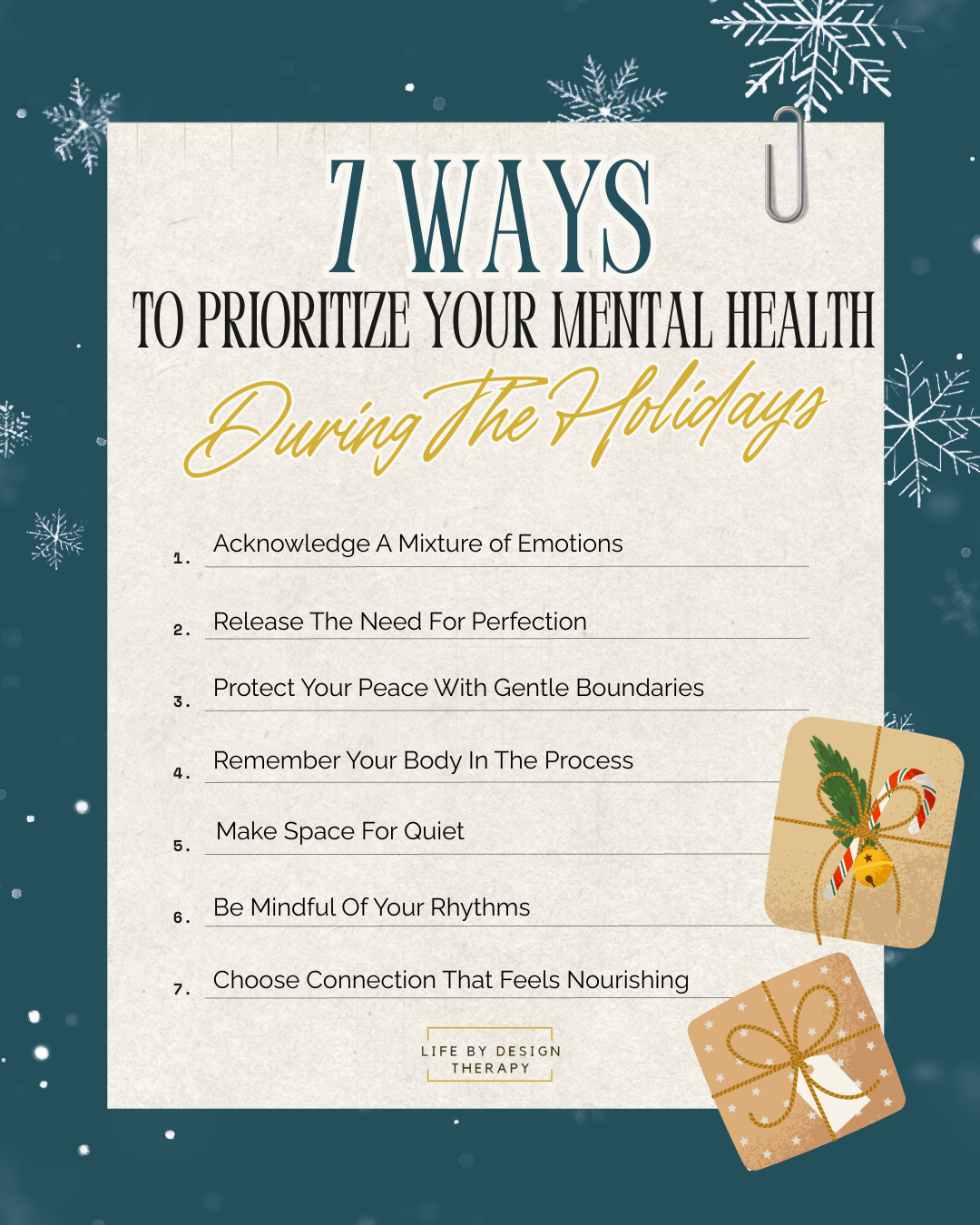
10 Ways to Prioritize Your Mental Health During the Holidays
1. Acknowledge A Mixture of Emotions
The holidays can stir up mixed emotions like joy that your family is together, sadness that it doesn’t look like it used to, gratitude for what you have, or even grief for what’s missing.
Maybe you’re celebrating with friends, but secretly miss the way your childhood home smelled of cinnamon and pine. Maybe you’re surrounded by people but still feel lonely.
Both can be true.
Feeling conflicting emotions doesn’t mean you’re ungrateful; it means you’re emotionally aware.
Our brains are wired for duality; we can hold warmth and sadness, love and loss, hope and fatigue all at once.
Naming what’s here (“I feel grateful and tired”) helps your nervous system relax. It reminds your body it’s safe to feel both without needing to choose one or fix the other.
2. Release The Need For Perfection
We all carry invisible scripts about what the holidays “should” be, whether that be the perfectly decorated home, the happy family photo, or the sense of magic and meaning.
But those expectations often clash with real life: schedules, grief, stress, and fatigue.
When we chase perfection, we disconnect from presence.
Let “enough” be the new goal. If you’re running behind on dinner, if the gifts end up in bags instead of perfectly wrapped, or if you keep some traditions simple this year, I want you to know that it’s okay.
The people who love you don’t need the curated version of you; they need the one who can laugh at the burnt cookies and still enjoy the moment.
Releasing perfection isn’t giving up; it’s coming back to what matters: connection, calm, and authenticity.
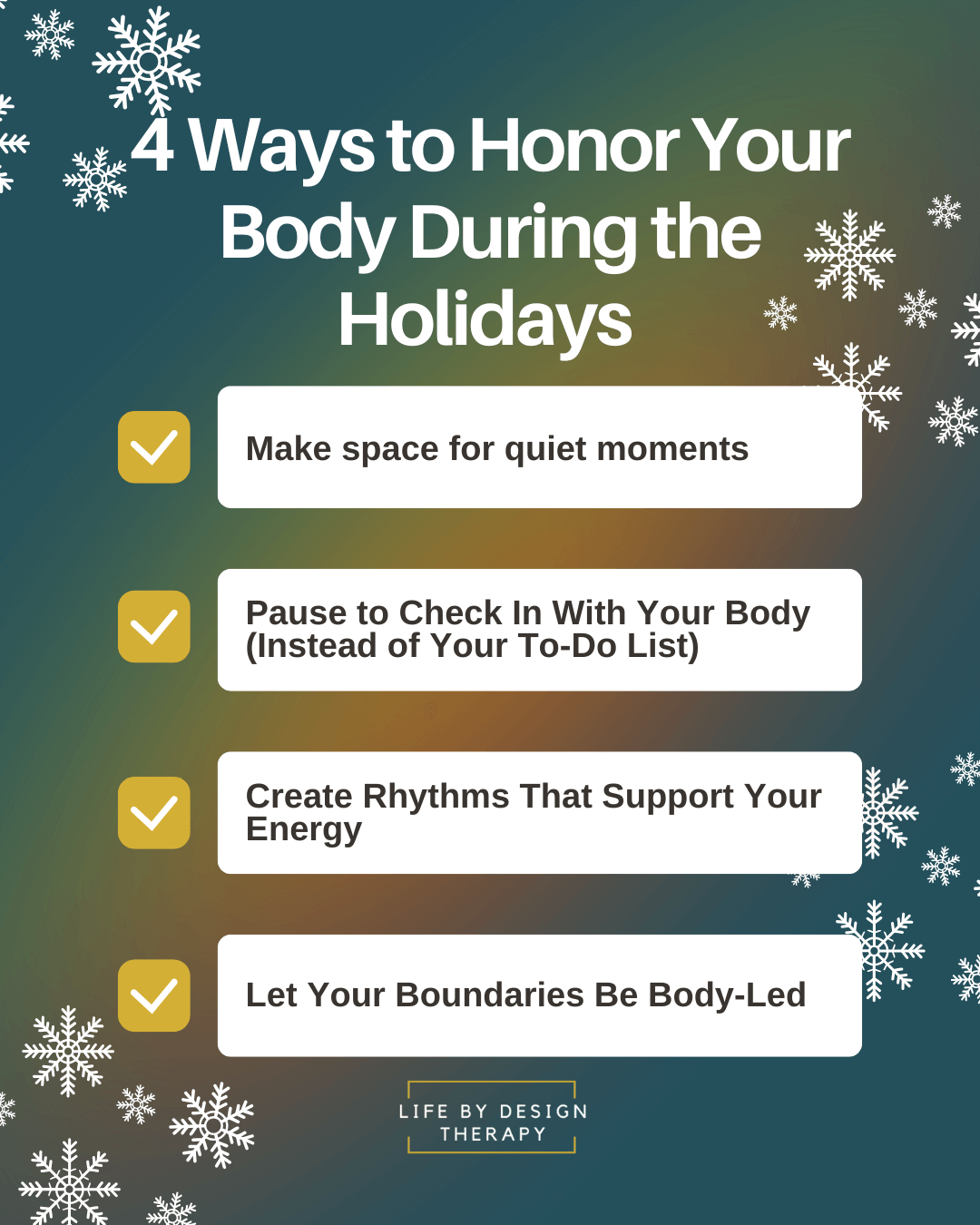
3. Communicate Gentle Boundaries to Protect Your Peace
The holidays can pull you in every direction. The family gatherings, work parties, and obligations that sound good on paper but can leave you drained in reality.
It’s okay to say no.
You’re not selfish for needing rest or for skipping an event that feels more stressful than joyful.
“Boundaries make it possible to show up for people in a way that feels good, not draining.”
They sound like:
“I can come for an hour, but I’ll need to head home early.”
“I’d love to help, but I don’t have the bandwidth this week.”
“That topic feels a little heavy for me right now. Can we come back to it tomorrow when I’ve been able to process this longer?”
Each boundary is a small act of nervous system regulation, a reminder that you can stay connected without abandoning yourself.
If you’d like to explore this more deeply, read our blog, Mindful Limits: The Connection Between Boundaries and Self-Compassion, a guide to creating boundaries that protect your peace without disconnecting from the people you love.
4. Remember Your Body In The Process
Your body experiences the holidays just as much as your mind does: the travel, the sugar, the noise, the lights, the constant stimulation.
When your system is overstimulated, your body shifts into protection mode. You might notice tight shoulders, shallow breathing, or zoning out when things get too loud.
To come back to safety, try:
Taking a long exhale (it tells your vagus nerve you’re safe).
Pressing your feet down and feeling the support under your feet.
Looking around the room and naming five things you see.
These small grounding moments bring you back to your body, and your body back to the present.
5. Make Space For Quiet
Stillness can feel foreign when life is busy, but it’s often the medicine your body needs most.
Remember, you don’t have to fill every moment with conversation or tasks.
Give yourself permission to have quiet mornings, slow walks, and maybe a few hours away from your phone.
Making intentional space for quiet moments allows your mind and body to rest and recalibrate.
6. Choose Connection That Feels Nourishing
Not every relationship feels good during the holidays. Some gatherings are filled with love; others might leave you feeling small or misunderstood.
This year, choose depth over obligation. Spend time with people who see you, rather than those who drain your energy.
If you’re alone this season, connection can look different. Try volunteering, attending a community event, or simply sitting in a cozy café surrounded by quiet company.
Loneliness often softens when we’re witnessed, even by strangers.
7. Honor The Grief That Lingers
Loss doesn’t take a holiday.
Whether it’s the loss of a person, a relationship, or simply a season of life that’s gone, it’s okay if joy feels tender.
Grief has a way of resurfacing in small ways like a song on the radio, a scent, an empty chair at the table.
If you feel yourself tearing up in the middle of something “happy”, that’s your heart remembering.
It’s okay to create space for remembrance. You can try lighting a candle, looking at photos, or carrying on a tradition. You’re not inviting sadness; you’re giving your love a place to land.
Grief doesn’t have to be something you carry alone.
If you’d like more support with this part of the season, read our blog on Navigating Grief During the Holidays, a compassionate guide to honoring your loss, tending to your emotions, and finding gentle moments of connection amid the pain.
8. Be Mindful Of Your Rhythms
During the holidays, it’s easy to slip out of the routines that support you. Late nights, heavy foods, skipped meals, or extra caffeine can all shift your mood and energy.
Instead of strict rules, focus on a gentle rhythm.
Get sunlight each morning.
Hydrate between gatherings.
Move your body in ways that feel good.
Prioritize sleep whenever possible.
Think of rhythm as nervous system hygiene; small ways to signal to your body that it is allowed to rest and recover, even when it’s busy.
9. Let Money Mirror Your Values, Not Your Stress
Financial stress can quietly erode holiday joy. The pressure to buy, decorate, or give beyond your means can come from comparison.
Ask yourself: What do I want this season to feel like? Then spend in alignment with that.
Maybe that means smaller gifts and more shared meals. Maybe it’s homemade items or acts of service.
Gifts rooted in meaning, not money, are the ones that linger.
10. Ask For Help Before You Hit The Wall
Many of us wait until we’re burned out to reach for help. But emotional overwhelm isn’t a sign of weakness; it’s a signal that your system has been doing too much for too long.
Support can look like therapy, a support group, or simply being honest with a trusted friend.
Sometimes the most healing thing you can do is admit that you can’t hold it all alone anymore.
You don’t have to. ❤️
Final Thoughts
Even though this might go against the grain of society, I want you to remember that as the year slows down, so can you.
You don’t have to earn your rest by running yourself into the ground.
You’re allowed to have a slower season, one that values peace over performance.
Caring for your mental health during the holidays isn’t selfish; it’s sacred and vitally important.
Because when you tend to your body and mind, you make room for a kind of calm that doesn’t depend on everything going right, it comes from feeling safe right where you are.
🌱 If you’re ready to create that kind of safety in your own life, therapy can help you reconnect with yourself in a deeper way.
Visit Life By Design Therapy™ to learn more about somatic and holistic therapy for nervous system regulation and stress recovery.
This Week's Affirmations
My worth isn’t measured by how much I give or do.
I release the need for perfection and return to what’s real.
My body deserves the same gentleness I offer to others.
It’s okay to move slower than the world around me.
I am allowed to create new traditions that fit who I am now.
Additional Resources
**If you’re interested in learning more about ways to prioritize your mental health, check out these books below:
Self-Compassion: The Proven Power of Being Kind to Yourself by Kristin Neff
Wherever You Go, There You Are: Mindfulness Meditation in Everyday Life by Jon Kabat-Zinn
The End of Burnout: Why Work Drains Us and How to Build Better Lives by Jonathan Malesic
**Some product links are affiliate links, which means we'll receive a commission if you purchase through our link, at no extra cost to you. Please read the full disclosure here.

How to Manage Stress and Prevent Burnout in the Workplace
By Melody Wright, LMFT

It started on a Wednesday.
I was sitting at my desk, halfway through a meeting, when I realized I hadn’t stopped all morning.
My inbox was overflowing, my shoulders ached, and my brain was locked on one thought: “Just get through the day.”
Sound familiar?
Workplace stress has become so normalized that many of us don’t notice how much it’s draining our energy and dysregulating our nervous system, until we’re completely depleted.
While many of us desire to be okay and live with a sense of purpose and peace, it’s hard to regulate and find those moments in the midst of hustle culture.
If this is resonating with you, I want to remind you that you cannot continue to push through and find that sense of peace.
Regulating comes from slowing down, creating space for rest, and allowing your body to return to balance.
The good news? You can learn to manage stress and prevent burnout from work.
If you’ve been struggling to manage stress during the work day, I have come up with 7 ways (grounded in psychology, holistic health, and my own lived experience) to support nervous system recovery and help you restore balance at work.
7 Ways To Manage Stress and Prevent Burnout at Work
1. Start your day with intention, not reaction
Before the day begins to pull you in a dozen directions, take a few minutes to decide how you want to move through it.
What kind of energy do you want to bring into your meetings, your emails, your interactions?
What words describe how you want to feel?
🌻Calm
🌻Present
🌻Grounded
🌻Open
🌻Focused
Starting your day with intention means consciously choosing how you want to show up, rather than reacting to whatever comes first.
That might involve:
Reviewing your schedule the night before
Prioritizing what matters most, or
Setting a gentle theme for the day (ex: “steady,” “patient,” or “clear.”)
When you orient your day around intention, you teach your nervous system what safety feels like before the chaos begins.
By starting your day with intention and direction, you’ll notice that your focus sharpens and your communication will feel smoother, helping your entire day flow more naturally.
2. Take mini-breaks to reset your nervous system
We often think rest requires a long pause, but your body can begin to reset in less than two minutes.
Try standing up, walking around the office, taking a quick stretch, or taking three slow breaths between meetings.
These short rests signal to your nervous system that the last task is complete and it’s safe to shift gears.
When you add in short moments of recovery throughout the day, you prevent stress from stacking up and give your body a chance to restore energy as you go.
“Sustaining your well-being at work isn’t about avoiding stress altogether; it’s about learning to recover in real time so you can stay steady and clear-headed through the day’s demands.”
3. Notice the stories your mind tells you
When something stressful happens, like a missed deadline, a hard conversation, or unexpected feedback, your body reacts first. You may notice your heart rate increase, your chest might tighten, and your brain might start creating a story to make sense of it.
Those thoughts might sound like:
💔 “I can’t handle this.”
💔 “I always mess up.”
💔 “They must be disappointed in me.”
These aren’t just random negative thoughts; they’re signs that your nervous system is activated and your brain is trying to protect you from perceived danger, including fear of failure, rejection, or perfectionism.
When you slow down and notice those stories with curiosity instead of judgment, you interrupt the thoughts that lead to stress, overwhelm, and burnout.
Try gently reframing the thought with compassion by saying:
“This is stressful, but I’m capable of working through it.”
“I made a mistake, but I can repair it.”
Meeting your thoughts this way helps your body feel supported instead of threatened.
You’ll find it’s easier to stay composed in difficult moments and to keep your day moving without carrying the emotional weight of every challenge that comes up in the workday.
4. Regulate your body, not just your calendar
No amount of color-coded scheduling can fix a dysregulated nervous system. Before diving into the next task or meeting, take a moment to return to your body.
Notice your posture, unclench your jaw, drop your shoulders, and take one deep breath.
Pay attention to the signals your body gives you, when your chest tightens or your breath shortens, pause and reconnect:
Press your feet into the ground
Exhale longer than you inhale
Look around the room and name what you see
These techniques are called grounding tools. They help your nervous system register safety, allowing focus, creativity, and clarity to return.
When your body feels steady, you’re able to think clearly, communicate effectively, and move through the workday with more ease.
If you would like more grounding tools for the office, check out our free download, 20 Calming Techniques You Can Do at Your Desk.
5. Protect your energy through clear boundaries
For many people, boundaries can feel uncomfortable, especially if you’ve spent years equating being dependable with saying “yes.”
You might worry that setting limits will disappoint others, create conflict, or make you seem less committed. Those feelings are valid. Boundaries can stir up a lot of vulnerability, especially in work cultures that reward constant availability.
But boundaries aren’t about pulling away; they’re about protecting your capacity, the energy that lets you show up fully and sustainably.
When you say “no” to what drains you, you’re saying “yes” to focus, presence, and longevity in the work you care about.
Start small. End your workday on time, pause before taking on a new task, or take your lunch break without multitasking.
“Each time you honor your limits, you signal safety to your nervous system, and you’ll notice how much clearer and more balanced you feel during your workday.”
If you would like to learn more about boundaries, check out our blog, Mindful Limits: The Connection Between Boundaries and Self-Compassion.

6. Reconnect with your purpose
There will be seasons when work feels more like survival than purpose; that’s just the ebbs and flows of life. But when your nervous system is in constant go-mode, it might be harder to connect to what matters, especially the moments when everything starts to feel like just another task to get through.
You might catch yourself thinking, “What’s the point?” or drifting through the day on autopilot.
It’s okay if you don’t feel inspired every day.
Sometimes reconnecting with purpose begins with noticing the smallest things that matter.
Maybe it’s the way your work supports your family.
Maybe it’s helping a client feel seen, finding a creative solution to a problem, or being part of a team that makes someone’s day easier.
Or maybe it’s the quiet pride of doing something well, even when no one’s watching.
Purpose doesn’t remove stress, but it gives your mind and body something to anchor to when things feel heavy.
When you reconnect to why you’re doing what you do, even in small ways, you bring meaning back into your workday and remind your nervous system that effort and purpose can coexist.
7. Lead with self-compassion
Managing stress isn’t built by being hard on yourself; it’s built by showing yourself compassion.
When you make a mistake, fall behind, or feel overwhelmed, notice how you speak to yourself.
Would you say those same words to a colleague or a friend?
I want you to try offering yourself the same understanding.
Self-compassion keeps your nervous system calm, which helps your brain recover, refocus, and stay adaptable.
Remember, when you treat yourself with kindness instead of criticism, your entire workday shifts. You’ll handle challenges with patience and end the day feeling grounded rather than drained.
Final Thoughts/Reflections
Work will always bring deadlines, challenges, and unpredictable moments, but the way you meet them determines how your body and mind experience the day.
Remember, managing stress and preventing burnout isn’t about doing more or toughing it out.
It’s about slowing down enough to notice what your body needs, creating space for recovery, and honoring your limits so you can sustain what truly matters: your peace, your purpose, and your capacity to show up fully.
Therapy can be a powerful support in this process.
At Life By Design Therapy™, our holistic and somatic therapists help high-achieving professionals and caregivers in California recover from burnout, manage work stress, and restore nervous system balance.
With the help of our holistic and somatic therapists, you don’t have to force yourself to feel okay. With the right support, your nervous system can relearn how to feel safe, calm, and grounded again.
This Week's Affirmations
It’s okay if I don’t feel inspired every day; I can still move through the day with intention.
My worth is not defined by how much I achieve.
I trust my body to tell me when I need to slow down.
My boundaries are acts of care, not rejection.
I can care deeply about my work without losing myself in it.
Additional Resources
**If you’re interested in learning more about building resilience, check out these books below:
Self-Compassion: The Proven Power of Being Kind to Yourself by Kristin Neff
No Hard Feelings: The Secret Power of Embracing Emotions at Work by Liz Fosslien & Molly West Duffy
Wherever You Go, There You Are: Mindfulness Meditation in Everyday Life by Jon Kabat-Zinn
The End of Burnout: Why Work Drains Us and How to Build Better Lives by Jonathan Malesic
**Some product links are affiliate links, which means we'll receive a commission if you purchase through our link, at no extra cost to you. Please read the full disclosure here.