

The Post-Holiday Slump: Why You Feel Off After the Holidays (and How to Recover)
By Melody Wright, LMFT
There’s something about the quiet after the holidays that can feel both peaceful and heavy.
The lights come down, the house feels still, and all that energy that carried you through December starts to fade.
You might notice a dip in motivation or find yourself feeling flat, restless, or even a little lost. And you might have caught yourself wondering, Why do I feel this way after such a joyful time?
Many people experience what’s often called the post-holiday slump, which is an emotional crash that follows after weeks of anticipation, connection, and constant stimulation.
After running on adrenaline and social energy, your nervous system is simply recalibrating.
So don’t worry about starting the year off wrong. Instead, remember that you’re actually coming back into the normal rhythm of everyday life.
However, understanding why you feel off can help you meet yourself with compassion instead of pressure.
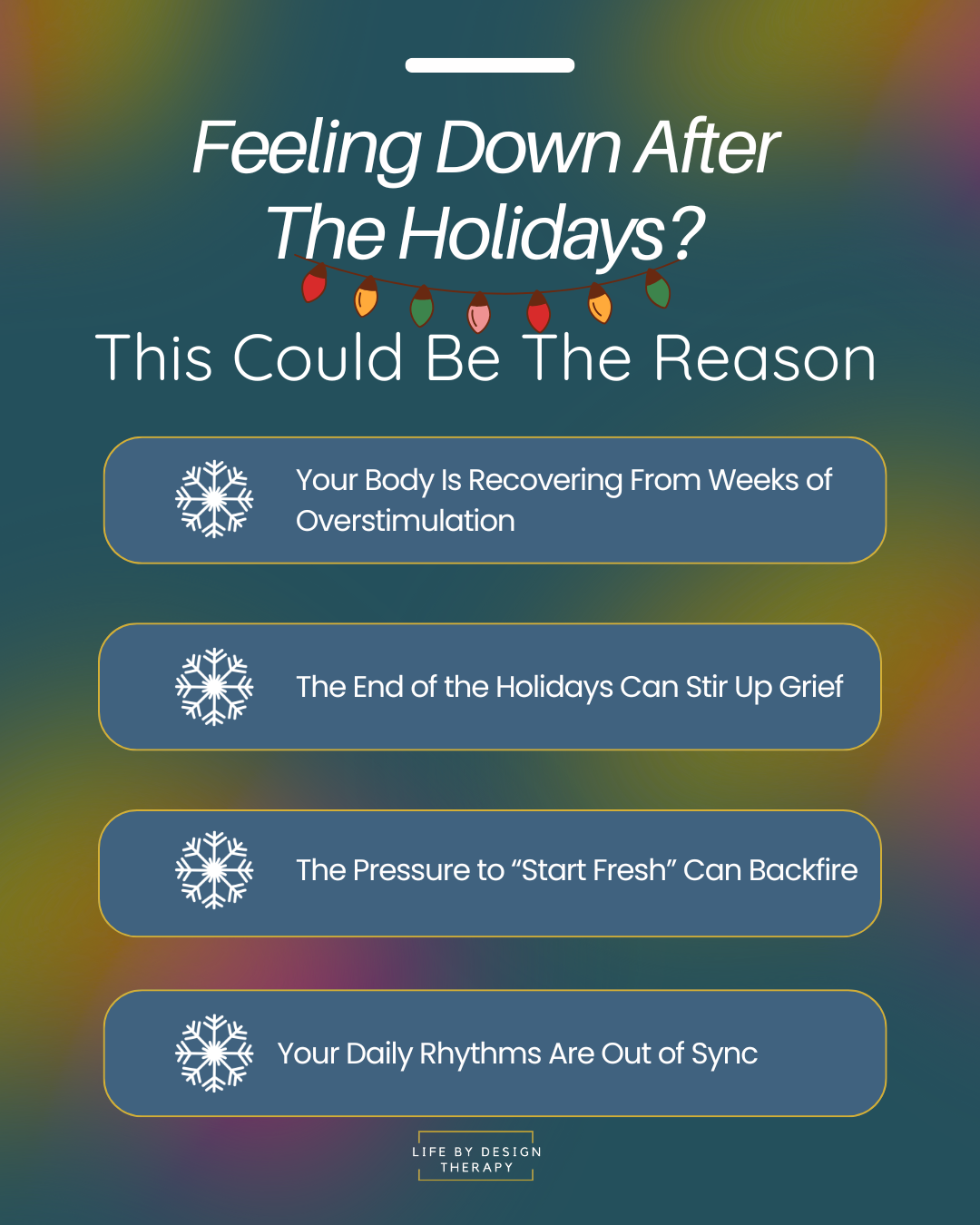
Here are seven reasons this slump happens and how to recover with gentleness and care.
1. Your Brain Is Coming Down From a Dopamine High
The holidays are filled with anticipation: the planning, socializing, connecting, giving, and receiving. Each of these moments triggers dopamine, the “feel-good” neurotransmitter responsible for motivation and excitement.
When the celebrations end, the dopamine rush fades. Without all the novelty and anticipation, your brain’s reward system quiets down, leaving you feeling emotionally flat or unmotivated.
Therapist Tip: Reintroduce smaller, sustainable forms of pleasure. Seek natural light, move your body, listen to music, or create something. Simple joys help your brain rebalance without overstimulation.
2. Your Body Is Recovering From Weeks of Overstimulation
Even when the holidays are filled with love and joy, they’re also full of stimulation: travel, crowds, sugar, disrupted sleep, and heightened emotion. For weeks, your nervous system has been in “go mode.”
When everything slows down, your body finally has space to process that energy. You might feel exhausted, irritable, or foggy, and it’s not necessarily because something’s wrong, but because your body is trying to return to regulation.
Therapist Tip: Gently regulate your nervous system. Try slow breathing, mindful movement, or grounding exercises that help your body shift from survival to safety.
3. Emotional Whiplash Is Real
Your body keeps track of rhythm and energy, and the holidays can feel like an emotional rollercoaster. Between joy, stress, nostalgia, and sensory overload, your system spends weeks riding emotional highs and lows.
When it’s suddenly quiet, your body doesn’t know what to do with all that leftover energy. You might feel restless, uneasy, or even a little sad, not because anything is wrong, but because your body is trying to find equilibrium again.
Therapist Tip: Let your emotions settle without judgment. Gentle movement, breathwork, or even a slow walk can help your body release stored emotional energy and return to balance.
4. The End of the Holidays Can Stir Up Grief
Even good endings can stir up grief. A new year has a way of making you think about who’s not here, what’s shifted, or what didn’t turn out the way you hoped. For some, being around family or friends can also trigger old emotional patterns that linger after the gatherings end.
What you’re feeling is your body integrating the emotional weight of the season.
Therapist Tip: Let yourself name what you’re feeling, whether it’s sadness, nostalgia, relief, or even emptiness. Acknowledging those emotions allows them to move through instead of getting stuck.
If you’re noticing waves of sadness or reflection surface this time of year, read our blog All About Grief: 6 Ways to Care for Yourself While Grieving

5. The Pressure to “Start Fresh” Can Backfire
The cultural push for “New Year, New You” arrives at the exact time your body is asking for rest. When energy is low, the pressure to set big goals or reinvent yourself can feel discouraging.
Your body doesn’t need a productivity plan; it needs recovery. Pushing for change when your system is tired often leads to burnout before February.
Therapist Tip: Think of January as an integration season. Focus on small, grounding habits, consistent sleep, nourishment, and gentle structure, before chasing new goals.
6. Your Daily Rhythms Are Out of Sync
Holiday schedules often mean staying up later, eating differently, and moving less. Those changes affect hormones, digestion, sleep, and mood, all key parts of emotional regulation.
When your body’s rhythms are disrupted, it can make everything feel just a little harder.
Therapist Tip: Re-establish consistency wherever you can. Go to bed and wake up at regular times, eat balanced meals, hydrate, and get natural light. Routine brings your nervous system back into balance.
If getting back into rhythm feels harder than it should, that’s okay. You don’t need to overhaul your life; just begin with one small, steady habit at a time. Read How to Build a Daily Routine to Support Overwhelm for ways to create structure that supports your nervous system and helps you feel more grounded day to day.
7. Your Low Mood Might Be Pointing to Something Deeper
Sometimes what starts as post-holiday fatigue lingers longer than expected. If you notice persistent sadness, loss of interest, or changes in appetite or sleep, it might be more than a seasonal dip.
Therapist Tip: Ask for help. Having support is a way to honor your needs. Therapy can help you understand what your body is communicating and teach tools for grounding and emotional regulation.
At Life By Design Therapy™, our somatic and holistic therapy approach helps clients reconnect to their bodies, regulate their nervous systems, and rebuild emotional balance.
Final Thoughts
If you’re feeling off after the holidays, it doesn’t mean you’ve lost your spark; it means your body and mind are finding balance again.
The truth is, we’re not meant to live in constant motion. The quieter pace of the new year isn’t a setback; it’s an invitation, giving you a chance to exhale after the rush, to listen more closely to what you need, and to rebuild your rhythm one gentle step at a time.
Remember to give yourself permission to rest, reflect, and move slowly into what’s next.
Healing and regulation aren’t born from pressure; they grow from presence.
This Week's Affirmations
I am allowed to slow down without losing momentum.
I honor the pace my body needs to recover.
I choose presence over perfection as I move into this new season.
I can hold both gratitude and sadness without judging either.
My body knows how to find its rhythm again.
Additional Resources
**If you’re looking for gentle ways to care for your mind and body as you ease into the new year, these books offer thoughtful insight and comfort.
Wintering: The Power of Rest and Retreat in Difficult Times by Katherine May
Self-Compassion: The Proven Power of Being Kind to Yourself by Kristin Neff
Radical Acceptance: Embracing Your Life With the Heart of a Buddha by Tara Brach
The Power of Now: A Guide to Spiritual Enlightenment by Eckhart Tolle
The Body Keeps the Score: Brain, Mind, and Body in the Healing of Trauma by Bessel van der Kolk M.D
Burnout: The Secret to Unlocking the Stress Cycle by Emily Nagoski and Amelia Nagoski
When the Body Says No: The Cost of Hidden Stress by Gabor Maté
The Untethered Soul: The Journey Beyond Yourself by Michael A. Singer
**Some product links are affiliate links, which means we'll receive a commission if you purchase through our link, at no extra cost to you. Please read the full disclosure here.


10 Ways to Prioritize Your Mental Health During the Holidays
By Melody Wright, LMFT
Every year, it sneaks up on you. One moment you’re lighting a candle or hanging the first ornament, and the next, your mind is already spinning with the gifts to buy, people to please, and plans to finalize.
You tell yourself you’ll slow down after all the boxes are checked on your list, but “after” never seems to come.
You want to feel present, grateful, even, but underneath the to-do lists and family dynamics, something feels off. Maybe you’re holding grief that no one talks about.
Maybe you’re stretched thin trying to make things “special.” Or maybe you just feel disconnected from the joy everyone else seems to be having.
If that’s you, I want you to know it makes sense.
The holidays tend to amplify everything we’re already holding. Not just the love and nostalgia, but also the exhaustion, the loneliness, and the ache for things to be different.
This year, instead of pushing through, what if you cared for yourself the way you care for everyone else?
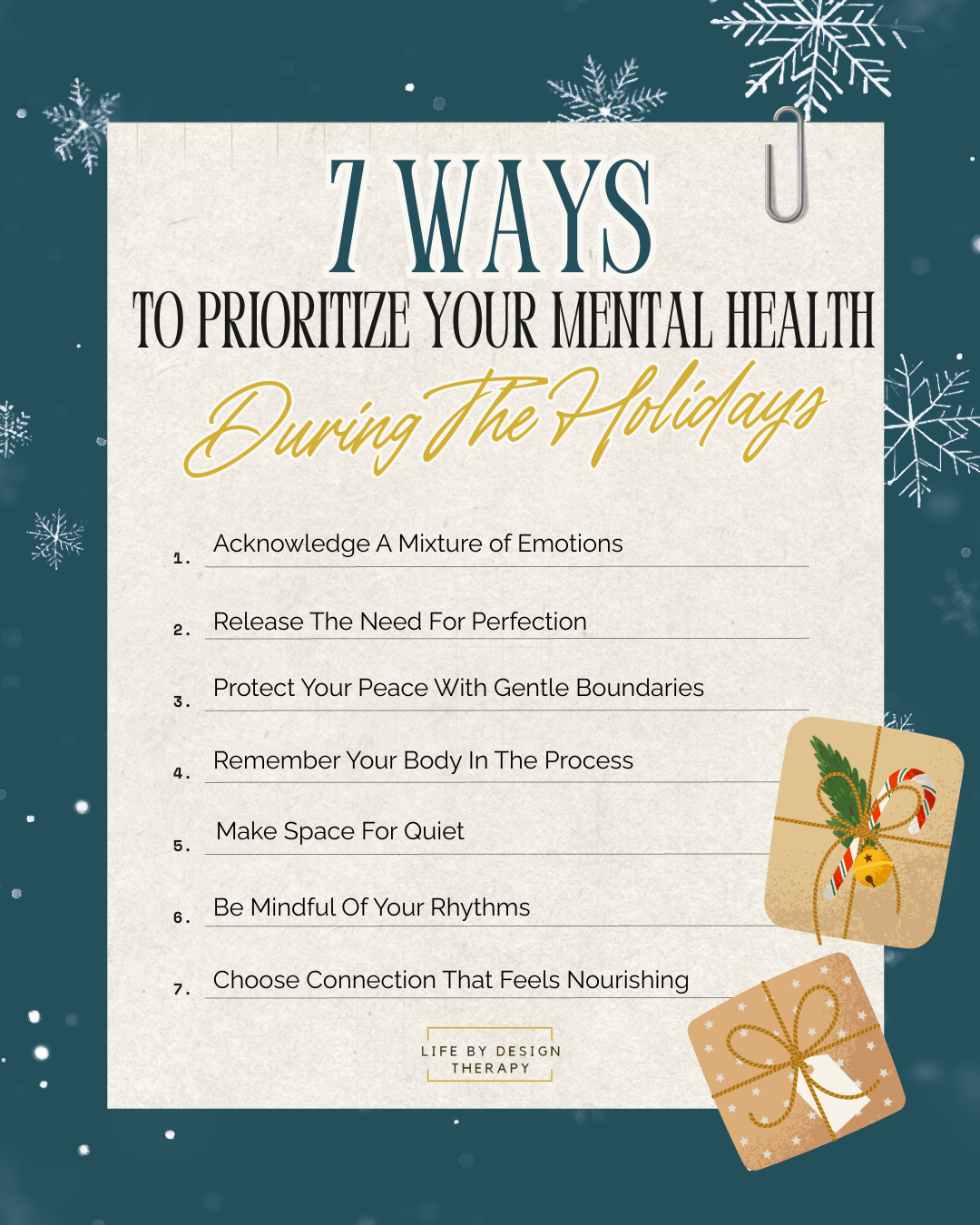
So, keeping the busy you in mind, here are ten gentle ways to tend to your mental health this season. And guess what, it’s not by doing more, but rather by slowing down to check in with your mind and body.
10 Ways to Prioritize Your Mental Health During the Holidays
1. Acknowledge A Mixture of Emotions
The holidays can stir up mixed emotions like joy that your family is together, sadness that it doesn’t look like it used to, gratitude for what you have, or even grief for what’s missing.
Maybe you’re celebrating with friends, but secretly miss the way your childhood home smelled of cinnamon and pine. Maybe you’re surrounded by people but still feel lonely.
Both can be true.
Feeling conflicting emotions doesn’t mean you’re ungrateful; it means you’re emotionally aware.
Our brains are wired for duality; we can hold warmth and sadness, love and loss, hope and fatigue all at once.
Naming what’s here (“I feel grateful and tired”) helps your nervous system relax. It reminds your body it’s safe to feel both without needing to choose one or fix the other.
2. Release The Need For Perfection
We all carry invisible scripts about what the holidays “should” be, whether that be the perfectly decorated home, the happy family photo, or the sense of magic and meaning.
But those expectations often clash with real life: schedules, grief, stress, and fatigue.
When we chase perfection, we disconnect from presence.
Let “enough” be the new goal. If you’re running behind on dinner, if the gifts end up in bags instead of perfectly wrapped, or if you keep some traditions simple this year, I want you to know that it’s okay.
The people who love you don’t need the curated version of you; they need the one who can laugh at the burnt cookies and still enjoy the moment.
Releasing perfection isn’t giving up; it’s coming back to what matters: connection, calm, and authenticity.
3. Communicate Gentle Boundaries to Protect Your Peace
The holidays can pull you in every direction. The family gatherings, work parties, and obligations that sound good on paper but can leave you drained in reality.
It’s okay to say no.
You’re not selfish for needing rest or for skipping an event that feels more stressful than joyful.
“Boundaries make it possible to show up for people in a way that feels good, not draining.”
They sound like:
“I can come for an hour, but I’ll need to head home early.”
“I’d love to help, but I don’t have the bandwidth this week.”
“That topic feels a little heavy for me right now. Can we come back to it tomorrow when I’ve been able to process this longer?”
Each boundary is a small act of nervous system regulation, a reminder that you can stay connected without abandoning yourself.
If you’d like to explore this more deeply, read our blog, Mindful Limits: The Connection Between Boundaries and Self-Compassion, a guide to creating boundaries that protect your peace without disconnecting from the people you love.
4. Remember Your Body In The Process
Your body experiences the holidays just as much as your mind does: the travel, the sugar, the noise, the lights, the constant stimulation.
When your system is overstimulated, your body shifts into protection mode. You might notice tight shoulders, shallow breathing, or zoning out when things get too loud.
To come back to safety, try:
Taking a long exhale (it tells your vagus nerve you’re safe).
Pressing your feet down and feeling the support under your feet.
Looking around the room and naming five things you see.
These small grounding moments bring you back to your body, and your body back to the present.
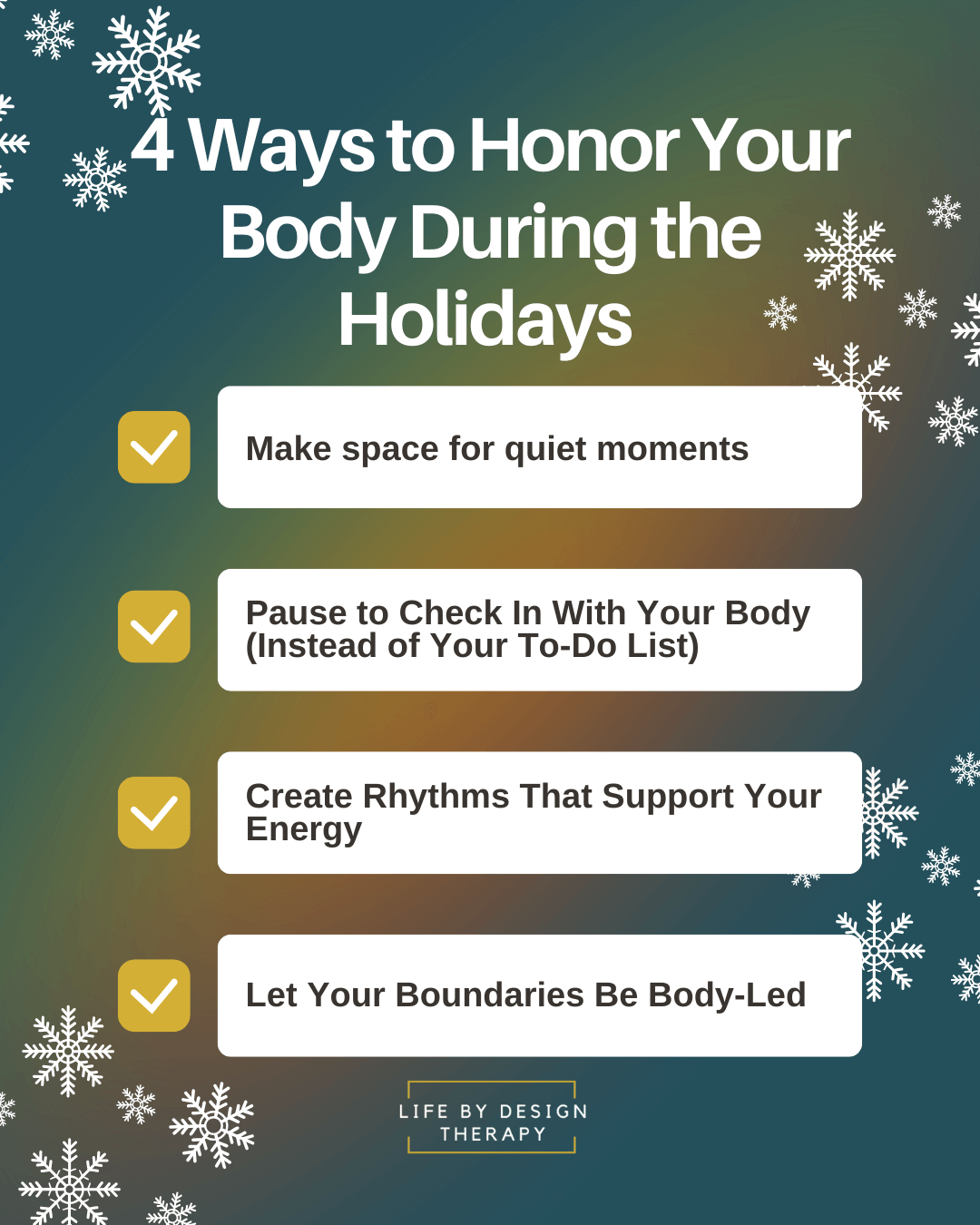
5. Make Space For Quiet
Stillness can feel foreign when life is busy, but it’s often the medicine your body needs most.
Remember, you don’t have to fill every moment with conversation or tasks.
Give yourself permission to have quiet mornings, slow walks, and maybe a few hours away from your phone.
Making intentional space for quiet moments allows your mind and body to rest and recalibrate.
6. Choose Connection That Feels Nourishing
Not every relationship feels good during the holidays. Some gatherings are filled with love; others might leave you feeling small or misunderstood.
This year, choose depth over obligation. Spend time with people who see you, rather than those who drain your energy.
If you’re alone this season, connection can look different. Try volunteering, attending a community event, or simply sitting in a cozy café surrounded by quiet company.
Loneliness often softens when we’re witnessed, even by strangers.
7. Honor The Grief That Lingers
Loss doesn’t take a holiday.
Whether it’s the loss of a person, a relationship, or simply a season of life that’s gone, it’s okay if joy feels tender.
Grief has a way of resurfacing in small ways like a song on the radio, a scent, an empty chair at the table.
If you feel yourself tearing up in the middle of something “happy”, that’s your heart remembering.
It’s okay to create space for remembrance. You can try lighting a candle, looking at photos, or carrying on a tradition. You’re not inviting sadness; you’re giving your love a place to land.
Grief doesn’t have to be something you carry alone.
If you’d like more support with this part of the season, read our blog on Navigating Grief During the Holidays, a compassionate guide to honoring your loss, tending to your emotions, and finding gentle moments of connection amid the pain.
8. Be Mindful Of Your Rhythms
During the holidays, it’s easy to slip out of the routines that support you. Late nights, heavy foods, skipped meals, or extra caffeine can all shift your mood and energy.
Instead of strict rules, focus on a gentle rhythm.
Get sunlight each morning.
Hydrate between gatherings.
Move your body in ways that feel good.
Prioritize sleep whenever possible.
Think of rhythm as nervous system hygiene; small ways to signal to your body that it is allowed to rest and recover, even when it’s busy.
9. Let Money Mirror Your Values, Not Your Stress
Financial stress can quietly erode holiday joy. The pressure to buy, decorate, or give beyond your means can come from comparison.
Ask yourself: What do I want this season to feel like? Then spend in alignment with that.
Maybe that means smaller gifts and more shared meals. Maybe it’s homemade items or acts of service.
Gifts rooted in meaning, not money, are the ones that linger.
10. Ask For Help Before You Hit The Wall
Many of us wait until we’re burned out to reach for help. But emotional overwhelm isn’t a sign of weakness; it’s a signal that your system has been doing too much for too long.
Support can look like therapy, a support group, or simply being honest with a trusted friend.
Sometimes the most healing thing you can do is admit that you can’t hold it all alone anymore.
You don’t have to. ❤️
Final Thoughts
Even though this might go against the grain of society, I want you to remember that as the year slows down, so can you.
You don’t have to earn your rest by running yourself into the ground.
You’re allowed to have a slower season, one that values peace over performance.
Caring for your mental health during the holidays isn’t selfish; it’s sacred and vitally important.
Because when you tend to your body and mind, you make room for a kind of calm that doesn’t depend on everything going right, it comes from feeling safe right where you are.
🌱 If you’re ready to create that kind of safety in your own life, therapy can help you reconnect with yourself in a deeper way.
Visit Life By Design Therapy™ to learn more about somatic and holistic therapy for nervous system regulation and stress recovery.
This Week's Affirmations
My worth isn’t measured by how much I give or do.
I release the need for perfection and return to what’s real.
My body deserves the same gentleness I offer to others.
It’s okay to move slower than the world around me.
I am allowed to create new traditions that fit who I am now.
Additional Resources
**If you’re interested in learning more about ways to prioritize your mental health, check out these books below:
Self-Compassion: The Proven Power of Being Kind to Yourself by Kristin Neff
Wherever You Go, There You Are: Mindfulness Meditation in Everyday Life by Jon Kabat-Zinn
The End of Burnout: Why Work Drains Us and How to Build Better Lives by Jonathan Malesic
**Some product links are affiliate links, which means we'll receive a commission if you purchase through our link, at no extra cost to you. Please read the full disclosure here.

7 Strategies for Surviving Holiday Gatherings
By Melody Wright, LMFT

It’s hard to believe but the holidays are right around the corner.
For some, they are a time of joy and bliss, but for others, the holidays might bring unwanted stress.
I can’t tell you how many stories I’ve heard from people who look forward to the season but secretly dread the pressures that come with it.
Despite our best intentions, it can feel like those pressures bubble up year after year, especially during gatherings.
So, why does that happen? Why does the stress of holiday gatherings feel so overwhelming?
Part of it has to do with family dynamics, but our own stress often plays a big role, sometimes without us even realizing it.
Fortunately, once I understood the reasons behind this pattern, I discovered a few simple strategies that help manage the stress and bring a little more peace to the season.
Here’s what I’ve learned along the way.
Why Conflicts Escalate During the Holidays
If you’ve ever walked into a family gathering with a sense of dread, anticipating an awkward conversation or simmering argument, you’re not alone.
Holiday gatherings can amplify family tensions for many reasons.
However, the pressure we place on ourselves to make everything "perfect" contributes to as much stress as family dynamics do.
When we blend high expectations with old family tensions, the holidays can easily become a time of emotional strain.
Understanding the different stressors, both internal and external, can help us approach gatherings with less pressure, more patience, and a healthier mindset.
Are Your Holiday Expectations Set Too High?
During the holidays, many of us push ourselves to create the “perfect” experience. You know the experience of a beautifully decorated home, a festive meal, and the seamless gift exchanges.
Sometimes we hold an idealized picture of how it should all go, hoping for a flawless, joyous day. However, this high bar we set for ourselves can possibly become a double-edged sword.
When reality falls short of these expectations, it can be easy to feel like we’ve failed or missed the mark, and that frustration can spill over onto those around us.
Combined with family dynamics, this personal pressure can fuel misunderstandings, magnify small tensions, and create a sense of disappointment that leaves everyone feeling strained.
Are You Holding onto Old Grudges and
Unresolved Issues?
It’s no secret that family gatherings have a way of stirring up the past.
Maybe it’s an old argument that never quite got resolved or some long-standing sibling rivalry.
When we’re around family we haven’t seen in a while, those unresolved issues tend to come up, even when you least expect it.
It’s almost like the past sneaks into the present, and suddenly, small disagreements can spiral into something much bigger.
Are Stress and Exhaustion Weighing You Down?
The holidays are exhausting.
Between shopping, cooking, traveling, and trying to please everyone, you might find yourself running on fumes by the time the big family event rolls around.
And when you’re tired, it’s easy for your patience levels to wear thin.
Things that wouldn’t normally bother you, can feel like a much bigger deal than it might be.
Is Financial Pressure Adding to the Stress?
This one might be tough to talk about, but it’s real.
The financial strain of the holidays comes from buying gifts, hosting dinners, or traveling to see family and it can really add up.
It’s easy for those money worries to bleed into family interactions, even when we don’t mean for them to.
Are You Feeling Grief or Loneliness This Holiday Season?
For those of you who’ve lost someone, or are going through a breakup or divorce, the holidays can be especially hard.
When grief is present it might show up as irritability or withdrawal.
There might even be some years where grief makes this holiday harder than the last.
Grief is such a personal experience which makes it tough because not everyone understands what’s really going on inside.
Now that we've gone over why conflicts escalate during the holidays, lets explore way to manage the pressures and conflicts that occur during holiday gatherings.
7 Ways To Manage The Pressures Of The Holiday Gatherings
So, how do we handle all of this without letting the conflict take over? Here are a few strategies that can make a big difference as you navigate upcoming family functions:
Set Realistic Expectations
One thing we need to consider is where these expectations come from. Are they coming from us or the expectations of others?
Actionable Step: Pause and journal out your thoughts. What expectations are you putting on yourself? Where do they stem from? What expectations are coming from others and why do we feel it necessary to meet them?
The truth is, nothing is ever perfect, because everyone has a different perspective of what “perfect” is.
And that’s okay.
When we are able to release the pressure of meeting certain expectations, disappointment has the opportunity to fade away.
Remember, the holidays are about connection, not perfection, and keeping that in mind can really help lower your stress levels.
Recognize Responsibility
If you’re someone who considers yourself a people pleaser, the holidays might be especially tough.
I understand, you desire for everyone to be happy, and when family conflicts start, you might feel like it's on you to smooth things over.
I want to remind you that you are not responsible for the emotions of others.
If tensions flare or arguments break out, it’s not your job to fix everything.
You can’t control how others react, only how you respond.
Do your best to detach from the outcome of the conflict and focus on staying calm and centered.
Remind yourself that it’s okay to set boundaries and you’re not being selfish by taking care of your own mental and emotional well-being. Read Prioritize Your Mental Health During the Holidays.
This might be surprising, but you’ll actually be in a better position to contribute to a healthier, more peaceful atmosphere without taking on the weight of everyone else’s emotions.
This holiday season, give yourself permission to let go of the need to please everyone and remember that your peace is just as important as anyone else’s.
Practicing Active Listening
I’ve found that when tensions rise, listening is my best tool.
Not just listening to respond, but really listening to understand.
When someone else is upset, try to pause and listen without interrupting.
It’s amazing how much it can diffuse a situation just by allowing the other person to feel heard.
Often it’s not about solving the problem right away, but about giving people space to express themselves.
Take Breaks
When things start to feel tense, it’s okay to step away.
Actionable Step: Consider going for a walk or finding a quiet space for a few minutes.
For some powering through is what you’re used to doing, but I want to encourage you to give yourself permission to take a break.
When you’re able to reset you can come back feeling calmer and more patient.
Avoid Sensitive Topics
When things start to feel tense, it’s okay to step away.
Actionable Step: Consider going for a walk or finding a quiet space for a few minutes.
For some powering through is what you’re used to doing, but I want to encourage you to give yourself permission to take a break.
When you’re able to reset you can come back feeling calmer and more patient.
Avoid Sensitive Topics
Let’s be honest, with it being an election year it might be tougher to avoid sensitive topics, but every family has hot-button conversations that are better left alone.
Whether it’s politics, religion, or unresolved family issues, sometimes it is just best to steer clear of those topics during the holidays.
If you feel one starting, I’ll gently change the subject to something lighter. Sometimes, agreeing to disagree is the best way to keep the peace.
Actionable Step: Try preparing redirection phases before your family gathering. For example, “Oh, that’s a big topic, but I would love to hear what you’ve been up to lately, how’s ___ going?”
Address Issues Beforehand
If there’s a lingering issue between you and a family member, it might be better to address it before the holiday gathering.
By having a conversation ahead of time, even just a brief phone call, you can clear the air and prevent unresolved tension from turning into conflict during the holidays.
However, I know how intimidating that can be.
To feel more comfortable addressing issues beforehand, choose a calm, distraction-free time and approach the conversation with kindness, using "I" statements to focus on your feelings rather than blame.
Practicing what you want to say can boost your confidence, and starting with small, neutral topics can ease into more difficult discussions.
Remember that it's okay to set boundaries and pause the conversation if needed.
Try to end on a positive note, acknowledging the effort and focusing on the shared goal of having a peaceful, enjoyable holiday.
Let Go of the Small Stuff
Not everything is worth a fight.
I know sometimes it feels like we need to engage in every argument, but feeling the need to prove ourselves can be exhausting.
Remember this holiday, the goal is to keep our peace.
Embracing the idea of letting go of the little things can ensure that this happens for you.
In the grand scheme of things, does it really matter if you don’t win that debate or if someone has a different opinion?
Choosing to let go doesn’t mean giving up or being passive, it means valuing your inner self and the well-being of your family over being “right.”
It’s freeing to realize that not every disagreement needs to be resolved, and sometimes the best response is no response at all.

final reflections
The holidays can certainly be challenging, but with a bit of patience and a few thoughtful strategies, it’s possible to manage the stress while still enjoying the season.
It’s not about creating a picture-perfect holiday or avoiding every conflict, instead, it’s about finding ways to stay grounded and nurture meaningful connections with the people we care about.
What truly matters are those moments of laughter, shared meals, and quiet connections that bring us together.
Family conflicts may arise, and that’s okay.
They don’t have to define the season.
This Weeks Affirmations
I release the need to control the situation and focus on my own well-being.
I honor my emotions without letting them overwhelm me.
I choose connection and love over the need to be right.
I am capable of creating a joyful, peaceful holiday, no matter what comes my way.
I respond with kindness and patience, even when tensions rise.
Additional Resources
**If you’re interested in learning more about communication tips & managing stress check out these books below:
Nonviolent Communication: A Language of Life" by Marshall B. Rosenberg
Radical Acceptance: Embracing Your Life With the Heart of a Buddha by Tara Brach
The Power of Now: A Guide to Spiritual Enlightenment by Eckhart Tolle
Burnout: The Secret to Unlocking the Stress Cycle by Emily Nagoski and Amelia Nagoski
Where to Draw the Line: How to Set Healthy Boundaries Every Day by Anne Katherine
**Some product links are affiliate links, which means we'll receive a commission if you purchase through our link, at no extra cost to you. Please read the full disclosure here.