
Why Slowing Down Feels So Hard When You’ve Learned to Stay in Survival Mode
By Melody Wright, LMFT
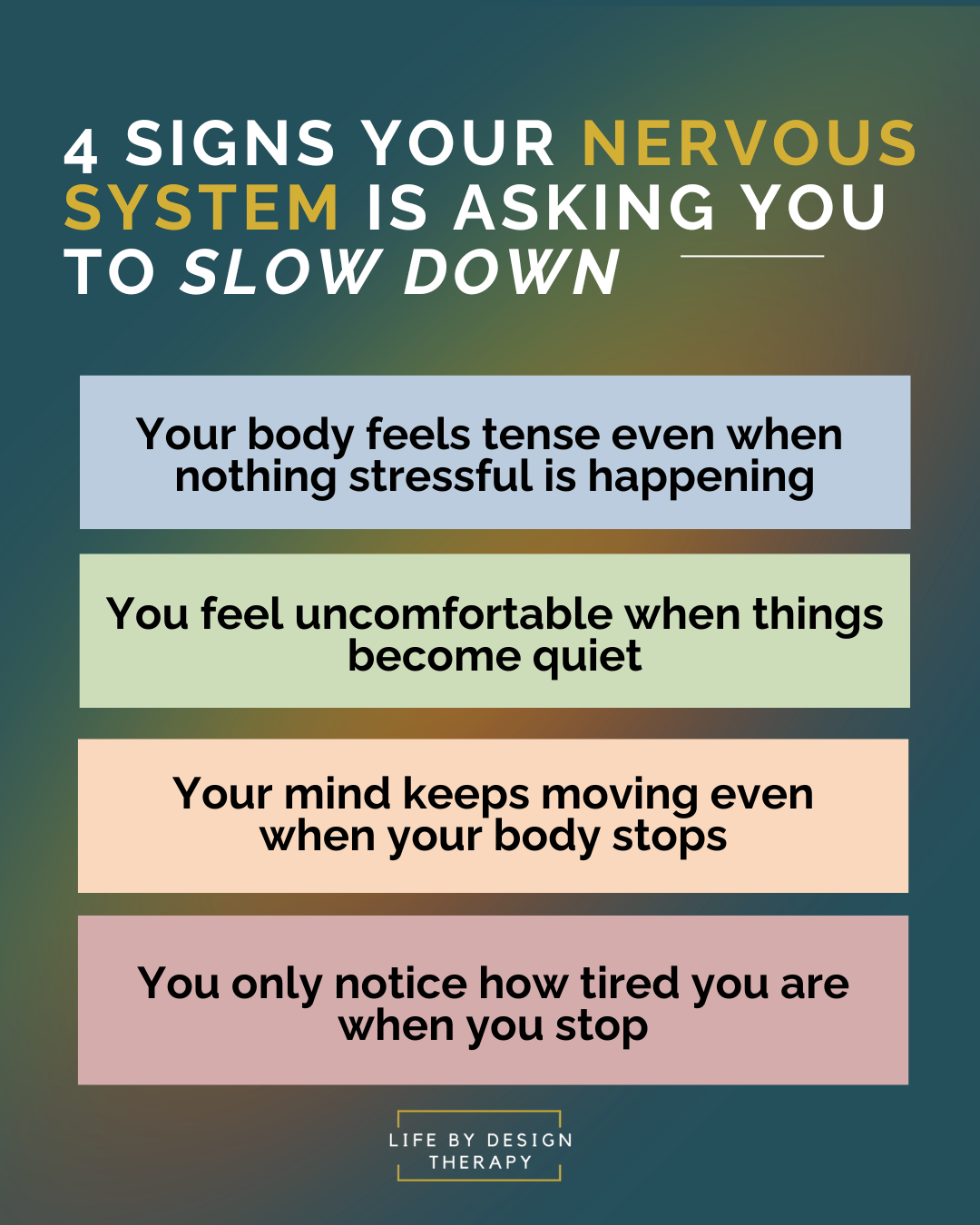
We often talk about slowing down as if it’s simple.
As if it’s just a matter of deciding to rest.
Logging off earlier.
Saying “no” more often.
Creating more space in your schedule.
But slowing down isn’t always accessible in the ways people imagine.
Your life may be full. There may be responsibilities that can’t be paused. People who depend on you. Roles you carry every day.
And even when there is space, your body may not immediately follow.
You might not notice how quickly you move from one moment to the next. Instead, you continue forward, carrying the tension, the focus, and the activation from the previous moment into the next.
Over time, this constant forward motion can become your nervous system’s baseline.
Slowing down, then, isn’t just about stopping. It’s about allowing your body to recognize that it no longer needs to remain in that same level of activation.
And for many people, that’s not something their nervous system has had much opportunity to practice.
Typically, this isn’t a conscious choice. It’s something your nervous system has learned over time.
How Your Nervous System Learns to Stay in Survival Mode
While the pace of adult life can reinforce this constant engagement, this pattern often didn’t begin in adulthood.
It may have started much earlier.
You might have been the responsible one, the one who handled things, and the one others relied on.
You may have learned, without anyone explicitly saying it, to stay aware of what was happening around you; to notice shifts in mood, expectations, or needs.
Not because you were doing anything wrong, but because that awareness helped things feel steadier.
For some, home environments were unpredictable. For others, expectations were high. And for many, it was simply the quiet understanding that being capable and aware was part of who they needed to be.
Over time, your body learned from those experiences.
It learned to stay prepared. To move quickly. To anticipate what might come next.
And as adulthood brings its own responsibilities, work, relationships, caregiving, and decision-making, your nervous system may continue using those same patterns, even now.
Your nervous system has spent a long time learning how to function this way, and that makes sense given what it has experienced.
Slowing down, then, isn’t unfamiliar simply because your life is busy.
It can feel unfamiliar because staying in motion, mentally, physically, and emotionally, has been one of the ways your nervous system has supported you.
And it’s also important to recognize that this isn’t only shaped by early experiences. Many people today are navigating systems that constantly reward speed, productivity, and doing more. Financial pressures, heavy workloads, caregiving demands, and a culture that often prioritizes independence over community can keep people operating in a constant state of motion.
In other words, someone can have had a supportive upbringing and still find themselves in survival mode simply because the pace and demands of modern life are overwhelming.
How Busyness and Productivity Reinforce Stress in the Body
You may notice that staying productive helps you feel steady.
Moving from one responsibility to the next can create a rhythm your body recognizes. There’s often clarity in knowing what needs your attention, what needs to be finished, or who needs you.
Productivity can provide structure. Direction. A sense that things are moving forward.
And when that movement pauses, even briefly, you might notice discomfort.
You may reach for your phone without thinking.
Start planning the next task before the current moment has fully ended.
Feel the urge to stay mentally occupied, even when nothing is immediately required of you.
This isn’t necessarily about having more to do. It’s often about what your body is used to.
When you’ve spent a long time staying engaged, mentally, emotionally, or physically, stillness can feel unfamiliar. Your nervous system may continue seeking movement, simply because that’s the state it knows best.
Over time, productivity can become more than a way to manage your responsibilities. It can become a way your nervous system maintains the momentum it has carried for years.
And this is part of why slowing down isn’t always as simple as deciding to rest.
How Slowing Down Affects Your Nervous System
When you begin to slow down, you may notice things you hadn’t fully registered before.
You might realize how tired you actually feel once your body isn’t pushing toward the next task.
You may begin to notice a clenched jaw, tightness across your shoulders, or that familiar churning or fluttering sensation in your stomach that’s been there all along, just outside of your awareness.
Your thoughts may feel louder in quiet moments. You may find yourself replaying conversations, thinking ahead, or feeling the urge to distract yourself.
Sometimes, emotions that were easier to move past while staying busy can begin to surface once there is space.
This isn’t because slowing down created those sensations or feelings.
It’s often because your attention is no longer being pulled entirely outward.
When your nervous system has been focused on staying engaged, solving problems, responding to needs, and moving from one responsibility to the next, it naturally prioritizes what is happening around you.
Slowing down shifts that attention inward.
And for many people, that inward awareness is unfamiliar at first.
You may notice restlessness. Or discomfort. Or the urge to get up and do something, even when nothing is required of you.
This is often your nervous system adjusting to a different pace.
Over time, as your body begins to experience moments of safety in stillness, it becomes easier to settle. Awareness becomes less overwhelming and more grounded.
Slowing down doesn’t force your body to change. It simply gives your nervous system the opportunity to reconnect with itself.
What slowing down can actually look like
Slowing down doesn’t require clearing your schedule or stepping away from your responsibilities.
More often, it happens in brief moments that already exist within your day.
It may begin with something as simple as:
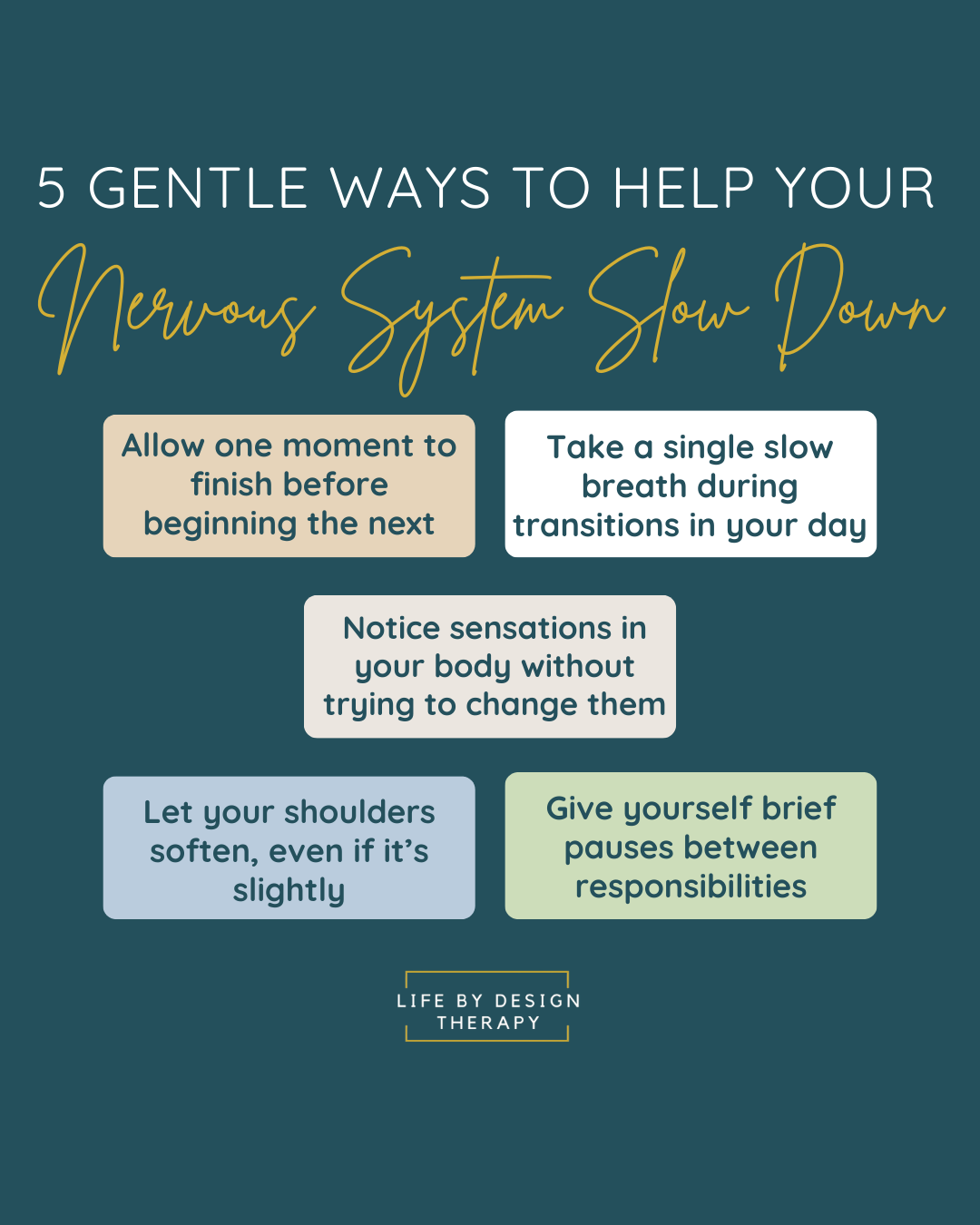
🌻Taking one full breath before opening your laptop, instead of moving immediately into work.
🌻 Pausing in your car before walking into your home.
🌻 Allowing yourself to sit for a moment after finishing something, rather than immediately reaching for the next task.
You may start to notice how quickly you normally move, and your attention shifts ahead before the present moment has fully ended.
Slowing down can be as simple as allowing one moment to finish before beginning another.
It can be as subtle as feeling your feet on the floor while you’re standing in the kitchen, noticing the support of the chair beneath you, becoming aware of tension in your shoulders, and letting them soften, even slightly.
From the outside, nothing may appear different.
But internally, your nervous system begins receiving a different message. It begins to recognize that constant motion isn’t required, allowing you to settle more fully into the present moment and into your body.
Over time, these small pauses create opportunities for your body to settle.
Not all at once. But gradually.
In ways that feel supportive and sustainable.
How somatic and holistic therapy can help
For many people, slowing down becomes more accessible with support.
Somatic and holistic therapy focuses on helping you reconnect with your body and nervous system in ways that feel manageable and safe.
Rather than pushing you to relax, therapy helps you notice what your body is already holding, and build the capacity to settle at a pace that feels sustainable.
Over time, this work can help your nervous system release patterns of constant readiness and develop a greater sense of internal stability.
Slowing down becomes less about effort and more about allowing your body to recognize that it no longer needs to stay in survival mode.
Final thoughts
Slowing down isn’t always as simple as deciding to rest.
It’s something your nervous system learns through repeated experiences of safety, presence, and pause.
If your body has spent a long time staying engaged, moving forward, and carrying responsibility, it makes sense that slowing down may feel unfamiliar at first.
But change doesn’t happen all at once.
It begins in small moments. A breath. A pause. A transition where your body is allowed to settle, even briefly.
Over time, those moments help your nervous system recognize that it doesn’t always need to stay in motion.
And gradually, slowing down becomes something your body remembers how to do.
This Week's Affirmations
I can be present without needing to prepare for what comes next
It is safe for me to move through my day without urgency
My worth is not defined by how much I accomplish
I am allowed to pause, even when there is more to do
I can allow this moment to be enough.
Additional Resources
**If you’re interested in learning more about ways to support your nervous system, check out these books below:
The Body Keeps the Score: Brain, Mind, and Body in the Healing of Trauma by Bessel van der Kolk M.D
Polyvagal Theory in Therapy: Engaging the Rhythm of Regulation by Deb Dana
The Stress-Proof Brain: Master Your Emotional Response to Stress Using Mindfulness
When the Body Says No: The Cost of Hidden Stress by Gabor Maté
The Power of Now: A Guide to Spiritual Enlightenment by Eckhart Tolle
The Disease to Please: Curing the People-Pleasing Syndrome by Harriet B. Braiker
Radical Acceptance: Embracing Your Life with the Heart of a Buddha by Tara Brach
**Some product links are affiliate links, which means we'll receive a commission if you purchase through our link, at no extra cost to you. Please read the full disclosure here.

