

How to Work With a Dysregulated Nervous System
By Melody Wright, LMFT
You finally have a quiet moment.
Nothing needs your immediate attention. There’s nowhere you need to be. You sit down, maybe even with the intention of relaxing, but somehow your body doesn’t seem to understand that the day is over.
Your shoulders are still tense. You’re reaching for your phone without really thinking about it. Your mind keeps jumping to what you forgot, what needs to happen tomorrow, or whether you should get up and do that one last thing.
So, you try to relax harder. Maybe you take a few deep breaths, tell yourself everything is fine, or remind yourself that you’re safe. And sometimes that helps.
Other times, you’re still sitting there wondering why your body can’t seem to settle when there’s no obvious reason for it to be on edge.
This is often where conversations about nervous system regulation begin - with the question of how to make an uncomfortable feeling go away.
Instead of focusing on How do I make this uncomfortable feeling go away?, it can be helpful to get curious about what’s happening first: What is my nervous system doing right now, and what might actually support me?
What Does a Dysregulated Nervous System Feel Like?
When people hear the words nervous system dysregulation, they often picture something like anxiety, restlessness, racing thoughts, or that familiar feeling of being on edge.
And dysregulation can certainly feel that way. But sometimes it’s much quieter.
You might go blank in the middle of a difficult conversation, feel completely exhausted after something stressful, or find that even a simple decision suddenly feels weirdly difficult.
You might withdraw, procrastinate, feel numb, become irritable, or find yourself staring at your phone without really taking anything in.
Sometimes it feels like you have too much energy moving through you; other times, it can feel like you don’t have enough.
These responses are part of the nervous system’s attempt to help us respond to what’s happening around us. And they are influenced by far more than the situation directly in front of us. Sleep, hunger, sensory input, relationships, previous experiences, ongoing stress, physical health, and even how much we’ve already had to manage that day can affect our capacity in a particular moment.
That’s one reason the same situation may feel manageable one day and completely overwhelming another.
Understanding this can shift the question from Why am I reacting like this? to What has my system been carrying today?
And that gives us somewhere different to begin.
Nervous System Regulation Isn't Always About Calming Down
There are plenty of nervous system regulation tools that can help you feel more grounded in the moment. You’ve probably heard some of them before: deep breathing, cold water, meditation, putting your feet on the floor, going outside, or naming things you can see around you.
These practices aren't inherently good or bad. The more important question is whether a particular practice is actually supportive for your nervous system at that moment.
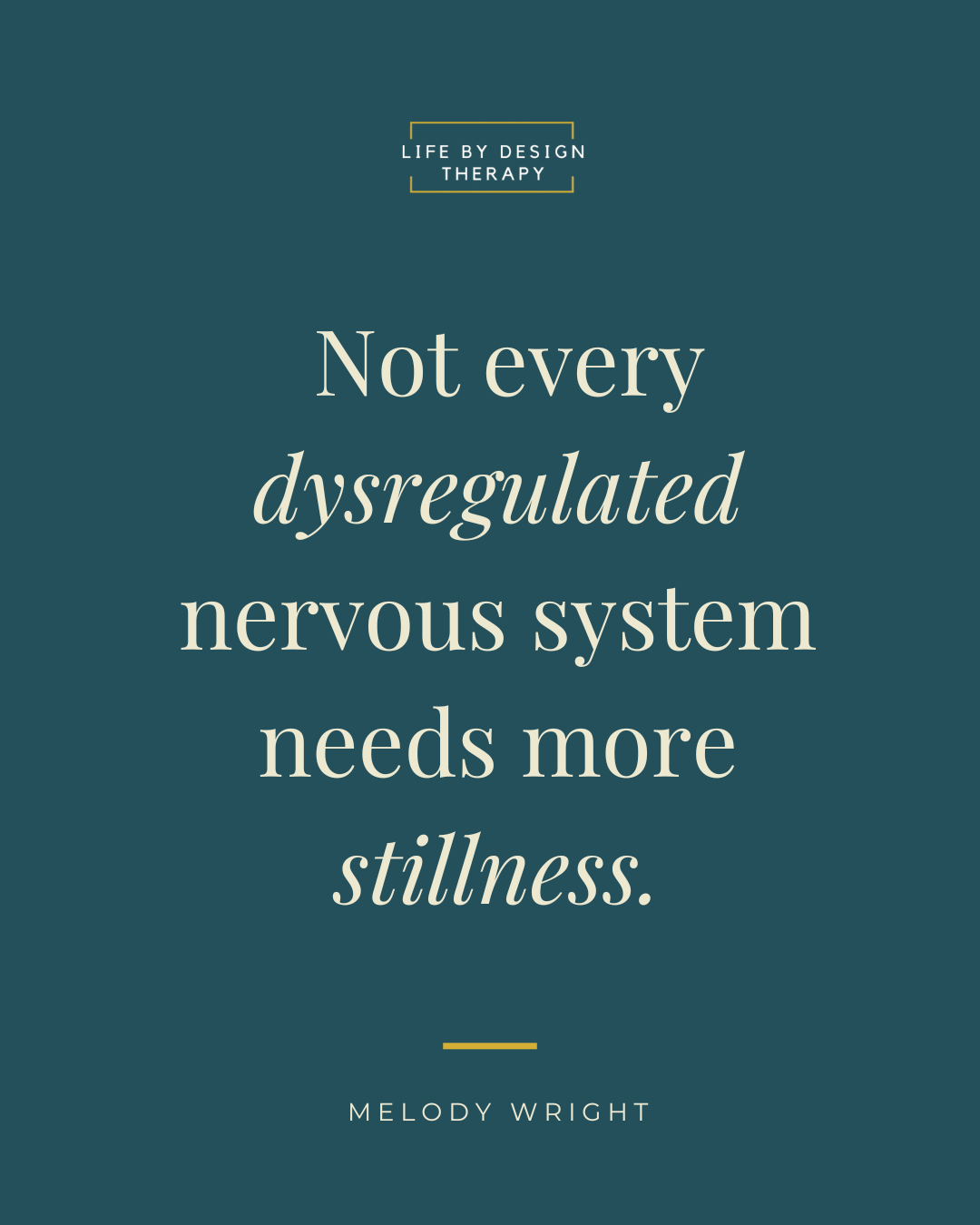
Because not every dysregulated nervous system needs more stillness.
If you feel restless, agitated, or like there is energy trapped inside your body, sitting quietly and trying to meditate may feel almost impossible. Walking, stretching, dancing, shaking out your arms, cleaning something, or simply moving your body may feel more accessible.
On the other hand, if everything already feels loud and overwhelming, adding more movement or stimulation may be the last thing you need. Dimmer lights, fewer sounds, a familiar blanket, a slower environment, or a few minutes without anyone asking anything from you might feel completely different.
And then there are the moments when what you need isn't necessarily quiet or movement at all. If you’re feeling disconnected or shut down, hearing a familiar voice, sitting beside someone you trust, spending time with a pet, receiving safe touch, or simply being around another person without needing to talk may help you feel more present.
This is why the goal isn't to memorize the “right” nervous system technique. It’s to become more familiar with yourself.
Learning to Notice Your Nervous System Before You're Overwhelmed
Most of us become aware that we're dysregulated once the feeling is already fairly loud. We realize we're overwhelmed when we're snapping at someone, notice we're anxious when our thoughts won't slow down, or recognize that we've shut down when we can't seem to make ourselves answer the text, start the task, or explain what we're feeling.
But your body may have been communicating long before that.
Maybe your jaw tightens or your breathing gets shallower. You might lose your appetite, start moving faster, become unusually sensitive to noise, stop making eye contact, or notice an urge to leave. For someone else, it might look like suddenly saying yes to everything because disappointing another person feels much harder to tolerate.
These earlier signals can be easy to miss, especially if you've spent a long time overriding them.
Part of working with your nervous system is slowly learning its language. Not so you can catch every reaction before it happens, but so there is a little more space between the first signal and the point where everything feels like too much.
That space can give you more choice.
Supporting Your Nervous System Happens Outside of Dysregulated Moments, Too
We tend to think about nervous system regulation when something is already wrong. But your nervous system isn't only paying attention during a grounding exercise. It is responding to the rhythm of your everyday life.
This is where some surprisingly ordinary things can matter.
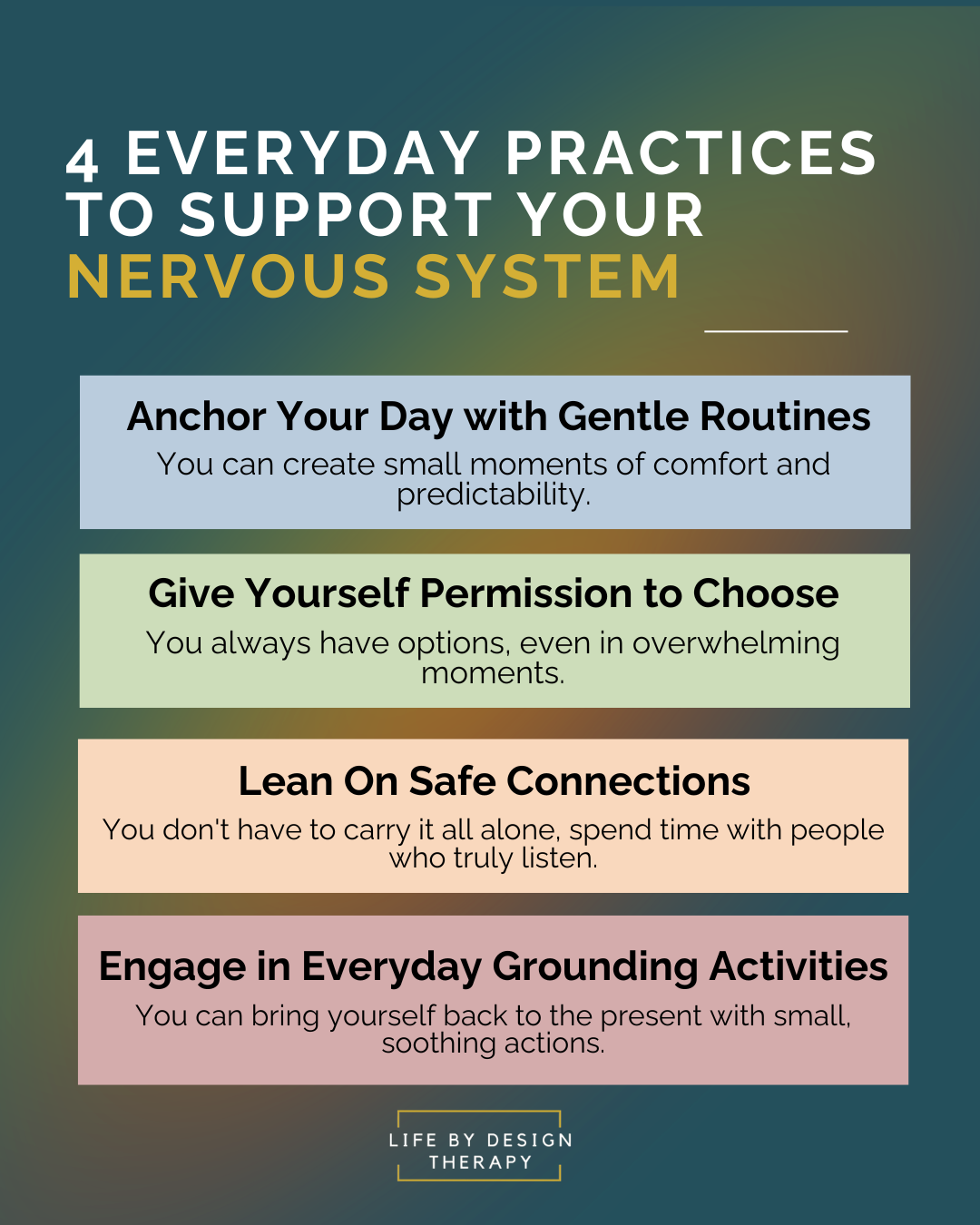
Routine, for example, isn't particularly exciting advice. But predictability can reduce some of the uncertainty your brain and body have to continually navigate. Knowing roughly when you'll eat, sleep, work, rest, or transition between parts of your day can create small points of familiarity.
That doesn't mean your life needs to run on a rigid schedule. Sometimes something as simple as drinking coffee in the same chair each morning, taking a walk after work, listening to the same playlist while making dinner, or having a familiar nighttime routine can become a small cue of I know what happens here.
Nervous system support can also happen through experiences that don't look like “nervous system work” at all. Massage or acupuncture might feel supportive for one person, while someone else finds that experience through gardening, swimming, lifting weights, cooking, sitting in the sun, or doing something with their hands.
It can also be found in moments that are harder to put into a wellness routine: laughing with someone who makes you feel like yourself, listening to music you’ve heard a hundred times, spending time somewhere you don't feel like you need to perform, or receiving a hug from someone you trust.
These aren't necessarily techniques for making your nervous system behave differently. They can simply be experiences where your body gets to encounter movement, pleasure, connection, predictability, rest, or safety.
And those experiences count, too.
Sometimes Regulation Is About Having More Choice
There's another part of nervous system regulation that doesn't always get as much attention: autonomy.
Imagine feeling overwhelmed at a crowded gathering. There's a difference between thinking, I have to stay here for three more hours, and knowing, I can step outside if I need to.
You may never actually leave. But knowing that you can changes something.
The same thing can happen in much smaller ways. Being able to say no, choosing where you sit, knowing when something will end, asking someone to stop, taking a break during a difficult conversation, deciding whether you want touch, or simply giving yourself permission to change your mind can all reinforce a sense that you have some choice in what happens next.
When we've had experiences where choice wasn't available, was ignored, or didn't feel safe to express, reconnecting with our own preferences can become an important part of nervous system work.
Sometimes support isn't about finding another way to calm your body. Sometimes it's about helping your body experience, I have options here.
Why Safe Relationships Can Help Regulate the Nervous System
We often talk about regulation as though it's something we're supposed to learn to do entirely by ourselves. But humans have always regulated in relationship with other humans.
Think about how different it can feel to receive difficult news alone versus sitting beside someone you trust. Or how your body can soften when someone speaks to you in a steady voice, listens without rushing you, or simply stays nearby when you're having a hard time.
This is sometimes referred to as co-regulation. It doesn't mean another person is responsible for managing your emotions, and it doesn't mean you should always need someone else in order to feel okay. It simply recognizes that connection can be one of the ways our nervous systems receive information about safety.
Over time, repeated experiences of being supported without being controlled, rushed, judged, or abandoned can matter.
And this is one reason the relationship itself can be such an important part of therapy.
How Somatic Therapy Can Help With Nervous System Regulation
Somatic therapy gives you an opportunity to pay attention not only to what we're thinking, but to what is happening in your body as we talk about our experiences.
A therapist might help you notice when your breathing changes, when tension appears, when you suddenly feel far away from what you're talking about, or when you feel an impulse to move, stop, turn away, or create more space.
The point isn't to analyze every sensation. It's to become more familiar with your own responses.
Therapy can also offer a supported space to experiment with what happens when you slow down instead of pushing through, or when you notice the urge to say no and become curious about what that feels like in your body. You might explore what helps you stay connected to yourself during a difficult conversation, or whether you can experience some discomfort without immediately needing to make it disappear.
Over time, these experiences can help build awareness and expand the range of responses available to you outside of therapy.
Because ultimately, the goal isn't for your therapist to regulate your nervous system for you. It's for you to understand yourself well enough that you have more ways to meet yourself when life happens.
You Don't Have to Be Regulated All the Time
There's an irony that can happen when we learn about nervous system regulation: we can become so focused on being regulated that dysregulation starts feeling like failure.
You might find yourself thinking, I know better than this. Why am I still getting triggered? I've done so much work—why does this still bother me?
Suddenly, regulation becomes another standard we're trying to meet.
But a healthy nervous system isn't one that stays calm all the time. Your nervous system is designed to respond.
There will be moments when you feel anxious, times when you become overwhelmed, conversations that activate something in you, and days when your capacity is simply lower than usual. The work isn't necessarily preventing those moments from happening.
It may look more like noticing sooner, understanding your patterns, having more choices available, knowing when you need support, and allowing yourself to respond differently. And when dysregulation does happen, you can find your way back without turning the experience into evidence that something is wrong with you.
Final Thoughts
Working with a dysregulated nervous system is less about mastering the perfect set of calming techniques and more about developing a relationship with your own responses.
Over time, you may begin to recognize what activation and shutdown feel like for you, what actually helps and what doesn’t, and what your body has been trying to communicate before the message becomes impossible to ignore. You may also start noticing the environments where you feel most at ease, the situations where you can be more fully yourself, and the people you feel safest and most connected around.
There may still be days when you don't catch it early, when the grounding exercise doesn't help, or when you realize what you needed three hours after you needed it.
That doesn't erase the awareness you're building.
Sometimes nervous system work is simply creating more opportunities to notice what’s happening within you, choose how you want to respond instead of moving on autopilot, receive support when you need it, and find your way back to yourself when things feel overwhelming.
And you don't have to learn how to do that alone.
At Life By Design Therapy™, our somatic and holistic approach to therapy creates space to explore how your experiences show up not only in your thoughts, but also in your body and nervous system. We offer holistic and somatic therapy in Berkeley, California, as well as online therapy through telehealth for clients throughout California.
If you're interested in learning more about somatic therapy and how it may support you, we invite you to connect with our team.
This Week's Affirmations
I don’t have to be calm all the time to be okay.
I am learning how to work with myself instead of against myself.
I am allowed to choose what feels supportive for me.
I can listen to my body without needing to immediately change what I feel.
I am learning to recognize what my nervous system needs.
Additional Resources
If you’re interested in understanding your nervous system, recognizing your own patterns of dysregulation, and learning what helps you feel more grounded and connected, the books below can be a helpful place to start.
In an Unspoken Voice: How the Body Releases Trauma and Restores Goodness by Peter A. Levine
The Body Keeps the Score: Brain, Mind, and Body in the Healing of Trauma by Bessel van der Kolk M.D
Polyvagal Theory in Therapy: Engaging the Rhythm of Regulation by Deb Dana
**Some product links are affiliate links, which means we'll receive a commission if you purchase through our link, at no extra cost to you. Please read the full disclosure here.


What Does a Dysregulated Nervous System Feel Like?
By Melody Wright, LMFT
I remember a season when I couldn’t quite explain what was happening to me.
Nothing was dramatically wrong. I was still answering messages, showing up, getting through the things that needed to get done. If someone had asked how I was, I probably would have said, “Fine,” because I didn’t have a better answer.
But I started to notice that I would stare at the same email for days, unable to make myself respond. I’d walk into a room and forget why I was there and even snap at people more easily. By the end of the day, if someone needed one more thing from me, I could feel my whole body resisting it.
What confused me most was when I would zoom out and look at the whole picture…none of these things seemed big enough to explain how overwhelmed I felt.
I wasn’t having panic attacks. I wasn’t falling apart in an obvious way. I was just having a harder time with ordinary life. Small things felt heavier than they should have, and I kept assuming I was simply tired, distracted, or not trying hard enough.
That’s part of what can make nervous system dysregulation so difficult to recognize. We tend to imagine it as something bigger, like panic, intense anxiety, or completely shutting down.
And truthfully, sometimes it does look like that.
But it can also look like an ordinary Tuesday when someone asks what you want for dinner, and that simple question can make you suddenly feel like you might cry.
Those more subtle shifts can be some of the hardest to recognize for what they are. So, let’s look at a few of the ways nervous system dysregulation can show up in everyday life.
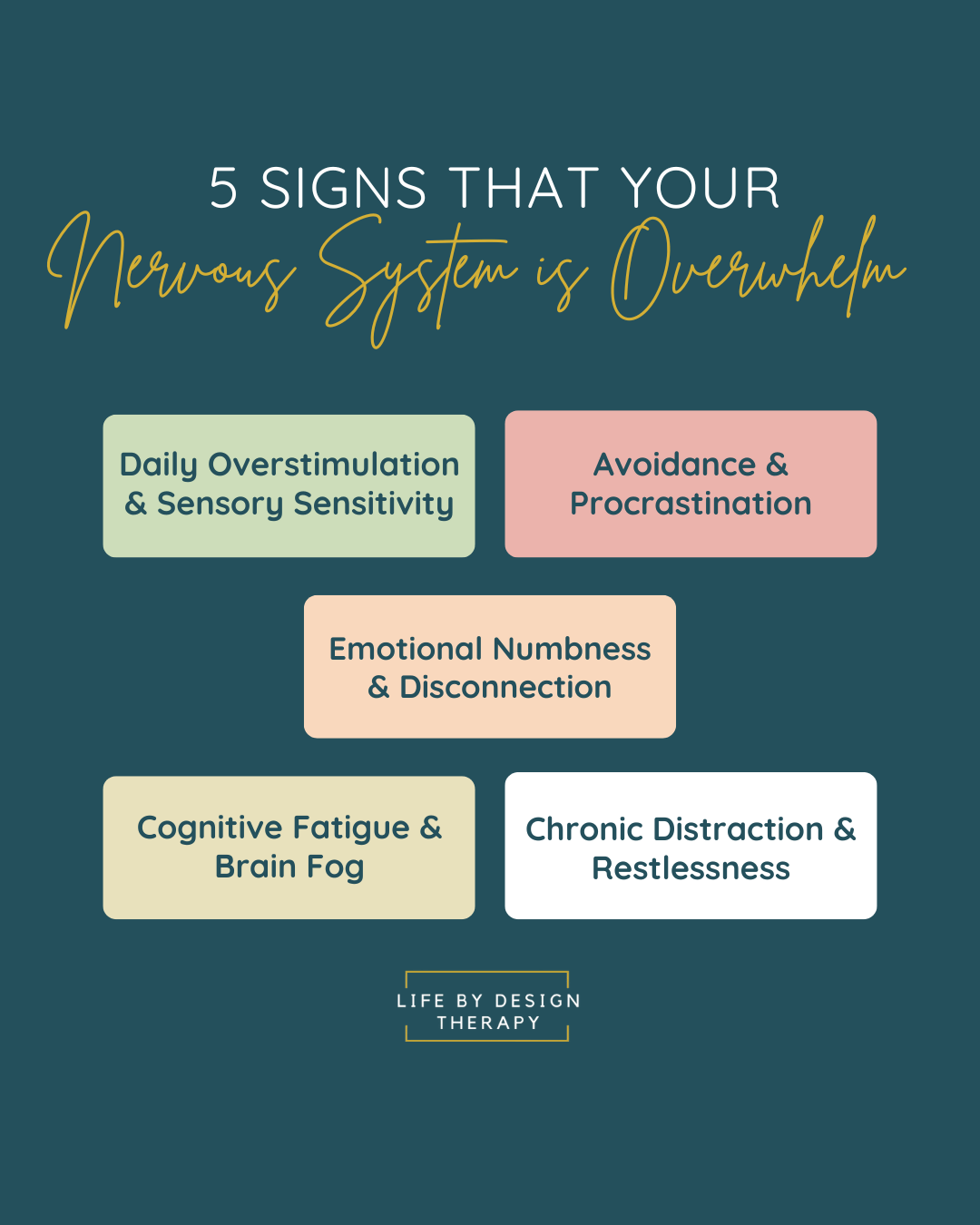
Overstimulation
For me, one of the biggest clues was how little tolerance I had for things that normally wouldn’t have bothered me.
It wasn’t necessarily one big thing. It was the TV being on while someone was talking to me. My phone buzzing when I was already struggling to concentrate. Someone gently touching my arm while I was in the middle of something.
Individually, these were such small moments that I almost felt silly for being bothered by them.
But together, they started telling me something.
I didn’t suddenly become an impatient person, and the world around me hadn’t suddenly gotten louder. I just didn’t have as much room for all of it.
And maybe you’ve felt some version of that, too, not necessarily in the same way, but in those moments when things that normally wouldn’t bother you suddenly feel like too much. Maybe certain sounds start getting under your skin. You raise your voice when you get frustrated. Clutter suddenly feels unbearable. Or a simple interruption brings up a much bigger reaction than you expected.
Sometimes the thing worth noticing isn’t what is bothering you, but that your threshold has changed.
Maybe you’re still moving through the same full days, but things are taking a little more out of you than they used to. You have less patience for interruptions, need more quiet at the end of the day, or notice that your emotions are closer to the surface. These shifts can be signals inviting you to pay attention to what your nervous system may be asking for.
Avoidance and Procrastination
Avoidance and procrastination can be subtle signs of overwhelm, which can make them easy to misread as something else.
You stop answering certain texts. There’s an appointment you keep meaning to make. An email sits unanswered even though you know it would only take a few minutes.
And maybe you start choosing what requires the least from you.
The same dinner. The familiar show. Staying home instead of making plans. Putting something off until tomorrow because today, for whatever reason, you just can’t make yourself deal with it.
From the outside, it can look like procrastination. From the inside, it can feel frustrating because you know these things aren’t actually that hard.
But when you’re already carrying a lot, sometimes even small things can feel like one decision, one conversation, one demand too many.
There can be something comforting about making life a little more predictable when you don’t have much capacity for anything else.
But sometimes it isn’t only our lives that start getting smaller. We can feel a little farther away from ourselves, too.
Feeling Disconnected From Yourself
This can be one of the harder shifts to put into words because nothing necessarily feels wrong.
You just feel...less like you.
Maybe you’re normally playful, but you haven’t felt very playful lately. Someone tells you something exciting, and you know you’re happy for them, but you can’t quite reach the feeling.
Or someone asks what you want.
What sounds good for dinner? Do you want to go out? What would feel good this weekend?
And your answer to everything seems to be, I don’t know.
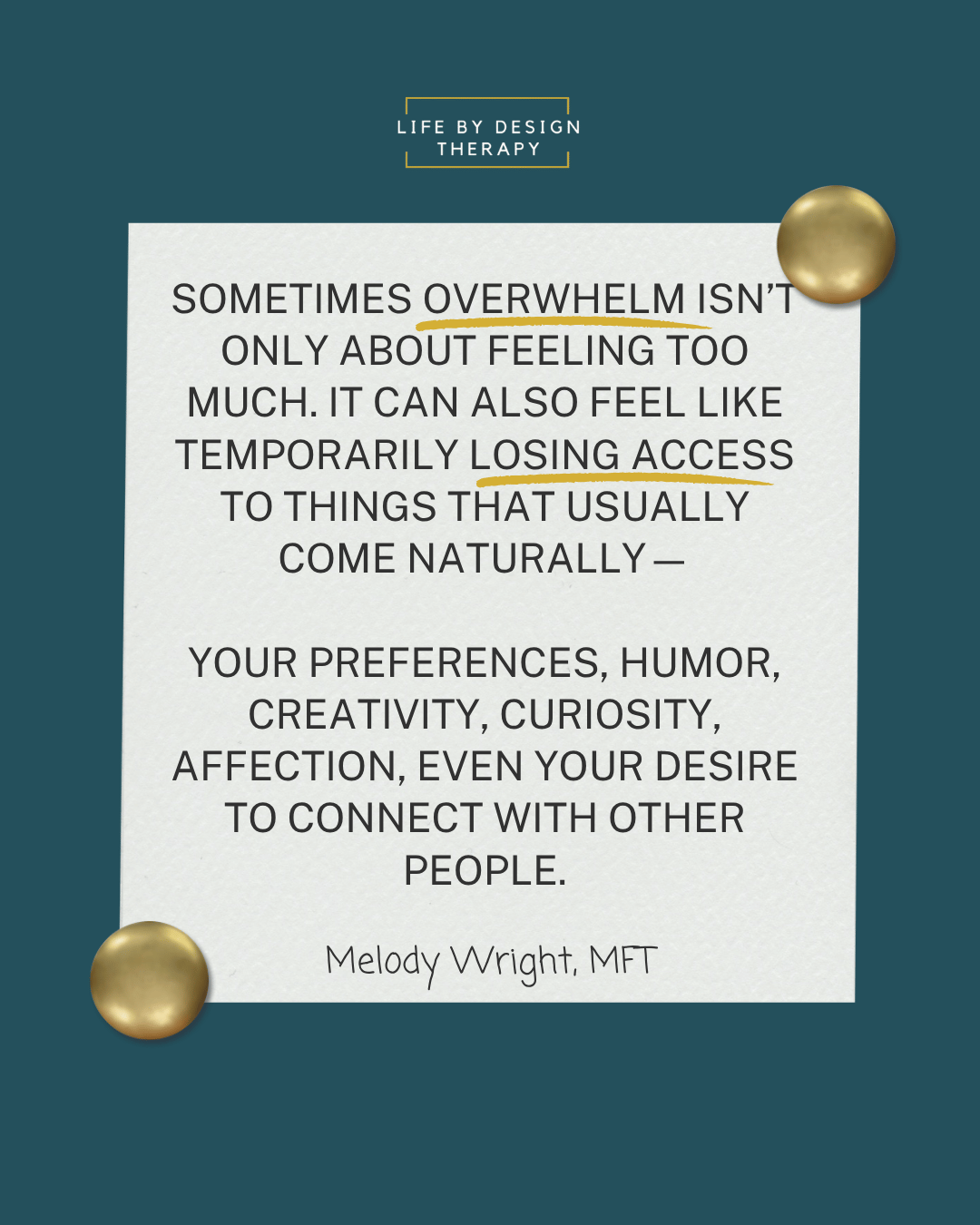
Sometimes overwhelm isn’t only about feeling too much. It can also feel like temporarily losing access to things that usually come naturally—your preferences, humor, creativity, curiosity, affection, even your desire to connect with other people.
That can feel unsettling.
And when we don’t feel particularly connected to ourselves, it makes sense that we might look for something outside of ourselves to fill the space.
Needing Constant Distraction
It’s easy to get used to always having something going on in the background. A little noise, something to scroll through, one more thing to get done. After a while, you might not even notice how rarely you’re actually sitting in quiet.
The podcast is on while you shower. You scroll while watching TV. You finally sit down after a long day and, within a few minutes, find yourself getting back up to do something that absolutely could have waited.
Or maybe you pick up your phone, scroll for a while, put it down...and pick it up again without really knowing what you’re looking for.
There’s a lot of conversation about spending less time on our phones, being more present, and getting better at resting. And those conversations have their place.
But I think there’s another question worth asking: What does the distraction give me?
Maybe it gives your mind somewhere to go. Maybe constant activity feels more familiar than stillness. Maybe the moment everything gets quiet, you become aware of just how tired, restless, sad, angry, or overwhelmed you actually are.
That’s different from simply being “bad at relaxing.”
And sometimes, even with all that distraction, you notice your brain isn’t keeping up the way it usually does.
Brain Fog and Forgetfulness
You walk into another room and completely forget why you’re there.
You’re halfway through a sentence when the thought disappears.
You read the same paragraph three times. You lose something you just had in your hand. A simple decision somehow feels like it requires an unreasonable amount of thought.
We all do these things sometimes.
But when they start happening more often, it can create that nagging feeling of, What is going on with me lately?
When we’re overwhelmed, things like attention, concentration, memory, and decision-making can become harder.
And this is where curiosity becomes much more helpful than criticism.
Not, Why can’t I get it together?
But maybe, When did things start feeling this hard?
Understanding Your Own Signs of Nervous System Dysregulation
Of course, the signs we’ve talked about here don’t automatically point to nervous system dysregulation. An unanswered text, an irritated mood, or the need for a little more quiet can all be part of being human.
Sometimes you’re tired. Sometimes you’re distracted. Sometimes someone really is getting on your nerves.
And things like brain fog, sensory sensitivity, emotional numbness, and difficulty concentrating can have many different causes, including physical and mental health conditions.
This isn’t about turning everything you do into a symptom.
It’s about getting to know your patterns.
Maybe you know you’re carrying too much when sounds start bothering you. Maybe you withdraw. Maybe you become incredibly productive and can’t seem to stop. Maybe you lose your sense of humor or stop knowing what you want.
Your signs may not look like anyone else’s.
But the more familiar they become, the sooner you can recognize that something has shifted.
Nervous System Regulation Doesn’t Mean Being Calm All the Time
There’s a version of nervous system regulation online that can make it seem like the goal is to become someone who moves through life completely unbothered.
Calm. Grounded. Patient. Present.
Preferably while drinking tea and taking deep breaths.
But that’s not really how being human works.
Your nervous system is supposed to respond to your life. You will have days when you’re overwhelmed. You’ll get irritated. You’ll need space. Sometimes you’ll need everyone to stop talking to you for ten minutes.
Regulation isn’t about never getting knocked off center.
It’s about recognizing when you have and, over time, learning what helps you find your way back.
Final Thoughts
If you recognize yourself in some of what we’ve talked about, please don’t take this as an invitation to start picking yourself apart. Learning to recognize nervous system dysregulation isn’t about watching yourself for signs that something is wrong.
It’s really about getting to know yourself a little better.
Maybe you start noticing that your patience disappears before you consciously feel overwhelmed. Or that you stop answering people when you need more space. Maybe you realize that when you’re constantly reaching for distraction, what you actually need is somewhere to put everything you’ve been carrying.
Those small observations can tell you a lot.
You don’t have to catch every signal or understand exactly why you’re feeling the way you do. Sometimes simply being able to say, Oh, I know this feeling. I’ve been carrying a lot lately, can change the way you respond to yourself in that moment.
And over time, that awareness can help you recognize what you need before everything has to feel quite so loud.
If you’ve been noticing some of these patterns in yourself and want support understanding what your nervous system may be communicating, Life By Design Therapy™ offers somatic and holistic therapy that looks beyond symptoms to explore what’s happening within the whole person.
Our therapists support adults who want to understand their patterns better, reconnect with themselves, and find ways of moving through life that feel more supportive and sustainable.
Ready to explore what support could look like for you? Learn more about working with Life By Design Therapy™ or schedule a consultation with our team.
This Week's Affirmations
Having less capacity today doesn’t mean I’m failing.
I can be curious about my reactions instead of criticizing them
Not knowing what I need yet doesn’t mean I won’t find my way back to myself.
I’m learning to recognize the ways my body asks for my attention.
I’m allowed to need less noise, less input, and more space.
Additional Resources
If you’re interested in understanding your nervous system, recognizing your own patterns of dysregulation, and learning what helps you feel more grounded and connected, the books below can be a helpful place to start.
The Body Keeps the Score: Brain, Mind, and Body in the Healing of Trauma by Bessel van der Kolk M.D
Polyvagal Theory in Therapy: Engaging the Rhythm of Regulation by Deb Dana
In an Unspoken Voice: How the Body Releases Trauma and Restores Goodness by Peter A. Levine
**Some product links are affiliate links, which means we'll receive a commission if you purchase through our link, at no extra cost to you. Please read the full disclosure here.

Why Anxiety Pulls You Out of the Present Moment (And How Grounding Helps You Come Back)
By Melody Wright, LMFT
Have you ever been sitting with your family, halfway through dinner, only to realize you haven't actually heard a word anyone has said for the last few minutes?
Your body is there, and you're physically present, but your mind is somewhere else entirely.
Maybe you're replaying a conversation from earlier in the day.
Maybe you're worrying about something happening next week.
Maybe you're mentally running through every possible outcome of a situation that hasn't even happened yet.
If you've experienced this, I’ve been there. One of the most frustrating parts of anxiety is that it has a way of pulling us away from the life happening right in front of us.
The hard part is that many people assume they're simply distracted, unfocused, or overthinking. But anxiety is doing something much deeper than that.
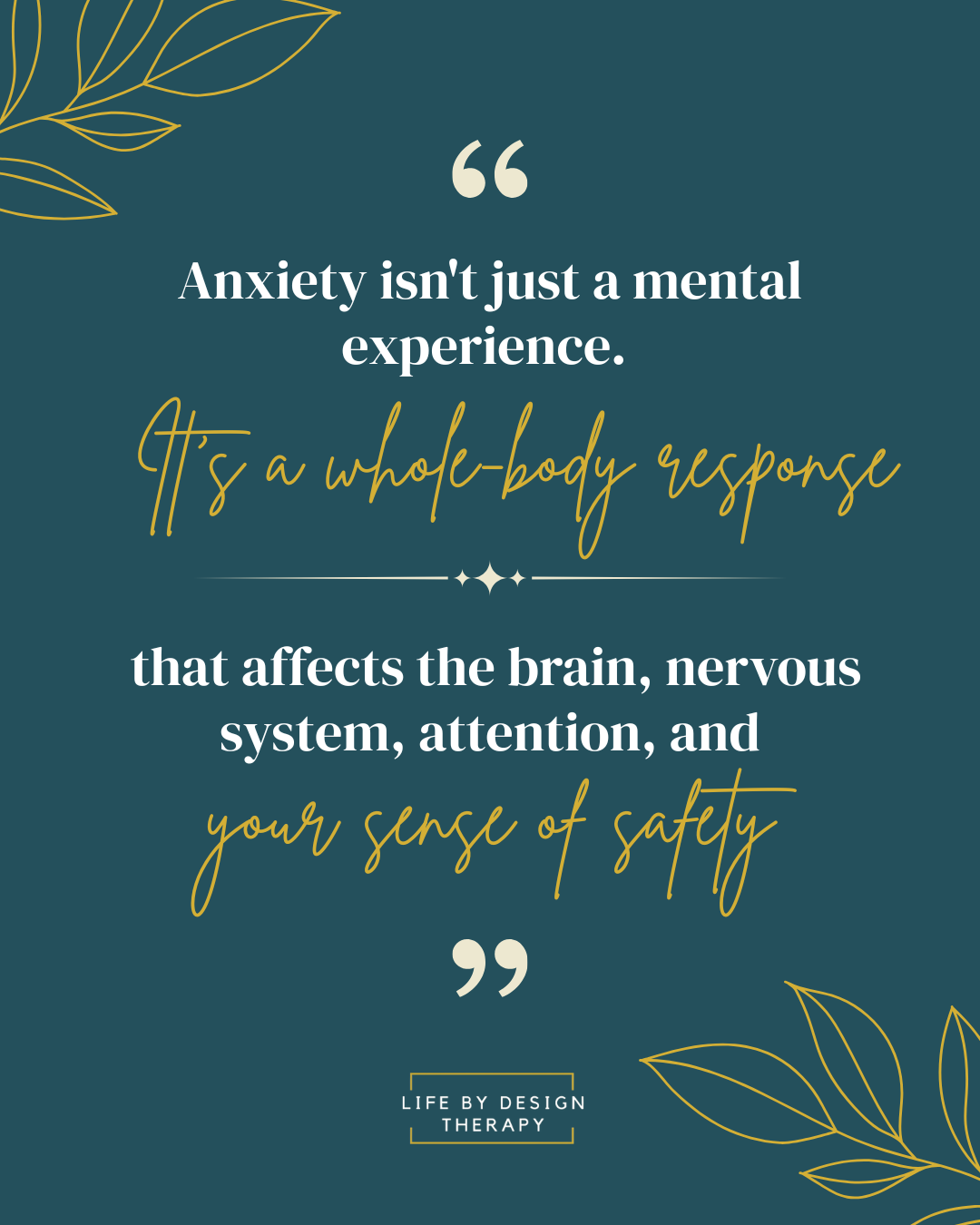
Anxiety isn't just a mental experience. It's a whole-body response that affects the brain, nervous system, attention, and your sense of safety.
And understanding what's happening can help explain why grounding techniques are often so effective.
What Anxiety Actually Does to the Brain and Body
At its core, anxiety is designed to protect us.
Your brain is constantly scanning for potential threats. Most of the time, this happens automatically and outside of your awareness. When your brain perceives something as potentially dangerous, your body's survival systems begin preparing you to respond.
The amygdala is the part of your brain that plays an important role in detecting threats and becomes more active. Stress hormones like cortisol and adrenaline are released. Your heart rate may increase, your muscles may tense, and your attention begins narrowing toward whatever feels threatening.
This response can be incredibly helpful in situations where danger is actually present.
The challenge is that our nervous systems don't always distinguish between a threat that is happening right now and a threat we imagine could happen in the future.
In both cases, your body may begin preparing for action.
This is why anxiety often shows up as:
Racing thoughts
Muscle tension
Restlessness
Difficulty concentrating
Trouble sleeping
Feeling "on edge"
A sense that you always need to be prepared
Your nervous system is just trying to keep you safe.
But in the process, it can become difficult to stay connected to the present moment.
Anxiety has a way of pulling our attention away from what's happening right now. Sometimes it keeps us replaying something that already happened. Other times it sends us racing ahead, trying to predict, prepare for, or prevent what might come next. Either way, our mind is no longer fully connected to the moment we're actually living.
Why Anxious Thoughts Pull Us Out of The Present Moment
Your brain is designed to look for patterns and keep you safe. So, when anxiety is active, that protective system can become overworked.
Instead of helping us respond to what's happening in front of us, it starts searching for problems that haven't happened yet, replaying situations that already ended, or scanning for signs that something is wrong. Your nervous system’s goal is protection, but the result is often exhaustion.
The more our attention is pulled away from the present, the harder it becomes to notice the things that actually help our nervous system settle: the chair supporting us, the sound of birds outside, the feeling of our feet on the floor, or the fact that, in this moment, we may be safe.
You might catch yourself thinking:
What if I fail?
What if something goes wrong?
What if I make the wrong decision?
What if I can't handle it?
If that sounds familiar, know that there's nothing wrong with you. These thoughts usually come from a place of wanting to feel safe. Your mind is trying to protect you by looking ahead and searching for answers.
The problem is that anxiety rarely settles for one answer. Even when you come up with a solution, it often responds with another question, another possibility, or another thing to worry about.
Before you know it, you've spent so much time living in "what if" that you've lost touch with what's actually happening right in front of you.
And when your attention is constantly being pulled toward the future, it can become really difficult to stay connected to the present moment.
Which brings us to another important piece of the puzzle.
How Anxiety Creates Disconnection From the Present Moment
When anxiety becomes loud enough, it can begin pulling us away from our actual experience.
You might find yourself driving somewhere and realizing you barely remember the drive.
You might struggle to enjoy a vacation because your mind keeps focusing on what needs to happen when you get home.
You might be spending time with people you love while simultaneously worrying about something that hasn't happened yet.
In many ways, anxiety hijacks attention. So, rather than allowing us to fully engage with what's happening around us, it continually redirects our focus toward potential threats, future problems, or worst-case scenarios.
Sometimes this can even create a sense of disconnection from your own body.
You may notice that you're living primarily in your thoughts.
Thinking.
Planning.
Analyzing.
Preparing.
But not fully experiencing the moment you're currently in, and this isn't because you're doing something wrong.
It's because anxiety is asking your nervous system to prioritize survival over presence.
The good news is that there are ways to gently help your mind and body reconnect.
And that's where grounding comes in.
Why Grounding Can Help
One of the biggest misconceptions about grounding is that it's supposed to instantly make anxiety disappear. That's a lot of pressure to put on any coping skill.
In reality, grounding is often less about getting rid of anxiety and more about helping your nervous system recognize that it is safe enough to return to the present moment.
When anxiety pulls your attention into future worries, grounding helps redirect your attention back to what's happening right now.
Back to your body.
Back to your environment.
Back to the information your senses are receiving in the present moment.
Research has shown that grounding practices can help interrupt spiraling thought patterns, increase present-moment awareness, and support nervous system regulation.
So, in other words, grounding helps create a bridge between where anxiety has taken you and where your life is actually happening.
Understanding why grounding works is one thing, but finding techniques that work for your specific nervous system is another.
If you're looking for practical ways to begin, check out our blog, 5 Body-Based Grounding Techniques, where we walk through several simple grounding exercises you can start using today. You can also download our free Mind-Body Toolkit for 50 exercises designed to help you reconnect with the present moment.
But while grounding can be incredibly helpful, it's important to remember that it isn't always addressing the reason anxiety showed up in the first place.
How Therapy Can Help Address the Root Causes of Anxiety
Grounding helps you come back to the present moment, but therapy can help you understand why your nervous system keeps getting pulled away from it.
For some people, anxiety is connected to chronic stress.
For others, it may be connected to trauma, attachment wounds, perfectionism, burnout, major life transitions, or experiences that taught the nervous system the world wasn't always predictable or safe.
Over time, therapy can help you identify these patterns, understand how they developed, and build new ways of relating to your thoughts, emotions, and body.
So, rather than constantly fighting anxiety, many people begin learning how to understand it.
And that understanding often creates more space for regulation, self-compassion, and lasting change.
Final Thoughts
Anxiety has a way of convincing us that our attention belongs somewhere else, in tomorrow's problems, yesterday's mistakes, or endless possibilities and unanswered questions. But your life isn't happening in any of those places. It's happening here, right now.
And sometimes the goal isn't to force yourself to stop worrying. Sometimes the first step is simply helping your nervous system find its way back to the present moment. Through a single breath, a sensation in your body, or a grounding exercise, you can begin reconnecting with what's happening around you instead of getting pulled into what might happen next.
But if anxiety is making it difficult to stay present, therapy can help you better understand what's happening beneath the surface and develop tools to support lasting change. Book a call today and learn how we can help you reconnect with yourself, your relationships, and the life happening right in front of you.
This Week's Affirmations
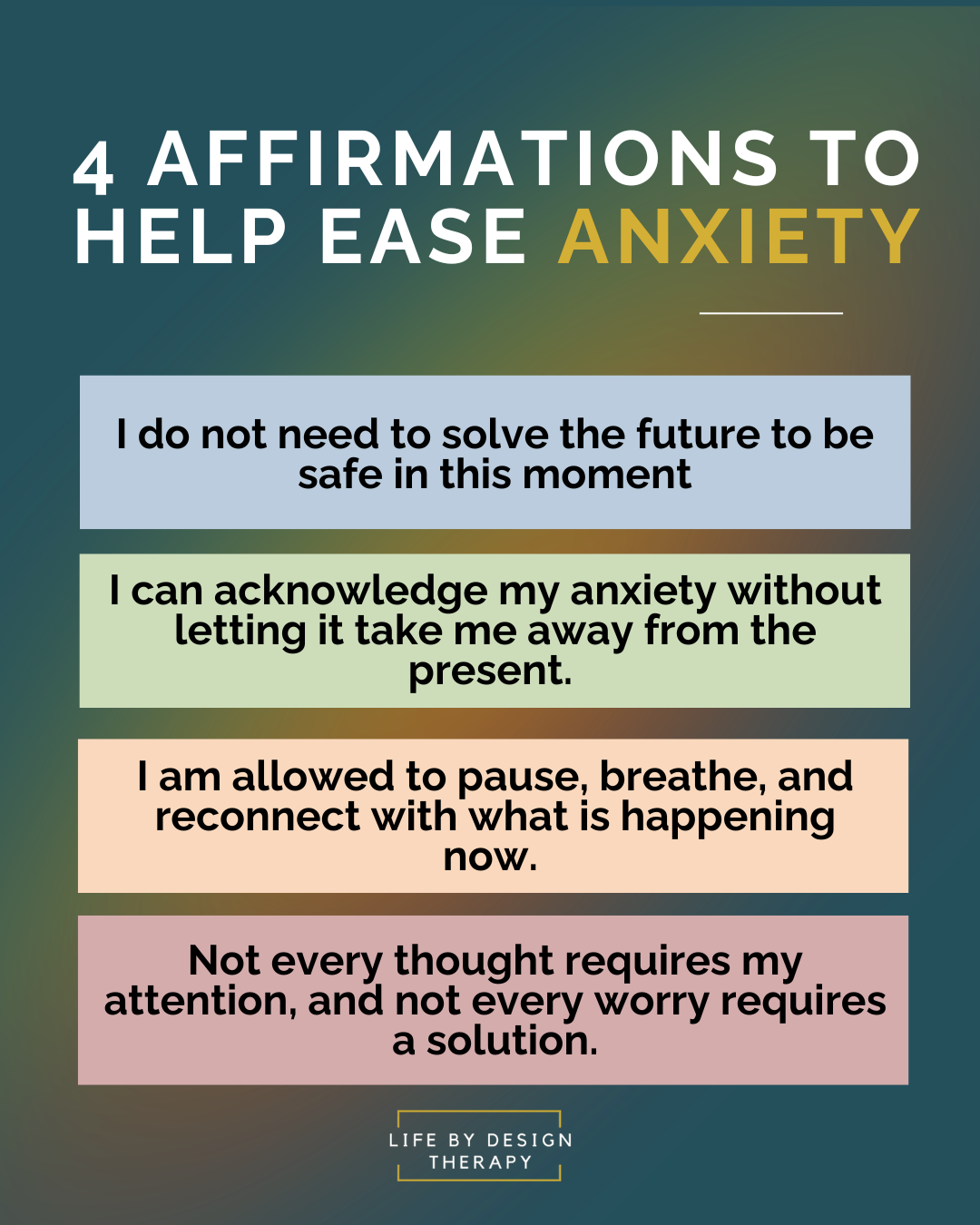
I do not need to solve the future to be safe in this moment.
I can acknowledge my anxiety without letting it take me away from the present.
I am learning to trust myself, even when uncertainty is present.
I am allowed to pause, breathe, and reconnect with what is happening now.
Not every thought requires my attention, and not every worry requires a solution.
Additional Resources
If you'd like to learn more about anxiety, grounding, nervous system regulation, and how anxiety can pull us away from the present moment, the books below offer helpful insights and practical tools to support your journey.
The Body Keeps the Score: Brain, Mind, and Body in the Healing of Trauma by Bessel van der Kolk M.D
Polyvagal Theory in Therapy: Engaging the Rhythm of Regulation by Deb Dana
The Power of Now: A Guide to Spiritual Enlightenment by Eckhart Tolle
Wherever You Go, There You Are: Mindfulness Meditation in Everyday Life by Jon Kabat-Zinn PhD
The Miracle of Mindfulness: An Introduction to the Practice of Meditation by Thich Nhat Hanh
Radical Acceptance: Embracing Your Life With the Heart of a Buddha by Tara Brach
**Some product links are affiliate links, which means we'll receive a commission if you purchase through our link, at no extra cost to you. Please read the full disclosure here.

5 Body-Based Grounding Techniques When Breathing Exercises Aren't Enough
By Melody Wright, LMFT
A while back, I was talking with someone who was feeling incredibly overwhelmed.
Their anxiety was high. Their thoughts were racing. Their chest felt tight. They were doing everything they had been told to do.
Deep breathing.
Box breathing.
Belly breathing.
The breathing app on their phone.
And finally they looked at me and said:
"I swear, if one more person tells me to take a deep breath..."
And honestly? I understood exactly what they meant.
Because while breathing exercises can be incredibly helpful, they're not always the right tool for every person or every moment.
Sometimes focusing on your breath helps you slow down. Sometimes it helps you feel more present. And sometimes it just makes you more aware of how anxious you already feel.
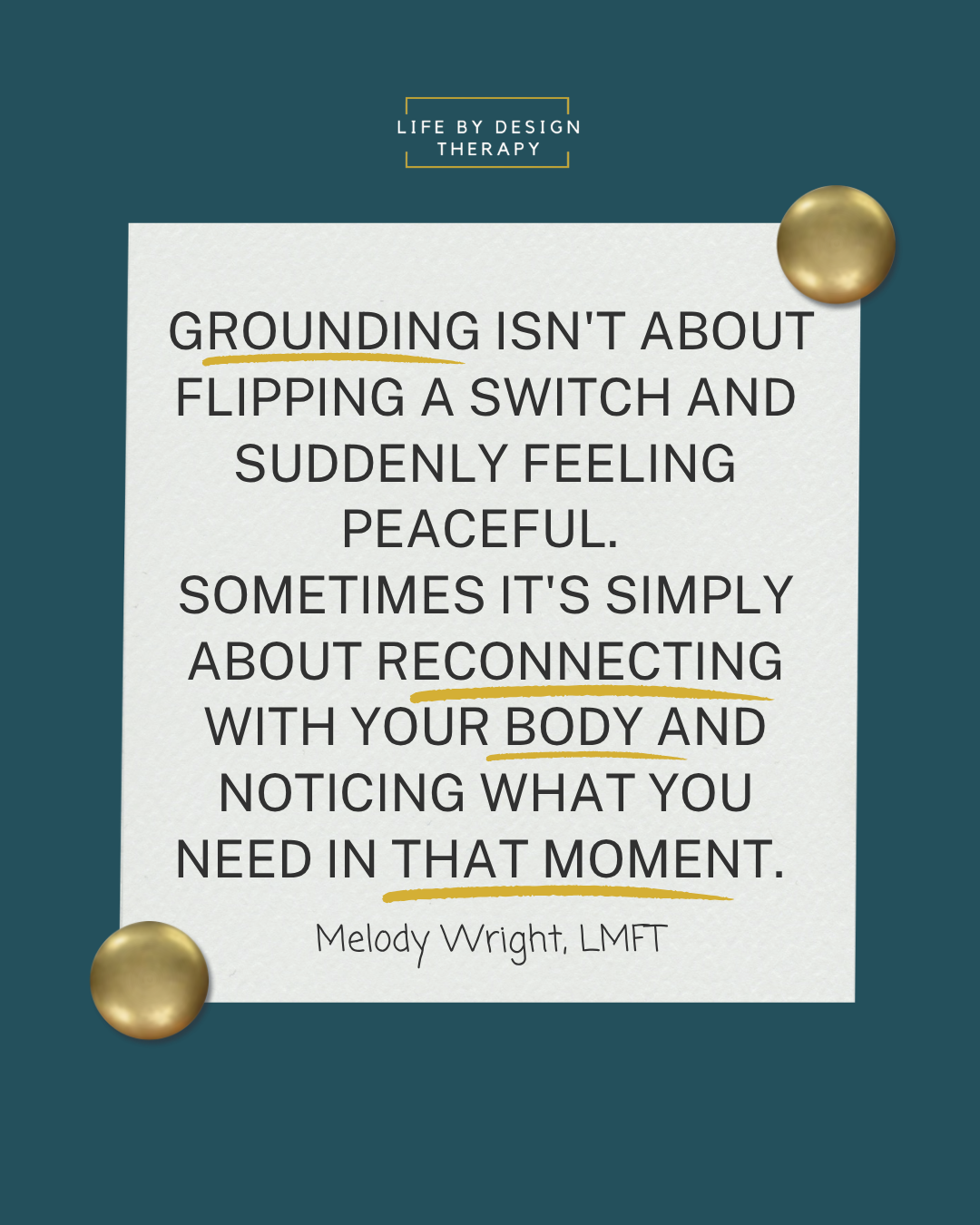
If you've ever found yourself paying attention to your breathing only to become more aware of your racing heart, tight chest, dizziness, or panic, you're not doing it wrong. In fact, becoming more aware of those sensations can be part of the process. Grounding isn't about flipping a switch and suddenly feeling peaceful. Sometimes it's simply about reconnecting with your body and noticing what you need in that moment.
People often assume grounding means sitting quietly, taking deep breaths, and trying to relax.
But grounding is really about helping your nervous system reconnect with the present moment, and there are a lot of ways to do that.
Sometimes it can be through breathing, but other times you can use movement, sensation, and so much more.
Before we get into a few body-based grounding techniques, let's talk about why breathing exercises don't always work in the first place. Understanding the "why" can help you find the tools that actually work for your body.
Why Breathing Exercises Don't Always Work
Before we go any further, I want to be clear about something: I'm not against breathing exercises.
In fact, I think your breath is one of the most powerful tools you have. It's always with you, it's free, and it's something I regularly help clients connect with in session. Slowing down and noticing your breath can help bring you back to the present moment and create a greater sense of connection with your body.
But here's the part we don't talk about enough.
Sometimes taking a few deep breaths doesn't help. Sometimes it even makes you more aware of your anxiety. If that's happened to you, it doesn't mean you're doing it wrong, and it doesn't mean breathing exercises don't work.
It simply means your nervous system may need something different in that moment.
That's why I encourage people to build a toolbox of grounding strategies rather than relying on just one. The more options you have, the easier it becomes to respond to what your body needs instead of trying to force the same tool to work every time.
When we're anxious, overwhelmed, or stressed, our nervous system shifts into protection mode. You may have heard this described as fight, flight, freeze, or fawn, your body's built-in survival response.
🌻 A difficult conversation.
🌻 Financial stress.
🌻 Relationship conflict.
🌻 An overwhelming workload.
🌻 Uncertainty about the future.
None of these are emergencies in the traditional sense, but your body can still respond as though it needs to protect you. Your heart rate may increase. Your muscles might tense. Your thoughts may begin racing as your nervous system prepares you to respond.
This is one of the reasons breathing exercises are so often recommended. Research shows that slow, intentional breathing can activate the parasympathetic nervous system, the part of your nervous system that supports rest, recovery, and regulation.
But here's the piece that doesn't get talked about enough.
When your nervous system is highly activated, it may not be ready to access calm through breathing alone.
Think about it this way. If your house alarm is blaring, someone quietly whispering, "Everything is okay," probably isn't going to be enough to help your body settle.
Sometimes your nervous system needs a different kind of input.
🌻 Something it can feel.
🌻 Something it can touch.
🌻 Something it can physically engage with.
That's where body-based grounding tools can be so helpful. They give your nervous system another way to reconnect with the present moment, especially when breathing doesn't feel accessible yet.
5 Grounding Tools to Add to Your Nervous System Toolbox
(+ 1 Bonus Technique Most People Don't Think About)
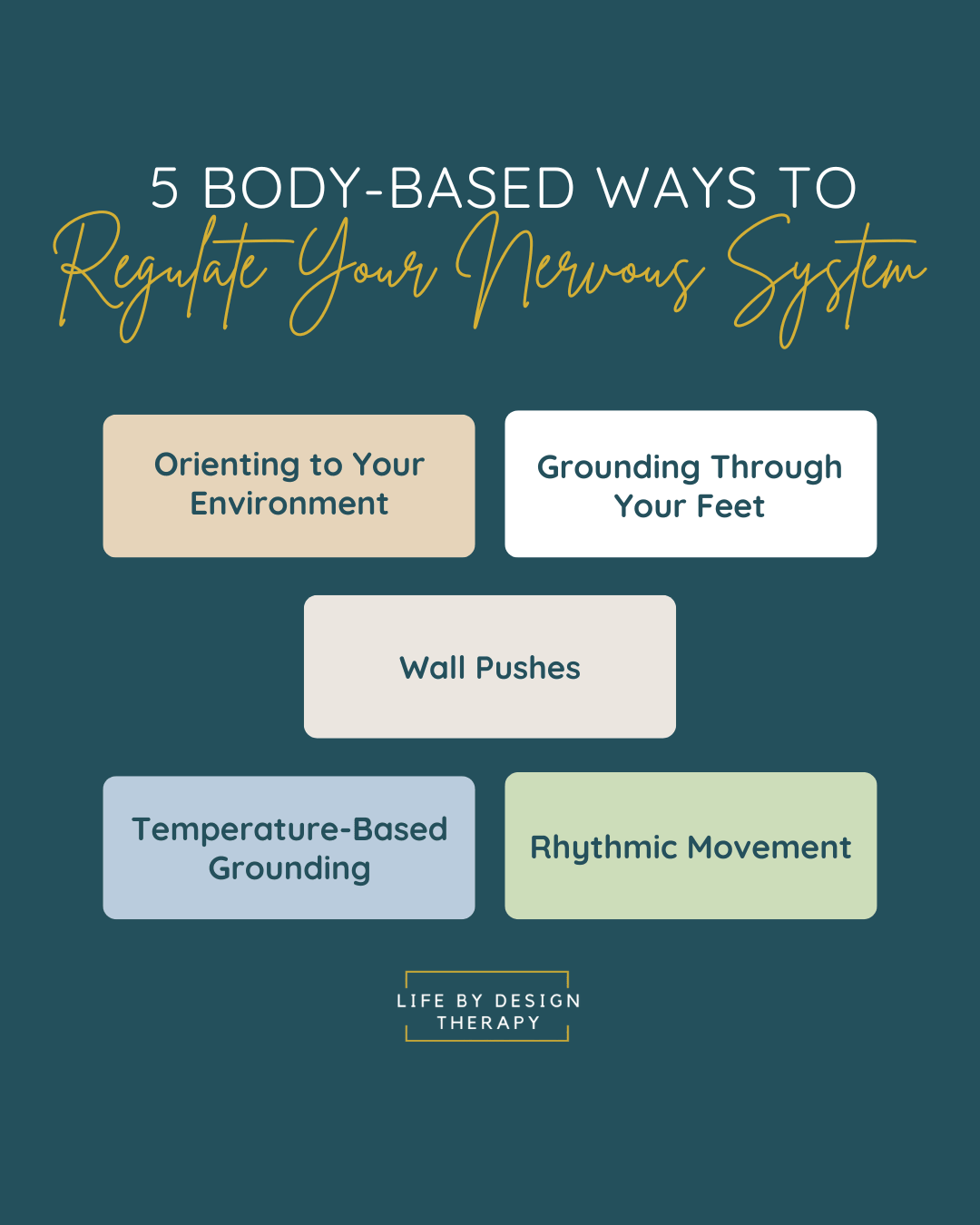
1. Orienting to Your Environment
One of the simplest grounding techniques I teach often feels almost too simple.
It's called orienting.
And before you roll your eyes and think, "There's no way looking around the room is going to help me," stay with me.
When anxiety shows up, our brains become incredibly focused on scanning for problems. For example, your brain might look for what could go wrong, what you forgot, and what you need to fix, which can cause your attention to narrow.
Orienting does the opposite.
Instead of looking inward at the anxiety, you gently begin looking outward.
Try it now. Take a slow look around the room you're in.
Notice the colors.
Notice the lighting.
Notice the textures.
Look for something pleasant like a plant, photograph, cozy blanket, or a favorite coffee mug.
As simple as it sounds, this practice helps your nervous system gather updated information about the environment around you.
It begins recognizing that this moment is different from the danger it may be preparing for.
I've had clients tell me they can literally feel their shoulders drop after doing this for a minute or two.
Not because they forced themselves to relax, but because their body finally got the memo that it wasn't currently under attack.
If you're curious about why your nervous system can sometimes react so strongly even when you're objectively safe, our blog Why Understanding Your Window of Tolerance is Essential to Manage Overwhelm & Stress takes a deeper look at how the nervous system responds to stress, overwhelm, and perceived threat.
2. Grounding Through Your Feet
Have you ever noticed how anxiety can make you feel like you're living entirely in your head? One minute you're trying to focus on what you're doing, and the next you're replaying an awkward conversation, worrying about tomorrow, or imagining every possible thing that could go wrong.
When we're anxious, it's easy to lose connection with our bodies altogether. That's why I love grounding through the feet.
It's simple, discreet, and can be done almost anywhere.
All you need to do is stand with both feet flat on the floor. Press them down gently and notice where your weight naturally falls.
Then shift your weight slightly from side to side, paying attention to the feeling of the ground supporting you.
One variation I especially like is imagining that you're gently pushing the floor away from you.
That tiny bit of muscle engagement often helps people feel more connected to their body and less consumed by what's happening in their head.
It's not magic, but sometimes reconnecting with the physical support underneath you is exactly what your nervous system needs.
3. Wall Pushes
If you've ever felt like anxiety was buzzing through your body, this one's for you.
You know that feeling where your thoughts are racing, you can't sit still, your shoulders are tight, your jaw is clenched, and you feel like you need to do something, but you don't know what.
That's because fight-or-flight energy is designed for action.
The problem is that most of us aren't actually running from danger.
We're sitting in traffic.
Answering emails.
Trying to fall asleep.
Having difficult conversations.
So, the energy gets activated, but it never has a chance to go anywhere.
Wall pushes can help.
Place your hands against a wall.
Push firmly for 10 to 20 seconds.
Engage your arms, shoulders, and core.
Then slowly release.
And here's the important part:
Pause afterward and notice what changed.
Maybe your breathing shifted.
Maybe your shoulders softened.
Maybe you feel warmth or tingling.
Sometimes people expect grounding to happen during the exercise. In reality, the regulation often happens in the moments after as you become more aware of the present moment.
4. Temperature-Based Grounding
One of my favorite things about the nervous system is that it's constantly taking in information through our senses.
This means we can intentionally use sensory experiences to help interrupt anxious spirals, and temperature is one of the easiest ways to do that.
Think about how quickly your attention shifts when you splash cold water on your face, or wrap your hands around a warm mug of tea, or even step outside on a chilly morning.
Suddenly, you're not entirely focused on your thoughts anymore.
You're noticing sensations.
You're noticing your environment.
You're noticing the present moment.
Ways to use temperature-based grounding can look like
Holding a cold glass of water.
Run cool water over your hands.
Wrapping up in a warm blanket.
Stepping outside and paying attention to the temperature of the air against your skin.
And instead of rushing through the experience, get curious.
Notice where you feel the change in temperature.
Pause for a moment and pay attention to where you feel it in your body.
Stay with that sensation for a few moments.
What do you notice? Remember, there's no right or wrong answer. Just allow yourself to experience whatever is there.
The goal isn't distraction. The goal is reconnection with your body and current surroundings.
5. Rhythmic Movement
There is a reason babies are rocked to sleep, and people sway to music.
There is a reason a walk can sometimes feel more regulating than sitting still and trying to meditate.
Humans are wired for rhythm, and rhythm can be incredibly calming for your nervous system.
When we're anxious, stillness isn't always what we need. Sometimes movement is…like predictable, gentle, and repetitive movement.
For example:
A walk around the block.
Rocking in a chair.
Stretching.
Slow dancing in your kitchen while making dinner.
Marching in place.
Cross-body movements like touching opposite knees.
As you do these movements, notice how different that feels than trying to force yourself to sit perfectly still when your nervous system may be begging for movement.
Sometimes regulation looks less like meditation and more like movement with intention.
6. BONUS TIP: Grounding Through Movement & Pressure
[Heavy Work]
This might be my favorite technique on the list because most people don't even realize they're doing it.
Occupational therapists often use the term "heavy work" to describe activities that provide proprioceptive input. Things like pushing, pulling, carrying, or lifting. These movements give your nervous system clear feedback about where your body is in space, which can help you feel calmer, more regulated, and more grounded.
For example, have you ever had a stressful day and suddenly found yourself deep-cleaning the kitchen? Pulling weeds in the garden? Reorganizing a closet? Or carrying every grocery bag into the house in a single trip?
Believe it or not, there may be a nervous system reason for that.
When anxiety is high, the body often feels full of energy that has nowhere to go, and heavy work gives that energy a job.
Some examples include:
Carrying laundry baskets
Digging in soil
Raking leaves
Moving boxes
Using a weighted blanket
Lifting weights
Unlike some grounding techniques that focus on slowing down, heavy work allows the body to engage first.
For people who feel restless, physically activated, or unable to sit still when anxious, this can be a much more accessible place to start.
Sometimes your nervous system doesn't need less movement. Sometimes it needs purposeful movement.
Of course, even the most effective grounding techniques aren't meant to eliminate anxiety on command. They're tools for supporting your nervous system, and different tools work for different people at different times.
That's one of the reasons I encourage people to build a variety of grounding tools rather than relying on a single technique. The more options you have, the easier it becomes to meet your nervous system where it is on any given day. If you'd like even more ideas, check out our blog on Grounding Techniques to Calm Your Nervous System, where we share additional ways to reconnect with the present moment and support regulation when stress or anxiety feels overwhelming.
Final Thoughts
If you've ever tried a grounding exercise and thought, "Well, that didn't do anything," I want you to know that's a completely normal response.
Grounding isn't a magic trick. It's not a way to instantly erase anxiety. It's not about forcing yourself to feel calm. As we talked about above, it's about helping your nervous system reconnect with the present moment.
And sometimes that takes time. Especially if you've been carrying chronic stress, anxiety, burnout, grief, or trauma for a long time, think of grounding less like flipping a light switch and more like building a relationship.
The more consistently you practice these skills, the more familiar they become.
Over time, your nervous system starts recognizing these experiences as signals of safety and support.
But if anxiety, stress, burnout, or overwhelm are making it difficult to feel grounded in your daily life, therapy can help. At Life By Design Therapy™, we work with people who want to better understand their nervous system, build practical coping skills, and create lasting emotional well-being. If you're ready for support, we'd be honored to walk alongside you. Reach out today to learn more about our therapy services and schedule a consultation.
This Week's Affirmations
My body is giving me information, not trying to work against me.
I am safe enough to slow down and reconnect with my body.
I can feel overwhelmed and still be grounded in the present moment.
My body deserves compassion, not criticism, as it moves through stress.
I don't have to fix everything right now. I only need to focus on this moment.
Additional Resources
If you'd like to continue learning about anxiety, nervous system regulation, grounding, and the connection between your mind and body, the books below can be a helpful place to start.
The Power of Now: A Guide to Spiritual Enlightenment by Eckhart Tolle
Wherever You Go, There You Are: Mindfulness Meditation in Everyday Life by Jon Kabat-Zinn PhD
The Miracle of Mindfulness: An Introduction to the Practice of Meditation by Thich Nhat Hanh
Radical Acceptance: Embracing Your Life With the Heart of a Buddha by Tara Brach
The Body Keeps the Score: Brain, Mind, and Body in the Healing of Trauma by Bessel van der Kolk M.D
Polyvagal Theory in Therapy: Engaging the Rhythm of Regulation by Deb Dana
**Some product links are affiliate links, which means we'll receive a commission if you purchase through our link, at no extra cost to you. Please read the full disclosure here.