

Why Slowing Down Feels So Hard When You’ve Learned to Stay in Survival Mode
By Melody Wright, LMFT
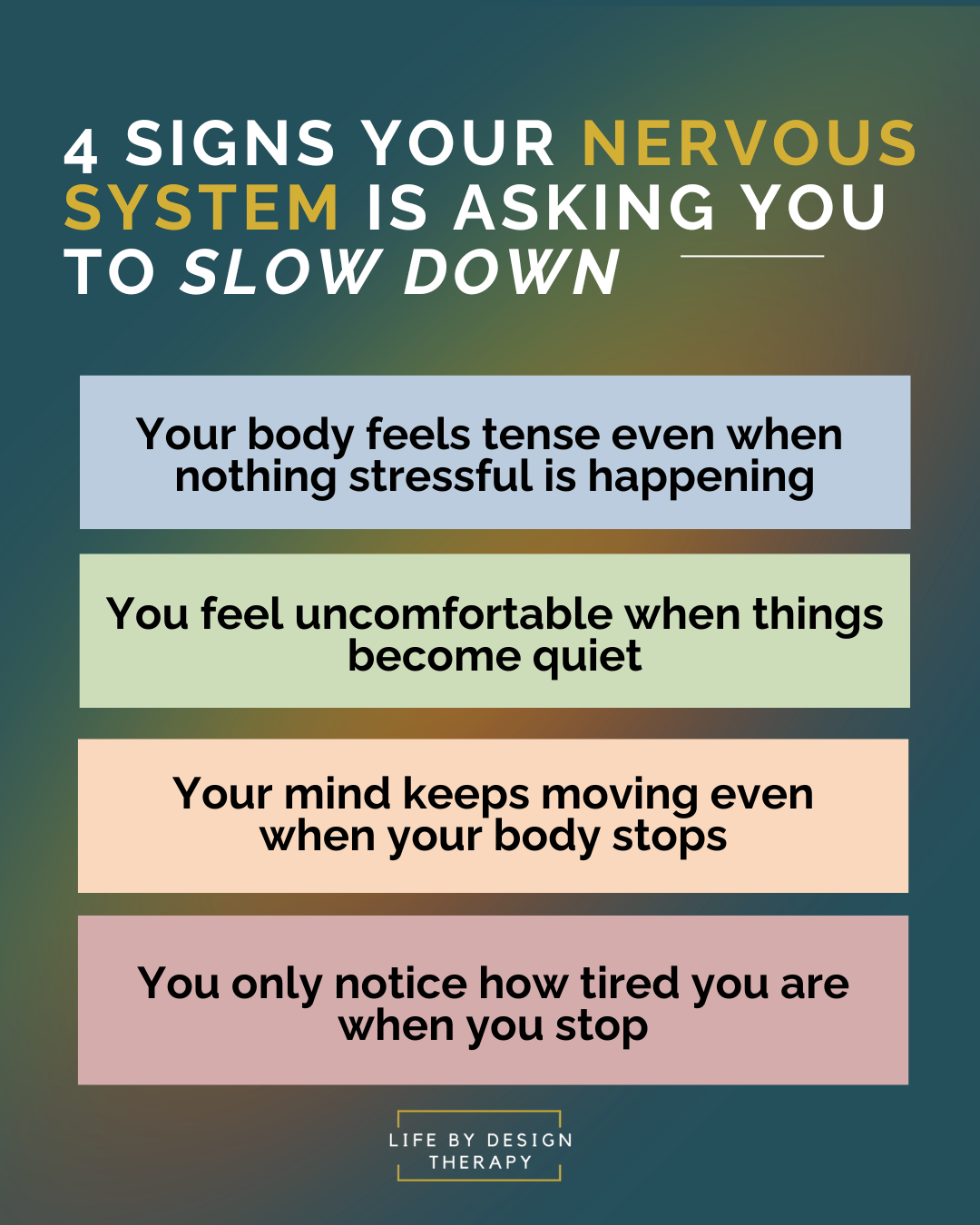
We often talk about slowing down as if it’s simple.
As if it’s just a matter of deciding to rest.
Logging off earlier.
Saying “no” more often.
Creating more space in your schedule.
But slowing down isn’t always accessible in the ways people imagine.
Your life may be full. There may be responsibilities that can’t be paused. People who depend on you. Roles you carry every day.
And even when there is space, your body may not immediately follow.
You might not notice how quickly you move from one moment to the next. Instead, you continue forward, carrying the tension, the focus, and the activation from the previous moment into the next.
Over time, this constant forward motion can become your nervous system’s baseline.
Slowing down, then, isn’t just about stopping. It’s about allowing your body to recognize that it no longer needs to remain in that same level of activation.
And for many people, that’s not something their nervous system has had much opportunity to practice.
Typically, this isn’t a conscious choice. It’s something your nervous system has learned over time.
How Your Nervous System Learns to Stay in Survival Mode
While the pace of adult life can reinforce this constant engagement, this pattern often didn’t begin in adulthood.
It may have started much earlier.
You might have been the responsible one, the one who handled things, and the one others relied on.
You may have learned, without anyone explicitly saying it, to stay aware of what was happening around you; to notice shifts in mood, expectations, or needs.
Not because you were doing anything wrong, but because that awareness helped things feel steadier.
For some, home environments were unpredictable. For others, expectations were high. And for many, it was simply the quiet understanding that being capable and aware was part of who they needed to be.
Over time, your body learned from those experiences.
It learned to stay prepared. To move quickly. To anticipate what might come next.
And as adulthood brings its own responsibilities, work, relationships, caregiving, and decision-making, your nervous system may continue using those same patterns, even now.
Your nervous system has spent a long time learning how to function this way, and that makes sense given what it has experienced.
Slowing down, then, isn’t unfamiliar simply because your life is busy.
It can feel unfamiliar because staying in motion, mentally, physically, and emotionally, has been one of the ways your nervous system has supported you.
And it’s also important to recognize that this isn’t only shaped by early experiences. Many people today are navigating systems that constantly reward speed, productivity, and doing more. Financial pressures, heavy workloads, caregiving demands, and a culture that often prioritizes independence over community can keep people operating in a constant state of motion.
In other words, someone can have had a supportive upbringing and still find themselves in survival mode simply because the pace and demands of modern life are overwhelming.
How Busyness and Productivity Reinforce Stress in the Body
You may notice that staying productive helps you feel steady.
Moving from one responsibility to the next can create a rhythm your body recognizes. There’s often clarity in knowing what needs your attention, what needs to be finished, or who needs you.
Productivity can provide structure. Direction. A sense that things are moving forward.
And when that movement pauses, even briefly, you might notice discomfort.
You may reach for your phone without thinking.
Start planning the next task before the current moment has fully ended.
Feel the urge to stay mentally occupied, even when nothing is immediately required of you.
This isn’t necessarily about having more to do. It’s often about what your body is used to.
When you’ve spent a long time staying engaged, mentally, emotionally, or physically, stillness can feel unfamiliar. Your nervous system may continue seeking movement, simply because that’s the state it knows best.
Over time, productivity can become more than a way to manage your responsibilities. It can become a way your nervous system maintains the momentum it has carried for years.
And this is part of why slowing down isn’t always as simple as deciding to rest.
How Slowing Down Affects Your Nervous System
When you begin to slow down, you may notice things you hadn’t fully registered before.
You might realize how tired you actually feel once your body isn’t pushing toward the next task.
You may begin to notice a clenched jaw, tightness across your shoulders, or that familiar churning or fluttering sensation in your stomach that’s been there all along, just outside of your awareness.
Your thoughts may feel louder in quiet moments. You may find yourself replaying conversations, thinking ahead, or feeling the urge to distract yourself.
Sometimes, emotions that were easier to move past while staying busy can begin to surface once there is space.
This isn’t because slowing down created those sensations or feelings.
It’s often because your attention is no longer being pulled entirely outward.
When your nervous system has been focused on staying engaged, solving problems, responding to needs, and moving from one responsibility to the next, it naturally prioritizes what is happening around you.
Slowing down shifts that attention inward.
And for many people, that inward awareness is unfamiliar at first.
You may notice restlessness. Or discomfort. Or the urge to get up and do something, even when nothing is required of you.
This is often your nervous system adjusting to a different pace.
Over time, as your body begins to experience moments of safety in stillness, it becomes easier to settle. Awareness becomes less overwhelming and more grounded.
Slowing down doesn’t force your body to change. It simply gives your nervous system the opportunity to reconnect with itself.
What slowing down can actually look like
Slowing down doesn’t require clearing your schedule or stepping away from your responsibilities.
More often, it happens in brief moments that already exist within your day.
It may begin with something as simple as:
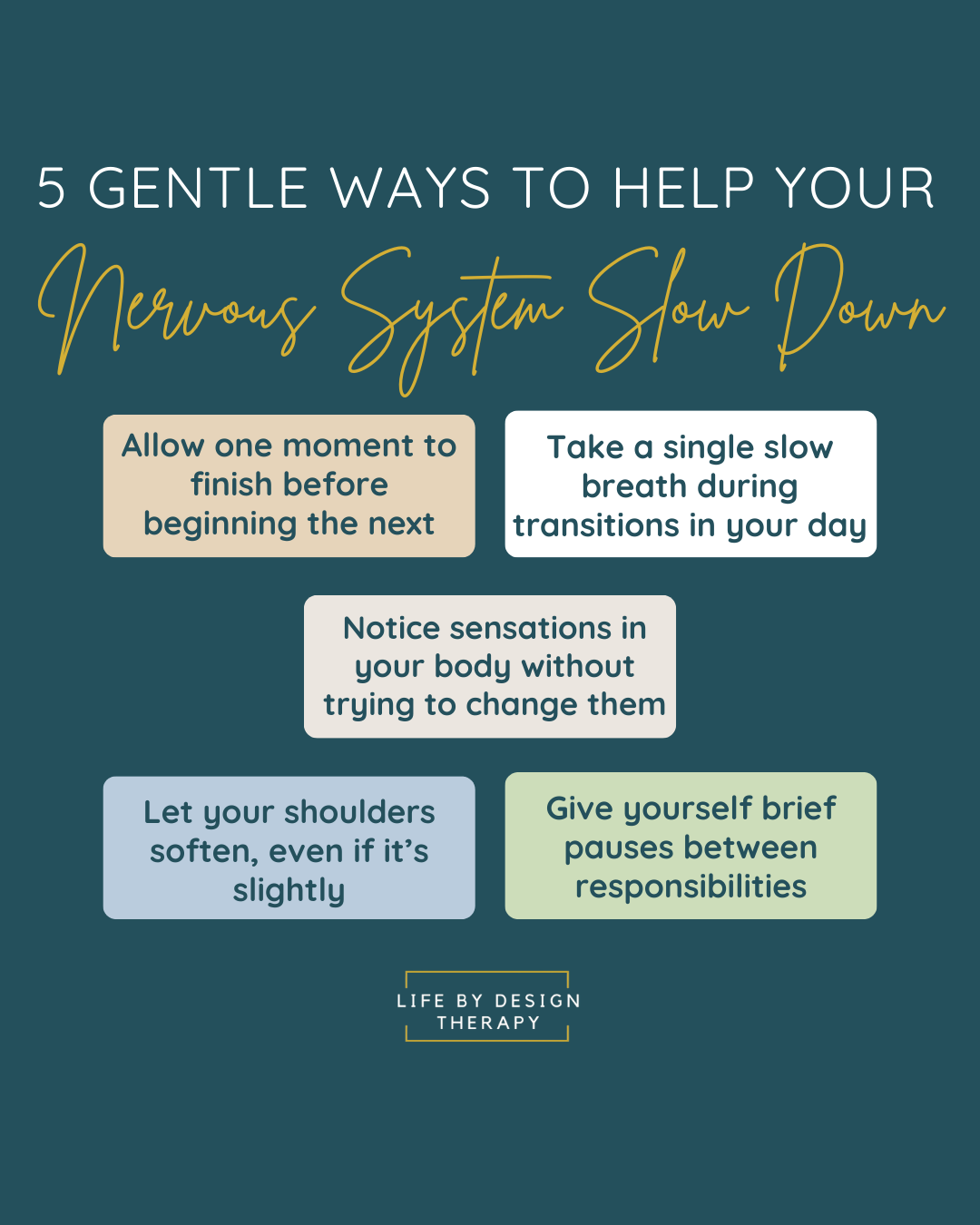
🌻Taking one full breath before opening your laptop, instead of moving immediately into work.
🌻 Pausing in your car before walking into your home.
🌻 Allowing yourself to sit for a moment after finishing something, rather than immediately reaching for the next task.
You may start to notice how quickly you normally move, and your attention shifts ahead before the present moment has fully ended.
Slowing down can be as simple as allowing one moment to finish before beginning another.
It can be as subtle as feeling your feet on the floor while you’re standing in the kitchen, noticing the support of the chair beneath you, becoming aware of tension in your shoulders, and letting them soften, even slightly.
From the outside, nothing may appear different.
But internally, your nervous system begins receiving a different message. It begins to recognize that constant motion isn’t required, allowing you to settle more fully into the present moment and into your body.
Over time, these small pauses create opportunities for your body to settle.
Not all at once. But gradually.
In ways that feel supportive and sustainable.
How somatic and holistic therapy can help
For many people, slowing down becomes more accessible with support.
Somatic and holistic therapy focuses on helping you reconnect with your body and nervous system in ways that feel manageable and safe.
Rather than pushing you to relax, therapy helps you notice what your body is already holding, and build the capacity to settle at a pace that feels sustainable.
Over time, this work can help your nervous system release patterns of constant readiness and develop a greater sense of internal stability.
Slowing down becomes less about effort and more about allowing your body to recognize that it no longer needs to stay in survival mode.
Final thoughts
Slowing down isn’t always as simple as deciding to rest.
It’s something your nervous system learns through repeated experiences of safety, presence, and pause.
If your body has spent a long time staying engaged, moving forward, and carrying responsibility, it makes sense that slowing down may feel unfamiliar at first.
But change doesn’t happen all at once.
It begins in small moments. A breath. A pause. A transition where your body is allowed to settle, even briefly.
Over time, those moments help your nervous system recognize that it doesn’t always need to stay in motion.
And gradually, slowing down becomes something your body remembers how to do.
This Week's Affirmations
I can be present without needing to prepare for what comes next
It is safe for me to move through my day without urgency
My worth is not defined by how much I accomplish
I am allowed to pause, even when there is more to do
I can allow this moment to be enough.
Additional Resources
**If you’re interested in learning more about ways to support your nervous system, check out these books below:
The Body Keeps the Score: Brain, Mind, and Body in the Healing of Trauma by Bessel van der Kolk M.D
Polyvagal Theory in Therapy: Engaging the Rhythm of Regulation by Deb Dana
The Stress-Proof Brain: Master Your Emotional Response to Stress Using Mindfulness
When the Body Says No: The Cost of Hidden Stress by Gabor Maté
The Power of Now: A Guide to Spiritual Enlightenment by Eckhart Tolle
The Disease to Please: Curing the People-Pleasing Syndrome by Harriet B. Braiker
Radical Acceptance: Embracing Your Life with the Heart of a Buddha by Tara Brach
**Some product links are affiliate links, which means we'll receive a commission if you purchase through our link, at no extra cost to you. Please read the full disclosure here.


Emotional Neglect: What It Is, How It Affects You, and How to Heal
By Melody Wright, LMFT

Have you ever felt like something was missing in your relationships, but you couldn’t quite name it?
Maybe you’ve struggled with feelings of emptiness, disconnection, or loneliness without understanding why.
If this resonates with you, you may have experienced some form of emotional neglect.
Emotional neglect is often invisible.
It’s not a single event, a dramatic betrayal, or a clear-cut trauma that others can see.
Instead, it’s the absence of something crucial like validation, attunement, and emotional support.
If you’ve ever felt unseen, unheard, or like your emotions didn’t matter, you’re not alone.
And more importantly, your experiences matter.
You may not have a specific memory of being emotionally neglected, and that’s part of what makes it so difficult to recognize.
Emotional neglect is defined by what doesn’t happen, the lack of emotional presence, support, and validation that every person needs to thrive.
So, what exactly is emotional neglect, and how does it impact those who experience it?
Let’s talk about it.
What Is Emotional Neglect?
Emotional neglect can be hard to recognize, especially because it’s not always about what did happen, but about what didn’t.
It shows up when the people who were supposed to be there for you, like parents, caregivers, or even partners, consistently miss, dismiss, or simply don’t notice your emotional needs.
Over time, that quiet absence can send a loud and painful message: Your feelings don’t matter.
Even when there’s no obvious harm or bad intentions, the impact can run deep.
You might struggle to connect with your emotions, put everyone else’s needs before your own, or walk around with this sense that something’s missing, but not know why.
These are signs that you may have experienced emotional neglect.
And the truth is, it’s more common than you might think.
Because it’s often unintentional and invisible, emotional neglect can go unnoticed for years, even by the person experiencing it.
A parent may believe they’re doing their best, but be emotionally unavailable because of stress, mental health challenges, or their own unresolved trauma.
In the same way, a partner might not realize they’re tuning out your emotional world or leaving you feeling alone in the relationship.
Recognizing emotional neglect for what it is doesn’t mean placing blame; it means beginning to understand your story in a new, more compassionate way.
What are the Forms of Emotional Neglect?
Emotional neglect isn’t always obvious, and it doesn’t look the same for everyone.
In fact, some forms of it may surprise you.
Here are some common ways emotional neglect can show up, sometimes in ways we don’t even realize
Childhood Emotional Neglect (CEN): Growing up in an environment where emotions were dismissed, ignored, or invalidated. This may have looked like being told “you’re too sensitive” or “stop crying,” or being expected to handle your emotions alone.
Parental Absence (Physical or Emotional): This can look like having a caregiver who was physically present but emotionally distant or unresponsive. When your emotional world wasn’t acknowledged or supported, you may have learned, consciously or not, that there wasn’t space for your feelings. As a result, you might struggle to identify or express emotions, or feel unsure about whether your feelings are valid or safe to share.
Romantic Relationships: Feeling unseen or unheard in a partnership, where your emotional needs are consistently dismissed or minimized.
Friendships and Social Circles: Being the person who listens and supports others but rarely receives the same emotional investment in return, creating a one-sided relationship.
Workplace and Professional Settings: Feeling undervalued, unsupported, or unseen in professional environments, leading to burnout, dissatisfaction, and feelings of inadequacy.
Recognizing the different ways emotional neglect can appear in our lives is the first step toward understanding its deeper impact. Read Why Emotional Neglect Can Lead to People Pleasing Behaviors.
Did you know that emotional neglect can rewire the way we respond to stress, interact with others, and even how our bodies function in times of stress?
How Does Emotional Neglect Affect Your Brain and Body?
Emotional neglect doesn’t just impact how you feel, it can affect your brain and nervous system, too.
When emotional needs go unmet over time, the body may adapt by staying in a heightened state of alert.
This can look like chronic stress, where your nervous system is stuck in fight, flight, freeze, or fawn mode, even when there’s no immediate danger.
These early experiences can shape the way you respond to the world well into adulthood.
Here are six ways emotional neglect can show up in your life:
Impact on the Nervous System: The lack of consistent emotional support disrupts the nervous system’s ability to regulate itself, making it harder for you to manage stress and emotions. Without this support, the nervous system stays stuck in a heightened state of alertness or shuts down to cope, which can cause chronic anxiety or emotional numbness over time.
Attachment and Relationship Patterns: Emotional neglect in childhood can lead to insecure attachment styles, such as anxious, avoidant, or disorganized attachment. This can make it challenging to form and maintain healthy relationships, because you may struggle with trust, and emotional intimacy, or have a fear of being abandoned.
Difficulty Processing Emotions: When your emotions are consistently ignored or dismissed, it can become difficult to understand or express how you feel. This might lead you to push your emotions down and ignore them, or, on the other hand, feel overwhelmed when unprocessed emotions surface in unexpected and intense ways.
Heightened Stress Response: When emotional needs are not met consistently, the body can remain stuck in a heightened state of stress. This may show up as feeling constantly on edge, struggling to relax, or being easily overwhelmed by emotions or situations that feel unpredictable.
Physical Health Consequences: Chronic emotional neglect has been linked to increased stress-related illnesses, such as headaches, digestive issues, sleep disturbances, and even muscle tension or pain.
Impact on Self-Perception: Over time, emotional neglect can shape your internal dialogue, reinforcing feelings of unworthiness or self-doubt. Many people who experience emotional neglect often struggle with impostor syndrome, perfectionism, or a fear of failure.
As you can see, not only does emotional neglect affect your physical self, it also impacts your mental, emotional, and spiritual well-being. Let’s talk about how this can impact your everyday life.
How Does Emotional Neglect Affect Your Everyday Life?
Emotional neglect doesn’t just fade with time, it can shape the way you see yourself and navigate the world.
If you've ever questioned why certain emotional struggles persist, it may be connected to the ways emotional neglect has shaped your experiences.
Here are 5 ways it might be affecting you:
Difficulty Identifying or Expressing Emotions: You might struggle to know what you’re feeling, or believe your emotions don’t matter. This can lead to emotional disconnection, where you feel numb, detached, or unable to put your feelings into words.
People-Pleasing Tendencies: Growing up without emotional validation can condition you to prioritize others’ needs as a way to feel valued or accepted while ignoring your own. This could lead you to feel responsible for others’ emotions or find it difficult to say no. If you would like to learn more about healing from people pleasing, check out my blog, Why Emotional Neglect Can Lead to People Pleasing Behaviors.
Fear of Vulnerability: If emotions were dismissed in the past, expressing them may feel unsafe or shameful. You might avoid deep conversations, struggle with emotional intimacy, or feel like you always need to be “strong.”
Chronic Loneliness: Even in relationships, you may feel isolated or unseen because you weren’t taught how to expect or accept emotional support. This can lead to feelings of disconnection, even in social settings.
Low Self-Worth: When your emotions were overlooked, you may have internalized the message that you are not important. This can manifest as self-doubt, difficulty advocating for yourself, or feeling unworthy of love and support.
Understanding these impacts is crucial because they influence how you navigate relationships, manage stress, and even perceive yourself.
But emotional neglect doesn't have to define your future, there are ways to heal and reclaim your emotional well-being.

How Do You Heal from Emotional Neglect?
Moving forward from emotional neglect begins with recognizing that your emotional needs are valid and worthy of attention.
While past experiences may have influenced your patterns, they do not define your ability to heal and build healthier connections.
Here are some steps toward healing:
Get Curious About Your Story: One of the first steps toward healing is becoming curious about your early experiences. Take some time to reflect on your upbringing. Were your caregivers emotionally present? Did they help you understand and make space for your feelings, especially when they felt big or overwhelming? You don’t have to have all the answers right away, and you don’t need to label it as emotional neglect. Exploring how your emotional needs were handled growing up can help you better understand the patterns that show up in your life now.
Enhance Your Emotional Vocabulary: Expanding your ability to name and understand emotions can help you reconnect with yourself. Reading about emotions, practicing mindfulness, and using emotion wheels can deepen your emotional awareness. When you can accurately label your emotions, it becomes easier to process them and communicate them to others. To learn more about how to expand your emotional vocabulary, check out my blog, 5 Ways to Build a Strong Emotional Vocabulary & Why It Matters.
Build Emotional Awareness: Practicing self-reflection, mindfulness, and journaling can help you tune into your emotions. Over time, this practice can strengthen your ability to recognize and respond to your emotional needs rather than suppressing them.
Set Boundaries: Learning to recognize and communicate your emotional needs is essential. Setting boundaries with those who drain your energy or dismiss your feelings allows you to create space for relationships that nurture and respect you.
Seek Supportive Relationships: Surround yourself with people who listen, validate, and care about your emotional experiences. Supportive relationships can help rewire the way you engage with others and allow you to experience emotional safety.
Consider Therapy: A therapist trained in attachment-based or somatic healing approaches can help you process past emotional neglect, build emotional resilience, and develop healthier coping mechanisms.
Final Thoughts
If any of this resonates with you, know that your emotions matter, and you deserve relationships that nurture and validate you.
Emotional neglect may have shaped parts of your story, but it doesn’t have to define your future.
Healing is not only possible, it’s something you deserve.
By acknowledging your needs, seeking support, and making space for emotional connection, you can begin to rewrite your narrative with compassion and self-awareness.
This Weeks Affirmations
It is safe for me to set boundaries that protect my well-being.
I am not defined by my past experiences. I am free to create a new path.
I give myself permission to feel, process, and heal at my own pace.
I am growing, evolving, and learning to trust myself.
My emotions are valid, and I deserve to express them.
Additional Resources
**If you’re interested in learning more about emotional neglect check out these books below:
Self-Compassion: The Proven Power of Being Kind to Yourself by Dr. Kristin Neff
Hold Me Tight: Seven Conversations for a Lifetime of Love by Dr. Sue Johnson
The Drama of the Gifted Child: The Search for the True Self by Alice Miller
The Disease to Please: Curing the People-Pleasing Syndrome by Harriet B. Braiker
Running on Empty: Overcome Your Childhood Emotional Neglect by Jonice Webb
**Some product links are affiliate links, which means we'll receive a commission if you purchase through our link, at no extra cost to you. Please read the full disclosure here.