

13 Different Types of Boundaries and Why They Matter
By Melody Wright, LMFT
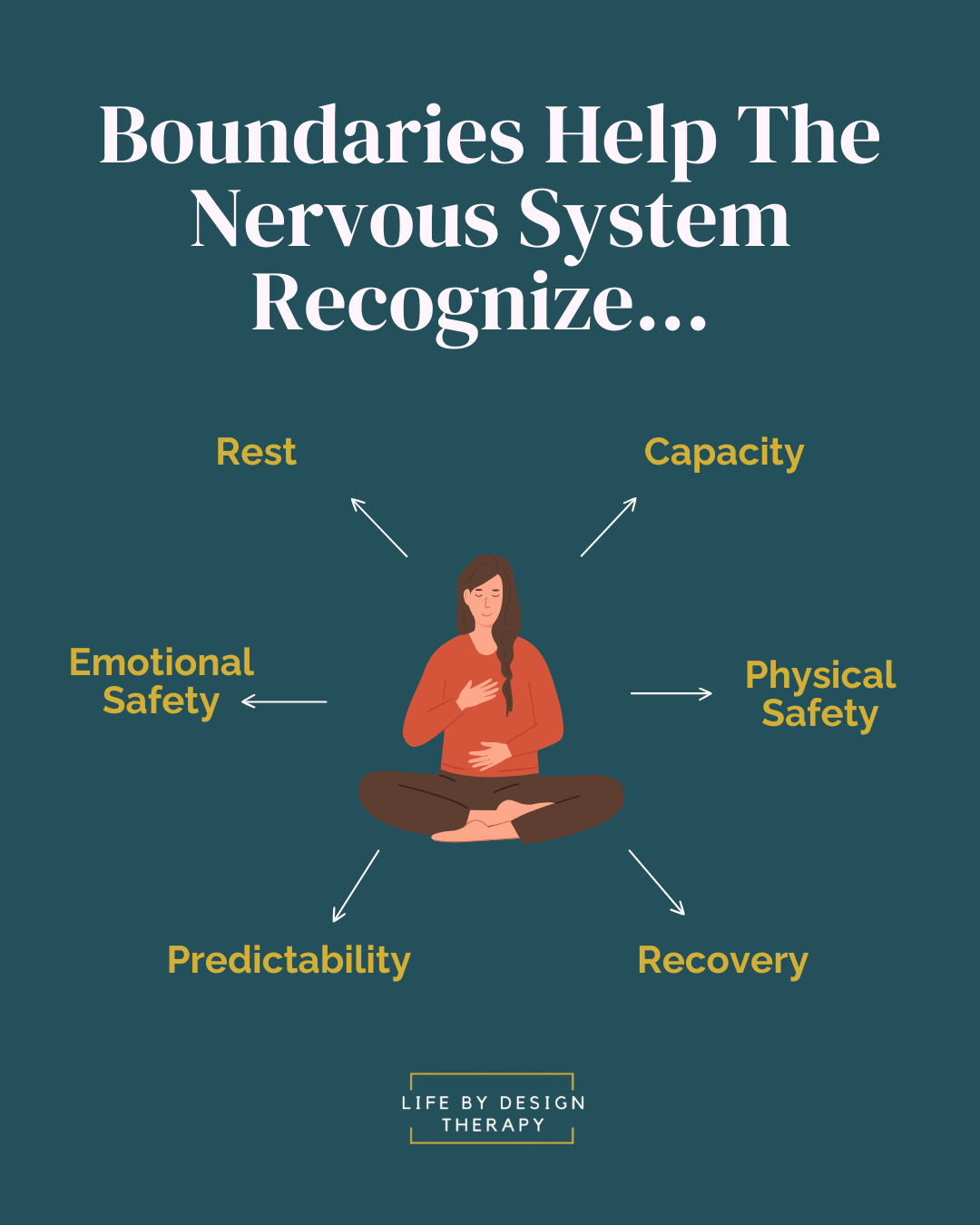
A lot of people don’t realize their nervous system has been asking for boundaries long before their mind ever catches up.
Sometimes it shows up as:
feeling emotionally exhausted after conversations
getting irritated more easily
feeling anxious every time your phone goes off
shutting down socially
struggling to rest
feeling overstimulated all the time
carrying tension in your body without fully knowing why
And honestly, many people assume this just means you’re stressed, too sensitive, bad at coping, or not managing life well enough.
But sometimes what’s actually happening is that your body is responding to a lack of boundaries. While boundaries are often thought of as something we set with other people, they also help create a sense of safety within ourselves
They help the nervous system recognize:
rest
separation
capacity
recovery
emotional safety
physical safety
predictability
And without them, the body can begin functioning as though it always has to stay alert, available, accommodating, or prepared for the next demand.
Why Boundaries Matter for Your Nervous System
A lot of people think boundaries are simply communication tools, but boundaries are also nervous system support tools.
Your body is constantly responding to:
interruptions
emotional demands
overstimulation
conflict
noise
emotional labor
constant accessibility
information overload
environments that don’t feel safe
And when your nervous system rarely gets a break from those things, it often starts showing up physically and emotionally.
Sometimes that looks like:
anxiety
burnout
emotional exhaustion
resentment
chronic tension
irritability
emotional shutdown
people pleasing
hypervigilance
fatigue after social interaction
difficulty relaxing
trouble sleeping
feeling emotionally numb
constantly feeling “on edge”
Sometimes burnout isn’t just about doing too much. It’s about the nervous system going too long without enough safety, rest, or protection to finally soften.
Signs Your Body May Be Asking for Stronger Boundaries
Sometimes the body notices missing boundaries long before the mind fully understands what’s happening.
A lot of people assume boundaries only become necessary once something becomes “bad enough.” But often, the nervous system starts signaling overload much earlier than that. The body begins communicating through tension, irritability, exhaustion, overstimulation, and emotional flooding without enough space to recover.
And honestly, many people become so used to functioning in survival mode that these signals start feeling normal. They normalize pushing through exhaustion, staying constantly available, overriding discomfort, ignoring resentment, and feeling emotionally responsible for everyone around them.
But the nervous system was never designed to function in a constant state of emotional accessibility, overstimulation, pressure, or hyper-alertness without consequences.
Here are some signs your nervous system may be asking for stronger boundaries:
chronic tension
irritability
emotional exhaustion after conversations
anxiety before responding to messages
resentment
feeling overwhelmed by small demands
difficulty relaxing
trouble sleeping
fatigue after social interaction
emotional numbness
overstimulation
people pleasing followed by shutdown
constantly feeling “on edge”
needing isolation after interactions
feeling emotionally flooded easily
Sometimes the nervous system responds by becoming anxious or overwhelmed. Other times, it responds by shutting down completely through numbness, avoidance, procrastination, disconnection, or mentally checking out altogether.
These are not character flaws; they’re signals that your nervous system may be carrying more than it was ever meant to hold alone.
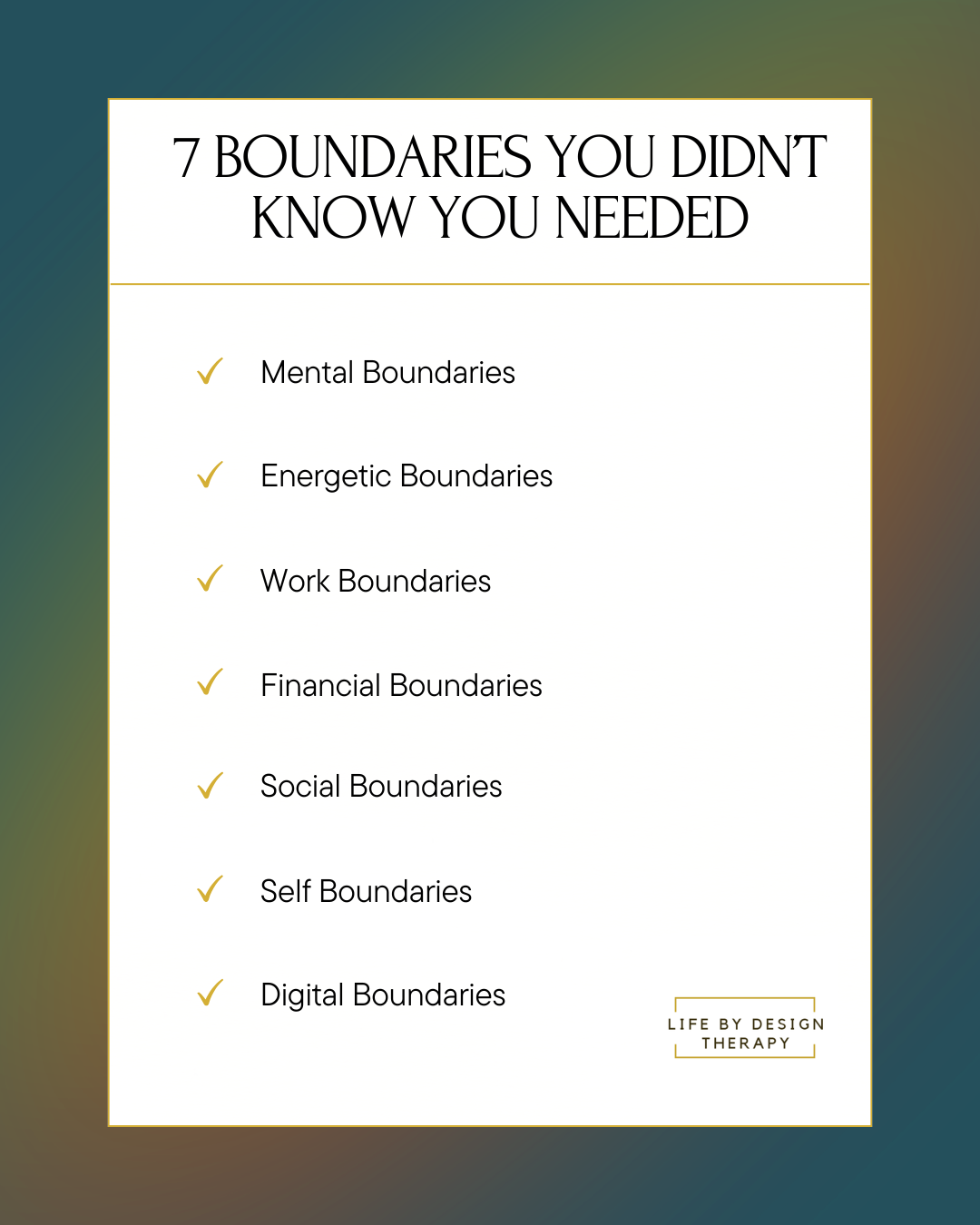
13 Boundaries You Didn’t Know You Needed
Emotional Boundaries
A lot of people learned that being loving meant:
always listening
always helping
always fixing
always being emotionally available
But emotional boundaries help your nervous system recognize where your emotional responsibility ends, and someone else’s begins.
Examples of emotional boundaries:
Saying “I don’t have the emotional capacity right now”
Not taking responsibility for someone else’s emotions
Saying no to emotional dumping
Not becoming everyone’s unpaid therapist
Allowing people to be upset without rescuing them
Protecting vulnerable emotions from emotionally unsafe people
Not overexplaining your feelings
Choosing who gets emotional access to you
Sometimes the issue isn’t that you care too much.
It’s that your nervous system never learned where your emotional responsibility stops.
2. Time Boundaries
A lot of people are physically exhausted not simply because they’re busy, but because their nervous system never exits “go mode.”
There’s no pause.No decompression.No transition time.
Just constant accessibility. So implementing boundaries with your time is essential for nervous system regulation.
Examples of time boundaries:
Not responding immediately to every text or email
Protecting slow mornings
Scheduling alone time
Allowing transition time between activities
Leaving events early when needed
Protecting rest without guilt
Having designated offline hours
Not overcommitting your schedule
Allowing yourself to be unavailable sometimes
Rest becomes difficult when the nervous system never fully believes it’s safe to stop.
3. Physical Boundaries
Many people learned very early to disconnect from their body’s signals in order to stay liked, accommodating, or emotionally safe.
They learned to override discomfort. But your body notices boundary violations long before your mind fully explains them.
So, here are some examples of physical boundaries:
Saying no to touch
Needing personal space
Protecting your sleep
Leaving overstimulating environments
Taking sensory breaks
Saying “I’m touched out”
Limiting physical closeness when emotionally overwhelmed
Asking before touching others
Allowing your body to rest before collapse
Sometimes healing involves learning how to hear your body again after years of overriding it.
4. Digital Boundaries
Honestly, modern nervous systems were not built for the amount of constant input most people experience every day.
Notifications.
Emails.
Social media.
News cycles.
Constant scrolling.
For many people, this creates a kind of ongoing background activation in the nervous system where the body never fully feels off-duty. Even during moments of rest, part of the brain may still be anticipating the next notification, demand, interruption, or piece of emotional input, making it difficult for the nervous system to fully settle, soften, or recover.
Examples of digital boundaries:
Turning off notifications
Limiting social media use
Taking breaks from doomscrolling
Logging out of work apps after hours
Creating no-phone times
Not checking emails constantly
Curating your social media feed intentionally
Limiting upsetting content
Not feeling obligated to be reachable 24/7
A lot of people don’t realize how dysregulated they feel because their nervous system rarely experiences actual quiet anymore.
5. Mental Boundaries
Mental boundaries help protect your attention, thoughts, concentration, and emotional bandwidth.
And honestly, many people are mentally exhausted from constant information overload.
Examples of mental boundaries:
Saying no to debates you don’t want to have
Limiting exposure to chronic negativity
Limiting interruptions to support focus and presence
Taking breaks from distressing news cycles
Not constantly consuming self-help content
Refusing to engage in circular arguments
Choosing not to explain every decision
Allowing yourself to change your mind
Taking breaks from the constant productivity culture
Your nervous system deserves moments where it gets to simply exist instead of constantly processing input.
6. Energetic Boundaries
Energetic boundaries are about recognizing your nervous system’s actual capacity before burnout happens. This is the kind of boundary many people don’t notice until their body forces them to.
Examples of energetic boundaries:
Protecting recovery time after socializing
Limiting emotionally draining interactions
Allowing yourself solitude
Leaving environments that dysregulate you
Not carrying emotional labor for everyone
Recognizing when your body feels overloaded
Resting before complete exhaustion hits
Paying attention to how your body feels around certain people
Implementing energetic boundaries is simply listening to what your body has been trying to communicate for a long time.
7. Relationship Boundaries
Did you know that healthy and secure relationships still need boundaries? Actually, boundaries are what make emotional safety possible within your relationships.
Here are some examples of relationship boundaries:
Not tolerating disrespect disguised as humor
Saying no to manipulation
Asking for accountability and repair
Maintaining individuality
Speaking honestly instead of people-pleasing
Protecting your privacy as a couple
Taking space without emotionally disappearing
Not allowing emotional punishment or silent treatment dynamics
Having separate hobbies and interests
Remember that boundaries are not the opposite of connection; they actually help create healthier connections.
8. Family Boundaries
Family boundaries can feel especially difficult because many people were taught that boundaries with family are disrespectful. But family access does not erase nervous system limits.
Sometimes this can look like:
Limiting intrusive questions
Saying no to guilt-based expectations
Protecting your parenting choices
Not answering every phone call immediately
Refusing criticism disguised as concern
Ending conversations that become harmful
Saying “That topic isn’t open for discussion.”
Limiting access to your home
Protecting your children’s emotional safety
I want you to remember that protecting your nervous system is not selfish. Many of us were raised to believe that being available to everyone at all times was part of being a good family member, partner, or parent. In reality, healthy boundaries help create the safety and space your nervous system needs to rest, recover, and engage with others in a more grounded and connected way.
9. Work Boundaries
Some people’s nervous systems never fully soften because work stress follows them into every area of life.
Here are some ways you can establish work boundaries:
Not working off the clock
Saying no to unpaid labor
Protecting lunch breaks
Not answering emails at all hours
Taking sick days when needed
Refusing unrealistic workloads
Protecting vacation time
Separating your worth from productivity
Limiting emotional labor at work
Burnout is not always caused by doing too much. Sometimes it’s because your nervous system has been managing stress without enough protection for far too long.
Many people struggle to fully disconnect from work even after the workday ends because their nervous system never fully exits “go mode.” If this is something you’ve been experiencing, you may also enjoy reading our blog on How to Actually Disconnect After Work Hours.
10. Financial Boundaries
This is a boundary that people rarely talk about. We don’t realize how deeply financial stress can impact us, because finances are our way of life. However, it’s so important for you to increase your financial awareness to protect your nervous system.
Here is what financial boundaries can look like:
Saying no to lending money
Protecting financial privacy
Not overspending to please others
Setting spending limits
Protecting savings goals
Saying no to financial pressure
Not financially rescuing everyone around you
Choosing not to discuss income with everyone
Separating guilt from financial decisions
Financial safety affects emotional safety more than many people realize.
11. Social Boundaries
Human connection can be deeply healing for the nervous system.
But a connection that consistently requires shrinking yourself, staying hyperaware, or overriding your own needs can slowly become emotionally exhausting instead of restorative. So, social boundaries can support self-regulation and even healthier connections with others.
Here are a few examples of social boundaries:
Leaving gatherings early
Saying no without lengthy explanations
Not forcing yourself to socialize when depleted
Choosing smaller social circles
Protecting recovery time after social events
Saying no to peer pressure
Not attending every event you’re invited to
Choosing reciprocal relationships
Limiting access to your personal life
Sometimes protecting your peace means becoming more intentional about where your energy goes.
12. Self Boundaries
Honestly, some of the most important boundaries are the ones people set with themselves.
That can look like:
Resting before you experience burnout
Not consistently criticizing yourself
Limiting perfectionism
Taking breaks from overanalyzing
Not doom-spiraling late at night
Allowing yourself to enjoy things without earning them
Recognizing when you need support
Giving yourself permission to disappoint people sometimes
Choosing softness over constant survival mode
Sometimes, the deeper work is not setting boundaries with other people. It’s rebuilding the ability to listen to yourself before you automatically push past your own limits.
And honestly, self-boundaries are often deeply connected to self-compassion, because learning to honor your needs, limits, and capacity requires unlearning the belief that you always have to push through, overperform, or abandon yourself to be worthy. If this resonates with you, you may also enjoy reading our blog on Mindful Limits: The Connection Between Boundaries and Self-Compassion.
13. “Invisible” Boundaries People Rarely Think About
Honestly, some of the most important boundaries are the ones people don’t even realize they’re allowed to have.
Like:
You don’t have to answer every question someone asks you
You don’t have to explain every decision
You don’t have to stay emotionally available all the time
You don’t have to tolerate constant interruption
You don’t have to justify rest
You don’t have to respond immediately to texts
You don’t have to consume upsetting content constantly
You don’t have to stay in emotionally harmful conversations
You don’t have to be endlessly accessible to be a good person
You don’t have to override your body to keep others comfortable
For many people, boundaries are not about becoming less caring. They’re about finally creating enough safety for you to stay connected to yourself.
Because when you spend enough time pushing past your own limits, emotions, exhaustion, or discomfort, it becomes harder to recognize what your body is actually trying to tell you.
Boundaries help interrupt that pattern, not by shutting people out, but by helping you remember that connection should not require you to abandon yourself.
How to Start Setting Boundaries Without Guilt
If boundaries feel uncomfortable for you, that does not necessarily mean you’re doing them wrong.
For many people, boundaries feel emotionally exposing because their nervous system learned that:
Saying no created conflict
Having needs felt unsafe
Rest had to be earned
Pleasing others created belonging
Self-protection felt selfish
Remember, boundaries are not just mental shifts; they’re nervous system work too.
It’s completely okay to start small.
You might begin noticing:
Where resentment keeps showing up
What leaves your body feeling tense or depleted
Where you feel obligated instead of safe
What environments leave you dysregulated
Where your body feels like it never gets to exhale
Sometimes healthy boundaries sound like:
“I don’t have capacity right now.”
“I need quiet time.”
“I’m unavailable after work hours.”
“I’m not looking for advice right now.”
“I need time before responding.”
Please hear this: you are allowed to protect your peace without needing to earn permission first.
Final Reflections
Boundaries are not just about protecting your peace mentally. They’re also about helping your body finally feel safe. Because, as we talked about, when your nervous system spends years overextending, overaccommodating, staying hyper-alert, carrying emotional weight, overriding exhaustion, and remaining constantly accessible to everyone around you, eventually the body starts responding. But healthy boundaries help create the emotional and physical safety needed for healing, connection, regulation, and rest.
And honestly, beginning the process of setting boundaries can feel incredibly difficult at first. That’s why support can matter so much during this process. Therapy can help you better understand the emotional patterns, attachment dynamics, and nervous system responses underneath people-pleasing, emotional overwhelm, guilt, conflict avoidance, and difficulty setting boundaries so that boundaries begin to feel less like danger and more like safety.
At Life By Design Therapy™, we offer holistic and somatic therapy for individuals and couples throughout California, both online and in-person in Berkeley. Our therapists can help you better understand the nervous system patterns, emotional dynamics, and body-based responses underneath burnout, overwhelm, anxiety, people-pleasing, and difficulty setting boundaries so you can build healthier, more sustainable ways of relating to yourself and others.
If you’re ready to start or just learn more, CLICK HERE to book a free phone consultation.
This Week's Affirmations
Healthy boundaries help me stay connected to myself and others.
I can honor my capacity without abandoning myself in the process.
I can care deeply about others without carrying everything for them
Setting boundaries does not make me selfish, difficult, or unkind.
I am allowed to protect my peace, energy, and emotional well-being without guilt.
Additional Resources
If you’re interested in continuing to explore boundaries, emotional safety, attachment patterns, and the nervous system dynamics underneath relationship disconnection, the books below can be a helpful place to start.
Adult Children of Emotionally Immature Parents by Lindsay C. Gibson
The Seven Principles for Making Marriage Work by John Gottman
**Some product links are affiliate links, which means we'll receive a commission if you purchase through our link, at no extra cost to you. Please read the full disclosure here.


Boundaries in Relationships vs. Emotional Walls: What’s the Difference?
By Melody Wright, LMFT
We hear a lot about boundaries now. And honestly? That’s not a bad thing.
A lot of people are finally learning they don’t have to overextend themselves, tolerate harmful behavior, or constantly abandon themselves just to keep a relationship going.
But I also think there’s another side of this conversation that doesn’t get talked about enough.
Sometimes what we call a boundary… isn’t actually a boundary.
🌻 Sometimes it’s shut down.
🌻 Sometimes it’s avoidance.
🌻 Sometimes it’s hurt.
🌻 Sometimes it’s exhaustion.
🌻 Sometimes it’s grabbing onto the only sense of control or “peace” we feel like we have left.
And if I’m being honest, I think a lot of people have had moments where they genuinely were trying to protect their peace, while also slowly pulling away from their partner without fully realizing it.
The reality is that relationships can feel vulnerable, conflict can feel overwhelming, and emotional closeness can bring up a lot more than people realize.
So let’s talk about the difference between boundaries and emotional walls, because they can look surprisingly similar from the outside.
Stonewalling vs. Healthy Boundaries
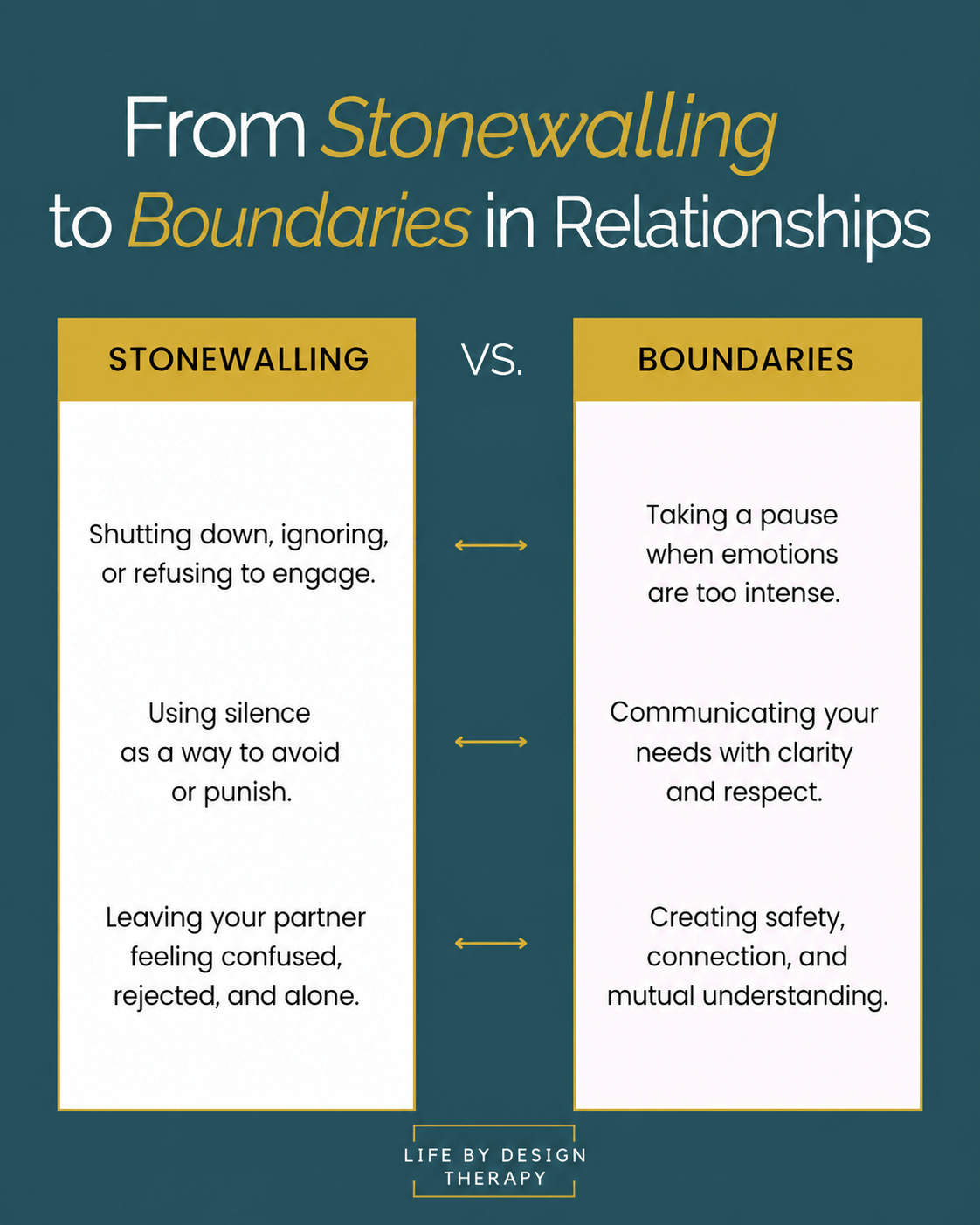
This is where the conversation around stonewalling comes in. Stonewalling is when someone emotionally shuts down or withdraws during conflict instead of staying engaged in the relationship.
That can look like:
silent treatment
refusing to respond
emotionally checking out
walking away without returning
becoming cold or unreachable
shutting conversations down indefinitely
Stonewalling is often less about intentional harm and more about nervous system overwhelm or emotional shutdown.
When someone feels emotionally flooded, their body can move into shutdown mode almost automatically. Their brain starts trying to escape the discomfort instead of staying present with it
Which is why this conversation is a little more layered than people realize. Needing space does not automatically mean someone is being avoidant or emotionally unavailable.
The bigger question is: What happens after the space is taken?
Healthy boundaries usually sound like: “I’m overwhelmed right now, but I want to come back and finish this conversation.”
Stonewalling often sounds more like: “I’m done,” followed by emotional disappearance.
One creates a temporary space for regulation, and the other creates emotional distance that never really gets repaired.
Sometimes "Protecting Your Peace" Is Actually Avoidance
This is probably the part people don’t always want to hear. There are times when “protecting my peace” becomes a way of avoiding discomfort, vulnerability, accountability, or emotional closeness.
And again, I don’t say that critically. I think most people do this at some point.
Sometimes, after enough conflict, stress, or emotional overwhelm, you start clinging to any sense of calm you can control.
You stop wanting hard conversations.
You stop wanting emotional intensity.
You stop wanting to explain yourself.
So distance starts feeling safer than connection. And sometimes that distance gets labeled as a boundary.
But there’s a difference between:
taking space to regulate, and
emotionally leaving the relationship every time things get uncomfortable
That difference matters. Because one creates room for repair, and the other slowly creates disconnection.
What Boundaries Actually Are
Setting boundaries isn't about controlling another person. Instead of trying to dictate someone else's behavior, boundaries focus on what you need and how you'll respond.
It’s not:
“You can’t do this.”
“You’re not allowed to feel that.”
“We're not talking about this anymore.”
Boundaries start with understanding yourself and what you need.
They sound more like:
“I need a moment before I respond.”
“I want to continue this conversation, but I can’t do it while we’re yelling.”
“I need space to regulate, not disconnect.”
That’s a really important distinction, because boundaries are supposed to help relationships feel safer and clearer, not colder.
Boundaries can serve different purposes in different relationships. Sometimes a boundary with a family member, friend, or other person may create distance because distance is what's needed to protect your well-being. But in a secure relationship, boundaries are often meant to create more clarity, safety, and understanding between partners.
The challenge is that when we're first learning how to set boundaries, it's easy to confuse protecting ourselves with shutting our partner out. Sometimes what starts as a need for space can slowly turn into emotional distance. Boundaries in a relationship help you honor your own needs while staying engaged in the relationship you're trying to build.
Why Implementing Boundaries Can Be So Hard in Romantic Relationships
At this point, you might be thinking, "Okay, that makes sense. But if healthy boundaries are supposed to help relationships, why do they feel so difficult sometimes?"
The truth is that most of us were never actually taught healthy boundaries.
A lot of people grew up learning how to:
keep the peace
avoid conflict
take care of everyone else's emotions
stay independent so they didn't have to rely on others
suppress their own needs to avoid feeling like a burden
So when we start trying to set boundaries later in life, it can feel incredibly uncomfortable. Not because boundaries are wrong or unhealthy, but because our bodies may have learned that having needs, taking up space, disappointing others, or saying no could threaten connection, safety, acceptance, or belonging in some way.
That's why boundaries can bring up so many emotions at once. They can feel:
selfish
scary
guilt-inducing
emotionally exposing
uncomfortable
even physically activating in the body
Which is exactly why it can be so easy to confuse a healthy boundary with emotional withdrawal. If boundaries have always felt uncomfortable, it makes sense that you might lean too far in one direction or the other.
Some people struggle to set boundaries at all. Others find themselves creating so much distance that connection becomes difficult.
How do you know whether you're genuinely protecting your peace or whether you're unintentionally pulling away from your partner?
Let's talk about some signs to look for. Because the truth is, emotional walls rarely announce themselves. Most of the time, they sound reasonable on the surface, which is why they can be so difficult to recognize.
Signs a "Boundary" Might Actually Be an Emotional Wall
Sometimes, the easiest way to tell the difference between a boundary and an emotional wall is by looking at what the boundary creates in the relationship.
You can ask yourself, does it create:
clarity?
honesty?
emotional safety?
room for reconnection?
Or does it create:
confusion?
fear?
emotional distance?
punishment?
instability?
Here are a few signs that a “boundary” may actually be functioning more like an emotional wall:
Every uncomfortable conversation gets shut down immediately
Therapy language gets used to avoid accountability
One person emotionally disappears whenever conflict comes up
Space is taken without communication or reconnection
Distance becomes chronic
“Protecting my peace” becomes a reason to avoid emotional intimacy altogether
People will sometimes confuse emotional discomfort with emotional danger, which honestly makes a lot of sense, especially if you’ve experienced trauma, chronic stress, emotional unpredictability, or relationships that didn’t feel emotionally safe in the past.
Sometimes relationships feel uncomfortable because vulnerability itself feels uncomfortable. But vulnerability is also often what creates deeper emotional intimacy, trust, and connection within relationships. If this is something you’ve been struggling with, you may also enjoy reading our blog on How Vulnerability Can Bring You and Your Partner Closer.
What Boundaries Look Like In A Secure Relationship
Boundaries don’t require you to disappear emotionally. They allow space for both honesty and connection.
So instead of: “Leave me alone.”
It may sound more like, “I need a little time to process, but I care about this conversation and want to come back to it.”
Or, “I can’t keep talking if we’re yelling at each other, but I do want us to figure this out.”
See the difference?
The relationship is still being acknowledged. That’s a huge part of emotional safety in relationships, especially from an attachment perspective.Someone with anxious attachment may worry that boundaries will create distance, rejection, or abandonment. Someone with avoidant attachment may feel safer relying on distance, emotional withdrawal, or hyper-independence. And someone with disorganized attachment may find themselves moving back and forth between craving closeness and wanting to pull away from it.
Which is why boundaries are often much deeper than communication skills alone.
In Emotionally Focused Therapy (EFT), there’s a lot of emphasis on emotional accessibility and responsiveness. Not perfection. Not never needing space. But learning how to stay emotionally connected even when things feel difficult.
Remember, healthy boundaries help create:
emotional safety
clarity
honesty
repair
mutual respect
Not emotional exile.
So now you know what boundaries in a secure relationship look like… but how can you start implementing them without stonewalling your partner? I’m glad you asked! Let’s talk about it!
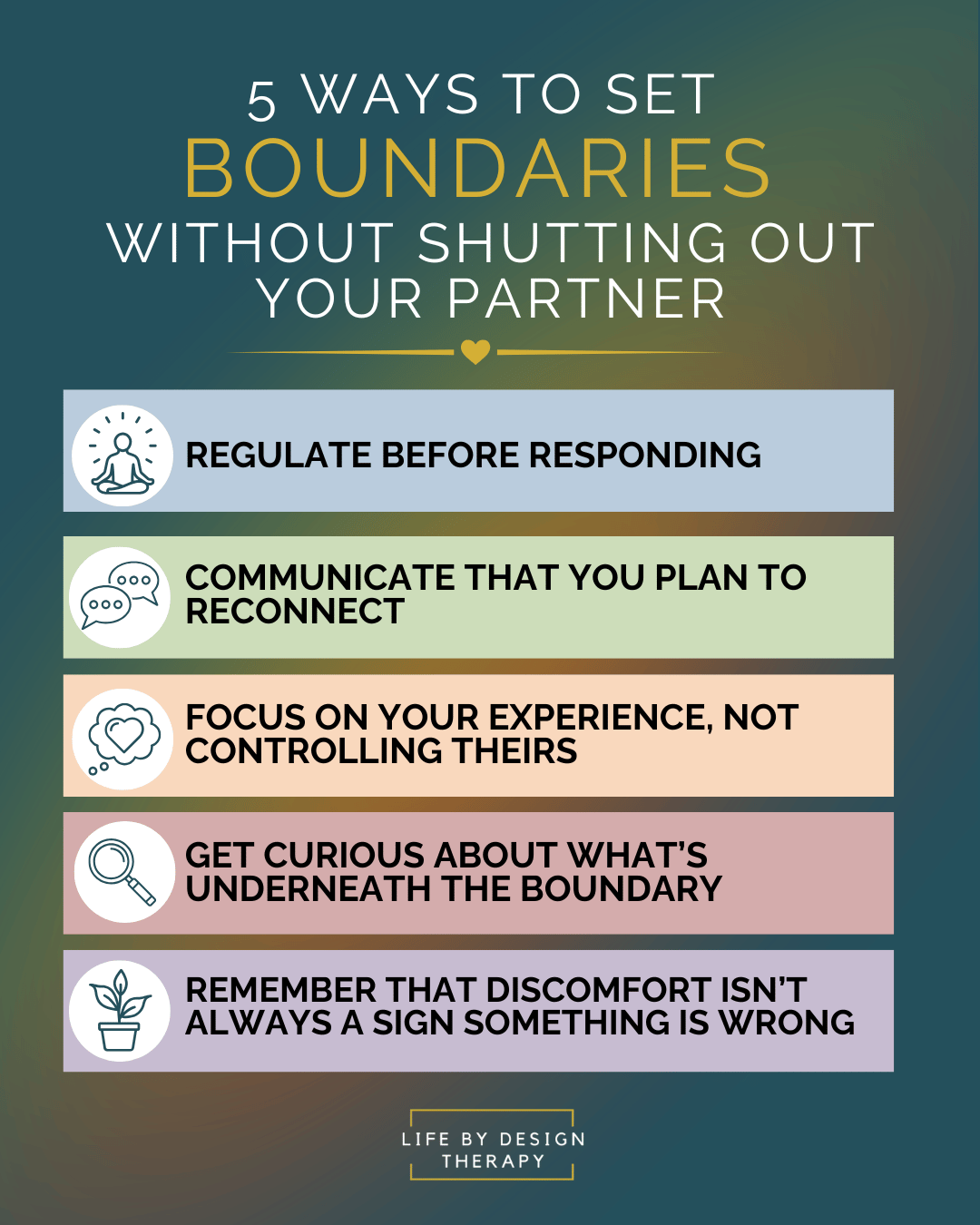
5 Ways to Set Boundaries Without Shutting Out Your Partner
Ok, before we start, I want to reiterate that this takes practice. Especially if your nervous system learned that closeness and conflict weren’t emotionally safe growing up. So please, remember to have patience and compassion for yourself as you integrate boundaries.
1. Regulate Before Responding
Not every feeling needs an immediate reaction. Sometimes your body needs support before the conversation can actually go anywhere productive.
2. Communicate That You Plan To Reconnect
This one matters more than people realize. Even something simple like: “I want to revisit the conversation soon, once I've had some time to process”, can help your partner feel emotionally safer.
3. Focus on Your Experience Rather Than Controlling Theirs
When you’re having a conversation with your partner, use language like:
“I need…”
“I’m feeling overwhelmed…”
“Can we slow down…”
Instead of:
“You always…”
“You need to…”
“You’re the problem…”
By doing this, it helps create more emotional safety within the conversation because the focus shifts from blame and defensiveness toward honesty, self-awareness, and understanding.
4. Get Curious About What's Underneath the Boundary
Part of learning how to establish healthy boundaries is developing a deeper sense of self-awareness and learning how to check in with yourself before automatically reacting from overwhelm, shutdown, resentment, or protection.
Ask yourself:
Am I regulating?
Am I avoiding?
Am I protecting myself from vulnerability?
That kind of self-awareness can completely shift the way you move through relationships. Instead of reacting purely from survival patterns, defensiveness, or emotional overwhelm, it creates more space to respond with intention, honesty, and emotional clarity.
And with time, that awareness can help you build boundaries that don’t just protect you, but also support healthier connections, communication, and emotional safety within all of your relationships.
5. Remember That Discomfort Isn't Always a Sign Something is Wrong
Sometimes healthy relationships still involve tension, repair, vulnerability, and difficult conversations. That’s normal.
And honestly, for many people, this work starts with learning how to recognize and understand their own emotions in the first place, especially if emotional awareness or expression wasn’t modeled growing up. If this resonates with you, you may also enjoy reading our blog on How to Recognize and Process Emotions When You Were Never Taught How.
Final Thoughts
Boundaries are not about becoming emotionally untouchable, and they’re not about avoiding every uncomfortable conversation or shutting people out before they can hurt you.
Real boundaries help create relationships where both people can be honest, human, emotionally safe, and connected at the same time. They create space for individuality without losing connection, and for honesty without abandoning yourself in the process.
And honestly, for a lot of people, learning boundaries is not just about communication. It’s about healing the underlying attachment wounds, nervous system responses, and survival patterns that made boundaries feel unsafe in the first place. That journey can be empowering and challenging all at the same time, and it’s helpful to have someone in your corner, cheering you on, and helping you with tools to keep moving forward. That’s where we come in!
AtLife By Design Therapy™, we offer holistic and somatic therapy for individuals and couples throughout California, both online and in-person in Berkeley. Our therapists help clients better understand the emotional patterns, relationship dynamics, and nervous system responses underneath overwhelm, disconnection, conflict avoidance, and difficulty setting boundaries so they can begin building healthier, more secure ways of relating to themselves and the people they love.
If you’re ready to start or just learn more, CLICK HERE to book a free phone consultation.

The Hidden Cost of Being the Capable One in Your Relationship
By Melody Wright, LMFT
Most people don’t come into therapy saying, “I don’t know how to stop doing everything without things falling apart.”
They come in saying things like, “I’m exhausted,” or “I feel like I’m doing everything,” or “I don’t feel like I can lean on my partner.”
And as they start talking, a familiar story begins to take shape.
It usually sounds something like:
“I’m the one managing schedules, finances, emotional check-ins, and future planning… and I’m doing it without being asked.”
“My partner isn’t a bad person. They’re not uncaring. But it feels like they are not carrying the same weight.”
And somewhere along the way, the relationship begins to feel less like a partnership and more like a responsibility.
And when love starts to feel like labor, your nervous system doesn’t need a pep talk.
It needs support. And it makes sense that you’re exhausted without it.
When Being Capable Starts to Feel Like a Burden
One of the hardest parts about this dynamic is that it can look normal from the outside.
You’re planning.
You’re organizing.
You’re thinking ahead.
You’re doing what adults do.
And to be fair… none of that is inherently a problem.
In many relationships, one partner naturally takes the lead in certain areas.
One person may be more detail-oriented. More proactive. More comfortable planning ahead.
That difference alone isn’t the issue.
What becomes painful is when the relationship starts to feel heavy in a way you can’t quite name, and when your effort stops feeling like a choice and starts feeling like the only way things will keep running smoothly.
But at a certain point, it makes sense that your capability stops feeling like a strength and starts feeling more like a burden.
Not because you don’t love your partner.
Not because your partner is “bad.”
Not because you don’t want the relationship to work.
But because even strong, capable people eventually reach a limit.
And when support doesn’t feel consistent, whether it’s emotionally, practically, or both, your nervous system stays on alert.
And that’s not a personal failure; it's actually your body responding to the experience of carrying more than what feels sustainable.
What Relationship Imbalance Looks Like in Real Life
This pattern rarely starts as a problem.
It often begins as responsiveness. Awareness. Care.
And on a larger level, these are traits our culture tends to reward.
We praise the person who stays on top of everything.
The one who’s responsible, perceptive, organized, emotionally aware, and always thinking ahead.
In a world that values productivity, competence, and “keeping it together,” being dependable can look like a strength.
But over time, the role can solidify.
One partner becomes the planner, the organizer, the emotional barometer.
They hold the timeline, the to-do list, and the future vision.
They remember appointments, initiate conversations, anticipate needs, and quietly manage the parts of life that feel unstable.
And what no one talks about enough is the emotional cost of that.
Because what looks like “being capable” on the outside can start to feel like carrying too much on the inside.
And because this role is so normalized, you might not even realize how much it’s costing you at first.
It doesn’t always show up as one big breaking point.
It shows up in the quieter ways your body and your relationship start to respond.
🌻 You feel chronically tired, even when you technically get enough sleep.
🌻 You feel irritable… and then guilty for being irritable.
🌻 You can’t fully relax, even during calm moments, because part of you is still tracking what needs attention next.
🌻 And resentment might start to build, not because you don’t love your partner, but because love has started to feel one-sided.
If resentment has been building, it’s often a signal.
That’s often what happens when the weight in a relationship starts to feel unbalanced.
Why This Dynamic Develops
From a therapeutic perspective, when uncertainty shows up, whether emotionally, practically, or relationally, some people cope by increasing effort and responsibility.
You stabilize the environment by staying alert, involved, and prepared, which is a nervous system response.
While some might consider this “overfunctioning.” But for many people living it, it feels simple:
“If I don’t handle it, it won’t get handled.”
“If I don’t stay on top of it, we’ll fall behind.”
“If I stop doing, everything will fall apart.”
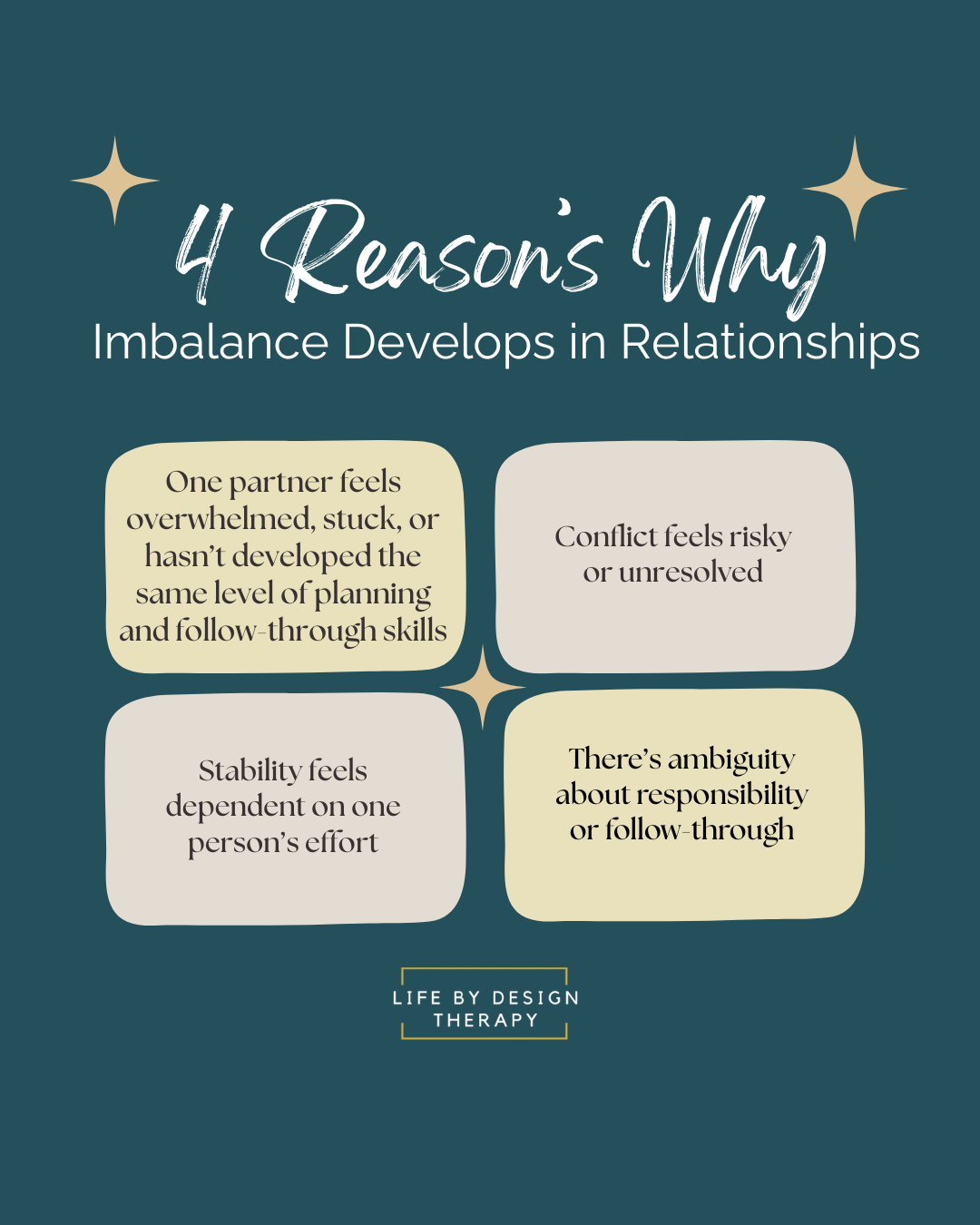
This dynamic might develop in relationships where:
One partner feels overwhelmed, stuck, or hasn’t developed the same level of planning and follow-through skills.
There’s ambiguity about responsibility or follow-through
Conflict feels risky or unresolved
Stability feels dependent on one person’s effort
Doing more becomes a way of preventing things from falling apart.
And for a while, it works.
Until it doesn’t.
The Attachment Roots of Carrying Too Much
If you’re the one who tends to carry more, there’s a good chance this didn’t start with your current partner.
For a lot of people, this is a role they learned early, often in childhood, as a way of staying connected and safe.
Maybe you grew up in an environment where being responsible was expected.
Where being mature was praised.
Where needing too much felt inconvenient.
Or maybe you learned something even more subtle:
The more tuned-in you were, the safer things felt.
If you could sense someone’s mood early, you could prevent conflict.
If you stayed one step ahead, you could keep the emotional temperature in the room from boiling over.
And sometimes, from an attachment perspective, it goes even deeper.
You might have learned to watch a caregiver’s emotional world closely because it affected you.
For example, your younger self might have felt things like:
“If I can make Mommy/Daddy feel better, then everything will be okay.”
“I have to be really good, so Mommy/Daddy doesn’t get mad.”
“Mommy/Daddy is happy when I help, so I’m going to do it before she asks.”
“If Mommy/Daddy is upset, I have to be extra quiet and careful.”
If any of that feels familiar, it makes sense that you became incredibly skilled at reading the room.
🌻 You became quick.
🌻 Responsible.
🌻 Helpful.
🌻 Highly attuned.
Your body learned how to stay safe and hypervigilant back then, but your body also knows that it’s doing too much now.
When The Dynamic Stops Feeling Sustainable
One of the ways you can tell the balance has shifted is when your effort starts to feel less like a choice and more like a necessity.
You’re no longer stepping in because you want to. You’re stepping in because it feels like you have to.
Because if you don’t…things won’t get done, conversations won’t happen, and the relationship won’t move forward.
At that point, effort turns into obligation.
Many people in this role carry a quiet belief: “If I don’t hold this together, no one will.”
And I want you to know something: You can love your partner and still feel completely worn down by this dynamic.
How This Impacts the Relationship
The more one partner manages, the less room there is for mutuality. The more one partner anticipates, the less space there is for shared responsibility to emerge naturally.
Over time, this can lead to:
Emotional distance
A parent–child dynamic rather than a partnership
Resentment that feels unsafe to express
A growing sense of loneliness, even inside the relationship
And what makes this dynamic so painful isn’t just the workload.
It’s what it can start to feel like over time.
Not because these beliefs are brand new… but because they’re familiar.
This dynamic can begin to activate beliefs you may have been carrying for a long time.
Beliefs like:
“I can’t rely on anyone.”
“If I need something, I’ll be disappointed.”
“I always end up alone in the hard parts.”
And those beliefs don’t just affect your relationship.
They affect how safe your body feels in connection with any relationship.
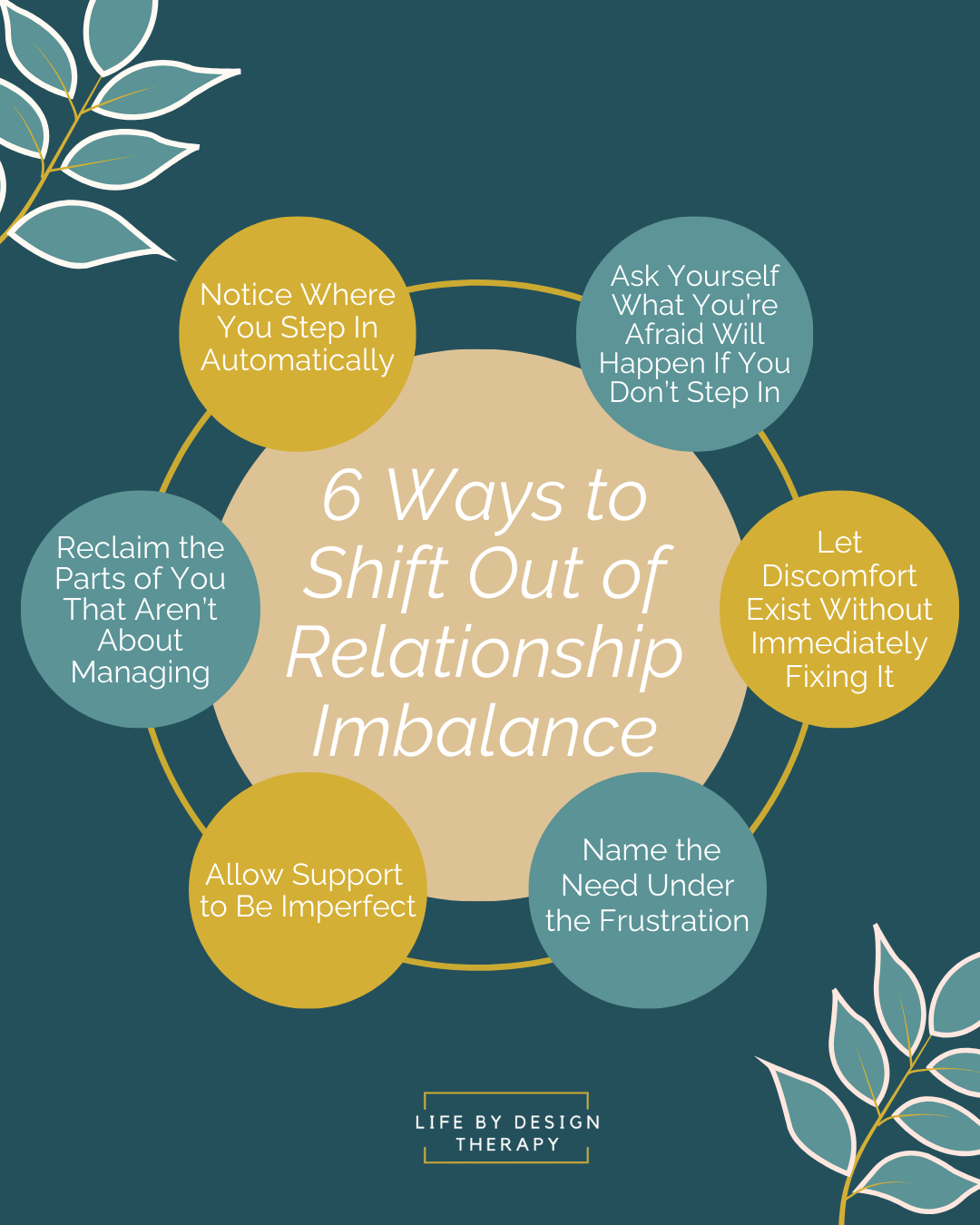
6 Ways to Restore Balance When You Feel Like You’re Carrying the Relationship
Restoring balance doesn’t mean pulling away or letting everything collapse.
It means bringing awareness and intention back into a role that has likely been running on autopilot.
Here are ways to start.
1. Notice Where You Step In Automatically
This dynamic often happens before conscious thought.
You fix. You remind. You follow up. You handle it. Sometimes, it’s before your partner even knows there was something to address.
Start by noticing:
Where you step in without being asked
Where it feels hard to sit back without doing something
Where responsibility feels assumed rather than chosen
This isn’t about stopping yourself right away. It’s about understanding and becoming aware of what your nervous system has learned to do to feel safe.
2. Ask Yourself What You’re Afraid Will Happen If You Don’t Step In
Instead of immediately stepping in, try pausing for a moment and asking yourself:
What’s actually driving me right now?
Is it anxiety?
Is it obligation?
Is it the quiet belief that if I don’t do this, no one else will?
Sometimes it is anxiety.
But sometimes it’s deeper than that.
Sometimes it’s the familiar pull of responsibility.
The part of you that feels more comfortable carrying something than risking it being dropped.
You might even notice a thought like:
“If I don’t handle this, it won’t get done.” Or, “It’s just easier if I take care of it.”
And becoming aware of what is driving that response matters, because when you understand what’s driving you, you have more choice in how you respond.
3. Let Discomfort Exist Without Immediately Fixing It
One of the hardest parts of restoring balance is tolerating some discomfort.
Because stepping back can feel like:
being irresponsible
being uncaring
risking conflict
But there’s a difference between neglect and space.
Space is what allows shared responsibility to grow.
This can look like:
Allowing tasks to be completed imperfectly, even when it’s uncomfortable
Initiating the hard conversations instead of smoothing them over
Stepping back enough for your partner to engage with responsibility in their own way
And yes, it will feel uncomfortable at first.
But discomfort here doesn’t mean you’re doing something wrong.
4. Name the Need Under the Frustration
When someone feels alone for a long time, frustration becomes the language of survival.
But underneath frustration is usually something softer. Try communicating with your partner:
“I’m overwhelmed and need help with this.”
“This has been feeling heavy for me.”
“I want to feel like we’re a team and need some additional support.”
You don’t need to justify your needs with a backstory. Needing support is enough to ask for it.
5. Allow Support to Be Imperfect
One of the hardest parts of restoring balance is tolerating differences.
Your partner may help differently than you would. Maybe they’re a little slower, less efficient, or less intuitive about what is needed.
Supporting yourself means allowing participation without controlling the outcome. Psst…this is okay 🙂
Shared responsibility doesn’t require sameness; it requires room for both people to show up in their own way.
And this is often where control and safety get tangled.
Because for many people, the desire to do it “right” is also a way of staying emotionally safe.
So if this part feels hard, it’s understandable.
6. Reclaim the Parts of You That Aren’t About Managing
When you feel like you’ve been carrying more for a long time, the scope of your world can shrink to what needs to be accomplished.
It’s important to reclaim parts of yourself that bring balance.
Restoring that balance means making room for:
Rest that isn’t earned
Pleasure that isn’t productive
Time that doesn’t serve anyone else
This isn’t indulgence. It’s nervous system regulation.
And a regulated nervous system doesn’t need to carry everything to feel safe. ♥️
Final Thoughts
If you’ve been the one who holds it all together… the capable one… the one who keeps things steady…
There’s a reason this pattern developed.
It helped you adapt.
It helped you care.
It helped you hold things together when things felt uncertain.
And it may have even been the way you stayed emotionally safe in your earliest relationships.
But patterns that once helped can become heavy when they’re no longer needed.
The goal isn’t to stop caring. It’s to stop trying to do it all alone.
And that shift is often where balance begins, because you deserve to feel regulated.
You deserve to feel more balanced in your body and in your life.
And you deserve a life that doesn’t require you to carry everything to feel safe.
This Week's Affirmations
I don’t have to carry everything to be a good partner.
I am allowed to pause without things falling apart.
Supporting my partner does not require sacrificing myself.
I can ask for support without overexplaining or apologizing.
Balance begins when I stop doing this alone.
Additional Resources
**If you’re interested in learning more about ways to support your relationship, check out these books below:
Beyond Codependency: And Getting Better All the Time by Melody Beattie
Hold Me Tight: Seven Conversations for a Lifetime of Love by Dr. Sue Johnson
Radical Acceptance: Embracing Your Life With the Heart of a Buddha by Tara Brach
The Disease to Please: Curing the People-Pleasing Syndrome by Harriet B. Braiker
Set Boundaries, Find Peace: A Guide to Reclaiming Yourself by Nedra Glover Tawwab
Nonviolent Communication: A Language of Life by Marshall B. Rosenberg
**Some product links are affiliate links, which means we'll receive a commission if you purchase through our link, at no extra cost to you. Please read the full disclosure here.

How to Not Lose Yourself When Supporting an Unmotivated Partner
By Melody Wright, LMFT
This is something I see come up again and again in my work with couples.
One partner feels stuck, unmotivated, disengaged, or emotionally checked out. The other partner feels frustrated, overwhelmed, and increasingly alone in carrying the emotional weight of the relationship.
Whether one partner isn’t working or they’re just not showing up emotionally, it can feel confusing and painful, especially when they’re physically there but emotionally unreachable.
If you’re the one who’s been carrying more lately, emotionally, practically, or both, you might watch your partner scroll on their phone, sleep in, avoid conversations, or say they’ll “figure it out later”… while you’re silently calculating everything that still has to get done.
And the hardest part is that you don’t always know what you’re looking at.
Are they depressed?
Are they giving up?
Are they shutting down?
Do they believe it’s not their job to help?
You might have this growing sense of, “We’re in the same relationship, but it doesn’t feel like we’re on the same team.”
Over time, you start carrying more…more planning, more worrying, more emotional labor.
And you get stuck in that exhausting middle space:
👉 “Should I say something… or stay quiet?”
👉 “Should I ask for help… or just do it myself because I already know they won’t?”
👉 “Should I push… or will that make them shut down even more?”
And with that, resentment starts to creep in like a slow tide. Not because you don’t love them, but because loving someone who feels stuck can be really hard, and sometimes exhausting.
After some time, you may notice your thoughts might shift to:
“Why does it feel like I care more?”
“Why am I the one holding everything together?”
“What’s wrong with them, or what’s wrong with us?”
These thoughts don’t mean you’re judgmental or unkind. They’re often a sign that something deeper is happening and that your brain is starting to assign meaning to what you’re seeing and feeling.
Because when we move from noticing a behavior (“they’re on the couch all day”) to attaching a story (“they don’t care about me”), your inner dialogue can start to shape the relationship in ways that quietly pull you further apart.
And that’s where this stops being about motivation and starts being about relationship dynamics.
The Overfunctioning Role (And Why It's So Exhausting)
When we care deeply about someone, it’s natural to want to fix what we see. To encourage more effort. To push gently, or not so gently, toward change.
But when someone is already overwhelmed, burned out, or unsure of themselves, pressure can backfire. Even well-intentioned motivation can land as criticism, disappointment, or proof that they’re falling short.
This is often when the “lazy” narrative might start to show up.
From a therapeutic perspective, what gets labeled as laziness is often something else entirely, like burnout, shutdown, fear of failure, depression, or not knowing where to start.
When those experiences go unnamed, both you and your partner may end up feeling alone, one feeling judged, the other feeling unsupported.
Rather than focusing on how to get your partner to change, it can be more helpful to ask, “How do we stay connected while we’re navigating something hard together?”
How to Support Your Partner Without Losing Yourself
When one partner feels stuck, and the other is carrying more, your instinct might be to push for change.
You bring it up again, try to explain it a different way, or hope that if you say it just right, something will finally click.
But you might find that approach creates the same cycle: one partner feels pressured, the other shuts down, and both can end up feeling more alone.
So instead of pushing harder, I want to invite you to try a different approach, one that starts with slowing down. Not to ignore what’s happening or pretend it doesn’t matter, but to pause long enough to check in with yourself first.
As the partner who’s carrying more, you might actually be holding more than just the responsibilities.
Maybe you’re holding things like fear, disappointment, loneliness, and the constant mental load of wondering, “What if this never changes?”
And when you’re carrying all of that, it makes sense that you’d default into a role that might feel familiar, like the one who handles it, the one who stays steady, the one who keeps things moving, the one who doesn’t ask for much.
But over time, that role can become exhausting and can cause resentment to build. Not just because your partner isn’t showing up, but because you feel like you’re showing up alone.
So, instead of the first step being confrontation, I want to encourage you to regulate first.
What this looks like is taking a moment to get honest with yourself about what’s really happening inside.
✔️ What are you feeling right now?
✔️ What story are you starting to tell yourself about what this means?
✔️ What do you need that you haven’t said out loud?
From there, the goal is to share with your partner what’s true in a way that doesn’t attack.
That might sound like:
✔️ “I’ve been having a hard time lately, and I don’t want to blame you, but I feel disconnected.”
✔️ “I’ve been watching you struggle, and I’ve felt really stuck on how to talk about it without making things worse.”
✔️ “I want to support you, and I also need support too.”
✔️ “I’ve been feeling stressed and alone, and I don’t want resentment to keep building between us.”
Because here’s what’s important to remember: your partner’s disengagement is rarely about a lack of care. More often, it’s their way of protecting themselves from the struggles they are dealing with.
For example, when something feels overwhelming, the nervous system doesn’t move toward it; it moves away from it.
But avoidance is not the same as laziness.
Sometimes it’s the body saying, “This feels too hard. I don’t know how to do this safely.”
And while you may be longing to feel like you’re still in this together, they may be sitting with shame…feeling like they’re letting you down, and not knowing how to show up without making things worse.
That’s why the path forward usually isn’t “try harder.” It’s slowing down enough to name what’s happening, soften what feels like a threat, and find your way back to each other as a team.
And from there, you can acknowledge what you’re noticing, without turning it into a fight.
How To Talk To Your Partner Without Starting a Fight
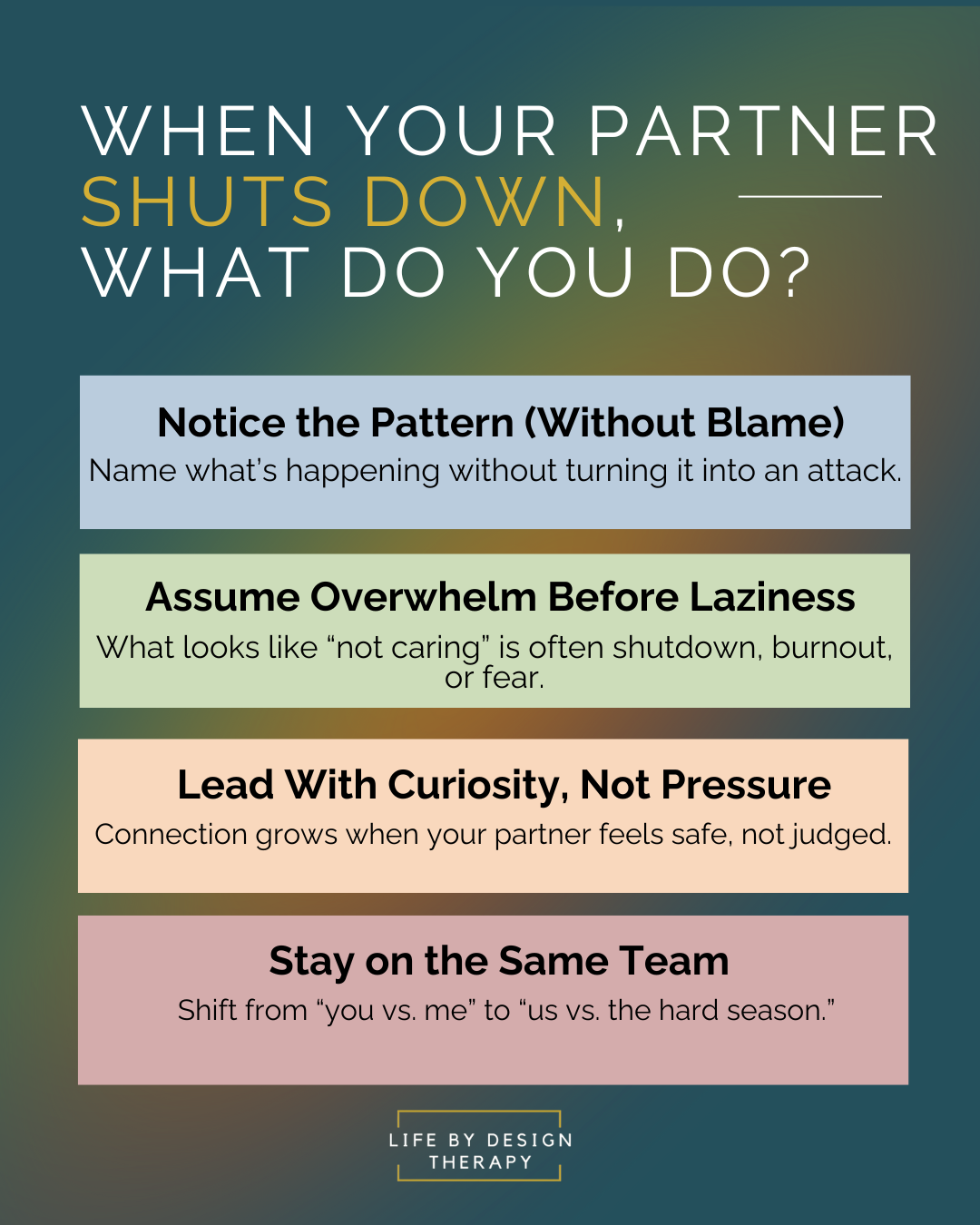
Staying connected doesn’t mean ignoring what you see. It means naming it in a way that keeps the relationship intact.
That might sound like:
“I hear you saying you want things to change, and I notice it’s been hard to take steps. I’m wondering how you’ve been feeling lately.”
“I miss feeling close to you. I want to talk about how we can find our way back to each other.”
This approach centers the relationship rather than assigning fault.
From there, curiosity becomes essential. Not interrogation. Not problem-solving.
Genuine curiosity about what’s actually happening internally for your partner.
Because if you and your partner are feeling stuck, isolation tends to deepen the problem, not solve it.
Staying on The Same Team
One of the most important shifts couples make is moving away from the idea that something is “wrong” with one partner.
Instead, the focus becomes: How are we navigating a difficult season together?
This requires awareness of your own internal narratives, especially the ones that sound like “They don’t care” or “I’m carrying everything.” Those stories often point to real pain, but they aren’t always the full picture.
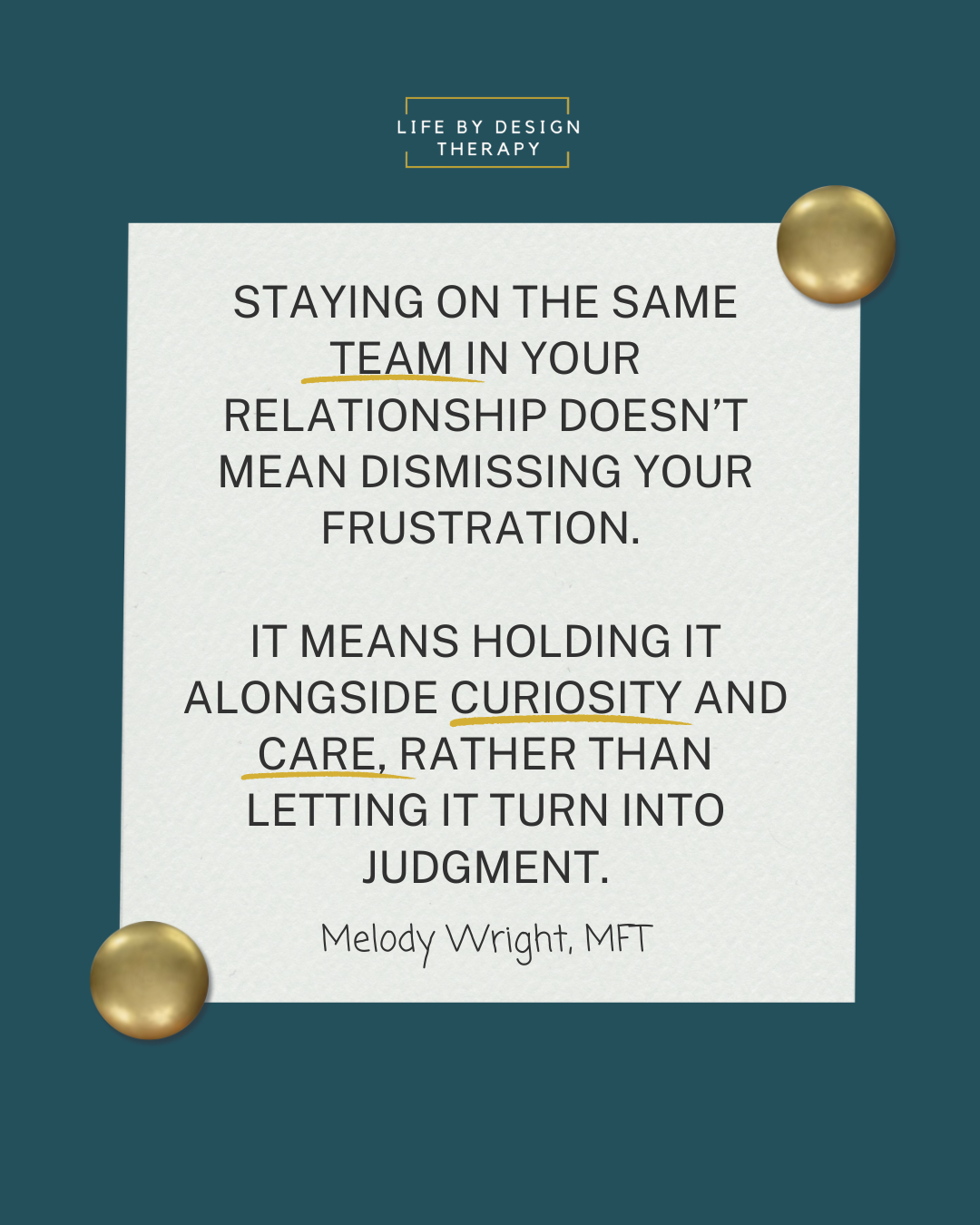
Staying on the same team doesn’t mean dismissing your frustration. It means holding it alongside curiosity and care, rather than letting it turn into judgment.
I want you to remember that connection doesn’t require perfect language or immediate answers.
It requires a willingness to stay present, honest, and open, even when things feel uncomfortable.
Final Thoughts
Loving someone who feels stuck, whether they’re unemployed, burned out, emotionally withdrawn, or overwhelmed, can be difficult.
And it can be especially painful when you’re trying so hard to stay connected, but you still feel like you’re carrying it alone.
This dynamic is challenging, and it affects both partners, even if it shows up differently for each of you. One person may feel pressure, shame, or defeat. The other may feel lonely, resentful, or emotionally exhausted.
When couples stay connected while talking about hard things, the conversation itself becomes safer, and movement happens more naturally over time.
You don’t have to solve everything at once. You don’t have to say it perfectly. Staying present, curious, and willing to talk about what’s actually happening is often where change begins.
If you’re reading this and thinking, “Yep… this is us,” couples therapy can really help.
Couples therapy can help you slow down, understand the cycle you’re stuck in, and rebuild connection in a way that feels safe for both of you.
At Life By Design Therapy™, we support couples who feel disconnected, stuck in resentment, or caught in the push–pull of overfunctioning and shutdown. If you’re ready to feel like a team again, we’d be honored to support you.
This Week's Affirmations
I can care deeply about my partner and acknowledge when this is hard for me.
I don’t have to fix my partner to stay connected to them.
Supporting my partner does not mean carrying everything alone.
I am allowed to move at a pace that protects the relationship and myself.
Connection matters more than getting it right.
Additional Resources
**If you’re interested in learning more about ways to support your relationship, check out these books below:
The Five Love Languages: The Secret to Love that Lasts by Gary Chapman
Nonviolent Communication: A Language of Life by Marshall B. Rosenberg
Hold Me Tight: Seven Conversations for a Lifetime of Love by Dr. Sue Johnson
**Some product links are affiliate links, which means we'll receive a commission if you purchase through our link, at no extra cost to you. Please read the full disclosure here.