
Boundaries in Relationships vs. Emotional Walls: What’s the Difference?
By Melody Wright, LMFT
We hear a lot about boundaries now. And honestly? That’s not a bad thing.
A lot of people are finally learning they don’t have to overextend themselves, tolerate harmful behavior, or constantly abandon themselves just to keep a relationship going.
But I also think there’s another side of this conversation that doesn’t get talked about enough.
Sometimes what we call a boundary… isn’t actually a boundary.
🌻 Sometimes it’s shut down.
🌻 Sometimes it’s avoidance.
🌻 Sometimes it’s hurt.
🌻 Sometimes it’s exhaustion.
🌻 Sometimes it’s grabbing onto the only sense of control or “peace” we feel like we have left.
And if I’m being honest, I think a lot of people have had moments where they genuinely were trying to protect their peace, while also slowly pulling away from their partner without fully realizing it.
The reality is that relationships can feel vulnerable, conflict can feel overwhelming, and emotional closeness can bring up a lot more than people realize.
So let’s talk about the difference between boundaries and emotional walls, because they can look surprisingly similar from the outside.
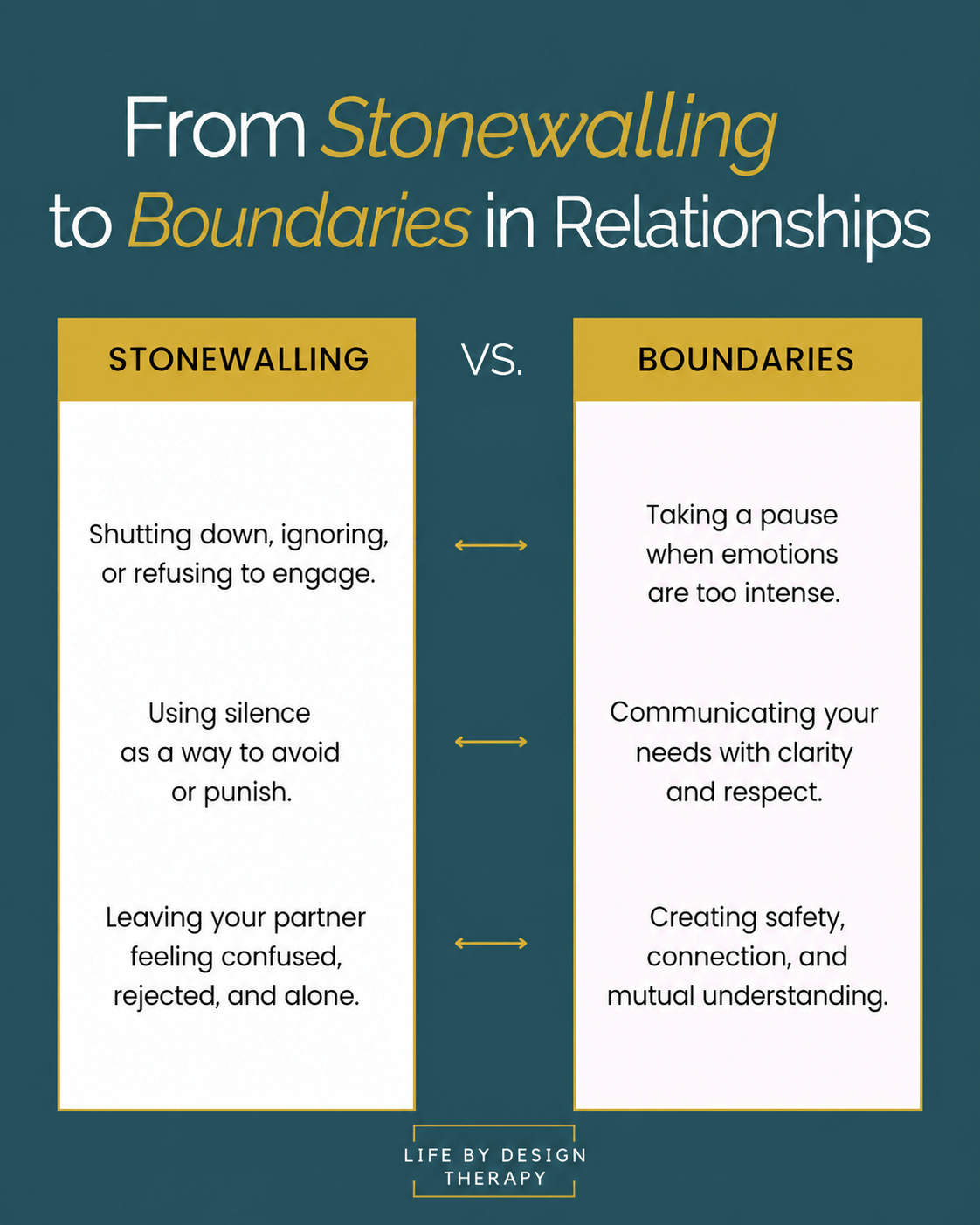
Stonewalling vs. Healthy Boundaries
This is where the conversation around stonewalling comes in. Stonewalling is when someone emotionally shuts down or withdraws during conflict instead of staying engaged in the relationship.
That can look like:
silent treatment
refusing to respond
emotionally checking out
walking away without returning
becoming cold or unreachable
shutting conversations down indefinitely
Stonewalling is often less about intentional harm and more about nervous system overwhelm or emotional shutdown.
When someone feels emotionally flooded, their body can move into shutdown mode almost automatically. Their brain starts trying to escape the discomfort instead of staying present with it
Which is why this conversation is a little more layered than people realize. Needing space does not automatically mean someone is being avoidant or emotionally unavailable.
The bigger question is: What happens after the space is taken?
Healthy boundaries usually sound like: “I’m overwhelmed right now, but I want to come back and finish this conversation.”
Stonewalling often sounds more like: “I’m done,” followed by emotional disappearance.
One creates a temporary space for regulation, and the other creates emotional distance that never really gets repaired.
Sometimes "Protecting Your Peace" Is Actually Avoidance
This is probably the part people don’t always want to hear. There are times when “protecting my peace” becomes a way of avoiding discomfort, vulnerability, accountability, or emotional closeness.
And again, I don’t say that critically. I think most people do this at some point.
Sometimes, after enough conflict, stress, or emotional overwhelm, you start clinging to any sense of calm you can control.
You stop wanting hard conversations.
You stop wanting emotional intensity.
You stop wanting to explain yourself.
So distance starts feeling safer than connection. And sometimes that distance gets labeled as a boundary.
But there’s a difference between:
taking space to regulate, and
emotionally leaving the relationship every time things get uncomfortable
That difference matters. Because one creates room for repair, and the other slowly creates disconnection.
What Boundaries Actually Are
Setting boundaries isn't about controlling another person. Instead of trying to dictate someone else's behavior, boundaries focus on what you need and how you'll respond.
It’s not:
“You can’t do this.”
“You’re not allowed to feel that.”
“We're not talking about this anymore.”
Boundaries start with understanding yourself and what you need.
They sound more like:
“I need a moment before I respond.”
“I want to continue this conversation, but I can’t do it while we’re yelling.”
“I need space to regulate, not disconnect.”
That’s a really important distinction, because boundaries are supposed to help relationships feel safer and clearer, not colder.
Boundaries can serve different purposes in different relationships. Sometimes a boundary with a family member, friend, or other person may create distance because distance is what's needed to protect your well-being. But in a secure relationship, boundaries are often meant to create more clarity, safety, and understanding between partners.
The challenge is that when we're first learning how to set boundaries, it's easy to confuse protecting ourselves with shutting our partner out. Sometimes what starts as a need for space can slowly turn into emotional distance. Boundaries in a relationship help you honor your own needs while staying engaged in the relationship you're trying to build.
Why Implementing Boundaries Can Be So Hard in Romantic Relationships
At this point, you might be thinking, "Okay, that makes sense. But if healthy boundaries are supposed to help relationships, why do they feel so difficult sometimes?"
The truth is that most of us were never actually taught healthy boundaries.
A lot of people grew up learning how to:
keep the peace
avoid conflict
take care of everyone else's emotions
stay independent so they didn't have to rely on others
suppress their own needs to avoid feeling like a burden
So when we start trying to set boundaries later in life, it can feel incredibly uncomfortable. Not because boundaries are wrong or unhealthy, but because our bodies may have learned that having needs, taking up space, disappointing others, or saying no could threaten connection, safety, acceptance, or belonging in some way.
That's why boundaries can bring up so many emotions at once. They can feel:
selfish
scary
guilt-inducing
emotionally exposing
uncomfortable
even physically activating in the body
Which is exactly why it can be so easy to confuse a healthy boundary with emotional withdrawal. If boundaries have always felt uncomfortable, it makes sense that you might lean too far in one direction or the other.
Some people struggle to set boundaries at all. Others find themselves creating so much distance that connection becomes difficult.
How do you know whether you're genuinely protecting your peace or whether you're unintentionally pulling away from your partner?
Let's talk about some signs to look for. Because the truth is, emotional walls rarely announce themselves. Most of the time, they sound reasonable on the surface, which is why they can be so difficult to recognize.
Signs a "Boundary" Might Actually Be an Emotional Wall
Sometimes, the easiest way to tell the difference between a boundary and an emotional wall is by looking at what the boundary creates in the relationship.
You can ask yourself, does it create:
clarity?
honesty?
emotional safety?
room for reconnection?
Or does it create:
confusion?
fear?
emotional distance?
punishment?
instability?
Here are a few signs that a “boundary” may actually be functioning more like an emotional wall:
Every uncomfortable conversation gets shut down immediately
Therapy language gets used to avoid accountability
One person emotionally disappears whenever conflict comes up
Space is taken without communication or reconnection
Distance becomes chronic
“Protecting my peace” becomes a reason to avoid emotional intimacy altogether
People will sometimes confuse emotional discomfort with emotional danger, which honestly makes a lot of sense, especially if you’ve experienced trauma, chronic stress, emotional unpredictability, or relationships that didn’t feel emotionally safe in the past.
Sometimes relationships feel uncomfortable because vulnerability itself feels uncomfortable. But vulnerability is also often what creates deeper emotional intimacy, trust, and connection within relationships. If this is something you’ve been struggling with, you may also enjoy reading our blog on How Vulnerability Can Bring You and Your Partner Closer.
What Boundaries Look Like In A Secure Relationship
Boundaries don’t require you to disappear emotionally. They allow space for both honesty and connection.
So instead of: “Leave me alone.”
It may sound more like, “I need a little time to process, but I care about this conversation and want to come back to it.”
Or, “I can’t keep talking if we’re yelling at each other, but I do want us to figure this out.”
See the difference?
The relationship is still being acknowledged. That’s a huge part of emotional safety in relationships, especially from an attachment perspective.Someone with anxious attachment may worry that boundaries will create distance, rejection, or abandonment. Someone with avoidant attachment may feel safer relying on distance, emotional withdrawal, or hyper-independence. And someone with disorganized attachment may find themselves moving back and forth between craving closeness and wanting to pull away from it.
Which is why boundaries are often much deeper than communication skills alone.
In Emotionally Focused Therapy (EFT), there’s a lot of emphasis on emotional accessibility and responsiveness. Not perfection. Not never needing space. But learning how to stay emotionally connected even when things feel difficult.
Remember, healthy boundaries help create:
emotional safety
clarity
honesty
repair
mutual respect
Not emotional exile.
So now you know what boundaries in a secure relationship look like… but how can you start implementing them without stonewalling your partner? I’m glad you asked! Let’s talk about it!
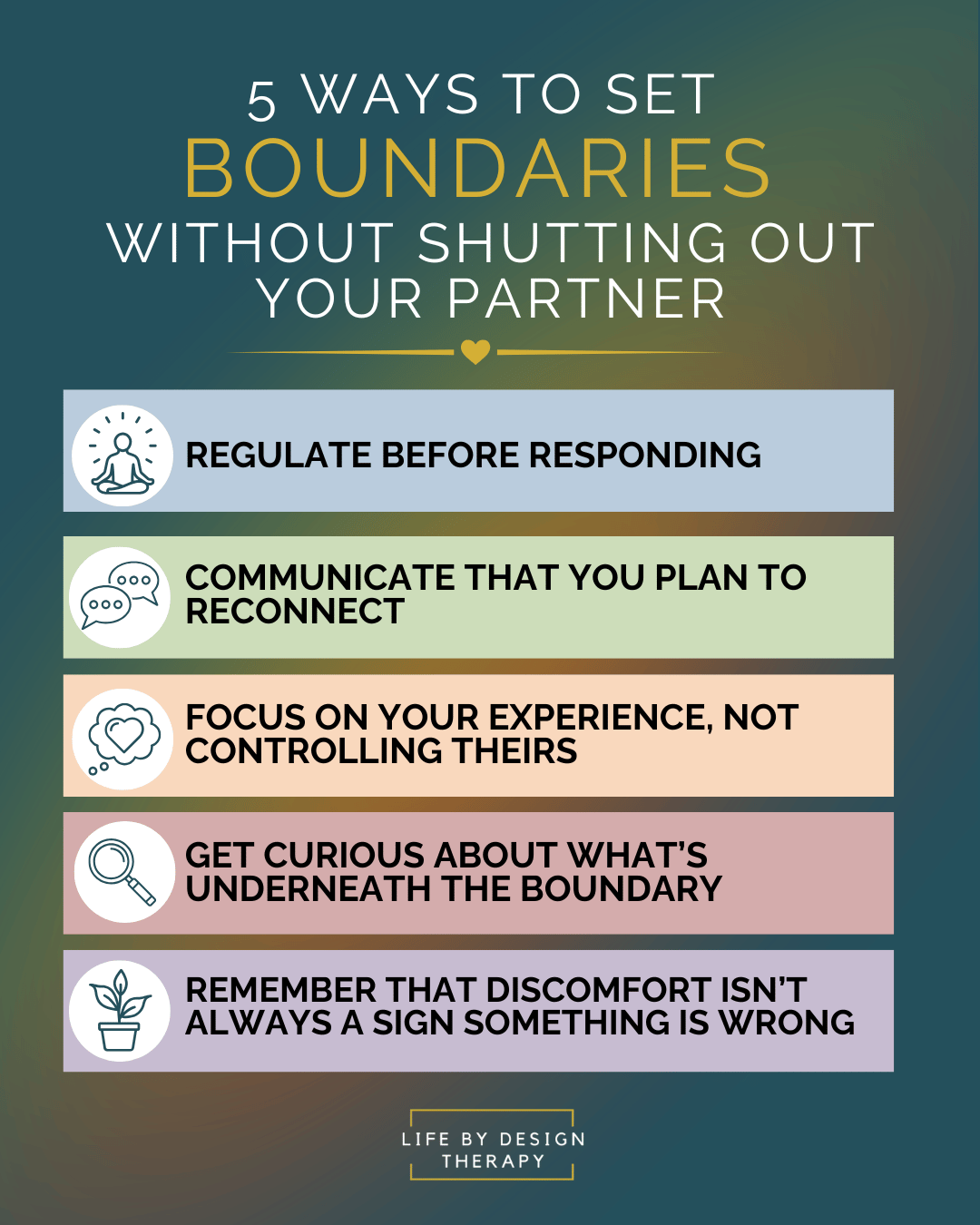
5 Ways to Set Boundaries Without Shutting Out Your Partner
Ok, before we start, I want to reiterate that this takes practice. Especially if your nervous system learned that closeness and conflict weren’t emotionally safe growing up. So please, remember to have patience and compassion for yourself as you integrate boundaries.
1. Regulate Before Responding
Not every feeling needs an immediate reaction. Sometimes your body needs support before the conversation can actually go anywhere productive.
2. Communicate That You Plan To Reconnect
This one matters more than people realize. Even something simple like: “I want to revisit the conversation soon, once I've had some time to process”, can help your partner feel emotionally safer.
3. Focus on Your Experience Rather Than Controlling Theirs
When you’re having a conversation with your partner, use language like:
“I need…”
“I’m feeling overwhelmed…”
“Can we slow down…”
Instead of:
“You always…”
“You need to…”
“You’re the problem…”
By doing this, it helps create more emotional safety within the conversation because the focus shifts from blame and defensiveness toward honesty, self-awareness, and understanding.
4. Get Curious About What's Underneath the Boundary
Part of learning how to establish healthy boundaries is developing a deeper sense of self-awareness and learning how to check in with yourself before automatically reacting from overwhelm, shutdown, resentment, or protection.
Ask yourself:
Am I regulating?
Am I avoiding?
Am I protecting myself from vulnerability?
That kind of self-awareness can completely shift the way you move through relationships. Instead of reacting purely from survival patterns, defensiveness, or emotional overwhelm, it creates more space to respond with intention, honesty, and emotional clarity.
And with time, that awareness can help you build boundaries that don’t just protect you, but also support healthier connections, communication, and emotional safety within all of your relationships.
5. Remember That Discomfort Isn't Always a Sign Something is Wrong
Sometimes healthy relationships still involve tension, repair, vulnerability, and difficult conversations. That’s normal.
And honestly, for many people, this work starts with learning how to recognize and understand their own emotions in the first place, especially if emotional awareness or expression wasn’t modeled growing up. If this resonates with you, you may also enjoy reading our blog on How to Recognize and Process Emotions When You Were Never Taught How.
Final Thoughts
Boundaries are not about becoming emotionally untouchable, and they’re not about avoiding every uncomfortable conversation or shutting people out before they can hurt you.
Real boundaries help create relationships where both people can be honest, human, emotionally safe, and connected at the same time. They create space for individuality without losing connection, and for honesty without abandoning yourself in the process.
And honestly, for a lot of people, learning boundaries is not just about communication. It’s about healing the underlying attachment wounds, nervous system responses, and survival patterns that made boundaries feel unsafe in the first place. That journey can be empowering and challenging all at the same time, and it’s helpful to have someone in your corner, cheering you on, and helping you with tools to keep moving forward. That’s where we come in!
AtLife By Design Therapy™, we offer holistic and somatic therapy for individuals and couples throughout California, both online and in-person in Berkeley. Our therapists help clients better understand the emotional patterns, relationship dynamics, and nervous system responses underneath overwhelm, disconnection, conflict avoidance, and difficulty setting boundaries so they can begin building healthier, more secure ways of relating to themselves and the people they love.
If you’re ready to start or just learn more, CLICK HERE to book a free phone consultation.

