

How to Start Trusting Yourself Again (When You’ve Been Second-Guessing Everything)
By Melody Wright, LMFT
If you've ever spent more time worrying about making the wrong decision than actually making the decision itself, you know how exhausting it can be. The mental back-and-forth, the constant weighing of options, and the fear of getting it wrong can leave you feeling stuck before you've even made a choice.
And if you’ve been second-guessing yourself lately…especially when it comes to making decisions…you’ve probably asked yourself some version of:
“Why can’t I just trust myself?”
“Why does everything feel so hard to decide?”
“Why do I feel like I’m going to get it wrong?”
And most advice will tell you to be more confident, to think it through, and to just go with your gut.
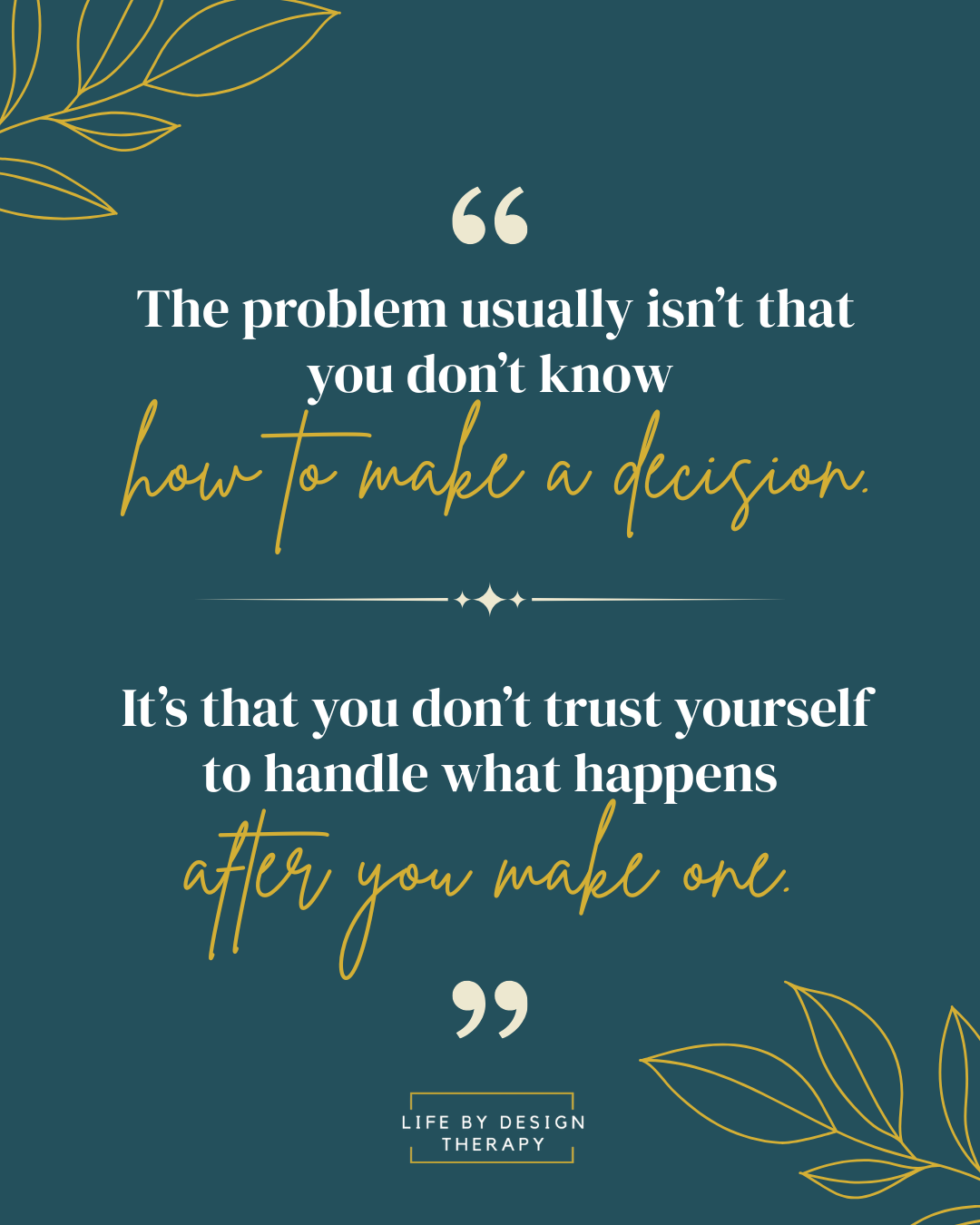
But if that actually worked, you wouldn’t still be here… going back and forth in your head. Because the problem usually isn’t that you don’t know how to make a decision.
It’s that you don’t trust yourself to handle what happens after you make one.
If this resonates with you, you may want to explore the deeper roots of these patterns. In our blog, The Hidden Reasons You Second-Guess Yourself, we take a closer look at how past experiences, nervous system responses, and learned survival strategies can shape self-doubt and make trusting yourself feel difficult. You can read it here: The Hidden Reasons You Second-Guess Yourself.
Why You Keep Second-Guessing Yourself
Remember, these patterns don’t come out of nowhere. It builds over time and often in ways that don’t feel obvious while they’re happening. But before we even talk about how to start trusting yourself again, it helps to understand where this comes from.
For a lot of people, second-guessing yourself is shaped by earlier experiences, like:
Being taught to rely on others over yourself
Having your needs or feelings dismissed or questioned
Being rewarded for being “easy,” “good,” or accommodating
Learning that getting it wrong had consequences
Time and time again, your nervous system adapts as a way to protect yourself, so instead of asking “What do I feel?”, you start asking “What’s the right decision?”
And that shift changes everything.
Because when your focus becomes getting it right instead of trusting yourself, decision-making can start to feel heavy. Even small choices can feel overwhelming, and it makes sense that you would start second-guessing yourself or looking outside of yourself for reassurance.
At some point, choosing stopped feeling simple and started feeling like a risk.
What Happens After a Decision Matters More Than the Decision Itself
You don’t learn to trust yourself by making the “right” decision every time. You learn to trust yourself by listening inward, making the best choice you can with the information you have, and discovering that you can handle what comes next.
In those moments where things don’t go the way you hoped…and your first instinct is to replay it, pick it apart, or tell yourself you should have known better. That’s usually the moment things start to break down. Not necessarily because of the decision itself, but because of how you respond to yourself afterward.
So rebuilding self-trust doesn’t mean getting better at choosing.
It means learning to respond differently when a choice doesn’t go as planned.
It looks like not turning against yourself. Not spiraling into “I messed this up,” not using it as proof that you can’t trust your own judgment, and not using it as proof that you can’t trust your own judgment.
And over time, something starts to shift.
Because your system begins to realize:
“Even if this doesn’t go perfectly… I’m still okay.”
“I’m not on my own in this.”
And that’s where trust actually starts to rebuild. Not when you get it right, but when you realize you can handle it, even if you don’t.
Building Self-Awareness as a Foundation for Self-Trust
Rebuilding self-trust doesn’t usually feel like a big, obvious shift. It’s usually subtle and comes from developing self-awareness.
So, it might look like one of those moments where you catch yourself right before you spiral into second-guessing… and instead of following it, you pause.
Or a moment where you notice what you’re feeling and, for once, you don’t immediately try to figure out the “right” decision, and you just sit with it for a second.
Maybe it’s choosing something small, like what you want or need, and not going back to question it five times after.
None of it feels dramatic, and you might even miss it if you’re not paying attention. But over time, implementing some small shifts can help you begin to change how you move through decisions.
So, if you’re starting to recognize this pattern in yourself, I want you to know that you don’t need to fix it overnight. You just need a place to begin.
If you'd like to explore that a little deeper, we recently wrote a blog called The Journey Within: 10 Ways to Conquer Self-Doubt. In it, we walk through practical ways to build self-awareness, challenge self-doubt, and reconnect with your own inner wisdom. You can read it here: The Journey Within: 10 Ways to Conquer Self-Doubt.
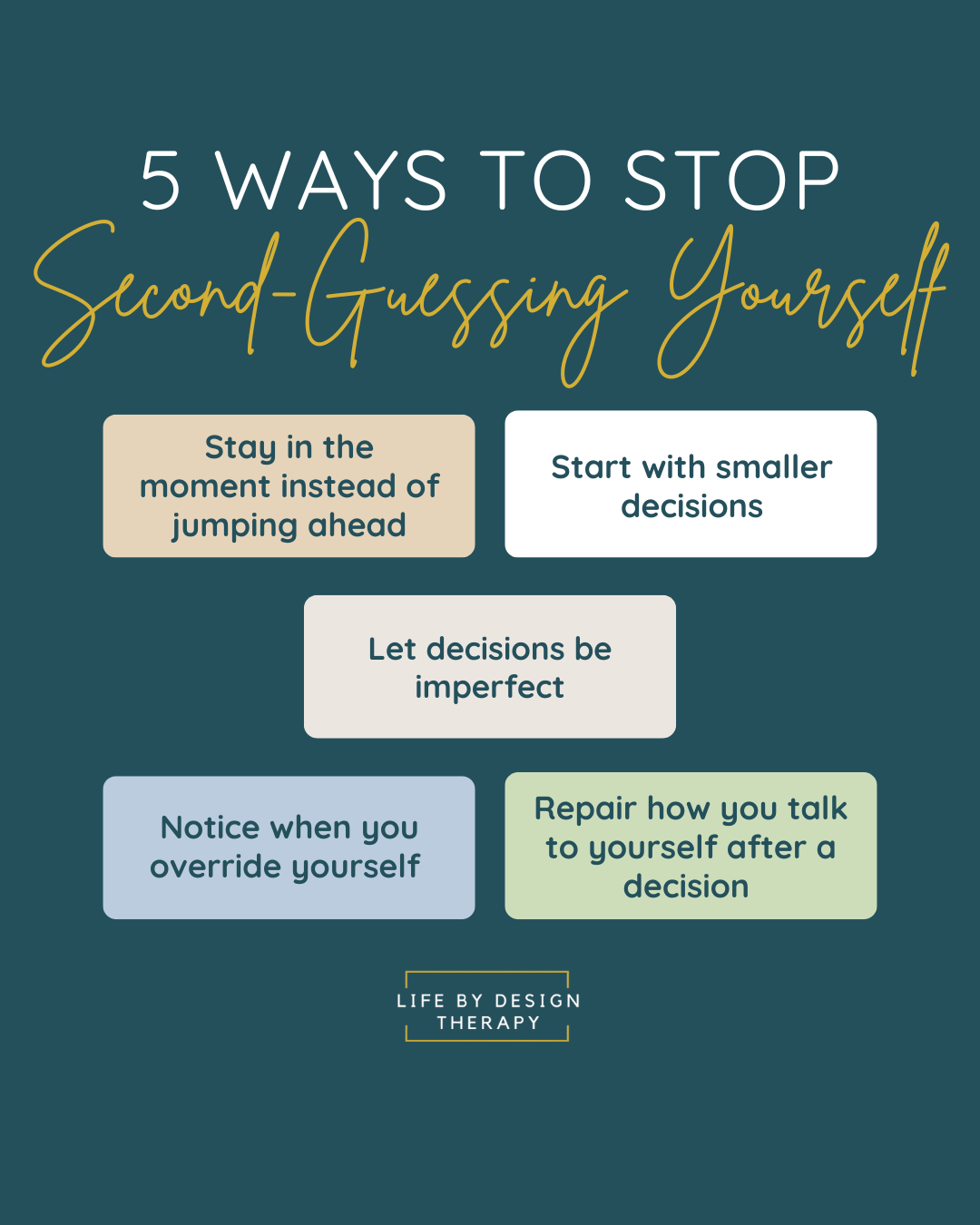
7 Ways to Stop Second-Guessing Yourself and Start Trusting Your Decisions
If you've been struggling to trust yourself or find yourself constantly questioning your choices, here are a few ways to help you begin rebuilding self-trust and easing some of that uncertainty.
1. Start noticing before you try to fix it - Pay attention to when you second-guess yourself, especially around decision-making, because awareness is what helps you start trusting yourself again.
2. Ask what you’re actually afraid of - Instead of asking “What’s the right decision?” ask: “What am I afraid will happen if I choose this?” Is it fear of embarrassment, disappointing someone, or maybe conflict? Naming it can change everything.
3. Stay in the moment instead of jumping ahead - Second-guessing often pulls you into the future, focusing on what could go wrong or what you might miss. Self-trust, however, is built in the present. As you're making decisions, gently notice what's happening in your body, your thoughts, and your emotions.
4. Start with smaller decisions - If trusting yourself feels hard, you don’t have to start big. You can build confidence in your decision-making with low-stakes choices.
5. Let decisions be imperfect - You don’t build self-trust by always getting it right. You build it by learning you can handle it when things don’t go as planned.
6. Notice when you override yourself - Pay attention to the moments you ignore what you feel. That’s where trust starts to break down.
7. Repair how you talk to yourself after a decision - This is the biggest one. If you tend to shame yourself after making a decision, that’s what keeps you stuck. Self-trust is built in how you respond to yourself afterward.
Learning to Trust Yourself Again
At first, it might not feel like much. You might still second-guess yourself when making decisions, and you might still feel unsure. And that's okay!
But as you start integrating these tools into your everyday life, you’ll start to notice shifts like more awareness or a more grounded internal space before responding.
And over time, this becomes your baseline for confidence and decision-making. Maybe not perfect certainty, but enough self-trust to make decisions without constantly questioning yourself, even when things don’t go the way you hoped.
Final Thoughts/Reflections
If you’ve been telling yourself that you’re bad at decision-making or that you can’t trust yourself, it makes sense why you might feel stuck. But that doesn’t mean you truly are stuck
Remember, you don’t learn to trust yourself by making perfect decisions. You build trust with yourself in the moments where things don’t go how you expected… and you don’t tear yourself apart for it afterward.
Sometimes the pattern of second-guessing yourself runs deeper, connected to past experiences, relationships, or a long history of feeling disconnected from your own needs. And in those moments, having support can make a real difference.
At Life By Design Therapy, we help clients rebuild self-trust and feel more confident in decision-making through somatic and holistic therapy by helping you reconnect with your body, your emotions, and your internal sense of safety.
Because trusting yourself isn’t about forcing confidence, it’s about creating enough safety within yourself that you can actually hear your own voice again.
This Week's Affirmations
I can make a decision and handle whatever comes next.
I don’t need to overthink to make a valid choice.
I can respond to myself with care, even when things don’t go as planned.
I don’t need to get every decision right to trust myself.
I am not defined by past decisions I regret.
Additional Resources
If you’re interested in continuing to explore your relationship with self-trust, the resources below can be a helpful place to start.
The Untethered Soul: The Journey Beyond Yourself by Michael A. Singer
Radical Acceptance: Embracing Your Life With the Heart of a Buddha by Tara Brach
Overcome Overthinking and Anxiety in Your Relationship By Robert J Charles
**Some product links are affiliate links, which means we'll receive a commission if you purchase through our link, at no extra cost to you. Please read the full disclosure here.


The Hidden Reasons You Second-Guess Yourself
By Melody Wright, LMFT
Have you ever found yourself second-guessing a decision that, for a moment, felt clear?
Like something in you quietly said, okay… this feels right…but then the doubt crept in.
Your chest tightens.
Your mind starts replaying every possible outcome.
You wonder if you missed something, overlooked a red flag, or made the “wrong” choice entirely.
And suddenly, the certainty you felt just moments ago feels hard to trust.
So you go back. You tweak it, rethink it, or maybe you ask someone else what they think, or you sit with it longer than you meant to.
And if you’re being honest, you’re probably tired of constantly going back and forth with yourself.
Tired of finally making a decision… only to start questioning it immediately. Wondering if you missed something, if you’re making a mistake, or if you can actually trust your own judgment.
That kind of mental back-and-forth can become exhausting after a while.
Because it’s not that you can’t make decisions, it’s that your mind keeps pulling you back into doubt. There always seems to be that quiet pull to double-check, to make sure, and to get it right.
And after a while, it starts to feel like something deeper is going on:
Why is this so hard for me?
Why can’t I just trust myself and move on?
If you’ve been stuck in that loop, it’s worth taking a closer look at what’s actually happening underneath it.
At first glance, what’s happening beneath the surface can be easy to misread. It might look like overthinking, self-doubt, or decision anxiety.
But what’s actually happening underneath usually follows a pattern, and when you begin to notice it, it starts to feel a little more understandable.
So keep reading if you want to know what's actually happening underneath the constant second-guessing… because there’s usually more going on than just “indecisiveness.”
What’s Actually Happening Beneath the Surface of Second-Guessing
When you go to make a decision, your brain isn’t just asking what do I want? It’s also quietly scanning for risk like...
Assessing for the safest option.
Trying to determine what will prevent the most discomfort.
Looking for the choice that leaves the least room for regret.
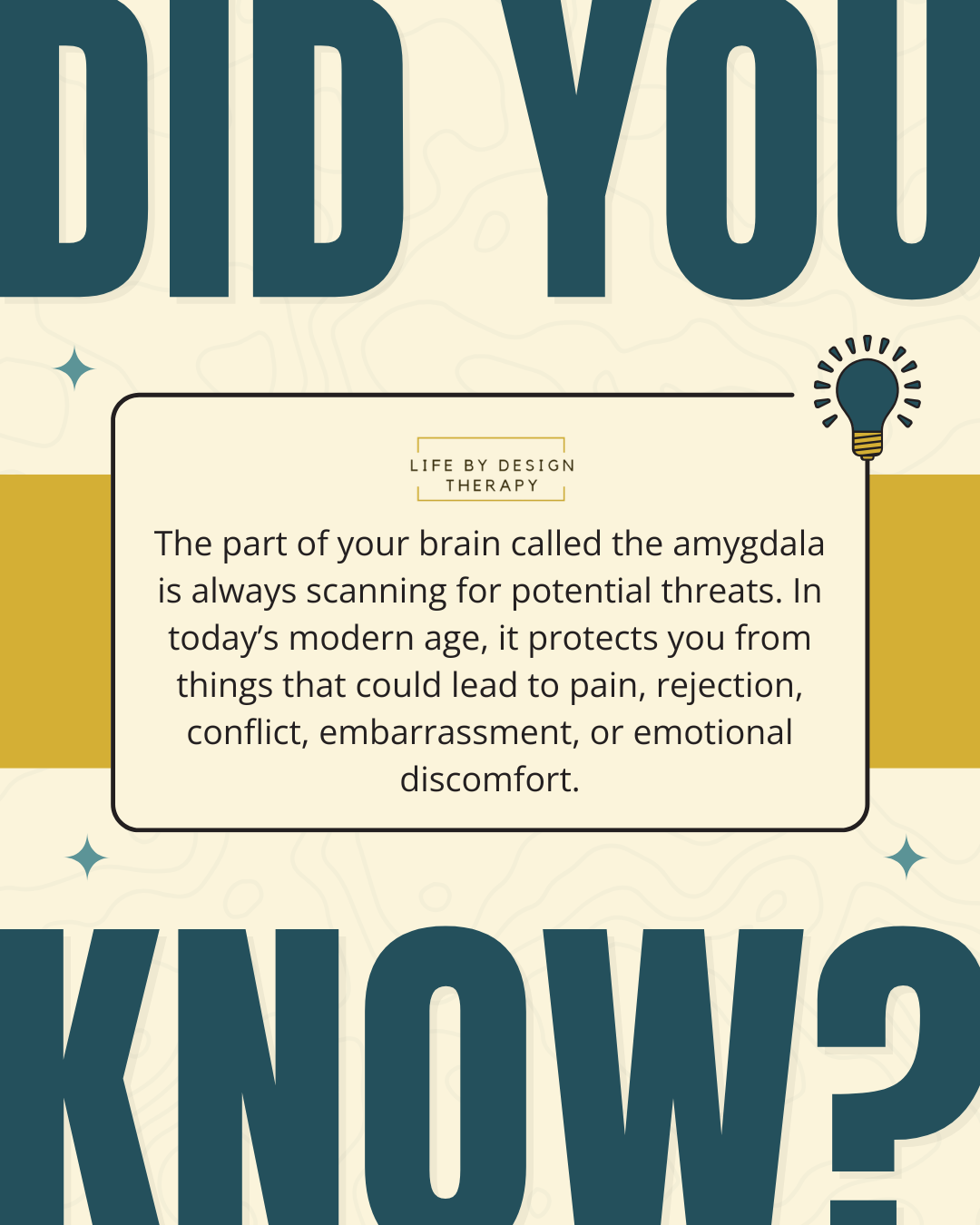
You see, a part of your brain called the amygdala is always scanning for potential threats. In today’s modern age, it protects you from things that could lead to pain, rejection, conflict, embarrassment, or emotional discomfort. And the tricky part is, your brain doesn’t just react to obvious danger. It can also react to subtle things, like tension in someone’s tone, feeling misunderstood, or sensing that someone is upset with you, and your brain starts keeping track of those experiences.
For example, maybe there was a time you trusted yourself, and someone criticized your decision afterward. Maybe you finally spoke up about what you wanted, and it created tension or conflict. Or maybe you made a choice that didn’t go the way you hoped, and you were left feeling embarrassed or blaming yourself afterward.
Your brain remembers that.
So eventually, decision-making can stop feeling like, What do I want? and start feeling more like, How do I avoid getting hurt, disappointing someone, or making the wrong choice?
And that’s usually when the overthinking kicks in.
The replaying.
The double-checking.
The trying to “figure out” the perfect decision before you make it.
Not because you’re incapable of making decisions, but because some part of your system has learned that decisions can carry emotional consequences.
That’s part of why decision-making can feel so exhausting, especially if you already struggle with anxiety, self-doubt, or feeling emotionally on edge a lot of the time.
I want you to know that this is not something you consciously choose, but it’s something your nervous system defaults to because it’s trying to protect you.
So, what starts as protection shapes how you move through your decisions in your day-to-day life.
The Pattern That Keeps Pulling You Back Into Overthinking & Second-Guessing
What started as your nervous system trying to protect you can slowly turn into a pattern of second-guessing yourself in your everyday life.
You make a decision, but instead of feeling settled afterward, your mind keeps circling back to the situation or decision by:
Replaying the conversation.
Re-reading the text.
Wondering if you said the wrong thing
Missing something important
Handling it badly somehow
Other subtle signs of a second-guessing pattern can look like:
Needing reassurance from other people by wanting someone to tell you that you made the “right” choice or responded the “right” way.
Changing your mind at the last minute, even when nothing actually changed except the doubt you started feeling inside.
And without even realizing it, that loop starts reinforcing itself.
What's really interesting about your brain is it’s always learning through repetition, through something called neuroplasticity. So, your brain and nervous system get more efficient at whatever you practice most. So if you repeatedly go back and question yourself after making a decision, your brain starts to learn: This is what we do when uncertainty shows up.
Over time, it can start feeling automatic, like second-guessing yourself is just part of your personality or “how your brain works.”
But usually, it’s not that simple.
Usually, there’s more underneath that pattern than people realize, and some of the reasons you second-guess yourself may not be as obvious as you think.
And truthfully, the loops of overthinking can be challenging to manage without the right tools. If you would like to learn how to support yourself when your mind won’t stay put, check out our blog, 6 Ways to Return to the Present When Your Mind Won't Stay Put.
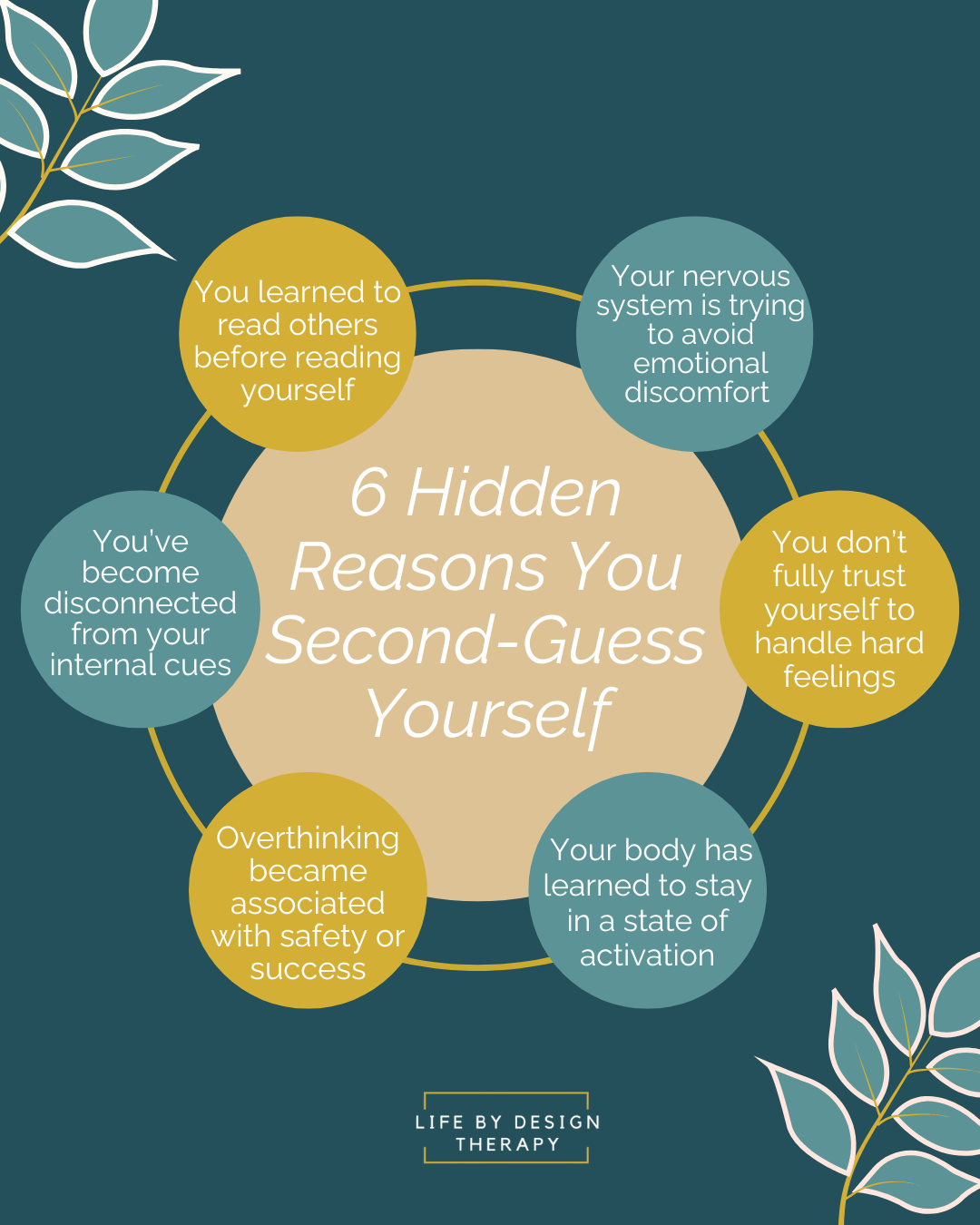
6 Hidden Reasons You Second-Guess Yourself
When you start to look at second-guessing through the lens of your nervous system, past experiences, and learned protective patterns, second-guessing begins to feel less random and more connected to the ways you’ve learned to move through the world.
It’s not just one thing. It’s usually a combination of patterns that have built over time, often in ways that are easy to miss.
Here are a few of the hidden reasons that might be showing up for you:
1. You learned to pay attention to everyone else’s emotional cues before your own internal ones
For some people, second-guessing starts with becoming highly attuned to other people’s emotions, reactions, and needs. This is especially common in anxious attachment, where your nervous system learns early on that connection and emotional safety may depend on staying aware of what other people are feeling.
So instead of feeling grounded in your own preferences, your attention automatically shifts toward managing the emotional environment around you.
You may notice yourself:
Softening your opinions to keep the peace.
Replaying conversations to make sure you didn’t upset someone.
Adjusting decisions based on how you think another person might react.
Feeling responsible for other people’s comfort, disappointment, or emotional responses.
Struggling to tell the difference between what you actually want and what feels safest relationally.
From a somatic perspective, this can become a form of hypervigilance, where your body stays focused on scanning for emotional cues, shifts in tone, or signs of disconnection. Over time, your attention becomes externally focused, which can make it harder to stay connected to your own internal cues, needs, and instincts.
And when your decisions are constantly filtered through other people’s emotional responses first, even simple choices can start to feel emotionally loaded.
2. Your nervous system is trying to avoid emotional discomfort
A lot of the time, the pressure behind second-guessing isn’t actually about the decision itself. It’s about the emotional experience your brain is trying to prevent afterward.
Feelings like:
Regret
Guilt
Embarrassment
Disappointment
Conflict
Feeling misunderstood
Your nervous system naturally wants to move away from experiences that feel emotionally painful or unsafe. So your mind keeps searching for the “right” choice, hoping it can find the one decision that prevents discomfort entirely.
But this is where people often get stuck: They learn to see certainty and avoiding conflict as the safest option.
And when your brain believes certainty is what keeps you emotionally safe, it becomes very hard to stop analyzing, replaying, or trying to predict every possible outcome before making a decision.
3. You don’t fully trust yourself to handle hard feelings
Sometimes the deeper fear underneath second-guessing isn’t actually: “What if I make the wrong choice?”
It’s: “What if I make the wrong choice and I can’t handle what comes next?”
That’s a very different kind of fear.
You see, self-trust is not just about trusting your decisions. It’s also about trusting your ability to navigate disappointment, grief, uncertainty, conflict, or repair if things don’t go as planned.
When that internal trust feels shaky, your nervous system will respond by trying to gain more control before acting. That can look like overanalyzing, freezing, reopening decisions repeatedly, or struggling to fully commit to a choice.
But this is not because you’re incapable, but because some part of you is trying to reduce emotional risk before moving forward.
4. Your body has learned to stay in a state of activation
If your nervous system is used to stress, pressure, overthinking, or constantly preparing for what could go wrong, calm can actually start to feel unfamiliar.
So when you finally make a decision, your body may not fully register it as “safe” to settle.
Instead, your system keeps searching.
You recheck
You rethink
You revisit the conversation
You look for reassurance
You reopen the decision again
From a somatic perspective, this often happens when the body becomes more familiar with activation than regulation. The mind interprets continued checking as productive or protective, but underneath it is a nervous system that has difficulty tolerating stillness, uncertainty, or completion.
So the loop continues, not necessarily because the decision is wrong, but because your body has learned that staying mentally activated feels safer than allowing uncertainty to exist.
5. Overthinking became associated with safety or success
For many people, overthinking started as an adaptive strategy.
Maybe you realized that being highly aware helped you avoid criticism. Maybe you thought that thinking through every possibility helped you stay prepared. Maybe anticipating problems helped you feel more in control growing up.
So your brain learned that overthinking keeps you safe.
And to be fair, sometimes it probably did help you survive certain environments or experiences.
But the nervous system doesn’t always recognize when a protective strategy is no longer helping in the same way. So even when constant analyzing starts creating stress, exhaustion, or disconnection from yourself, your brain may still interpret it as responsible, productive, or necessary.
6. You’ve become disconnected from your internal cues
Self-trust relies heavily on interoception, which is your ability to notice and interpret the internal signals coming from your body.
This feels off
I feel open here
I feel constricted here
This feels grounding
But if you’ve spent years overriding your needs, minimizing your feelings, prioritizing survival, or staying focused on everyone else around you, those internal signals can become harder to access. Instead of trusting how something feels, you keep searching for certainty through overthinking.
That’s part of why second-guessing can feel endless sometimes. Your mind is trying to solve something, and your nervous system is still learning how to feel safe enough to trust.
Grounding is a great way to begin learning how to reconnect with yourself and your internal cues. To learn more about how to do this, check out our blog, Grounding Techniques to Calm Your Nervous System.
Final Thoughts
If you’ve been struggling with overthinking, self-doubt, or difficulty trusting your decisions, I want you to know that these patterns are more common than you might think. It just means your brain and your body have learned ways to protect you, to anticipate, and to try to keep you safe.
And while those patterns may not feel helpful right now, they make sense when you look at where they came from.
Remember, the goal isn’t to force yourself to “just trust yourself” overnight, but rather to start understanding the patterns you’ve been moving through, and gently begin shifting them in a way that actually feels sustainable.
If this is something you’ve been struggling with, you don’t have to figure it out on your own. At Life By Design Therapy™, our Holistic & Somatic Therapists will support you in understanding the patterns behind second-guessing and help you develop more consistent, embodied self-trust over time.
If you’re ready to get started, CLICK HERE to book your free phone consultation.
This Week's Affirmations
I am learning to stay with my decisions, even when it feels uncomfortable.
I can move forward without having all the answers.
My first instinct is worth listening to.
It’s safe for me to let a decision be enough.
I can trust myself to handle whatever comes next.
Additional Resources
If you’re interested in continuing to explore your relationship with self-trust, the resources below can be a helpful place to start.
The Untethered Soul: The Journey Beyond Yourself by Michael A. Singer
Radical Acceptance: Embracing Your Life With the Heart of a Buddha by Tara Brach
Overcome Overthinking and Anxiety in Your Relationship By Robert J Charles
**Some product links are affiliate links, which means we'll receive a commission if you purchase through our link, at no extra cost to you. Please read the full disclosure here.

The Journey Within: 10 Ways to Conquer Self-Doubt
By Melody Wright, LMFT

Do you ever find yourself wrestling with doubts about your abilities, worth, or place in the world? If you answered “yes”, we want you to know that you're not alone. Self-doubt is a common experience that can plague even the most confident people. It has the ability to cast shadows of uncertainty on our thoughts and actions. Yet, you have the potential for profound transformation—a journey from self-doubt to self-love.
In this blog post, we'll explore some actionable steps to replace self-doubt with confidence and self-love. Whether you're grappling with fleeting moments of insecurity or facing persistent doubts that overshadow your life, this blog will support the path toward greater self-compassion, resilience, and inner peace.
From Doubt To Empowerment
This journey from having negative thoughts or self-doubt to embracing an empowered mindset is something that requires commitment to self-awareness, self-compassion, and mindful actions geared toward cultivating a positive self-image. It’s not about erasing all doubts overnight but rather about developing inner resilience and self-acceptance to navigate through them with grace when they arise. Here are some essential steps to guide you through this transformation process.
Acknowledge Your Self-Doubt: The first step in transforming self-doubt is to become aware of it and acknowledge it. This self-awareness will support you in recognizing when self-doubt comes through and how it manifests in your thoughts and behaviors.
Practice Self-Compassion: Treat yourself with kindness and understanding, just as you would treat a close friend. Hold a non-judgmental space and allow self-compassion to come through. This allows you to be gentle with yourself when facing difficult situations or perceived failures. Instead of harsh self-criticism, offer yourself words of encouragement and support.
Challenge Negative Thoughts: Pay attention to your inner dialogue and challenge negative self-talk. When you notice yourself doubting your abilities or worth, counter those thoughts with positive affirmations and realistic perspectives. Remind yourself of your strengths, accomplishments, and past successes. You can say things such as, “It’s ok, I can handle it better next time”, or “I can”.
Set Realistic Goals: Break down your goals into smaller, achievable steps. Setting realistic goals helps prevent feelings of overwhelm and inadequacy. Celebrate each milestone you reach, no matter how small, because every step contributes to your growth and progress.
Stop the Comparison: Instead of comparing yourself to others, focus on your personal growth and development. Remember that everyone is at a different stage in life, everyone was raised differently, carries different perspectives, and has different obstacles in their life. Embrace your journey of continuous improvement, knowing that progress takes time and effort. Cultivate a growth mindset that views challenges as opportunities for learning and self-discovery.
Practice Gratitude: Keep gratitude at the forefront of your mind by acknowledging the positive aspects of your life. Reflect on the things you appreciate about yourself and your experiences. Gratitude helps shift your perspective from what you lack to what you already have, which will help foster self-love and contentment.
Engage in Self-Care: Prioritize self-care activities that nurture your physical, emotional, and mental well-being. This could include exercise, healthy eating, relaxation techniques, hobbies, spending time with loved ones, or seeking professional support when needed. Taking care of yourself demonstrates self-love and reinforces your worthiness of care and attention. This step will also help you discover things that make YOU happy rather than following the outside influences telling you what will make you happy.
Surround Yourself with Supportive People: Surround yourself with supportive friends, family members, or mentors who uplift and encourage you. Seek out positive influences that affirm your worth and capabilities. Having this strong support system can boost your confidence and help you navigate through moments of doubt.
Practice Mindfulness and Meditation: Cultivate mindfulness through practices such as meditation, deep breathing, or mindfulness exercises. Mindfulness helps you observe your thoughts and emotions without judgment, allowing you to develop greater self-awareness and acceptance. Over time, mindfulness can reduce the intensity of self-doubt and foster a greater sense of inner peace and acceptance.
Seek Professional Help if Needed: If self-doubt significantly impacts your daily life or mental health, consider seeking support from a therapist or counselor. Therapy can help you get to the root of where your negative self-talk might come from and provide you with tools and strategies to address the underlying issues, build self-esteem, and cultivate self-love in a safe and supportive environment. You might find that narrative therapy, holistic therapy, and somatic therapy can be especially supportive for boosting self-esteem.

Final Thoughts
We want you to remember that transforming self-doubt and negative self-talk into self-love is a gradual process that requires patience, persistence, and self-compassion. Be gentle with yourself as you walk out this journey of self-discovery and growth. If you find that you are interested in therapy to support this journey, consider meeting with one of our skilled clinicians here at Life By Design Therapy. Our therapists specialize in Holistic and Somatic Therapy and they are ready to customize your care within a secure environment. Click HERE to schedule a free consultation today.

Affirmations for Self-Doubt
"I am capable of overcoming any challenges that come my way."
"I trust in my ability to make sound decisions."
"I am deserving of success and happiness."
"I recognize my strengths and value my unique qualities."
"I choose to believe in myself, even when faced with uncertainty."
Additional Resources
**If you’re interested in expanding your knowledge on growing your confidence, check out these books below:
"Self-Compassion: The Proven Power of Being Kind to Yourself" by Kristin Neff
"Radical Acceptance: Embracing Your Life With the Heart of a Buddha" by Tara Brach
“The Untethered Soul: The Journey Beyond Yourself" by Michael A. Singer
"Emotional Intelligence: Why It Can Matter More Than IQ" by Daniel Goleman
"Big Magic: Creative Living Beyond Fear" by Elizabeth Gilbert
"The Power of Now: A Guide to Spiritual Enlightenment" by Eckhart Tolle
**Some product links are affiliate links, which means we'll receive a commission if you purchase through our link, at no extra cost to you. Please read full disclosure here.