

Why Anxiety Pulls You Out of the Present Moment (And How Grounding Helps You Come Back)
By Melody Wright, LMFT
Have you ever been sitting with your family, halfway through dinner, only to realize you haven't actually heard a word anyone has said for the last few minutes?
Your body is there, and you're physically present, but your mind is somewhere else entirely.
Maybe you're replaying a conversation from earlier in the day.
Maybe you're worrying about something happening next week.
Maybe you're mentally running through every possible outcome of a situation that hasn't even happened yet.
If you've experienced this, I’ve been there. One of the most frustrating parts of anxiety is that it has a way of pulling us away from the life happening right in front of us.
The hard part is that many people assume they're simply distracted, unfocused, or overthinking. But anxiety is doing something much deeper than that.
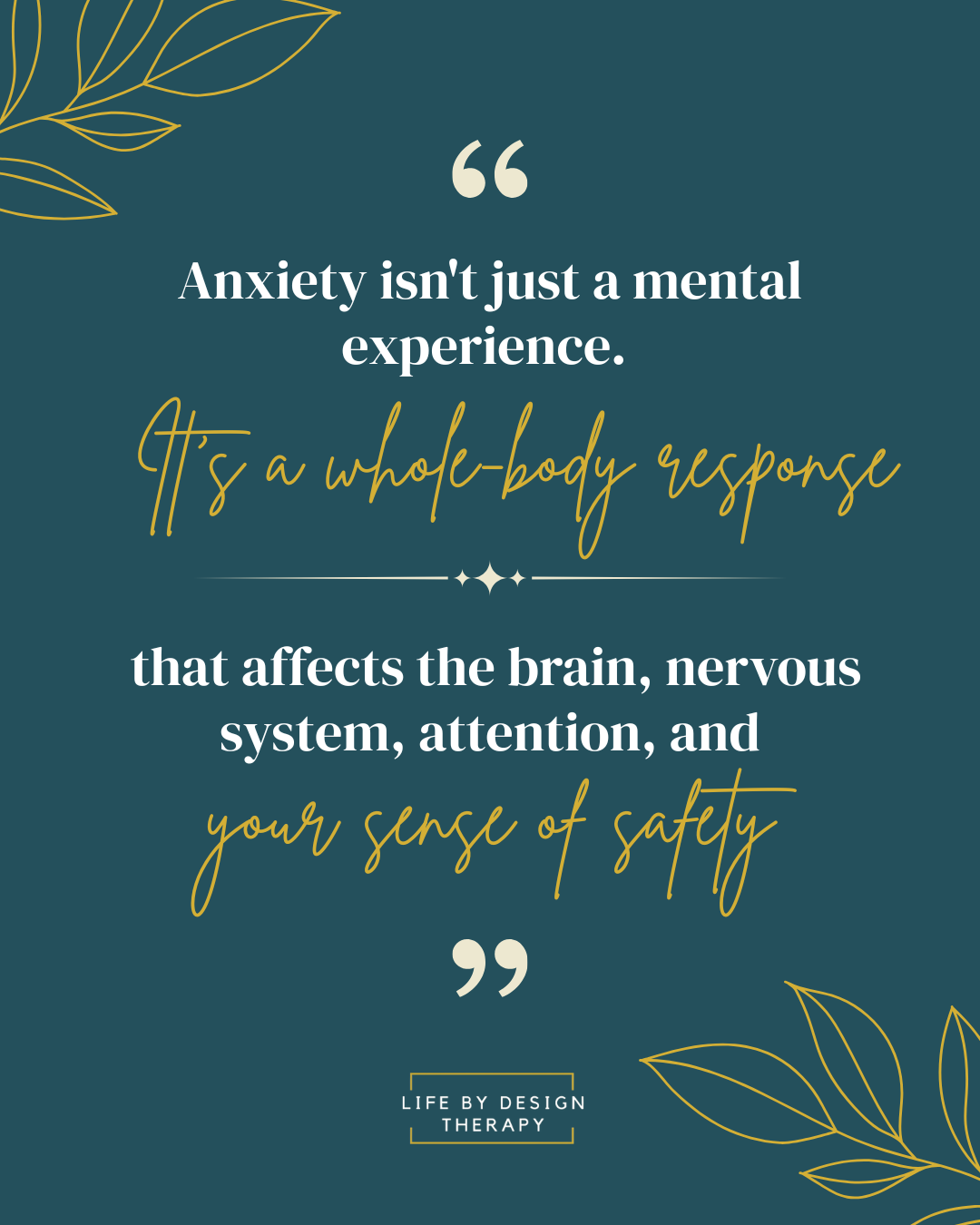
Anxiety isn't just a mental experience. It's a whole-body response that affects the brain, nervous system, attention, and your sense of safety.
And understanding what's happening can help explain why grounding techniques are often so effective.
What Anxiety Actually Does to the Brain and Body
At its core, anxiety is designed to protect us.
Your brain is constantly scanning for potential threats. Most of the time, this happens automatically and outside of your awareness. When your brain perceives something as potentially dangerous, your body's survival systems begin preparing you to respond.
The amygdala is the part of your brain that plays an important role in detecting threats and becomes more active. Stress hormones like cortisol and adrenaline are released. Your heart rate may increase, your muscles may tense, and your attention begins narrowing toward whatever feels threatening.
This response can be incredibly helpful in situations where danger is actually present.
The challenge is that our nervous systems don't always distinguish between a threat that is happening right now and a threat we imagine could happen in the future.
In both cases, your body may begin preparing for action.
This is why anxiety often shows up as:
Racing thoughts
Muscle tension
Restlessness
Difficulty concentrating
Trouble sleeping
Feeling "on edge"
A sense that you always need to be prepared
Your nervous system is just trying to keep you safe.
But in the process, it can become difficult to stay connected to the present moment.
Anxiety has a way of pulling our attention away from what's happening right now. Sometimes it keeps us replaying something that already happened. Other times it sends us racing ahead, trying to predict, prepare for, or prevent what might come next. Either way, our mind is no longer fully connected to the moment we're actually living.
Why Anxious Thoughts Pull Us Out of The Present Moment
Your brain is designed to look for patterns and keep you safe. So, when anxiety is active, that protective system can become overworked.
Instead of helping us respond to what's happening in front of us, it starts searching for problems that haven't happened yet, replaying situations that already ended, or scanning for signs that something is wrong. Your nervous system’s goal is protection, but the result is often exhaustion.
The more our attention is pulled away from the present, the harder it becomes to notice the things that actually help our nervous system settle: the chair supporting us, the sound of birds outside, the feeling of our feet on the floor, or the fact that, in this moment, we may be safe.
You might catch yourself thinking:
What if I fail?
What if something goes wrong?
What if I make the wrong decision?
What if I can't handle it?
If that sounds familiar, know that there's nothing wrong with you. These thoughts usually come from a place of wanting to feel safe. Your mind is trying to protect you by looking ahead and searching for answers.
The problem is that anxiety rarely settles for one answer. Even when you come up with a solution, it often responds with another question, another possibility, or another thing to worry about.
Before you know it, you've spent so much time living in "what if" that you've lost touch with what's actually happening right in front of you.
And when your attention is constantly being pulled toward the future, it can become really difficult to stay connected to the present moment.
Which brings us to another important piece of the puzzle.
How Anxiety Creates Disconnection From the Present Moment
When anxiety becomes loud enough, it can begin pulling us away from our actual experience.
You might find yourself driving somewhere and realizing you barely remember the drive.
You might struggle to enjoy a vacation because your mind keeps focusing on what needs to happen when you get home.
You might be spending time with people you love while simultaneously worrying about something that hasn't happened yet.
In many ways, anxiety hijacks attention. So, rather than allowing us to fully engage with what's happening around us, it continually redirects our focus toward potential threats, future problems, or worst-case scenarios.
Sometimes this can even create a sense of disconnection from your own body.
You may notice that you're living primarily in your thoughts.
Thinking.
Planning.
Analyzing.
Preparing.
But not fully experiencing the moment you're currently in, and this isn't because you're doing something wrong.
It's because anxiety is asking your nervous system to prioritize survival over presence.
The good news is that there are ways to gently help your mind and body reconnect.
And that's where grounding comes in.
Why Grounding Can Help
One of the biggest misconceptions about grounding is that it's supposed to instantly make anxiety disappear. That's a lot of pressure to put on any coping skill.
In reality, grounding is often less about getting rid of anxiety and more about helping your nervous system recognize that it is safe enough to return to the present moment.
When anxiety pulls your attention into future worries, grounding helps redirect your attention back to what's happening right now.
Back to your body.
Back to your environment.
Back to the information your senses are receiving in the present moment.
Research has shown that grounding practices can help interrupt spiraling thought patterns, increase present-moment awareness, and support nervous system regulation.
So, in other words, grounding helps create a bridge between where anxiety has taken you and where your life is actually happening.
Understanding why grounding works is one thing, but finding techniques that work for your specific nervous system is another.
If you're looking for practical ways to begin, check out our blog, 5 Body-Based Grounding Techniques, where we walk through several simple grounding exercises you can start using today. You can also download our free Mind-Body Toolkit for 50 exercises designed to help you reconnect with the present moment.
But while grounding can be incredibly helpful, it's important to remember that it isn't always addressing the reason anxiety showed up in the first place.
How Therapy Can Help Address the Root Causes of Anxiety
Grounding helps you come back to the present moment, but therapy can help you understand why your nervous system keeps getting pulled away from it.
For some people, anxiety is connected to chronic stress.
For others, it may be connected to trauma, attachment wounds, perfectionism, burnout, major life transitions, or experiences that taught the nervous system the world wasn't always predictable or safe.
Over time, therapy can help you identify these patterns, understand how they developed, and build new ways of relating to your thoughts, emotions, and body.
So, rather than constantly fighting anxiety, many people begin learning how to understand it.
And that understanding often creates more space for regulation, self-compassion, and lasting change.
Final Thoughts
Anxiety has a way of convincing us that our attention belongs somewhere else, in tomorrow's problems, yesterday's mistakes, or endless possibilities and unanswered questions. But your life isn't happening in any of those places. It's happening here, right now.
And sometimes the goal isn't to force yourself to stop worrying. Sometimes the first step is simply helping your nervous system find its way back to the present moment. Through a single breath, a sensation in your body, or a grounding exercise, you can begin reconnecting with what's happening around you instead of getting pulled into what might happen next.
But if anxiety is making it difficult to stay present, therapy can help you better understand what's happening beneath the surface and develop tools to support lasting change. Book a call today and learn how we can help you reconnect with yourself, your relationships, and the life happening right in front of you.
This Week's Affirmations
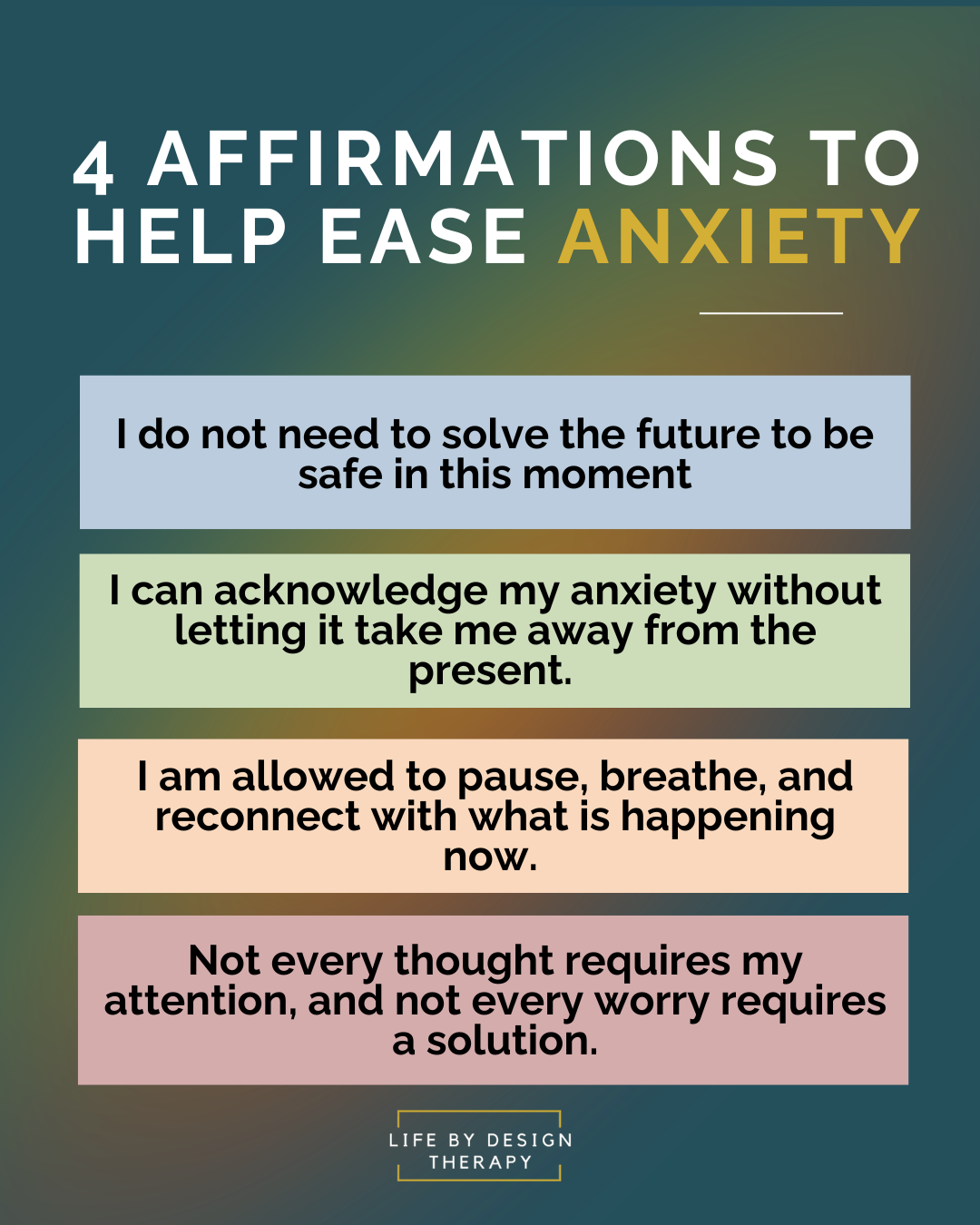
I do not need to solve the future to be safe in this moment.
I can acknowledge my anxiety without letting it take me away from the present.
I am learning to trust myself, even when uncertainty is present.
I am allowed to pause, breathe, and reconnect with what is happening now.
Not every thought requires my attention, and not every worry requires a solution.
Additional Resources
If you'd like to learn more about anxiety, grounding, nervous system regulation, and how anxiety can pull us away from the present moment, the books below offer helpful insights and practical tools to support your journey.
The Body Keeps the Score: Brain, Mind, and Body in the Healing of Trauma by Bessel van der Kolk M.D
Polyvagal Theory in Therapy: Engaging the Rhythm of Regulation by Deb Dana
The Power of Now: A Guide to Spiritual Enlightenment by Eckhart Tolle
Wherever You Go, There You Are: Mindfulness Meditation in Everyday Life by Jon Kabat-Zinn PhD
The Miracle of Mindfulness: An Introduction to the Practice of Meditation by Thich Nhat Hanh
Radical Acceptance: Embracing Your Life With the Heart of a Buddha by Tara Brach
**Some product links are affiliate links, which means we'll receive a commission if you purchase through our link, at no extra cost to you. Please read the full disclosure here.


Grounding Techniques to Calm Your Nervous System
By Melody Wright, LMFT
There’s a moment many people don’t talk about enough, in my opinion.
The moment when nothing is technically wrong, but your body won’t settle.
Work is over, yet your chest feels tight. You finally sit down, and your mind starts racing. You’re exhausted, but rest feels out of reach.
If this sounds familiar, it doesn’t mean you’re bad at managing stress. It usually means your nervous system has been carrying more than it knows how to put down, and it’s asking for support.
Not in the form of advice.
Not in the form of “just relax.”
But in a language your body actually understands.
That’s where grounding techniques come in.
Why Your Nervous System Won’t Just “Calm Down”
Your nervous system’s job is protection. It’s constantly scanning for danger and safety, even when you’re not aware of it.
When stress, burnout, anxiety, or unresolved experiences stack up, your body can get stuck in survival mode—fight, flight, or freeze. This is why you might feel:
Anxious for no clear reason
On edge, irritable, or overwhelmed
Disconnected or numb
Tense, restless, or unable to relax
Tired but wired at the same time
You might feel like your body is overreacting, but it’s actually responding exactly the way your nervous system should when it’s been under pressure for too long.
Grounding techniques help by gently reminding your body: You’re here, you’re safe. And you can soften now.
How Grounding Works in the Nervous System
Grounding techniques are somatic tools or body-based practices that can calm the nervous system by bringing your awareness into the present moment.
If you’ve ever explored the idea of mindful living, grounding is one of the most practical ways to do that in your body. If you’d like to explore this connection between presence and healing more deeply, check out our blog, The Art of Mindfulness: Harnessing the Power of the Present Moment.
Unlike coping strategies that focus on talking yourself out of how you feel or trying to “think positively,” grounding doesn’t ask you to analyze your emotions or change your thoughts.
Instead, it works by engaging your senses, breath, and physical body.
This matters because when your nervous system is activated, logic isn’t what it needs first…safety is.
Grounding is one of the ways you can begin offering that sense of safety to both your mind and body.
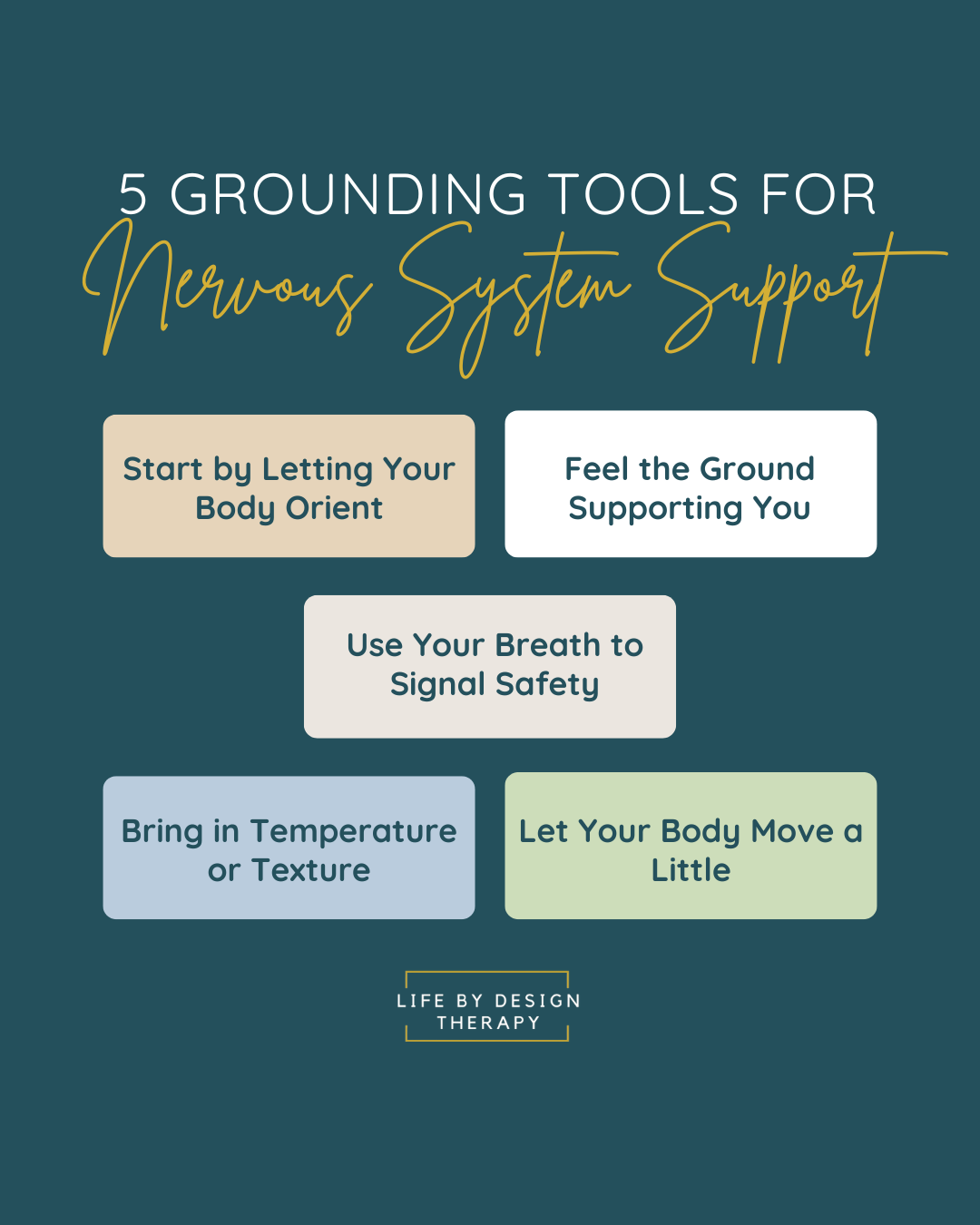
5 Grounding Techniques to Calm Your Nervous System (That Don’t Feel Forced)
Now, before you start making a mental checklist or grading yourself on how well you’re doing this…I want you to pause for a second.
You don’t need to do all of these. You don’t even need to do them perfectly. Think of these as open invitations rather than rigid assignments.
1. Start by Letting Your Body Orient
Before anything else, let your body take in where you are.
Slowly look around the room.
Notice the walls, the light, the objects near you.
Let your eyes land on something neutral or comforting.
You might quietly think:
“This is where I am right now.”
This simple act, called orienting, helps your nervous system update itself from past or future stress back into the present.
2. Feel the Ground Supporting You
So much anxiety comes from feeling like you have to hold everything together on your own.
As silly as it might sound…let the ground help.
Notice your feet against the floor, or the chair supporting your weight.
Place a hand on your legs or chest if that feels calming.
In this moment, you don’t need to focus on relaxing or changing anything. Just let yourself notice that you’re being held, and that, for this moment, you don’t have to hold everything on your own.
For many people, this alone starts to reduce nervous system activation.
3. Use Your Breath to Signal Safety
Breathing techniques can be a huge support to your nervous system, even in the middle of a stressful moment.
It doesn’t need to be deep breathing or anything special. Even small, simple practices can help.
Here’s a simple exercise you can try:
Inhale through your nose
Exhale slowly through your mouth
Let the exhale be just a little longer than the inhale - think inhale for 4 counts, exhale for 6 counts.
Even a few slow breaths can tell your body that it’s safe to start relaxing.
This is one of the most effective grounding techniques for anxiety and stress because it directly engages your parasympathetic nervous system, helping your body move out of fight, flight, or freeze and back into a state of safety.
4. Bring in Temperature or Texture
When thoughts feel overwhelming, sensation can help anchor you.
Notice:
The warmth of a mug
The coolness of water on your hands
The soft texture of a blanket
Focus on the sensation itself and quietly name what you notice—warm, cool, soft, solid.
Doing this helps your body stay anchored in the present, rather than trailing elsewhere.
5. Let Your Body Move a Little
Although we often associate grounding with stillness, sometimes the energy you’re experiencing needs a different direction. In those moments, your body may need movement instead of quiet.
And that’s okay.
In these moments, try gentle movement:
Rolling your shoulders
Stretching your arms
Rocking slightly side to side
Movement can help release stored stress or anxious energy and bring your body back into a state of calm and regulation.
Follow what feels natural; there’s no right way or wrong way to do this.
Why Grounding Techniques Can Feel Hard
For some people, especially those with trauma or chronic stress, slowing down can feel uncomfortable at first. This is completely normal!
If that’s you, here are a few tips:
Keep grounding brief, even one minute can be enough
Focus on external cues (what you see or touch)
Choose movement-based grounding over stillness
Your nervous system learns safety slowly, and that’s okay.
This is also why somatic therapy can be so helpful. You don’t have to navigate nervous system regulation alone.
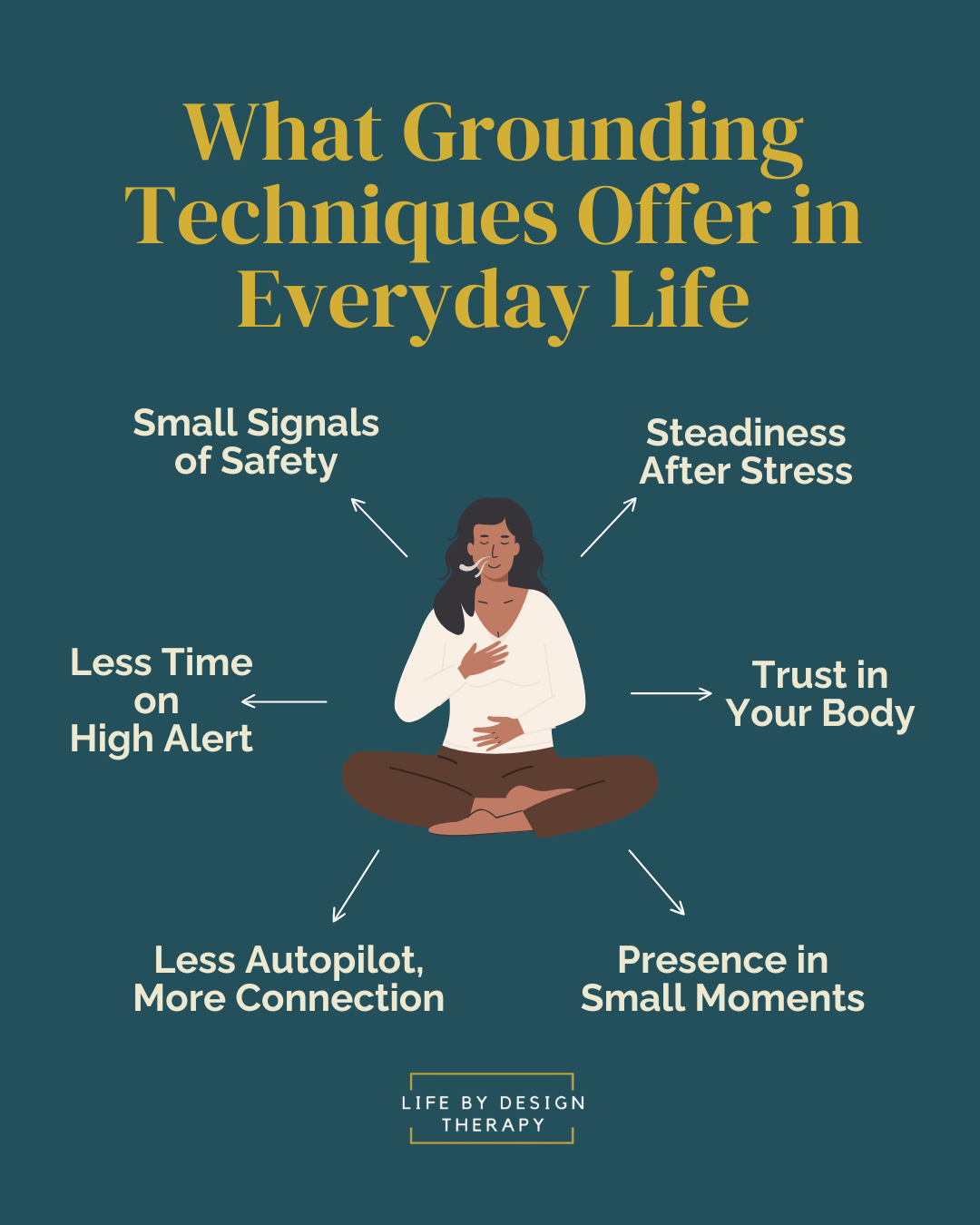
What Grounding Techniques Offer in Everyday Life
Grounding techniques aren’t meant to erase emotion or make life feel easy, and they’re not about forcing calm, positive thinking, or trying to override what you’re feeling.
Instead, grounding works at the level of the nervous system.
When you practice grounding, you’re sending your body small, repeated signals that it’s safe enough to slow down. Over time, your nervous system learns that it doesn’t have to stay on high alert all the time and that it can soften without losing control or awareness.
This is how nervous system regulation happens: not in big breakthroughs, but in quiet moments of noticing support, sensation, and presence.
With practice, grounding becomes something you naturally return to throughout the day.
Not just when anxiety spikes or stress feels overwhelming, but in ordinary moments, like while sitting at your desk, washing your hands, or taking a breath between tasks.
These small check-ins help you stay connected to your body instead of pushing through on autopilot.
And slowly, that connection builds trust; not in the sense of forcing yourself to feel better, but in learning that your body can experience emotions, respond to stress, and still come back to a place of steadiness.
That’s the real work of grounding, not constant calm, but a nervous system that knows how to find its footing again.
Final Thoughts
If you’ve been feeling anxious, overwhelmed, disconnected, or exhausted, it’s understandable. Given the pace of life, the pressure to keep up, and how little space we’re given to rest or process, these feelings are often a natural response, not a sign that anything is “wrong” with you.
And if you’ve ever found yourself wondering why you feel this way or blaming yourself for it, that’s a really common place to go.
These experiences aren’t a personal flaw, they’re often signs of a nervous system that has been working overtime to try to keep you safe.
Your body has been doing its best, and those patterns can be exhausting, but they come from protection, not weakness.
Grounding techniques are one way to begin supporting your nervous system. They help your body find moments of steadiness and relief in everyday life.
But sometimes, support needs to go deeper, especially when stress, anxiety, or past experiences have been living in your body for a long time.
That’s where somatic and holistic therapy can be especially powerful.
At Life By Design Therapy™, we focus on more than just talking through symptoms. Our somatic and holistic approach helps you understand how your nervous system has adapted, and gently supports your body in learning that safety is possible again.
“Therapy becomes a place where you don’t have to push through or explain everything, and your body is part of the healing process.”
There’s no pressure to rush or “fix” yourself. Healing happens slowly, in relationship, and at a pace your nervous system can trust.
You deserve support that meets you where you are.
This Week's Affirmations
My body is doing its best to protect me, and I can meet it with care.
In this moment, I am safe.
Support is available to me, and I am allowed to receive it.
I don’t need to force calm for healing to happen.
I am learning to trust my body again.
Additional Resources
**If you’re interested in learning more about ways to regulate your nervous system, check out these books below:
The Body Keeps the Score: Brain, Mind, and Body in the Healing of Trauma by Bessel van der Kolk M.D
Polyvagal Theory in Therapy: Engaging the Rhythm of Regulation by Deb Dana
Wherever You Go, There You Are: Mindfulness Meditation in Everyday Life by Jon Kabat-Zinn PhD
Radical Acceptance: Embracing Your Life With the Heart of a Buddha by Tara Brach

Grounding 101: Practical Tools for Anchoring in the Present
By Melody Wright, LMFT
Imagine you’re on a ship out at sea. The once-calm waves are now becoming rogue and chaotic, which pulls you further away from the safety of the shore. When you look across the horizon, you can see the land diminishing in the distance, and a sense of overwhelm sets in. You find yourself at a loss, unsure of how to regain control of your situation. In the midst of the chaos, you remember you have an anchor. Without hesitation, you lower the anchor, securing your boat to the ocean floor. As you feel the anchor take hold, a sense of stability and peace sets in. You become aware that the waves no longer dictate the movement of your boat.

The waves of life continuously change which can cause many different emotions, thoughts, and reactions. As the captains of our “ship” called life, we hold a power resource which is our anchor, the grounding tool. In other words, if you are grounded in life, you have the power to engage in peace on an inward level even when life is chaotic. In this blog, we will discuss the importance of grounding and techniques you can use in your day-to-day life.
Why is Grounding Important?
Grounding is an important practice that allows us to find serenity in the midst of our stress. It supports us by allowing us to reconnect with the present moment and find a sense of stability. When we intentionally anchor ourselves to the here and now, we can create a deeper awareness of our surroundings and ourselves. When we become more aware of ourselves we become more attuned to our strengths, weaknesses, values, and beliefs. This heightened sense of self-awareness allows us to make conscious choices that are aligned with our authentic selves, which can lead to living a more fulfilled life. This awareness also empowers us to navigate relationships without judgment, communicate more authentically, and build stronger connections with others.

How Do You Ground?
There are many ways to ground yourself throughout your day-to-day life. We suggest trying many different ways to see what is going to work best for you. You might also find that as you grow what worked for you before needs to be tweaked or another approach needs to be tried. Grounding is unique to you and your experiences. Here are a few grounding techniques you can try today.
Deep Breathing: One of the simplest grounding techniques is deep breathing. By focusing on your breath, you can bring your attention back to the present. As you take slow, deep breaths be aware of the sensation of air entering and leaving your body. This practice not only grounds you but also activates relaxation by reducing the intensity of your body's stress response.
Grounding Objects: Having a tangible object to hold on to can help you ground. Consider carrying a small object such as a smooth stone, a worry stone, or a piece of fabric to run your fingers over. Whenever you feel overwhelmed or disconnected, hold the object in your hand and pay attention to its texture, weight, and temperature. By focusing on the object, you redirect your attention to the present and create a sense of stability and connection.
Meditation: This grounding technique takes practice, but it’s one of the best grounding techniques. You can find a calm spot to sit or lie down. Close your eyes and focus on your breath or a chosen point. When thoughts come up you can acknowledge them without judgment and return your attention to the present. Mindfulness meditation helps to quiet the mind, reduce stress, and improve overall well-being. With regular practice, you can develop a greater ability to stay grounded and centered even when challenging situations occur.

Final Thoughts
Grounding techniques offer practical ways to support our mental, emotional, and physical well-being. These tools also create space for you to find healing from anxiety, depression, and even trauma. If you would like to learn more about the mind-body connection check out our free downloadable eBook, The Mind-Body Tool Kit. We also have an amazing team of therapists who have extensive experience and training in healing the whole person. We are currently offering sessions in-person, during the weekend, online, and sessions in Spanish. You can CLICK HERE to schedule your free phone consultation today!
Additional Resources
If you would like to learn about grounding and tools to help you ground, check out the resources below!
In an Unspoken Voice: How the Body Releases Trauma and Restores Goodness by Peter A. Levine
"The Body Keeps the Score: Brain, Mind, and Body in the Healing of Trauma" by Bessel van der Kolk
Sensorimotor Psychotherapy: Interventions for Trauma and Attachment" by Pat Ogden and Janina Fisher
Grace Unfolding: Psychotherapy in the Spirit of Tao-te ching by Greg Johanson and Ronald S. Kurtz
**Some product links are affiliate links, which means we'll receive a commission if you purchase through our link, at no extra cost to you. Please read the full disclosure here.

The Art of Mindfulness: Harnessing the Power of the Present Moment
By Melody Wright, LMFT

Have you ever felt so stressed and overwhelmed that you feel disconnected from yourself and those around you? It’s like being frozen in your tracks, yet your mind races with calculating the best next step. Where 30 minutes or even an hour could go by but it only felt like a few minutes? This is more common than you think! It’s no secret that we live in a world that constantly demands our attention and pulls us in countless directions. It makes it almost impossible to remain in the present moment. However, there is power in embracing the present moment and living a mindful life. Cultivating mindfulness brings awareness, gratitude, and a deeper connection with ourselves and the world around us. So how exactly do we harness the power of the present moment? In this blog, we will explore how to embrace mindfulness and discover how embracing the power of the present moment can transform our lives.
What is Mindfulness?
At its core, mindfulness is the practice of being fully present and engaged in the moment you’re in without creating judgment or attaching it to past or future events. It involves cultivating a state of increased awareness and acceptance, which allows us to experience life with more clarity and ultimately permits us to live with authenticity. Engaging in mindfulness encourages us to acknowledge and accept our thoughts, and emotions without trying to control or resist them. By engaging with the present, we can break free from the “autopilot mode” that can dominate our lives. Rather than being carried away by regrets of the past or consumed by anxieties of the future, we learn to anchor ourselves in the now. This anchoring empowers us to respond consciously to the circumstances of our lives, which cultivates resilience, peace, and self-awareness.
Mindfulness also involves establishing a compassionate and non-judgmental attitude toward ourselves and others. It invites us to observe our inner experiences with curiosity and kindness, without labeling them as good or bad. This non-reactive stance creates space for self-reflection, self-compassion, and the potential for personal growth and transformation. Mindful living is an ongoing journey of self-discovery where we consciously choose to dwell in the present moment.
What are the Benefits of Engaging in Mindfulness?
There are many benefits to having mindfulness as a tool in your life. It can create a sense of calm and inner peace, which can reduce stress and anxiety. Mindfulness also enhances our emotional well-being by promoting self-compassion and acceptance which can pour over into our relationships. As we learn to listen attentively, communicate more effectively, and empathize with ourselves, we may find that our understanding and communication improve with those around us. Additionally, mindful living can boost our productivity and creativity by sharpening our focus and enabling us to engage fully in our tasks.
Ways to Practice mindfulness
Now that we’ve talked about the importance of engaging in mindfulness, I’m sure you’re wondering how to cultivate it. Here are a few tips to start your journey.
Practice Gratitude: Regularly expressing gratitude creates a positive mindset and shifts your focus to the present moment. You can do this by journaling or starting your day by finding 3 things to be grateful for
Using Breathing Techniques: Take a few moments each day to focus on your breath, observing its natural rhythm. You can even perform different breathing techniques such as box breathing, alternating nostril breathing, or deep breathing. This simple practice helps anchor your awareness in the present moment and also allows you to connect with what your body might be telling you as well.
Become Aware Of Your Senses: When you pause and pay attention to the sights, sounds, smells, tastes, and textures you can fully engage with your environment and embrace each sensory experience.
Non-judgmental Observation: When you notice your thoughts and emotions without judgment you can let them come and go. This allows you to detach yourself from those thoughts and emotions and develop a deeper understanding of what you might be experiencing internally.
Go to a Holistic Therapist: Engaging with a Holistic Therapist will give you a support system and the tools you need to learn more about mindfulness and self-awareness. Living mindfully can be challenging for some, and having this safe, supportive space can create confidence and accountability to encounter the self-growth you desire.

Final Thoughts
In a world that often pulls us away from the present, mindfulness allows us to find peace and fulfillment. It’s not something that can just be flipped on, it's an ongoing journey. By embracing this practice, we can discover a profound sense of joy and purpose. If you are ready to engage in this transformative path and cultivate a life filled with mindful awareness, reach out to one of our therapists today. You can schedule a free consultation HERE.
Additional Resources
If you would like to learn more about mindfulness, check out the resources below!
"Mindfulness for Beginners: Reclaiming the Present Moment and Your Life" by Jon Kabat-Zinn
The Healing Power of Mindfulness: A New Way of Being" by Jon Kabat-Zinn
"Wherever You Go, There You Are: Mindfulness Meditation in Everyday Life" by Jon Kabat-Zinn
The Power of Now: A Guide to Spiritual Enlightenment by Eckhart Tolle
"Radical Acceptance: Embracing Your Life with the Heart of a Buddha" by Tara Brach
Think Like a Monk: Train Your Mind for Peace and Purpose Every Day by Jay Shetty
**Some product links are affiliate links, which means we'll receive a commission if you purchase through our link, at no extra cost to you. Please read the full disclosure here.