

How to Start Trusting Yourself Again (When You’ve Been Second-Guessing Everything)
By Melody Wright, LMFT
If you've ever spent more time worrying about making the wrong decision than actually making the decision itself, you know how exhausting it can be. The mental back-and-forth, the constant weighing of options, and the fear of getting it wrong can leave you feeling stuck before you've even made a choice.
And if you’ve been second-guessing yourself lately…especially when it comes to making decisions…you’ve probably asked yourself some version of:
“Why can’t I just trust myself?”
“Why does everything feel so hard to decide?”
“Why do I feel like I’m going to get it wrong?”
And most advice will tell you to be more confident, to think it through, and to just go with your gut.
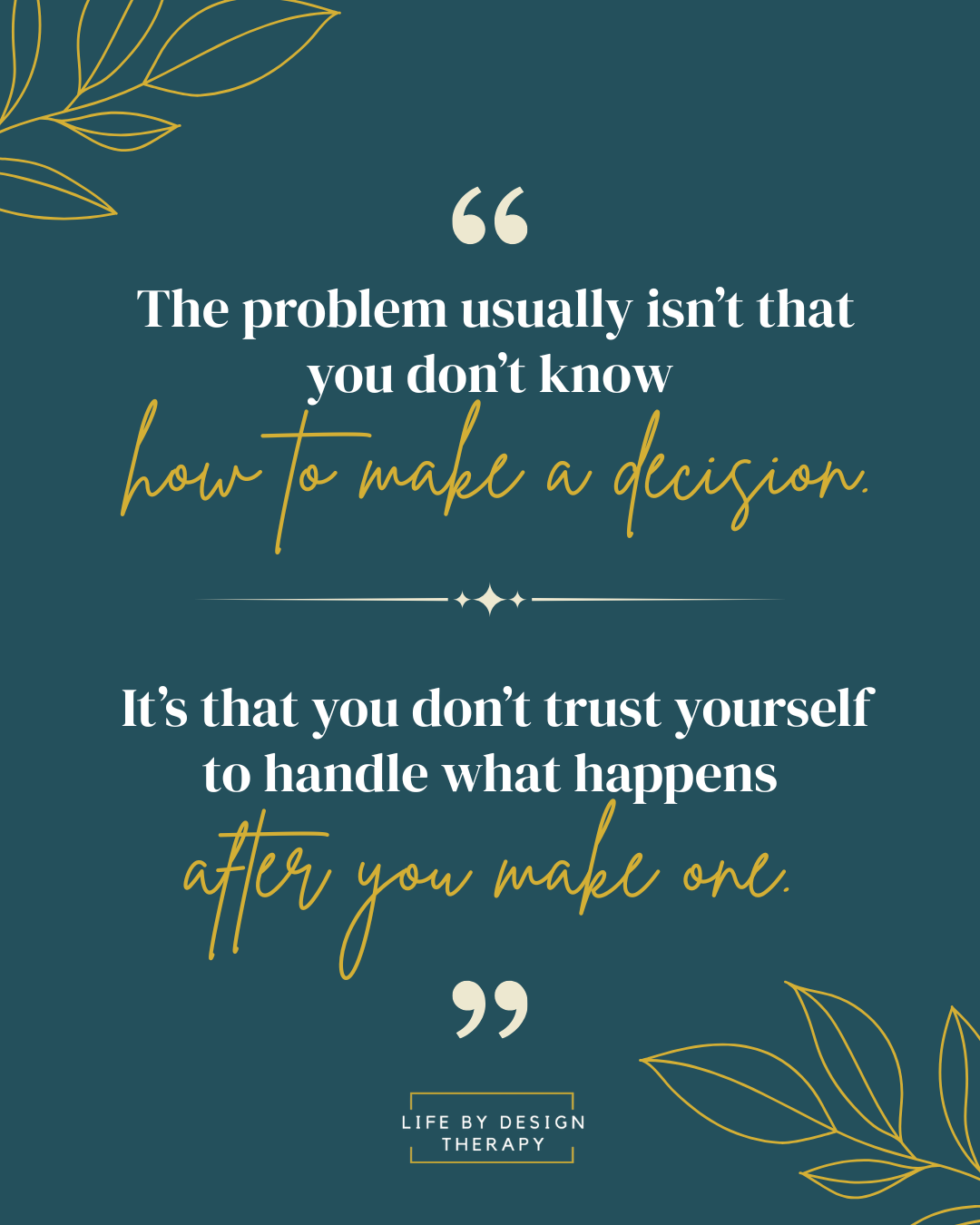
But if that actually worked, you wouldn’t still be here… going back and forth in your head. Because the problem usually isn’t that you don’t know how to make a decision.
It’s that you don’t trust yourself to handle what happens after you make one.
If this resonates with you, you may want to explore the deeper roots of these patterns. In our blog, The Hidden Reasons You Second-Guess Yourself, we take a closer look at how past experiences, nervous system responses, and learned survival strategies can shape self-doubt and make trusting yourself feel difficult. You can read it here: The Hidden Reasons You Second-Guess Yourself.
Why You Keep Second-Guessing Yourself
Remember, these patterns don’t come out of nowhere. It builds over time and often in ways that don’t feel obvious while they’re happening. But before we even talk about how to start trusting yourself again, it helps to understand where this comes from.
For a lot of people, second-guessing yourself is shaped by earlier experiences, like:
Being taught to rely on others over yourself
Having your needs or feelings dismissed or questioned
Being rewarded for being “easy,” “good,” or accommodating
Learning that getting it wrong had consequences
Time and time again, your nervous system adapts as a way to protect yourself, so instead of asking “What do I feel?”, you start asking “What’s the right decision?”
And that shift changes everything.
Because when your focus becomes getting it right instead of trusting yourself, decision-making can start to feel heavy. Even small choices can feel overwhelming, and it makes sense that you would start second-guessing yourself or looking outside of yourself for reassurance.
At some point, choosing stopped feeling simple and started feeling like a risk.
What Happens After a Decision Matters More Than the Decision Itself
You don’t learn to trust yourself by making the “right” decision every time. You learn to trust yourself by listening inward, making the best choice you can with the information you have, and discovering that you can handle what comes next.
In those moments where things don’t go the way you hoped…and your first instinct is to replay it, pick it apart, or tell yourself you should have known better. That’s usually the moment things start to break down. Not necessarily because of the decision itself, but because of how you respond to yourself afterward.
So rebuilding self-trust doesn’t mean getting better at choosing.
It means learning to respond differently when a choice doesn’t go as planned.
It looks like not turning against yourself. Not spiraling into “I messed this up,” not using it as proof that you can’t trust your own judgment, and not using it as proof that you can’t trust your own judgment.
And over time, something starts to shift.
Because your system begins to realize:
“Even if this doesn’t go perfectly… I’m still okay.”
“I’m not on my own in this.”
And that’s where trust actually starts to rebuild. Not when you get it right, but when you realize you can handle it, even if you don’t.
Building Self-Awareness as a Foundation for Self-Trust
Rebuilding self-trust doesn’t usually feel like a big, obvious shift. It’s usually subtle and comes from developing self-awareness.
So, it might look like one of those moments where you catch yourself right before you spiral into second-guessing… and instead of following it, you pause.
Or a moment where you notice what you’re feeling and, for once, you don’t immediately try to figure out the “right” decision, and you just sit with it for a second.
Maybe it’s choosing something small, like what you want or need, and not going back to question it five times after.
None of it feels dramatic, and you might even miss it if you’re not paying attention. But over time, implementing some small shifts can help you begin to change how you move through decisions.
So, if you’re starting to recognize this pattern in yourself, I want you to know that you don’t need to fix it overnight. You just need a place to begin.
If you'd like to explore that a little deeper, we recently wrote a blog called The Journey Within: 10 Ways to Conquer Self-Doubt. In it, we walk through practical ways to build self-awareness, challenge self-doubt, and reconnect with your own inner wisdom. You can read it here: The Journey Within: 10 Ways to Conquer Self-Doubt.
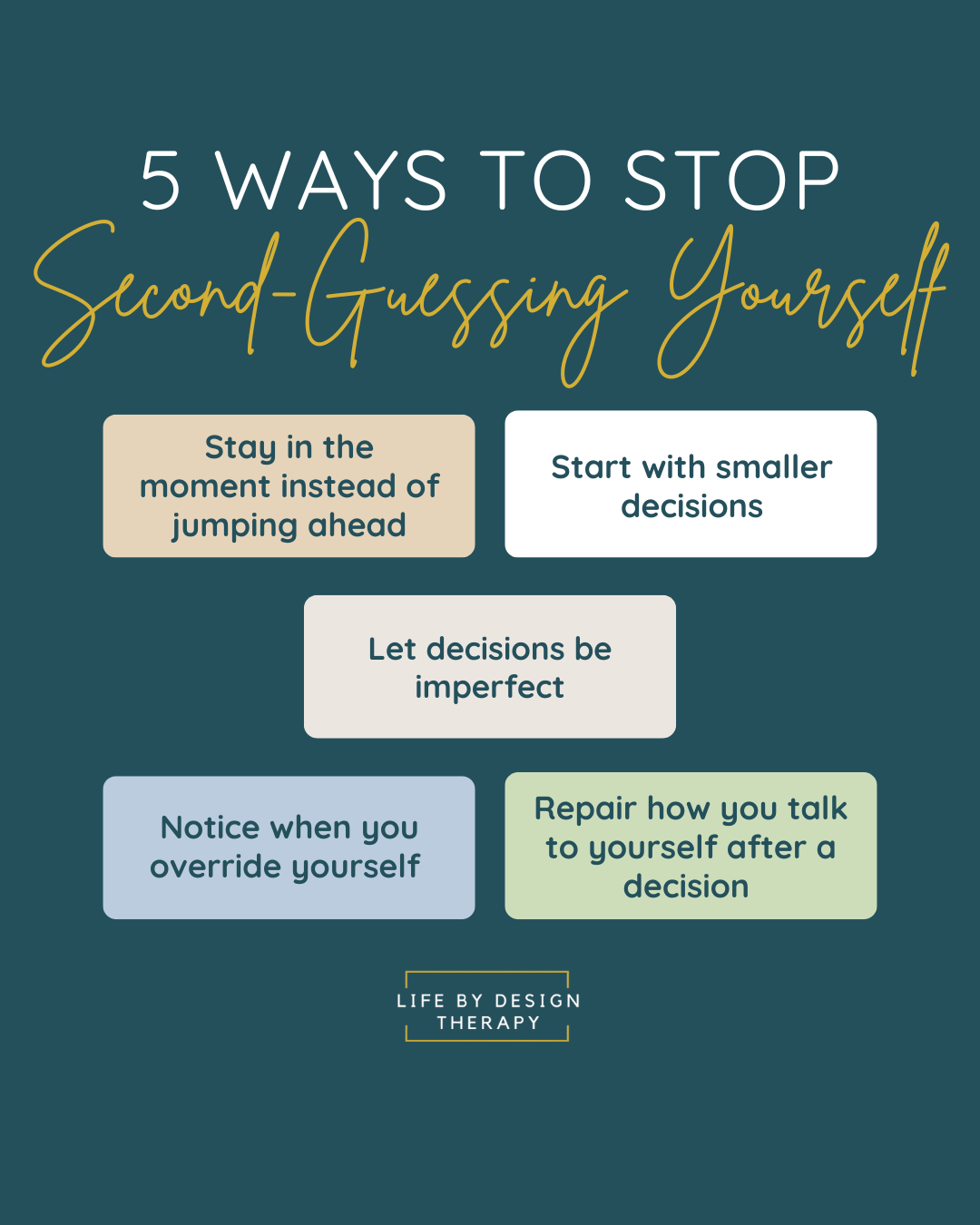
7 Ways to Stop Second-Guessing Yourself and Start Trusting Your Decisions
If you've been struggling to trust yourself or find yourself constantly questioning your choices, here are a few ways to help you begin rebuilding self-trust and easing some of that uncertainty.
1. Start noticing before you try to fix it - Pay attention to when you second-guess yourself, especially around decision-making, because awareness is what helps you start trusting yourself again.
2. Ask what you’re actually afraid of - Instead of asking “What’s the right decision?” ask: “What am I afraid will happen if I choose this?” Is it fear of embarrassment, disappointing someone, or maybe conflict? Naming it can change everything.
3. Stay in the moment instead of jumping ahead - Second-guessing often pulls you into the future, focusing on what could go wrong or what you might miss. Self-trust, however, is built in the present. As you're making decisions, gently notice what's happening in your body, your thoughts, and your emotions.
4. Start with smaller decisions - If trusting yourself feels hard, you don’t have to start big. You can build confidence in your decision-making with low-stakes choices.
5. Let decisions be imperfect - You don’t build self-trust by always getting it right. You build it by learning you can handle it when things don’t go as planned.
6. Notice when you override yourself - Pay attention to the moments you ignore what you feel. That’s where trust starts to break down.
7. Repair how you talk to yourself after a decision - This is the biggest one. If you tend to shame yourself after making a decision, that’s what keeps you stuck. Self-trust is built in how you respond to yourself afterward.
Learning to Trust Yourself Again
At first, it might not feel like much. You might still second-guess yourself when making decisions, and you might still feel unsure. And that's okay!
But as you start integrating these tools into your everyday life, you’ll start to notice shifts like more awareness or a more grounded internal space before responding.
And over time, this becomes your baseline for confidence and decision-making. Maybe not perfect certainty, but enough self-trust to make decisions without constantly questioning yourself, even when things don’t go the way you hoped.
Final Thoughts/Reflections
If you’ve been telling yourself that you’re bad at decision-making or that you can’t trust yourself, it makes sense why you might feel stuck. But that doesn’t mean you truly are stuck
Remember, you don’t learn to trust yourself by making perfect decisions. You build trust with yourself in the moments where things don’t go how you expected… and you don’t tear yourself apart for it afterward.
Sometimes the pattern of second-guessing yourself runs deeper, connected to past experiences, relationships, or a long history of feeling disconnected from your own needs. And in those moments, having support can make a real difference.
At Life By Design Therapy, we help clients rebuild self-trust and feel more confident in decision-making through somatic and holistic therapy by helping you reconnect with your body, your emotions, and your internal sense of safety.
Because trusting yourself isn’t about forcing confidence, it’s about creating enough safety within yourself that you can actually hear your own voice again.
This Week's Affirmations
I can make a decision and handle whatever comes next.
I don’t need to overthink to make a valid choice.
I can respond to myself with care, even when things don’t go as planned.
I don’t need to get every decision right to trust myself.
I am not defined by past decisions I regret.
Additional Resources
If you’re interested in continuing to explore your relationship with self-trust, the resources below can be a helpful place to start.
The Untethered Soul: The Journey Beyond Yourself by Michael A. Singer
Radical Acceptance: Embracing Your Life With the Heart of a Buddha by Tara Brach
Overcome Overthinking and Anxiety in Your Relationship By Robert J Charles
**Some product links are affiliate links, which means we'll receive a commission if you purchase through our link, at no extra cost to you. Please read the full disclosure here.


The Hidden Reasons You Second-Guess Yourself
By Melody Wright, LMFT
Have you ever found yourself second-guessing a decision that, for a moment, felt clear?
Like something in you quietly said, okay… this feels right…but then the doubt crept in.
Your chest tightens.
Your mind starts replaying every possible outcome.
You wonder if you missed something, overlooked a red flag, or made the “wrong” choice entirely.
And suddenly, the certainty you felt just moments ago feels hard to trust.
So you go back. You tweak it, rethink it, or maybe you ask someone else what they think, or you sit with it longer than you meant to.
And if you’re being honest, you’re probably tired of constantly going back and forth with yourself.
Tired of finally making a decision… only to start questioning it immediately. Wondering if you missed something, if you’re making a mistake, or if you can actually trust your own judgment.
That kind of mental back-and-forth can become exhausting after a while.
Because it’s not that you can’t make decisions, it’s that your mind keeps pulling you back into doubt. There always seems to be that quiet pull to double-check, to make sure, and to get it right.
And after a while, it starts to feel like something deeper is going on:
Why is this so hard for me?
Why can’t I just trust myself and move on?
If you’ve been stuck in that loop, it’s worth taking a closer look at what’s actually happening underneath it.
At first glance, what’s happening beneath the surface can be easy to misread. It might look like overthinking, self-doubt, or decision anxiety.
But what’s actually happening underneath usually follows a pattern, and when you begin to notice it, it starts to feel a little more understandable.
So keep reading if you want to know what's actually happening underneath the constant second-guessing… because there’s usually more going on than just “indecisiveness.”
What’s Actually Happening Beneath the Surface of Second-Guessing
When you go to make a decision, your brain isn’t just asking what do I want? It’s also quietly scanning for risk like...
Assessing for the safest option.
Trying to determine what will prevent the most discomfort.
Looking for the choice that leaves the least room for regret.
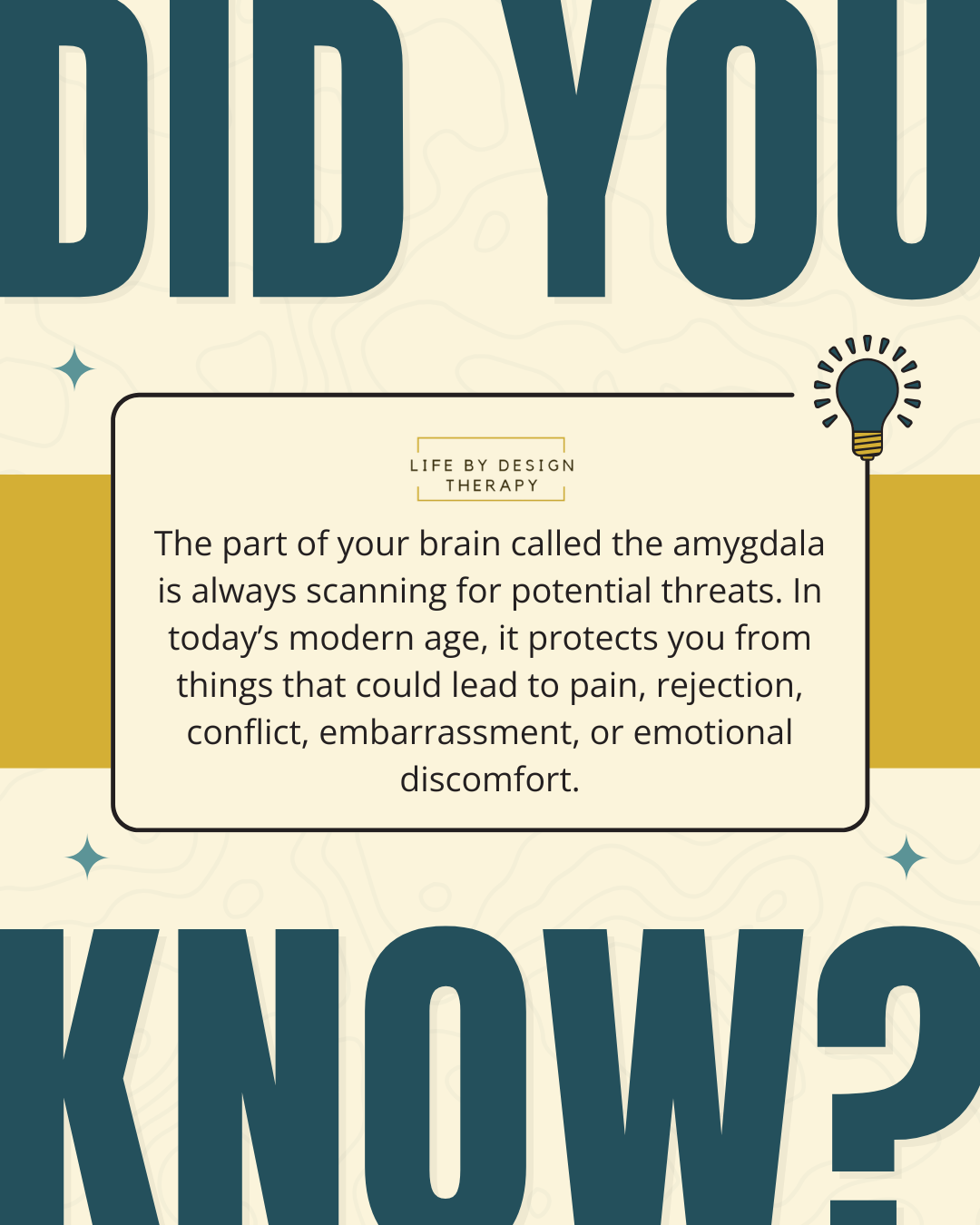
You see, a part of your brain called the amygdala is always scanning for potential threats. In today’s modern age, it protects you from things that could lead to pain, rejection, conflict, embarrassment, or emotional discomfort. And the tricky part is, your brain doesn’t just react to obvious danger. It can also react to subtle things, like tension in someone’s tone, feeling misunderstood, or sensing that someone is upset with you, and your brain starts keeping track of those experiences.
For example, maybe there was a time you trusted yourself, and someone criticized your decision afterward. Maybe you finally spoke up about what you wanted, and it created tension or conflict. Or maybe you made a choice that didn’t go the way you hoped, and you were left feeling embarrassed or blaming yourself afterward.
Your brain remembers that.
So eventually, decision-making can stop feeling like, What do I want? and start feeling more like, How do I avoid getting hurt, disappointing someone, or making the wrong choice?
And that’s usually when the overthinking kicks in.
The replaying.
The double-checking.
The trying to “figure out” the perfect decision before you make it.
Not because you’re incapable of making decisions, but because some part of your system has learned that decisions can carry emotional consequences.
That’s part of why decision-making can feel so exhausting, especially if you already struggle with anxiety, self-doubt, or feeling emotionally on edge a lot of the time.
I want you to know that this is not something you consciously choose, but it’s something your nervous system defaults to because it’s trying to protect you.
So, what starts as protection shapes how you move through your decisions in your day-to-day life.
The Pattern That Keeps Pulling You Back Into Overthinking & Second-Guessing
What started as your nervous system trying to protect you can slowly turn into a pattern of second-guessing yourself in your everyday life.
You make a decision, but instead of feeling settled afterward, your mind keeps circling back to the situation or decision by:
Replaying the conversation.
Re-reading the text.
Wondering if you said the wrong thing
Missing something important
Handling it badly somehow
Other subtle signs of a second-guessing pattern can look like:
Needing reassurance from other people by wanting someone to tell you that you made the “right” choice or responded the “right” way.
Changing your mind at the last minute, even when nothing actually changed except the doubt you started feeling inside.
And without even realizing it, that loop starts reinforcing itself.
What's really interesting about your brain is it’s always learning through repetition, through something called neuroplasticity. So, your brain and nervous system get more efficient at whatever you practice most. So if you repeatedly go back and question yourself after making a decision, your brain starts to learn: This is what we do when uncertainty shows up.
Over time, it can start feeling automatic, like second-guessing yourself is just part of your personality or “how your brain works.”
But usually, it’s not that simple.
Usually, there’s more underneath that pattern than people realize, and some of the reasons you second-guess yourself may not be as obvious as you think.
And truthfully, the loops of overthinking can be challenging to manage without the right tools. If you would like to learn how to support yourself when your mind won’t stay put, check out our blog, 6 Ways to Return to the Present When Your Mind Won't Stay Put.
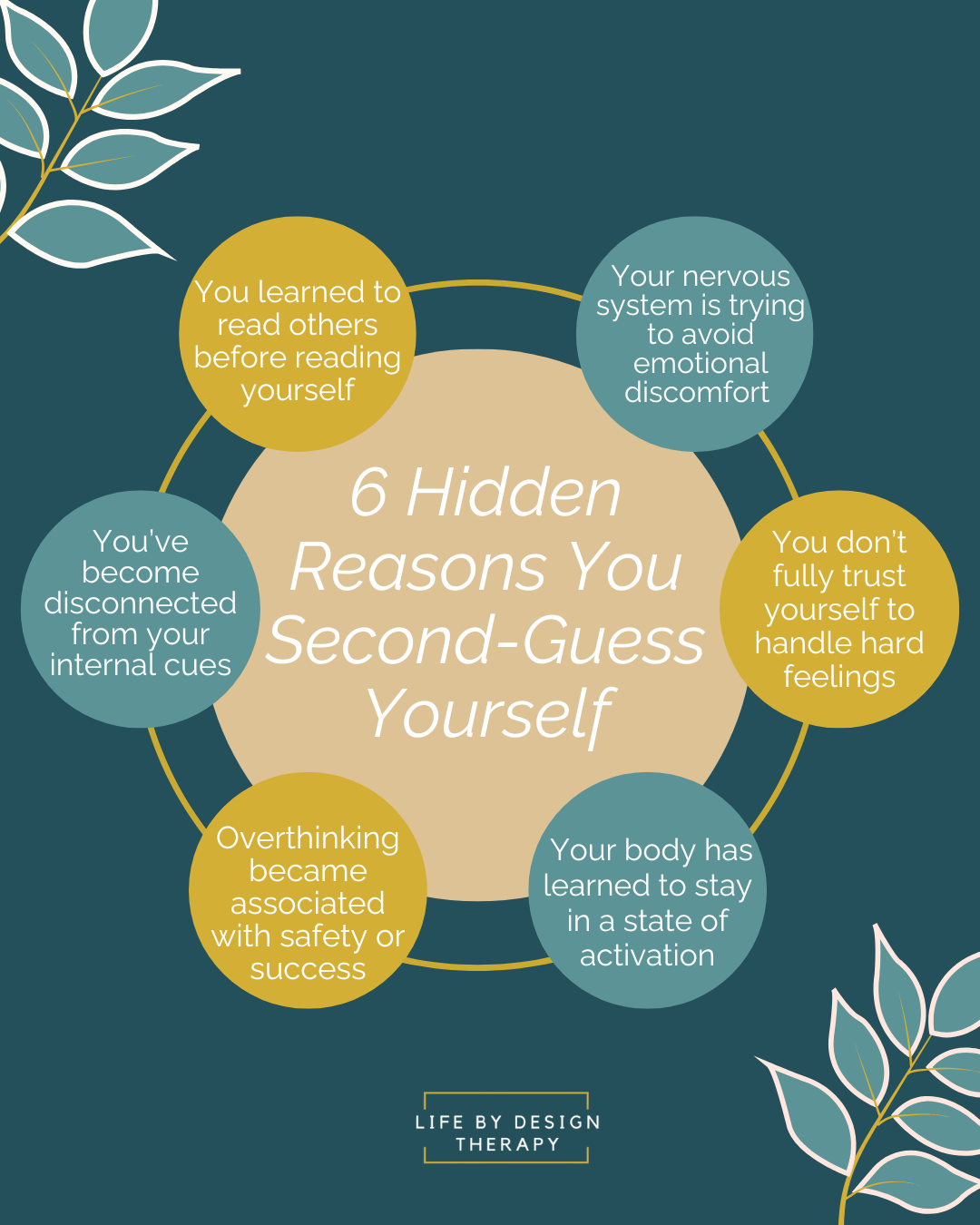
6 Hidden Reasons You Second-Guess Yourself
When you start to look at second-guessing through the lens of your nervous system, past experiences, and learned protective patterns, second-guessing begins to feel less random and more connected to the ways you’ve learned to move through the world.
It’s not just one thing. It’s usually a combination of patterns that have built over time, often in ways that are easy to miss.
Here are a few of the hidden reasons that might be showing up for you:
1. You learned to pay attention to everyone else’s emotional cues before your own internal ones
For some people, second-guessing starts with becoming highly attuned to other people’s emotions, reactions, and needs. This is especially common in anxious attachment, where your nervous system learns early on that connection and emotional safety may depend on staying aware of what other people are feeling.
So instead of feeling grounded in your own preferences, your attention automatically shifts toward managing the emotional environment around you.
You may notice yourself:
Softening your opinions to keep the peace.
Replaying conversations to make sure you didn’t upset someone.
Adjusting decisions based on how you think another person might react.
Feeling responsible for other people’s comfort, disappointment, or emotional responses.
Struggling to tell the difference between what you actually want and what feels safest relationally.
From a somatic perspective, this can become a form of hypervigilance, where your body stays focused on scanning for emotional cues, shifts in tone, or signs of disconnection. Over time, your attention becomes externally focused, which can make it harder to stay connected to your own internal cues, needs, and instincts.
And when your decisions are constantly filtered through other people’s emotional responses first, even simple choices can start to feel emotionally loaded.
2. Your nervous system is trying to avoid emotional discomfort
A lot of the time, the pressure behind second-guessing isn’t actually about the decision itself. It’s about the emotional experience your brain is trying to prevent afterward.
Feelings like:
Regret
Guilt
Embarrassment
Disappointment
Conflict
Feeling misunderstood
Your nervous system naturally wants to move away from experiences that feel emotionally painful or unsafe. So your mind keeps searching for the “right” choice, hoping it can find the one decision that prevents discomfort entirely.
But this is where people often get stuck: They learn to see certainty and avoiding conflict as the safest option.
And when your brain believes certainty is what keeps you emotionally safe, it becomes very hard to stop analyzing, replaying, or trying to predict every possible outcome before making a decision.
3. You don’t fully trust yourself to handle hard feelings
Sometimes the deeper fear underneath second-guessing isn’t actually: “What if I make the wrong choice?”
It’s: “What if I make the wrong choice and I can’t handle what comes next?”
That’s a very different kind of fear.
You see, self-trust is not just about trusting your decisions. It’s also about trusting your ability to navigate disappointment, grief, uncertainty, conflict, or repair if things don’t go as planned.
When that internal trust feels shaky, your nervous system will respond by trying to gain more control before acting. That can look like overanalyzing, freezing, reopening decisions repeatedly, or struggling to fully commit to a choice.
But this is not because you’re incapable, but because some part of you is trying to reduce emotional risk before moving forward.
4. Your body has learned to stay in a state of activation
If your nervous system is used to stress, pressure, overthinking, or constantly preparing for what could go wrong, calm can actually start to feel unfamiliar.
So when you finally make a decision, your body may not fully register it as “safe” to settle.
Instead, your system keeps searching.
You recheck
You rethink
You revisit the conversation
You look for reassurance
You reopen the decision again
From a somatic perspective, this often happens when the body becomes more familiar with activation than regulation. The mind interprets continued checking as productive or protective, but underneath it is a nervous system that has difficulty tolerating stillness, uncertainty, or completion.
So the loop continues, not necessarily because the decision is wrong, but because your body has learned that staying mentally activated feels safer than allowing uncertainty to exist.
5. Overthinking became associated with safety or success
For many people, overthinking started as an adaptive strategy.
Maybe you realized that being highly aware helped you avoid criticism. Maybe you thought that thinking through every possibility helped you stay prepared. Maybe anticipating problems helped you feel more in control growing up.
So your brain learned that overthinking keeps you safe.
And to be fair, sometimes it probably did help you survive certain environments or experiences.
But the nervous system doesn’t always recognize when a protective strategy is no longer helping in the same way. So even when constant analyzing starts creating stress, exhaustion, or disconnection from yourself, your brain may still interpret it as responsible, productive, or necessary.
6. You’ve become disconnected from your internal cues
Self-trust relies heavily on interoception, which is your ability to notice and interpret the internal signals coming from your body.
This feels off
I feel open here
I feel constricted here
This feels grounding
But if you’ve spent years overriding your needs, minimizing your feelings, prioritizing survival, or staying focused on everyone else around you, those internal signals can become harder to access. Instead of trusting how something feels, you keep searching for certainty through overthinking.
That’s part of why second-guessing can feel endless sometimes. Your mind is trying to solve something, and your nervous system is still learning how to feel safe enough to trust.
Grounding is a great way to begin learning how to reconnect with yourself and your internal cues. To learn more about how to do this, check out our blog, Grounding Techniques to Calm Your Nervous System.
Final Thoughts
If you’ve been struggling with overthinking, self-doubt, or difficulty trusting your decisions, I want you to know that these patterns are more common than you might think. It just means your brain and your body have learned ways to protect you, to anticipate, and to try to keep you safe.
And while those patterns may not feel helpful right now, they make sense when you look at where they came from.
Remember, the goal isn’t to force yourself to “just trust yourself” overnight, but rather to start understanding the patterns you’ve been moving through, and gently begin shifting them in a way that actually feels sustainable.
If this is something you’ve been struggling with, you don’t have to figure it out on your own. At Life By Design Therapy™, our Holistic & Somatic Therapists will support you in understanding the patterns behind second-guessing and help you develop more consistent, embodied self-trust over time.
If you’re ready to get started, CLICK HERE to book your free phone consultation.
This Week's Affirmations
I am learning to stay with my decisions, even when it feels uncomfortable.
I can move forward without having all the answers.
My first instinct is worth listening to.
It’s safe for me to let a decision be enough.
I can trust myself to handle whatever comes next.
Additional Resources
If you’re interested in continuing to explore your relationship with self-trust, the resources below can be a helpful place to start.
The Untethered Soul: The Journey Beyond Yourself by Michael A. Singer
Radical Acceptance: Embracing Your Life With the Heart of a Buddha by Tara Brach
Overcome Overthinking and Anxiety in Your Relationship By Robert J Charles
**Some product links are affiliate links, which means we'll receive a commission if you purchase through our link, at no extra cost to you. Please read the full disclosure here.

What Is Body Neutrality (And How Is It Different From Body Positivity)?
By Melody Wright, LMFT
You didn’t wake up this morning planning to think about your body…but somehow, it still happened.
Maybe it was when you got dressed.
Or caught your reflection in the mirror.
Or saw someone online and, without even meaning to, started comparing.
And just like that, your body became something to evaluate again.
For a lot of people, this happens dozens of times a day, so automatically, they don’t even notice it anymore.
But over time, it can start to feel exhausting.
Because the message is everywhere.
An ad suggesting your skin could be smoother.
A post promising the “best shape of your life.”
A subtle before-and-after transformation that makes you wonder if you should be doing more.
It’s not always obvious. Sometimes it’s even framed as “wellness” or “self-improvement.”
But underneath it, there’s often the same message: You’re not quite there yet.
And when you’re surrounded by that every day, it slowly shapes how you relate to your body.
Instead of simply living in your body…you start monitoring it.
You notice how it looks.
You compare it to others.
You wonder what needs to change.
If you’ve ever felt stuck in that cycle, it makes sense given what you’re exposed to on a daily basis.
A lot of people don’t hate their bodies… but they don’t feel at ease in them either. They’re stuck somewhere in the middle between “I don’t like my body” and “I’m supposed to love it.”
And more people feel this than you’d think… they’re just not always talking about it. And it’s where a different approach starts to come into the conversation: Body neutrality.
Body neutrality is one of those phrases that’s been gaining a lot of attention lately… but it’s also often misunderstood.
Body neutrality is the practice of relating to your body without judgment, focusing on what your body does for you rather than how it looks. It removes the pressure to feel positive about your body at all times and instead focuses on what your body does for you and the role it plays in your life, rather than on how it looks.
It’s more like taking a step back from constantly judging it. Letting your body just be there, without needing to analyze or critique it all the time.
So, if you pause for a moment and notice your own internal dialogue, you might realize how often your body has been filtered through one core question:
“How does my body look right now?”
For a lot of us, that question didn’t just come out of nowhere. It was shaped over time through comments, media, comparisons, and subtle messaging that taught us our bodies were something to monitor, improve, or fix.
And that’s exactly where body neutrality begins to help shift things.
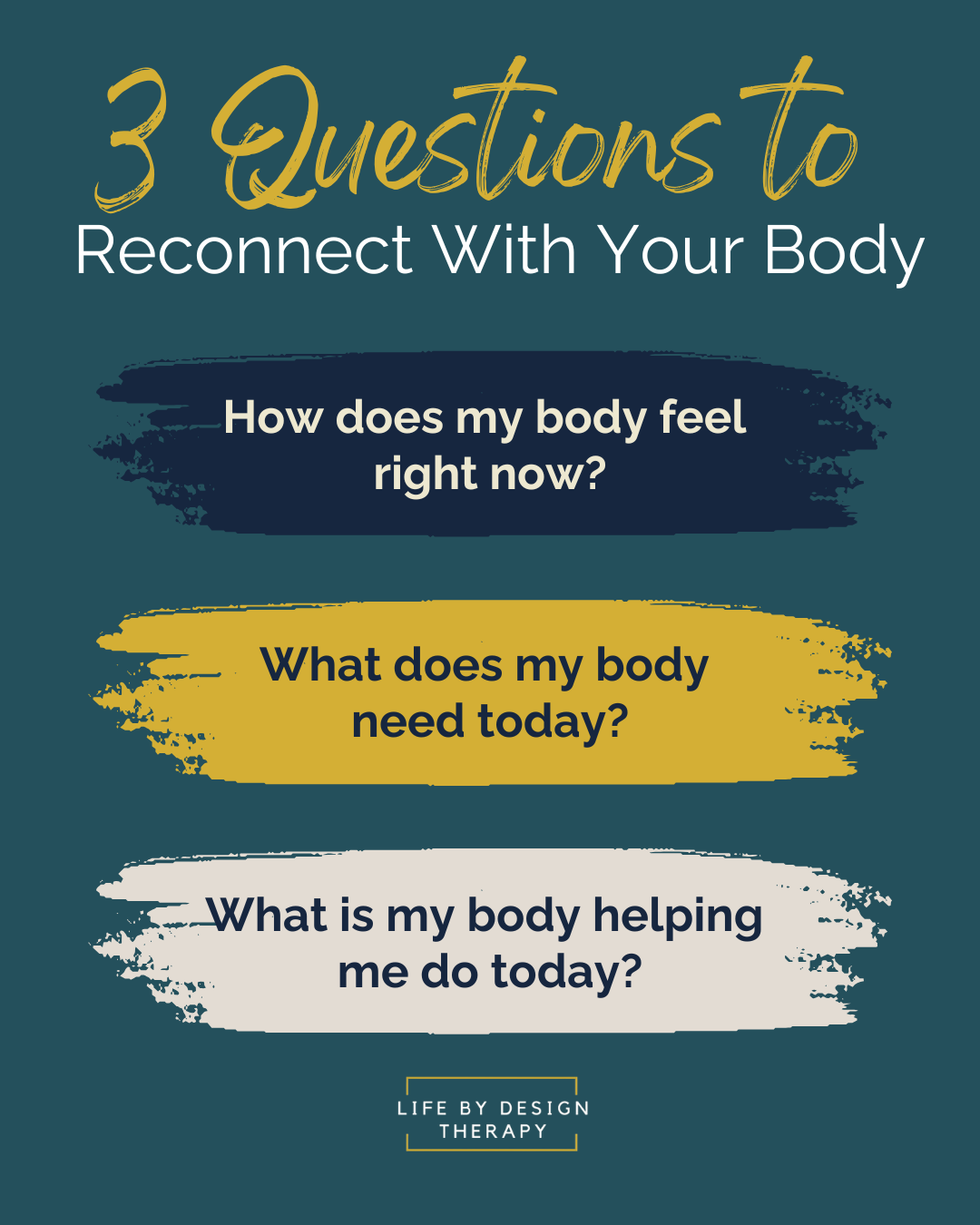
Not by demanding you suddenly love your body…but by gently offering different questions like:
How does my body feel right now?
What does my body need today?
What is my body helping me do today?
It might not seem like a major difference, but it changes the direction of your attention from the outside… back to the inside.
Where Did Body Neutrality Come From?
What’s interesting is that body neutrality didn’t emerge on its own.
It began gaining traction in the early 2010s, largely as a response to the body positivity movement, which, while incredibly important, didn’t always feel accessible for people who were still struggling to feel at home in their bodies.
Body positivity, popularized through fat acceptance activism and voices like Connie Sobczak and Elizabeth Scott, encouraged people to love their bodies as they were. And for many, that message was powerful and needed.
But for others, it felt… out of reach.
If you’ve spent years feeling disconnected from or critical of your body, jumping straight to love can feel overwhelming or maybe even inauthentic. That’s where body neutrality started to take shape as a kind of middle ground.
It wasn’t a rejection of body positivity, but rather an expansion of the conversation. From a Body Neutral perspective, you don’t have to love your body today. You don’t even have to like it.
But what if you could stop fighting it?
Over time, body neutrality has grown into more of a quiet movement—one that’s been shaped by therapists, dietitians, and advocates who focus on reducing body obsession and reconnecting people with their lived experience.
And this is where it naturally overlaps with somatic work.
Because at its core, somatic therapy is also about shifting out of constant observation and into experience.
Instead of analyzing your body from the outside, you begin to notice it from within.
Sensations. Needs. Signals. Capacity.
In that way, body neutrality isn’t just a mindset shift. It’s a different relationship with your body. And if this way of relating feels unfamiliar… that makes sense. Most of us were never taught to experience our bodies this way. We were taught to look at them, compare them, and judge them.
So learning to simply be in your body, without constantly evaluating it, can feel like a completely new language at first. But it’s one that your body already understands.
Why Body Neutrality Can Feel More Realistic Than Body Positivity
The body positivity movement has done a lot of important work.
For many people, it’s been empowering and healing. But for others, it can feel like a really big leap.
Because if your relationship with your body has been shaped by years of criticism, comparison, or pressure…suddenly loving it can feel out of reach.
You might find yourself thinking:
I don’t hate my body… but I don’t exactly love it either.
And sometimes, even that can feel heavier than it should.
This is where body neutrality can feel like a relief.
It removes the pressure to feel a certain way about your body.
You don’t have to love it every day.
You don’t have to feel confident all the time.
You don’t have to force positivity when it’s not there.
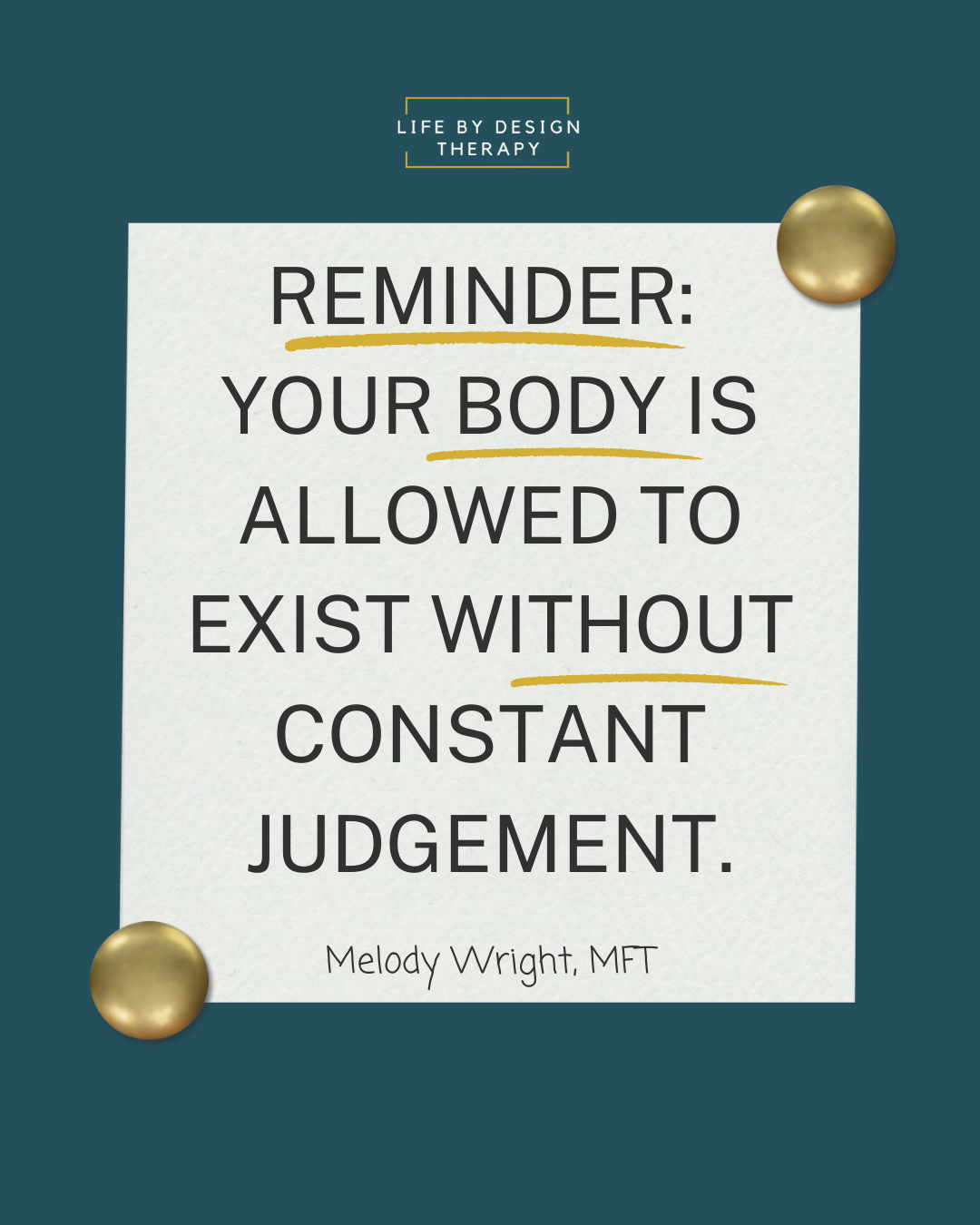
Your body is simply allowed to exist… without constant judgment.
And for many people, that’s where things start to feel a little easier.
How to Practice Body Neutrality in Everyday Life
Body neutrality isn’t about making a drastic shift.
It starts with small, intentional changes. Like noticing when your focus goes to appearance and redirecting it toward what your body is experiencing instead
You might start to notice small changes in how you relate to your body.
You notice how your body feels after a full night of sleep, not because it looks different, but because you have more energy and feel more like yourself.
You start paying attention to how movement affects your energy, even if your appearance hasn’t changed.
You recognize when your body is hungry, thirsty, or overstimulated instead of ignoring it.
You begin to notice how stress shows up physically—tight shoulders, a heavy chest, or a clenched jaw.
Instead of automatically asking, “How do I look?”
You might catch yourself asking, “What’s going on in my body right now?”
At first, this can feel a little unfamiliar, and you might not be used to paying attention in this way. But over time, it can change how you relate to your body. Not because you forced yourself to feel differently about it. But because you stopped focusing on fixing it all the time.
The Real-Life Benefits of Body Neutrality
As you start to build a more stable and supportive relationship with your body, you may begin to notice small shifts.
One of the first changes is often awareness.
You’ll begin noticing what’s going on in your body without immediately judging it or trying to fix it.
You might start to become more aware of when you’re tired, when your body feels tense, when something feels off, or when you feel more settled.
Instead of evaluating how your body looks, you begin paying attention to how it feels and what it needs.
You might start to prioritize your needs in a different way.
You rest when you notice you’re tired.
You eat when your body is actually hungry.
You pay attention to stress earlier, instead of pushing through it.
And over time, that can help you feel more connected to your body again.
Not because everything suddenly feels positive, but because you’re noticing your body more and actually responding to it.
Final Thoughts
If loving your body feels like too big a step right now, that’s okay.
For a lot of people, it is a big step, especially if your relationship with your body has been shaped by years of criticism or pressure.
So instead of trying to jump straight to confidence or self-love, body neutrality offers something more realistic.
It gives you a place to start without having to force how you feel.
You don’t have to convince yourself that you love your body. You don’t have to pretend things feel better than they do.
You just start relating to your body a little differently, with more awareness and a bit more responsiveness to what it actually needs. And over time, that can start to change things in a way that feels more natural. For many people, body image struggles aren’t just about appearance.
They’re connected to deeper experiences like stress, comparison, past criticism, or patterns that have been building over time. And working through that alone can feel overwhelming.
At Life By Design Therapy™, we take a holistic and somatic approach to this work. That means we don’t just explore how you think about your body, we also explore how you experience it.
Together, we help you reconnect with your body in a way that feels safer, more grounded, and more supportive over time. If you’ve been feeling stuck in the cycle of constantly thinking about your body, you don’t have to navigate that alone.
You can learn more or schedule a consultation HERE.
This Week's Affirmations
I can focus on how my body feels instead of how it looks.
I am learning to listen to my body and respond to what it needs.
I don’t have to fix my body to take care of it
My body is allowed to exist without being judged or evaluated.
My needs are valid, and I’m allowed to prioritize them.
Additional Resources
**If you're interested in continuing to explore your relationship with your body, the books below can be a helpful place to start.
Intuitive Eating by RDN Evelyn Tribole, MS and RDN Elyse Resch, MS
Self-Compassion: The Proven Power of Being Kind to Yourself by Kristin Neff
Body Kindness: Transform Your Health from the Inside Out by Rebecca Scritchfield
The Body Keeps the Score: Brain, Mind, and Body in the Healing of Trauma by Bessel van der Kolk M.D
**Some product links are affiliate links, which means we'll receive a commission if you purchase through our link, at no extra cost to you. Please read the full disclosure here.

5 Steps to Regain a Sense of Control in Unpredictable Times
By Melody Wright, LMFT

If you’re anything like me, you know what it feels like to wake up and immediately feel the weight of the world pressing down.
The uncertainty, the unpredictability…it can make even the simplest decisions feel overwhelming.
So many of us are carrying an undercurrent of fear and vulnerability, whether it’s about personal rights, financial stability, or the overall state of the world.
And while these feelings are valid, there are ways to work through them so they don't overwhelm us.
Understanding why fear and vulnerability show up the way they do can be empowering.
Fear is our nervous system’s way of keeping us safe.
When we sense a threat, whether real or perceived, our bodies react instinctively.
But when we’re constantly exposed to stressors, especially in a chaotic political climate, our system can stay stuck in fight, flight, or freeze mode.
This chronic activation can lead to exhaustion, burnout, and even physical symptoms like headaches or digestive issues.
So, how do we navigate this?
How do we move forward without becoming overwhelmed?
The key is grounding ourselves in both emotional resilience and practical action.
Here are a few strategies to help you regain a sense of stability.
Step 1: Regulate Your Nervous System
Before tackling external stressors, it’s essential to bring your body back to a place of balance.
Try these:
Release Through Breath and Movement: Imagine yourself clenching your uncomfortable emotions or memories in your fists as you inhale. As you exhale, release your fists and imagine yourself letting go of those emotions or memories. Repeat as many times as you need.
Grounding Through Touch: Keep a grounding stone or crystal in your pocket, purse, or backpack. Run your fingers over it when you are feeling ungrounded. Notice the texture—the smoothness, the rough edges, the temperature of the stone. Focus on how it feels in your hand, using it as an anchor to bring you back to the present moment. This simple practice can serve as a tangible reminder of stability in moments of stress.
Temperature Tools for Grounding and Regulation: Using temperature shifts can be a powerful way to support nervous system regulation. Cool or warm sensations can help signal your body to slow down and find a sense of calm. You might try splashing cool water on your face, running cool water over your wrists, or holding an ice cube in your hand. You can also lean into warmth, like taking a short, relaxing bath, enjoying a warm cup of tea or coffee, or soaking your feet in warm water. Experiment with different temperatures and methods to discover what feels most grounding and supportive for you.
Step 2: Set Boundaries with News & Social Media
While staying informed is important, constant exposure to distressing news can heighten anxiety and leave you feeling powerless. The key is to find a balance that keeps you aware without overwhelming your nervous system. Consider:
Setting Clear News Consumption Boundaries: Designate specific times for checking news updates instead of consuming them throughout the day. Limiting exposure can help reduce stress and allow you to stay present.
Filtering and Choosing Your Information Sources Wisely: Follow journalists and media outlets that focus on constructive or solutions-based reporting. This can help to shift your perspective from feelings of helplessness to awareness and action.
Taking Intentional Social Media Breaks: When content becomes overwhelming, step away. Engage in offline activities like reading, journaling, or spending time in nature to restore a sense of calm.
Engaging Mindfully with Information: Instead of passively absorbing negative news, ask yourself, "Is there an action I can take based on this information?" If not, give yourself permission to disengage.

Step 3: Anchor Yourself in Community
Fear thrives in isolation, making challenges feel even more overwhelming.
However, connection reminds us that we are not alone and that collective support can be a source of strength and resilience.
Surrounding yourself with a community, whether big or small, can create a buffer against fear and uncertainty.
Here are a few ways to build community:
Seek Out Supportive Groups: Join local or online support groups related to issues that matter to you. Sharing experiences with like-minded individuals can offer validation and new perspectives.
Engage in Meaningful Community Events: Attend events that foster real conversations, collective problem-solving, and mutual encouragement. Participating in activities like town halls, book clubs, or advocacy groups can help you feel more engaged and empowered.
Find Safe Processing Spaces: Whether it’s a therapist, a close friend, or a grassroots organization, having a place to process your emotions is crucial. Speaking your fears aloud to a trusted person can lessen their hold and help you feel more supported.
Be the Support You Seek: Sometimes, offering support to others, whether through active listening, small acts of kindness, or simply being present, can create a reciprocal sense of connection and purpose.
Step 4: Take Action In A Way That Empowers You
Fear often stems from feeling powerless, and when we feel like we have no control over our circumstances, it can be paralyzing. However, even small actions can create a ripple effect, reinforcing a sense of agency and purpose.
Advocate for What Aligns With Your Values: Whether through volunteering, donating, or community organizing, channeling your energy into meaningful causes can be empowering. Even spreading awareness within your network can contribute to change.
Educate Yourself and Stay Informed: Understanding policies and upcoming elections helps you make informed decisions. Knowledge is power, and staying engaged with reliable sources enables you to take action that aligns with your values.
Make a Difference in Your Immediate Community: Large-scale change can feel daunting, but focusing on your immediate community makes a tangible impact. Supporting local businesses, assisting neighbors, helping at food banks, or attending town halls fosters a sense of connection and purpose.
Use Your Voice: Whether through signing petitions, writing to representatives, or speaking up in discussions, expressing your beliefs can contribute to larger societal shifts. Even small contributions to dialogue can create momentum toward change.
Create Change in Everyday Interactions: Acts of kindness, listening with empathy, and uplifting others in your daily life may seem minor, but they contribute to a collective sense of hope and resilience.
Taking action reminds us that we are not powerless.
Even the smallest steps can build momentum toward meaningful change and provide a sense of control amidst uncertainty.
Step 5: Reclaim Your Sense of Safety
For those feeling particularly vulnerable, whether due to personal rights, finances, or social unrest, taking proactive steps can provide security and a greater sense of stability in uncertain times.
Build Financial Resilience: If financial instability is a concern, start by creating a budget that prioritizes essentials. Even setting aside small amounts for an emergency fund can create a buffer against unexpected expenses and reduce financial stress over time. Look into local resources, grants, or assistance programs that may provide support.
Know Your Rights and Protections: If personal rights feel threatened, take the time to research legal protections that apply to your situation. Understanding your rights at work, in your community, or in legal matters can help you feel more empowered. Keep a list of resources, such as legal aid organizations or advocacy groups, that you can turn to if needed.
Create a Personalized Safety and Support Plan: Identify people you trust who can offer emotional and practical support in times of need. Whether it’s a friend, therapist, or community group, knowing who you can reach out to can make a significant difference. Also, developing self-care practices that help you feel secure, whether that means establishing daily routines, having a safe place to retreat to, or setting up contingency plans for unexpected situations.
Taking these steps won’t eliminate all uncertainty, but they can provide a greater sense of control and reassurance as you navigate challenging times.
Final Thoughts
I want to remind you that you are not alone in these feelings, and you are not without power.
While uncertainty can feel overwhelming, small, intentional steps can help you regain a sense of control and resilience.
By grounding yourself, setting boundaries, connecting with others, and taking purposeful action, you can cultivate a sense of stability even in challenging times.
Fear and vulnerability might still come up, but they don’t have to dictate your life.
You are capable of navigating this at your own pace, with the support and tools that feel right for you.
If you need guidance in processing these emotions or creating a plan for uncertainty, Life By Design Therapy™ is here to help.
Our therapists provide a compassionate space to explore your fears and develop strategies that foster emotional strength and security. CLICK HERE to book your free no-obligation phone consultation.
This Weeks Affirmations
I choose to focus on what I can control and release what I cannot.
I give myself permission to set boundaries that protect my well-being.
I trust myself to navigate challenges with courage and self-compassion.
Fear does not control me. I am grounded, present, and resilient.
I allow myself to feel my emotions without being consumed by them.
Additional Resources
**If you’re interested in learning more about navigating fear, vulnerability & anxiety around world issues check out these books below:
It's Time to Talk (and Listen) by Anatasia S. Kim and Alicia del Prado
The Body Keeps the Score: Brain, Mind, and Body in the Healing of Trauma by Bessel van der Kolk M.D
Radical Uncertainty: Decision-Making Beyond the Numbers by John Kay & Mervyn King
The Righteous Mind: Why Good People Are Divided by Politics and Religion by Jonathan Haidt
The Art of Uncertainty: How to Live in the Mystery of Life and Love It by Dennis Merritt Jones
Uncertainty: Turning Fear and Doubt into Fuel for Brilliance by Jonathan Fields
**Some product links are affiliate links, which means we'll receive a commission if you purchase through our link, at no extra cost to you. Please read the full disclosure here.

9 Strategies to Thrive in Uncertain Times
By Melody Wright, LMFT

With the state of the world, so many of us are experiencing a common issue…uncertainty.
Uncertainty can feel overwhelming.
We’ve all been there.
Standing at the edge of the unknown.
Wondering what to do, or what the next step should be.
Whether it’s about your job, your health, finances, economic strain, the upcoming election, or life simply not going according to plan. It’s no secret that facing uncertainty can stir up anxiety and leave you feeling powerless.
However, I want you to remember that you’re not alone in this.
There’s a part of our humanity that craves a sense of control.
In fact, we are wired for safety and predictability.
However, while you can’t predict the future, there are ways to handle uncertainty that can help bring peace and balance into your life.
You don’t have to have all the answers right now, but with the right strategies, you can navigate the unknown with a little more confidence—and hopefully a lot less stress.
Let’s dive into some practical ways to help you stay grounded, even when things feel unsteady.
9 Ways to Stay Grounded in Uncertainty
Acknowledge Your Feelings
Take a moment to think about how you’re feeling right now.
A good step to dealing with uncertainty is to acknowledge how you’re feeling.
Whether it’s fear, worry, or frustration, try not to push these emotions away. Embracing the discomfort allows you to better understand and manage the situation, rather than being controlled by it.
Actionable Step: Consider journaling, talking to a trusted friend, or simply sitting with your thoughts to help you process these feelings.
Focus on What You Can Control
Uncertainty often amplifies the sense of helplessness.
Instead of dwelling on what’s unknown or outside your control, redirect your focus to things you can manage.
This might include your daily routine, how you spend your time, or how you care for your mental and physical health.
Actionable Step: Small actions, like getting enough sleep, exercising, or scheduling a time to relax, can provide a sense of control in the chaos.
If you would like to learn more about the benefits of self-care, check out our blog Reclaim YOU: 8 Ways to Prioritize Your Well-Being.
Ask Yourself: What are some things that are in your control right now? What are some things you can let go of?
Practice Mindfulness
Mindfulness teaches us to stay grounded in the present moment, which can be a powerful tool when faced with uncertainty.
Instead of ruminating on worst-case scenarios or future anxieties, consider the present moment. Mindfulness encourages us to focus on what’s happening right now.
Techniques such as deep breathing, guided meditation, or simply taking a few minutes to observe your surroundings can help calm the mind and reduce stress.
Actionable Step: If you are struggling with anxiety building up, take a moment and find 5 things you can see, 4 things you can touch, 3 things you can hear, 2 things you can smell, and 1 thing you can taste. Practicing this mindfulness activity supports being present in the moment and engaging not only with your environment but also with your body.
If you would like additional mindfulness & grounding techniques, check out our free eBook, The Mind-Body Toolkit!
Embrace Adaptability
In times of uncertainty, it’s natural to feel a strong desire for control and predictability.
However, embracing adaptability can transform your experience.
Consider allowing yourself the grace to explore different outcomes and be open to adjusting your expectations as situations evolve.
For example, instead of viewing uncertainty as a source of fear, try seeing it as a canvas for new possibilities.
By permitting yourself to adapt, you can discover strengths you may not have known you had and find creative solutions to the challenges ahead.
Remember, it’s okay to take your time in this process—flexibility is a skill that develops over time.
Nurture Your Mind
With the constant updates and information thrown our way every day, it’s easy to feel overwhelmed by the noise.
While staying informed is important, it’s equally important to nurture your mental well-being.
Actionable Steps: Consider setting boundaries around how much information you consume each day. Take breaks from the news and social media to create space for things that bring balance and peace to your life.
Actionable Step: This might look like reading a comforting book, enjoying nature, or engaging in a hobby you love. Remember, it’s perfectly okay to step back and prioritize your mental health; you deserve moments of calm.
Cultivate Gratitude
Gratitude is a powerful antidote to anxiety.
When you regularly reflect on what you’re thankful for, your mindset shifts from lack to what’s abundant in your life.
This doesn’t mean ignoring real challenges but rather balancing them with the positives.
You might find it helpful to keep a gratitude journal or take a few moments each day to think of something you appreciate that can cultivate a more hopeful outlook.
Actionable Step: Consider starting your day off with your gratitude moment. It can shift your entire day toward peace and balance.
Focus on Growth, Not Perfection
So many of us struggle with uncertainty because we feel pressure to get everything right or have a clear path forward.
Take a moment to consider where this pressure might come from.
Are you carrying the pressure of someone else's expectations or are you connecting with what is best for you?
Remember that perfection is an illusion.
Everyone has their own idea of what "perfect" looks like, which makes it impossible to meet everyone's standards.
It’s important to release the need for perfection and instead focus on progress. Focusing on the progress will help you stay present and provide a sense of accomplishment.
Have a Plan, And Stay Open
It’s perfectly natural to set goals and make plans, even when life feels uncertain.
Having a sense of direction can provide comfort and purpose, helping to alleviate feelings of uncertainty.
However, it’s important to approach your plans with a sense of openness and curiosity.
By allowing yourself the flexibility to adapt when circumstances shift, you’ll be able to adjust your goals with ease as you navigate new experiences.
Stay Connected to Your Values
When everything feels uncertain, grounding yourself in your core values can offer a profound sense of purpose and stability.
Actionable Step: Take a moment to reflect on what truly matters to you.
Consider family, kindness, creativity, or integrity as examples.
By staying connected to your values and priorities, you can navigate decisions with clarity and confidence.

Final Thoughts
Dealing with uncertainty is never easy, but with the right tools, you can face it with more resilience and grace.
Acknowledging your feelings, staying connected to your values, focusing on what you can control, and embracing adaptability in your thinking all support stress management, anxiety, and the overwhelm of uncertainty.
Take a moment to reflect on how you manage uncertainty in your life.
Consider some of the strategies discussed here and incorporate them into your daily routine.
This Weeks Affirmations
Uncertainty is part of life, and I trust in my ability to move forward.
I trust myself to handle whatever challenges come my way.
I am resilient, adaptable, and capable of navigating the unknown.
I welcome flexibility and trust that everything will unfold as it should.
I allow myself to be present in this moment, free from fear of the future.
Additional Resources
**If you’re interested in learning more about overcoming uncertainty check out these books below:
Radical Uncertainty: Decision-Making Beyond the Numbers by John Kay & Mervyn King
The Power of Now: A Guide to Spiritual Enlightenment by Eckhart Tolle
The Art of Uncertainty: How to Live in the Mystery of Life and Love It by Dennis Merritt Jones
Grit: The Power of Passion and Perseverance by Angela Duckworth
Uncertainty: Turning Fear and Doubt into Fuel for Brilliance by Jonathan Fields
The Obstacle Is the Way: The Timeless Art of Turning Trials into Triumph by Ryan Holiday
My Age of Anxiety: Fear, Hope, Dread, and the Search for Peace of Mind by Scott Stossel
**Some product links are affiliate links, which means we'll receive a commission if you purchase through our link, at no extra cost to you. Please read the full disclosure here.

The Journey Within: 10 Ways to Conquer Self-Doubt
By Melody Wright, LMFT

Do you ever find yourself wrestling with doubts about your abilities, worth, or place in the world? If you answered “yes”, we want you to know that you're not alone. Self-doubt is a common experience that can plague even the most confident people. It has the ability to cast shadows of uncertainty on our thoughts and actions. Yet, you have the potential for profound transformation—a journey from self-doubt to self-love.
In this blog post, we'll explore some actionable steps to replace self-doubt with confidence and self-love. Whether you're grappling with fleeting moments of insecurity or facing persistent doubts that overshadow your life, this blog will support the path toward greater self-compassion, resilience, and inner peace.
From Doubt To Empowerment
This journey from having negative thoughts or self-doubt to embracing an empowered mindset is something that requires commitment to self-awareness, self-compassion, and mindful actions geared toward cultivating a positive self-image. It’s not about erasing all doubts overnight but rather about developing inner resilience and self-acceptance to navigate through them with grace when they arise. Here are some essential steps to guide you through this transformation process.
Acknowledge Your Self-Doubt: The first step in transforming self-doubt is to become aware of it and acknowledge it. This self-awareness will support you in recognizing when self-doubt comes through and how it manifests in your thoughts and behaviors.
Practice Self-Compassion: Treat yourself with kindness and understanding, just as you would treat a close friend. Hold a non-judgmental space and allow self-compassion to come through. This allows you to be gentle with yourself when facing difficult situations or perceived failures. Instead of harsh self-criticism, offer yourself words of encouragement and support.
Challenge Negative Thoughts: Pay attention to your inner dialogue and challenge negative self-talk. When you notice yourself doubting your abilities or worth, counter those thoughts with positive affirmations and realistic perspectives. Remind yourself of your strengths, accomplishments, and past successes. You can say things such as, “It’s ok, I can handle it better next time”, or “I can”.
Set Realistic Goals: Break down your goals into smaller, achievable steps. Setting realistic goals helps prevent feelings of overwhelm and inadequacy. Celebrate each milestone you reach, no matter how small, because every step contributes to your growth and progress.
Stop the Comparison: Instead of comparing yourself to others, focus on your personal growth and development. Remember that everyone is at a different stage in life, everyone was raised differently, carries different perspectives, and has different obstacles in their life. Embrace your journey of continuous improvement, knowing that progress takes time and effort. Cultivate a growth mindset that views challenges as opportunities for learning and self-discovery.
Practice Gratitude: Keep gratitude at the forefront of your mind by acknowledging the positive aspects of your life. Reflect on the things you appreciate about yourself and your experiences. Gratitude helps shift your perspective from what you lack to what you already have, which will help foster self-love and contentment.
Engage in Self-Care: Prioritize self-care activities that nurture your physical, emotional, and mental well-being. This could include exercise, healthy eating, relaxation techniques, hobbies, spending time with loved ones, or seeking professional support when needed. Taking care of yourself demonstrates self-love and reinforces your worthiness of care and attention. This step will also help you discover things that make YOU happy rather than following the outside influences telling you what will make you happy.
Surround Yourself with Supportive People: Surround yourself with supportive friends, family members, or mentors who uplift and encourage you. Seek out positive influences that affirm your worth and capabilities. Having this strong support system can boost your confidence and help you navigate through moments of doubt.
Practice Mindfulness and Meditation: Cultivate mindfulness through practices such as meditation, deep breathing, or mindfulness exercises. Mindfulness helps you observe your thoughts and emotions without judgment, allowing you to develop greater self-awareness and acceptance. Over time, mindfulness can reduce the intensity of self-doubt and foster a greater sense of inner peace and acceptance.
Seek Professional Help if Needed: If self-doubt significantly impacts your daily life or mental health, consider seeking support from a therapist or counselor. Therapy can help you get to the root of where your negative self-talk might come from and provide you with tools and strategies to address the underlying issues, build self-esteem, and cultivate self-love in a safe and supportive environment. You might find that narrative therapy, holistic therapy, and somatic therapy can be especially supportive for boosting self-esteem.

Final Thoughts
We want you to remember that transforming self-doubt and negative self-talk into self-love is a gradual process that requires patience, persistence, and self-compassion. Be gentle with yourself as you walk out this journey of self-discovery and growth. If you find that you are interested in therapy to support this journey, consider meeting with one of our skilled clinicians here at Life By Design Therapy. Our therapists specialize in Holistic and Somatic Therapy and they are ready to customize your care within a secure environment. Click HERE to schedule a free consultation today.

Affirmations for Self-Doubt
"I am capable of overcoming any challenges that come my way."
"I trust in my ability to make sound decisions."
"I am deserving of success and happiness."
"I recognize my strengths and value my unique qualities."
"I choose to believe in myself, even when faced with uncertainty."
Additional Resources
**If you’re interested in expanding your knowledge on growing your confidence, check out these books below:
"Self-Compassion: The Proven Power of Being Kind to Yourself" by Kristin Neff
"Radical Acceptance: Embracing Your Life With the Heart of a Buddha" by Tara Brach
“The Untethered Soul: The Journey Beyond Yourself" by Michael A. Singer
"Emotional Intelligence: Why It Can Matter More Than IQ" by Daniel Goleman
"Big Magic: Creative Living Beyond Fear" by Elizabeth Gilbert
"The Power of Now: A Guide to Spiritual Enlightenment" by Eckhart Tolle
**Some product links are affiliate links, which means we'll receive a commission if you purchase through our link, at no extra cost to you. Please read full disclosure here.

Mindful Limits: The Connection Between Boundaries and Self-Compassion
By Melody Wright, LMFT

In the hustle culture of life, where demands seem endless and the pace is relentless, the concept of boundaries is becoming more and more prevalent. When many of us hear the word boundaries we probably consider them as a strategy for creating physical space, yet they go beyond just that. Have you ever considered that boundaries are a way to show yourself compassion or that utilizing boundaries is a form of self-care?
Not only do boundaries have the ability to create physical space, but they also create mental and emotional space as well. Boundaries can also be utilized when cultivating a secure relationship with yourself. In this blog, we will explore the ways to mindfully incorporate boundaries into every aspect of your life.
Understanding Boundaries Through a Mindful Lens
Cultivating mindfulness establishes an awareness that will support you in every aspect of your life. Mindfulness is the practice of being fully present and aware of the current moment. We call it a practice because, with every new adventure or obstacle in life, you will find that in new seasons you might need to shift the way you approach things. When living mindfully you will find that creating limits, such as boundaries, involves a conscious and deliberate approach. And to be honest, it’s not always easy. You will begin to learn your limits, where to place the boundaries, or where to let things slide, however, It’s all about finding balance within yourself.
SELF-DISCOVERY Through Mindful Boundaries
Mindfulness encourages self-awareness, which enables you to recognize your needs, desires, and limits. When you take the time to reflect on personal values, preferences, and places of comfort, you’re able to start creating boundaries that reflect your authentic self. This process of self-discovery is actually an act of self-compassion. By acknowledging your unique qualities you start to value them enough to protect and nurture them which in turn is acknowledging how valuable you are.
Compassion in Saying “NO”
Setting boundaries often involves saying 'no' to certain demands, commitments, or situations, which can be challenging for many people. When you evaluate the situation and determine that it doesn’t align with your needs or find that you don’t have the mental, emotional, or physical capacity to fulfill the demand, this 'no' becomes an act of self-compassion rather than a rejection. By mindfully saying 'no', you communicate that your well-being is a priority, cultivating a sense of self-respect and self-love.
Balancing Empathy and Boundaries
Empathy is a cornerstone of compassion, both towards others and oneself. Cultivating mindful boundaries creates a balance between empathy and self-preservation, showing that you can be compassionate without sacrificing your personal well-being. For those naturally inclined towards empathy, tend to absorb the emotions and needs of others to the detriment of one's own mental and emotional health. Cultivating these mindful boundaries allows you to empathize with others without becoming overwhelmed. Creating this awareness allows you to know when to engage and when to create a gentle barrier to safeguard your emotional equilibrium.
Self-Compassion in Conflict
When on your on your self-discovery journey you might find that boundaries often come into play during conflicts or challenging conversations. Navigating these situations mindfully involves approaching conflicts with compassion. Instead of viewing boundaries as walls, consider them as bridges that enable open communication while still preserving personal well-being. When you practice mindfulness in conflict, you can foster understanding and compassion for yourself and the other person or persons involved.

Recognizing Burnout Signals
As you journey through the practice of mindfulness, you’ll begin to become more attuned to the present moment and move through it without judgment or distraction. When this happens you’ll become more aware of the things that trigger any overwhelm or burnout in its early stages. This will allow you to become more proactive in placing those boundaries to prevent the stress from taking over and allow you the opportunity for rest and rejuvenation.
Practical Tips for Mindful Boundary Setting
1. Self-Reflection: Regularly check in with yourself to assess your emotional and mental state. What are your current needs and limits?
2. Communicate with Clarity: When setting boundaries, communicate with clarity and honesty. Articulate your needs and limits in a way that cultivates understanding. However, we want you to know that it’s ok if others don’t understand. What matters is that you and your well-being feel secure.
3. Practice Saying 'No': Saying 'No' is an essential aspect of setting boundaries. Although this can be challenging for many people practice doing so with kindness and assertiveness.
4. Reevaluate and Adjust: Life is dynamic, and so are your boundaries. It’s okay to check in with yourself, reassess your limits, and adjust them as needed.

Final Thoughts
Through the practice of mindfulness, you can discover, communicate, and uphold boundaries that not only protect your well-being but also nurture a compassionate relationship with yourself and others. By recognizing the interplay between empathy, present-moment awareness, and the setting of boundaries, you can create a more balanced and fulfilling life.
We understand that communication, self-discovery, and establishing boundaries can be complex and even challenging. If you are finding that you need support in these areas, consider working with a therapist. Life By Design Therapy has a team of therapists who are committed to seeing you heal, grow, and thrive in life. If you are interested in working with one of our therapists, CLICK HERE to schedule a free consultation today!
Affirmations for Creating Mindful Boundaries
My boundaries are a reflection of my self-respect and commitment to well-being.
I trust my instincts to guide me in establishing healthy and mindful limits.
I am worthy of the peace and harmony that mindful boundaries bring to my life.
My boundaries are flexible and adaptive, allowing me to grow while maintaining balance.
I release guilt when saying 'no,' knowing that it is an expression of self-love.
Additional Resources

Empower Your Inner Self: 10 Steps to Elevate Your Self-Esteem
by Melody Wright, LMFT

In a world with social media highlight reels and what seem to be perfectly curated personas, it’s not always easy to feel the freedom to be yourself. Living in the age of influencers and filtered realities, we can find our authentic selves becoming lost in the noise. Yet, authenticity is where your true power lies, it’s the source of genuine self-esteem and confidence. The rise of low self-esteem is a significant and widespread issue, but why? How can we learn to live authentically? In this blog, we'll look at how being authentic can boost your self-worth and discover 10 mindful steps you can take to become more confident and comfortable with who you are.
Why is Low Self-Esteem So Profound?
Social Media and Comparison Culture: The presence of social media platforms can lead to a comparison mindset. This can lead to feelings of inadequacy and low self-esteem when you believe you don't measure up to the images and experiences you see online.
Societal Pressure: Society tend to place immense pressure on us to conform to certain standards of beauty, success, and achievement. These unrealistic expectations can make us feel that we are never "good enough," no matter what we do.
Bullying and Cyberbullying: Bullying, whether in person or online, can have a devastating impact on your self-esteem and mental health. The constant fear of being ridiculed or belittled can erode one's self-worth.
Economic Insecurity: Economic instability and uncertainty can create anxiety and self-doubt. That can include financial difficulties, unemployment, etc which can lead to a sense of failure and diminished self-esteem.
Isolation and Loneliness: Despite the connectedness facilitated by technology, many people can experience deep feelings of loneliness and isolation. These emotions can contribute to poor mental health because it may cause feeling of being unwanted or unimportant.
Pressure to Achieve and Perform: There's often a relentless drive to achieve and perform at the highest levels in various aspects of life, from academics and career to personal relationships. This intense pressure can lead to a fear of failure, which can take a toll on your mental health.
Mental Health Issues: Mental health problems like anxiety, depression, and eating disorders can profoundly impact self-esteem. The negative thought patterns associated with these conditions can reinforce feelings of worthlessness and inadequacy.
Childhood Experiences: Early experiences, particularly in childhood, can shape your self-esteem. Negative or traumatic experiences during the early years can leave lasting scars on one's self-worth.

Ways to Build Self-Esteem and Cultivate Authenticity
Low self-esteem can cast a shadow over every aspect of our lives, which can hold us back from reaching our full potential and experiencing the fulfillment we deserve. But the good news is that self-esteem is not immovable; it's a quality that can be nurtured and strengthened over time. However, remember that these tools are not overnight solutions, but rather tools to help cultivate a deep and lasting sense of self-worth.
Get to Know YOU: We spend most of our time being told what we should like, how we should look, what we should buy, and what we should accomplish to be successful. However, we usually don’t take the time to get to know ourselves. Ask yourself “what do I want” and “what do I like”, then enjoy the journey free of judgement.
Increase Self Awareness: The more you begin to learn about who you are, the more you’ll want to become aware of your thoughts, patterns, and feelings. Mindful journaling and meditation can support you as you check in with yourself.
Use Positive Affirmations: As you become aware of your thoughts, patterns, and feelings, you can challenge the negative thoughts with affirming ones. As you utilize affirmations, you can rewire your thinking to move into a place of self-love, self-empowerment, and self-compassion which will boost your self-esteem.
Develop Healthy Boundaries: Establishing and maintaining boundaries is a vital aspect of self-care. It ensures the protection of your mental and emotional well-being. Learning to say "no" when necessary and prioritize your own needs, without guilt, can support with self-empowerment and honoring your own thoughts and feelings.
Set Realistic Goals: Setting achievable goals, whether small or large, is essential for improving self-esteem. These goals serve as stepping stones to success, boosting your confidence as you accomplish them. Be sure to celebrate your achievements, no matter how modest they may seem.
Limit Self-Comparison: Try limiting your time on social media. The time you do spend there, remind yourself that many people you see only share the highlights of their life. They are a human just like you.
Create a Self-Love Journal: Consider creating a journal space to write down things you like about yourself. You can use this as a place to dump your thoughts and feelings, write affirmations and cultivate gratitude for yourself and your life.
Attune to your Body: Pay attention to your body and its needs. Engage in regular physical activity, eat nourishing foods, and get enough rest. When you feel well physically, it supports your mental and emotional health leading to a positive self-image.
Consider Creative Expression: As you learn about who you’re authentic self is, consider expressing yourself creatively. Trying new hobbies allow you to expand your mind. The act of creation can also create a sense of accomplishment.
Build A Network: Having those around you who see your true self can support in building you up, which can boost your moral. Considering therapy for self-growth and working through traumas can also cultivate a sense self-compassion and encouragement.

Final Thoughts
Boosting your self-esteem is a journey that unfolds over time. Remember, it’s not about perfection; it's about self-acceptance and growth. As you to explore these approaches, be kind to yourself, and know that your journey is unique. With patience and dedication, you can build a healthier and more confident relationship with yourself, unlocking the potential for a more fulfilling and authentic life. If building a support network is one of the tools you decide to try, consider reaching out to one of our therapists here at Life By Design Therapy. If you’re in California and interested in our holistic and somatic therapy services, click below to schedule your free phone consultation today.
Additional Resources
”Self-Compassion: The Proven Power of Being Kind to Yourself" by Kristin Neff
”The Confidence Gap: A Guide to Overcoming Fear and Self-Doubt" by Russ Harris
”Atomic Habits: An Easy & Proven Way to Build Good Habits & Break Bad Ones” by James Clear
”A Renaissance of Our Own: A Memoir & Manifesto on Reimagining” by Rachel E. Cargle

Three Keys to Self-Love
by Melody Wright, LMFT

In today's world, loving yourself is easier said than done. We are constantly bombarded with cultural messages that tell us we aren't "enough" in one way or another: thin enough, pretty enough, happy enough, successful enough.
At the same time, the media encourages us to buy into a commercialized version of self-love that requires us to purchase yoga equipment, expensive supplements, and beauty products as an expression of our commitment to ourselves.
When we view self-love as a destination, rather than an ever-evolving journey, the task of learning to love ourselves can feel overwhelming. Realistically, self-love is better thought of as self-compassion.
When we are compassionate toward ourselves, we recognize that, as humans, we are inherently flawed -- yet our flaws do not make us any less worthy of empathy or respect. We recognize that we will always have moments where self-love doesn't feel authentic, but that these moments do not define our value.
Even as you are unlearning harmful beliefs or silencing your inner critic, you can still show yourself love and treat yourself with the kindness you deserve. Over time, these three key behaviors can help you strengthen your commitment to loving yourself.
1. Honor Your Needs

Growing up, your parents may have stressed to you the importance of distinguishing "needs" vs. "wants." This principle goes for money, but also for behaviors. Some actions -- such as substance abuse, driving too fast, or texting an ex-lover -- may feel good to us in the moment, yet we know that, in the long-run, they may have harmful or even dangerous consequences on our physical, mental, and/or emotional health.
Self-respect goes hand-in-hand with self-love. When we respect ourselves, we know and honor our needs. This includes our basic needs, such as eating right and getting enough sleep, but also our emotional needs, such as setting boundaries and avoiding self-destructive behaviors. Focusing on what we need over what we want helps us turn away from harmful patterns, like skipping meals or practicing unsafe behaviors -- even when they are temporarily gratifying.
2. Keep Good Company

The people we surround ourselves with are a reflection of our opinion of ourselves. When we do not love ourselves, we may allow people into our lives who take too much and offer little in return. "Frenemies" or toxic individuals often take advantage of people with weak boundaries. That doesn't mean that it's your fault for permitting this behavior to happen. However, it's important to recognize that you always have a choice about what kinds of behavior you will accept from others moving forward.
Loving yourself means defining the types of behavior you are and are not willing to tolerate from the company you keep, and enforcing consequences when your boundaries are violated. Sometimes, when boundaries are repeatedly violated by the same person, the most appropriate consequence may be to limit the amount of time we spend with that person, or to cut them out of our lives altogether. When we love ourselves, we view the decision to let go of a toxic relationship as a natural progression of their behavior, rather than the product of selfishness.
3. Accept All Emotions

Many of us fall into the trap of labeling our emotions as "good" or "bad." As a result, we may try to hide from our so-called "negative" emotions via compartmentalization, suppression, or avoidance. These labels are often learned from our culture, the media, or others around us. However, we can also make a conscious decision to unlearn these designations and find acceptance in all of our physical and mental sensations. When we love ourselves, we do not judge ourselves for experiencing unpleasant emotions.
Loving ourselves means accepting all of our emotions as a natural part of the human experience. Even the most cheerful people we know must experience sadness, anger, guilt, or grief in order to understand what true happiness feels like. Rather than labeling emotions as "good" or "bad," we can choose to honor all of our emotions by being present with our thoughts and bodily sensations. We can then use this mindfulness to make an informed decision about how we want to react to those emotions, rather than giving into an automatic urge that could result in self-sabotage, or mental or physical harm.
While simply stated, we understand the tools mentioned above can take time, lots of practice, and a willingness to move beyond what has been familiar and comfortable to you. At Life by Design Therapy, we work with adults, couples, teens and families to support the inner work necessary to have more self-compassion, self-acceptance and self-love.

Diamond in the Rough: How to Reveal the Hidden Gems in Saying “No”
by Ashley Gregory, LMFT

Saying “No” Can Be Illuminating
A few years ago, a friend of my partner and I asked about staying at our place during a road trip up the California Coast. She and a friend of hers were going to be passing by the Bay Area on a weeknight. While we were thrilled to hear from her, my partner and I both had to work that week and had no chance to take time off. We considered our needs and her request carefully. We absolutely wanted to reminisce about our college days and laugh until our faces hurt. We also knew that having our friend and her companion stay over would lead to staying up too late and feeling drained the next day. Ultimately, after a thoughtful assessment of what we had going on in our life, we decided we weren’t going to be able to host a sleepover.
We relayed this boundary to our friend, letting her know we would love to have her over on a weekend. Our friend took this boundary personally, suggesting that we had made this decision for other reasons. Sadly, she also declined to talk things through with my partner, who had been friends with her for much longer. We felt surprised and disheartened by her response. We wanted to authentically offer our space, time and attention when we were able to give it freely rather than allow resentment and dishonesty to damage our relationship by saying “yes.” While it was an uncomfortable experience, we also came to grips with the lack of trust in the friendship.
Ideally, we would have liked to connect empathetically with our friend, listening to how she experienced the boundary we set as well as being offered the opportunity to share where we were coming from at the time. This experience exposed the relationship cracks and fissures that were already there. While we’re still open to mending the rift between us, we also accept that we may never get that chance.
Heteropatriarchy and the “Caregiver” Role
So much of the time, many of us believe we have to offer care or resources to someone who is asking, sometimes simply because they are asking. We feel pressured to acquiesce to requests even though there is a very vocal part of us who knows we don’t have the energy or capacity. In particular, people socialized as women or feminine have been told that their success in caregiving roles equates to their worth as a person. When the expectations of this role conflicts with one’s personal needs, the resulting shame and guilt can be debilitating. This identity as “caregiver” comes with unspoken expectations and extends into all areas of life--work, friendships, family dynamics. These expectations may look like:
doing tasks outside of your job description that others are fully capable of doing themselves,
being available by phone all of the time,
assumption that you are always emotionally available, or
coordinating all of the family gathering
Heteropatriarchy rests on the gender binary system--an insistence that there are only two options for humans: man and woman. Furthermore, “man” must assert his power over “woman” in all arenas of society (family, work, government, etc.), lest a complete breakdown of the world as we know it occurs. Powerful men can’t be caring or show emotion because that would be weak. Heteropatriarchal gender norms dictate that being a “good woman” means self-sacrifice and being a “good man” means dehumanization. This setup is just that: a setup for human beings to feel unhappy, unfulfilled and isolated. Being honest with yourself about what you want and how you feel honors your true self and is a courageous holistic practice.
Saying “No” Can Be a Gift

Saying “no” can be an opportunity for your coworker, friend or loved one to seek out more support in places they didn’t previously know existed. They may learn a new skill they didn’t know before because you (or someone else) had been doing it for them.
Saying “no” can free up opportunities for you to also get creative. Knowing your “no” means letting go of all of the “what-ifs” and “shoulds” that makes decision-making hazy. That’s when we feel stuck and helpless. Getting in touch with where you stand means feeling grounded and centered in your truth.
I invite you to explore how you know your “no.” Is it a thought? A memory or image? A sensation? An emotion? What needs might you be meeting by honoring your “no”? Spend some time with your “no” and get curious about it. What can you learn from your “no” right now?
