

What Does a Dysregulated Nervous System Feel Like?
By Melody Wright, LMFT
I remember a season when I couldn’t quite explain what was happening to me.
Nothing was dramatically wrong. I was still answering messages, showing up, getting through the things that needed to get done. If someone had asked how I was, I probably would have said, “Fine,” because I didn’t have a better answer.
But I started to notice that I would stare at the same email for days, unable to make myself respond. I’d walk into a room and forget why I was there and even snap at people more easily. By the end of the day, if someone needed one more thing from me, I could feel my whole body resisting it.
What confused me most was when I would zoom out and look at the whole picture…none of these things seemed big enough to explain how overwhelmed I felt.
I wasn’t having panic attacks. I wasn’t falling apart in an obvious way. I was just having a harder time with ordinary life. Small things felt heavier than they should have, and I kept assuming I was simply tired, distracted, or not trying hard enough.
That’s part of what can make nervous system dysregulation so difficult to recognize. We tend to imagine it as something bigger, like panic, intense anxiety, or completely shutting down.
And truthfully, sometimes it does look like that.
But it can also look like an ordinary Tuesday when someone asks what you want for dinner, and that simple question can make you suddenly feel like you might cry.
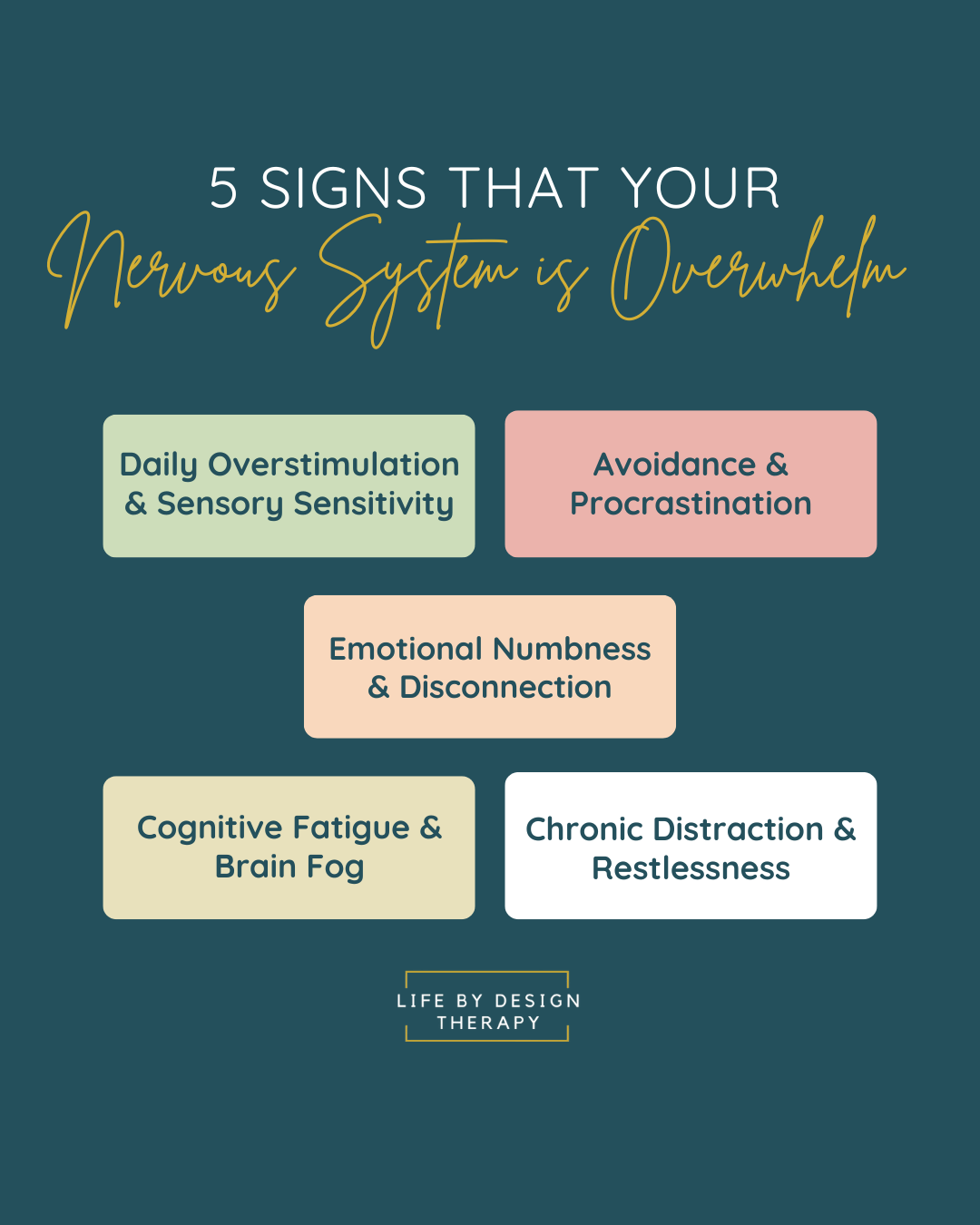
Those more subtle shifts can be some of the hardest to recognize for what they are. So, let’s look at a few of the ways nervous system dysregulation can show up in everyday life.
Overstimulation
For me, one of the biggest clues was how little tolerance I had for things that normally wouldn’t have bothered me.
It wasn’t necessarily one big thing. It was the TV being on while someone was talking to me. My phone buzzing when I was already struggling to concentrate. Someone gently touching my arm while I was in the middle of something.
Individually, these were such small moments that I almost felt silly for being bothered by them.
But together, they started telling me something.
I didn’t suddenly become an impatient person, and the world around me hadn’t suddenly gotten louder. I just didn’t have as much room for all of it.
And maybe you’ve felt some version of that, too, not necessarily in the same way, but in those moments when things that normally wouldn’t bother you suddenly feel like too much. Maybe certain sounds start getting under your skin. You raise your voice when you get frustrated. Clutter suddenly feels unbearable. Or a simple interruption brings up a much bigger reaction than you expected.
Sometimes the thing worth noticing isn’t what is bothering you, but that your threshold has changed.
Maybe you’re still moving through the same full days, but things are taking a little more out of you than they used to. You have less patience for interruptions, need more quiet at the end of the day, or notice that your emotions are closer to the surface. These shifts can be signals inviting you to pay attention to what your nervous system may be asking for.
Avoidance and Procrastination
Avoidance and procrastination can be subtle signs of overwhelm, which can make them easy to misread as something else.
You stop answering certain texts. There’s an appointment you keep meaning to make. An email sits unanswered even though you know it would only take a few minutes.
And maybe you start choosing what requires the least from you.
The same dinner. The familiar show. Staying home instead of making plans. Putting something off until tomorrow because today, for whatever reason, you just can’t make yourself deal with it.
From the outside, it can look like procrastination. From the inside, it can feel frustrating because you know these things aren’t actually that hard.
But when you’re already carrying a lot, sometimes even small things can feel like one decision, one conversation, one demand too many.
There can be something comforting about making life a little more predictable when you don’t have much capacity for anything else.
But sometimes it isn’t only our lives that start getting smaller. We can feel a little farther away from ourselves, too.
Feeling Disconnected From Yourself
This can be one of the harder shifts to put into words because nothing necessarily feels wrong.
You just feel...less like you.
Maybe you’re normally playful, but you haven’t felt very playful lately. Someone tells you something exciting, and you know you’re happy for them, but you can’t quite reach the feeling.
Or someone asks what you want.
What sounds good for dinner? Do you want to go out? What would feel good this weekend?
And your answer to everything seems to be, I don’t know.
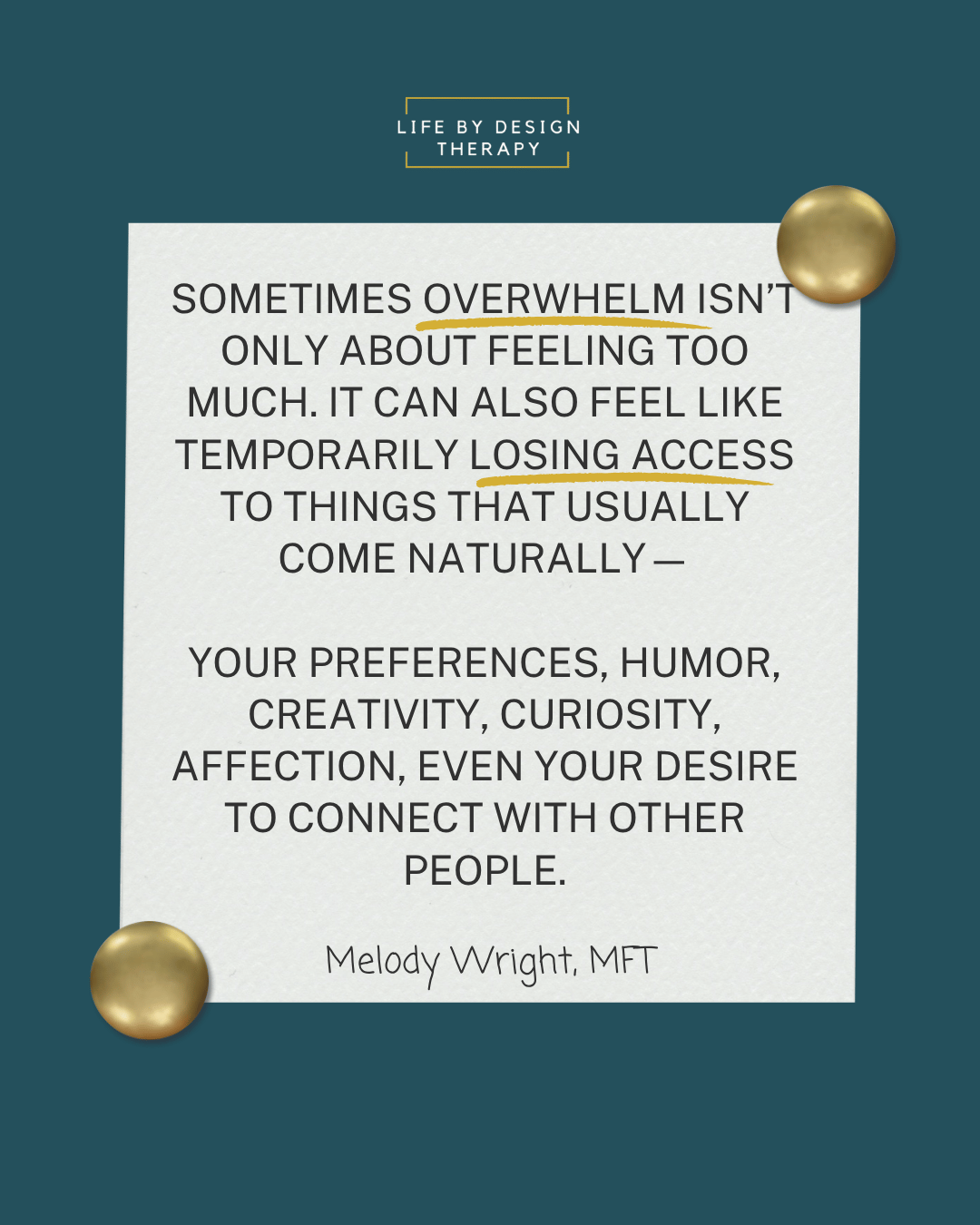
Sometimes overwhelm isn’t only about feeling too much. It can also feel like temporarily losing access to things that usually come naturally—your preferences, humor, creativity, curiosity, affection, even your desire to connect with other people.
That can feel unsettling.
And when we don’t feel particularly connected to ourselves, it makes sense that we might look for something outside of ourselves to fill the space.
Needing Constant Distraction
It’s easy to get used to always having something going on in the background. A little noise, something to scroll through, one more thing to get done. After a while, you might not even notice how rarely you’re actually sitting in quiet.
The podcast is on while you shower. You scroll while watching TV. You finally sit down after a long day and, within a few minutes, find yourself getting back up to do something that absolutely could have waited.
Or maybe you pick up your phone, scroll for a while, put it down...and pick it up again without really knowing what you’re looking for.
There’s a lot of conversation about spending less time on our phones, being more present, and getting better at resting. And those conversations have their place.
But I think there’s another question worth asking: What does the distraction give me?
Maybe it gives your mind somewhere to go. Maybe constant activity feels more familiar than stillness. Maybe the moment everything gets quiet, you become aware of just how tired, restless, sad, angry, or overwhelmed you actually are.
That’s different from simply being “bad at relaxing.”
And sometimes, even with all that distraction, you notice your brain isn’t keeping up the way it usually does.
Brain Fog and Forgetfulness
You walk into another room and completely forget why you’re there.
You’re halfway through a sentence when the thought disappears.
You read the same paragraph three times. You lose something you just had in your hand. A simple decision somehow feels like it requires an unreasonable amount of thought.
We all do these things sometimes.
But when they start happening more often, it can create that nagging feeling of, What is going on with me lately?
When we’re overwhelmed, things like attention, concentration, memory, and decision-making can become harder.
And this is where curiosity becomes much more helpful than criticism.
Not, Why can’t I get it together?
But maybe, When did things start feeling this hard?
Understanding Your Own Signs of Nervous System Dysregulation
Of course, the signs we’ve talked about here don’t automatically point to nervous system dysregulation. An unanswered text, an irritated mood, or the need for a little more quiet can all be part of being human.
Sometimes you’re tired. Sometimes you’re distracted. Sometimes someone really is getting on your nerves.
And things like brain fog, sensory sensitivity, emotional numbness, and difficulty concentrating can have many different causes, including physical and mental health conditions.
This isn’t about turning everything you do into a symptom.
It’s about getting to know your patterns.
Maybe you know you’re carrying too much when sounds start bothering you. Maybe you withdraw. Maybe you become incredibly productive and can’t seem to stop. Maybe you lose your sense of humor or stop knowing what you want.
Your signs may not look like anyone else’s.
But the more familiar they become, the sooner you can recognize that something has shifted.
Nervous System Regulation Doesn’t Mean Being Calm All the Time
There’s a version of nervous system regulation online that can make it seem like the goal is to become someone who moves through life completely unbothered.
Calm. Grounded. Patient. Present.
Preferably while drinking tea and taking deep breaths.
But that’s not really how being human works.
Your nervous system is supposed to respond to your life. You will have days when you’re overwhelmed. You’ll get irritated. You’ll need space. Sometimes you’ll need everyone to stop talking to you for ten minutes.
Regulation isn’t about never getting knocked off center.
It’s about recognizing when you have and, over time, learning what helps you find your way back.
Final Thoughts
If you recognize yourself in some of what we’ve talked about, please don’t take this as an invitation to start picking yourself apart. Learning to recognize nervous system dysregulation isn’t about watching yourself for signs that something is wrong.
It’s really about getting to know yourself a little better.
Maybe you start noticing that your patience disappears before you consciously feel overwhelmed. Or that you stop answering people when you need more space. Maybe you realize that when you’re constantly reaching for distraction, what you actually need is somewhere to put everything you’ve been carrying.
Those small observations can tell you a lot.
You don’t have to catch every signal or understand exactly why you’re feeling the way you do. Sometimes simply being able to say, Oh, I know this feeling. I’ve been carrying a lot lately, can change the way you respond to yourself in that moment.
And over time, that awareness can help you recognize what you need before everything has to feel quite so loud.
If you’ve been noticing some of these patterns in yourself and want support understanding what your nervous system may be communicating, Life By Design Therapy™ offers somatic and holistic therapy that looks beyond symptoms to explore what’s happening within the whole person.
Our therapists support adults who want to understand their patterns better, reconnect with themselves, and find ways of moving through life that feel more supportive and sustainable.
Ready to explore what support could look like for you? Learn more about working with Life By Design Therapy™ or schedule a consultation with our team.
This Week's Affirmations
Having less capacity today doesn’t mean I’m failing.
I can be curious about my reactions instead of criticizing them
Not knowing what I need yet doesn’t mean I won’t find my way back to myself.
I’m learning to recognize the ways my body asks for my attention.
I’m allowed to need less noise, less input, and more space.
Additional Resources
If you’re interested in understanding your nervous system, recognizing your own patterns of dysregulation, and learning what helps you feel more grounded and connected, the books below can be a helpful place to start.
The Body Keeps the Score: Brain, Mind, and Body in the Healing of Trauma by Bessel van der Kolk M.D
Polyvagal Theory in Therapy: Engaging the Rhythm of Regulation by Deb Dana
In an Unspoken Voice: How the Body Releases Trauma and Restores Goodness by Peter A. Levine
**Some product links are affiliate links, which means we'll receive a commission if you purchase through our link, at no extra cost to you. Please read the full disclosure here.
