

How to Not Lose Yourself When Supporting an Unmotivated Partner
By Melody Wright, LMFT
This is something I see come up again and again in my work with couples.
One partner feels stuck, unmotivated, disengaged, or emotionally checked out. The other partner feels frustrated, overwhelmed, and increasingly alone in carrying the emotional weight of the relationship.
Whether one partner isn’t working or they’re just not showing up emotionally, it can feel confusing and painful, especially when they’re physically there but emotionally unreachable.
If you’re the one who’s been carrying more lately, emotionally, practically, or both, you might watch your partner scroll on their phone, sleep in, avoid conversations, or say they’ll “figure it out later”… while you’re silently calculating everything that still has to get done.
And the hardest part is that you don’t always know what you’re looking at.
Are they depressed?
Are they giving up?
Are they shutting down?
Do they believe it’s not their job to help?
You might have this growing sense of, “We’re in the same relationship, but it doesn’t feel like we’re on the same team.”
Over time, you start carrying more…more planning, more worrying, more emotional labor.
And you get stuck in that exhausting middle space:
👉 “Should I say something… or stay quiet?”
👉 “Should I ask for help… or just do it myself because I already know they won’t?”
👉 “Should I push… or will that make them shut down even more?”
And with that, resentment starts to creep in like a slow tide. Not because you don’t love them, but because loving someone who feels stuck can be really hard, and sometimes exhausting.
After some time, you may notice your thoughts might shift to:
“Why does it feel like I care more?”
“Why am I the one holding everything together?”
“What’s wrong with them, or what’s wrong with us?”
These thoughts don’t mean you’re judgmental or unkind. They’re often a sign that something deeper is happening and that your brain is starting to assign meaning to what you’re seeing and feeling.
Because when we move from noticing a behavior (“they’re on the couch all day”) to attaching a story (“they don’t care about me”), your inner dialogue can start to shape the relationship in ways that quietly pull you further apart.
And that’s where this stops being about motivation and starts being about relationship dynamics.
The Overfunctioning Role (And Why It's So Exhausting)
When we care deeply about someone, it’s natural to want to fix what we see. To encourage more effort. To push gently, or not so gently, toward change.
But when someone is already overwhelmed, burned out, or unsure of themselves, pressure can backfire. Even well-intentioned motivation can land as criticism, disappointment, or proof that they’re falling short.
This is often when the “lazy” narrative might start to show up.
From a therapeutic perspective, what gets labeled as laziness is often something else entirely, like burnout, shutdown, fear of failure, depression, or not knowing where to start.
When those experiences go unnamed, both you and your partner may end up feeling alone, one feeling judged, the other feeling unsupported.
Rather than focusing on how to get your partner to change, it can be more helpful to ask, “How do we stay connected while we’re navigating something hard together?”
How to Support Your Partner Without Losing Yourself
When one partner feels stuck, and the other is carrying more, your instinct might be to push for change.
You bring it up again, try to explain it a different way, or hope that if you say it just right, something will finally click.
But you might find that approach creates the same cycle: one partner feels pressured, the other shuts down, and both can end up feeling more alone.
So instead of pushing harder, I want to invite you to try a different approach, one that starts with slowing down. Not to ignore what’s happening or pretend it doesn’t matter, but to pause long enough to check in with yourself first.
As the partner who’s carrying more, you might actually be holding more than just the responsibilities.
Maybe you’re holding things like fear, disappointment, loneliness, and the constant mental load of wondering, “What if this never changes?”
And when you’re carrying all of that, it makes sense that you’d default into a role that might feel familiar, like the one who handles it, the one who stays steady, the one who keeps things moving, the one who doesn’t ask for much.
But over time, that role can become exhausting and can cause resentment to build. Not just because your partner isn’t showing up, but because you feel like you’re showing up alone.
So, instead of the first step being confrontation, I want to encourage you to regulate first.
What this looks like is taking a moment to get honest with yourself about what’s really happening inside.
✔️ What are you feeling right now?
✔️ What story are you starting to tell yourself about what this means?
✔️ What do you need that you haven’t said out loud?
From there, the goal is to share with your partner what’s true in a way that doesn’t attack.
That might sound like:
✔️ “I’ve been having a hard time lately, and I don’t want to blame you, but I feel disconnected.”
✔️ “I’ve been watching you struggle, and I’ve felt really stuck on how to talk about it without making things worse.”
✔️ “I want to support you, and I also need support too.”
✔️ “I’ve been feeling stressed and alone, and I don’t want resentment to keep building between us.”
Because here’s what’s important to remember: your partner’s disengagement is rarely about a lack of care. More often, it’s their way of protecting themselves from the struggles they are dealing with.
For example, when something feels overwhelming, the nervous system doesn’t move toward it; it moves away from it.
But avoidance is not the same as laziness.
Sometimes it’s the body saying, “This feels too hard. I don’t know how to do this safely.”
And while you may be longing to feel like you’re still in this together, they may be sitting with shame…feeling like they’re letting you down, and not knowing how to show up without making things worse.
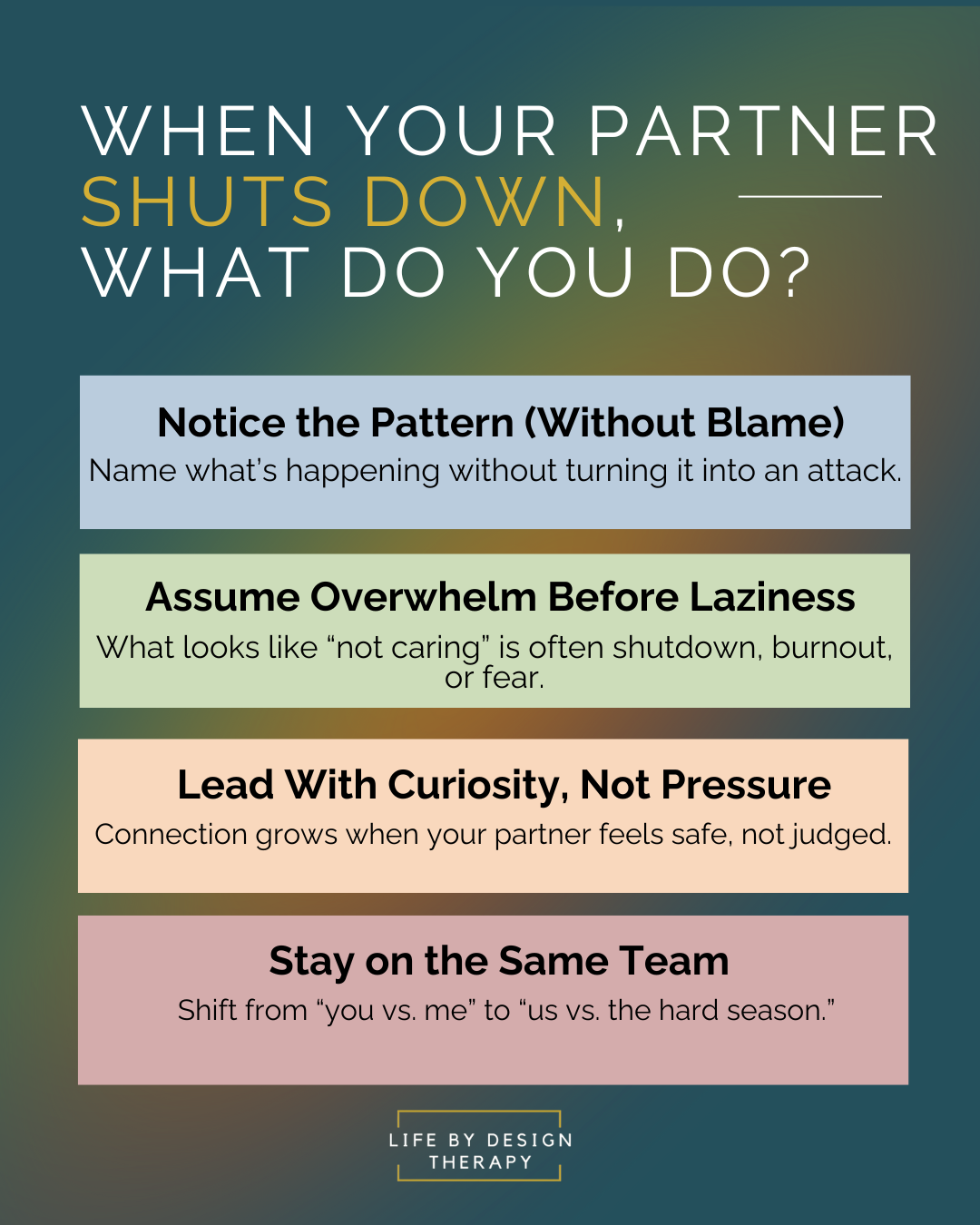
That’s why the path forward usually isn’t “try harder.” It’s slowing down enough to name what’s happening, soften what feels like a threat, and find your way back to each other as a team.
And from there, you can acknowledge what you’re noticing, without turning it into a fight.
How To Talk To Your Partner Without Starting a Fight
Staying connected doesn’t mean ignoring what you see. It means naming it in a way that keeps the relationship intact.
That might sound like:
“I hear you saying you want things to change, and I notice it’s been hard to take steps. I’m wondering how you’ve been feeling lately.”
“I miss feeling close to you. I want to talk about how we can find our way back to each other.”
This approach centers the relationship rather than assigning fault.
From there, curiosity becomes essential. Not interrogation. Not problem-solving.
Genuine curiosity about what’s actually happening internally for your partner.
Because if you and your partner are feeling stuck, isolation tends to deepen the problem, not solve it.
Staying on The Same Team
One of the most important shifts couples make is moving away from the idea that something is “wrong” with one partner.
Instead, the focus becomes: How are we navigating a difficult season together?
This requires awareness of your own internal narratives, especially the ones that sound like “They don’t care” or “I’m carrying everything.” Those stories often point to real pain, but they aren’t always the full picture.
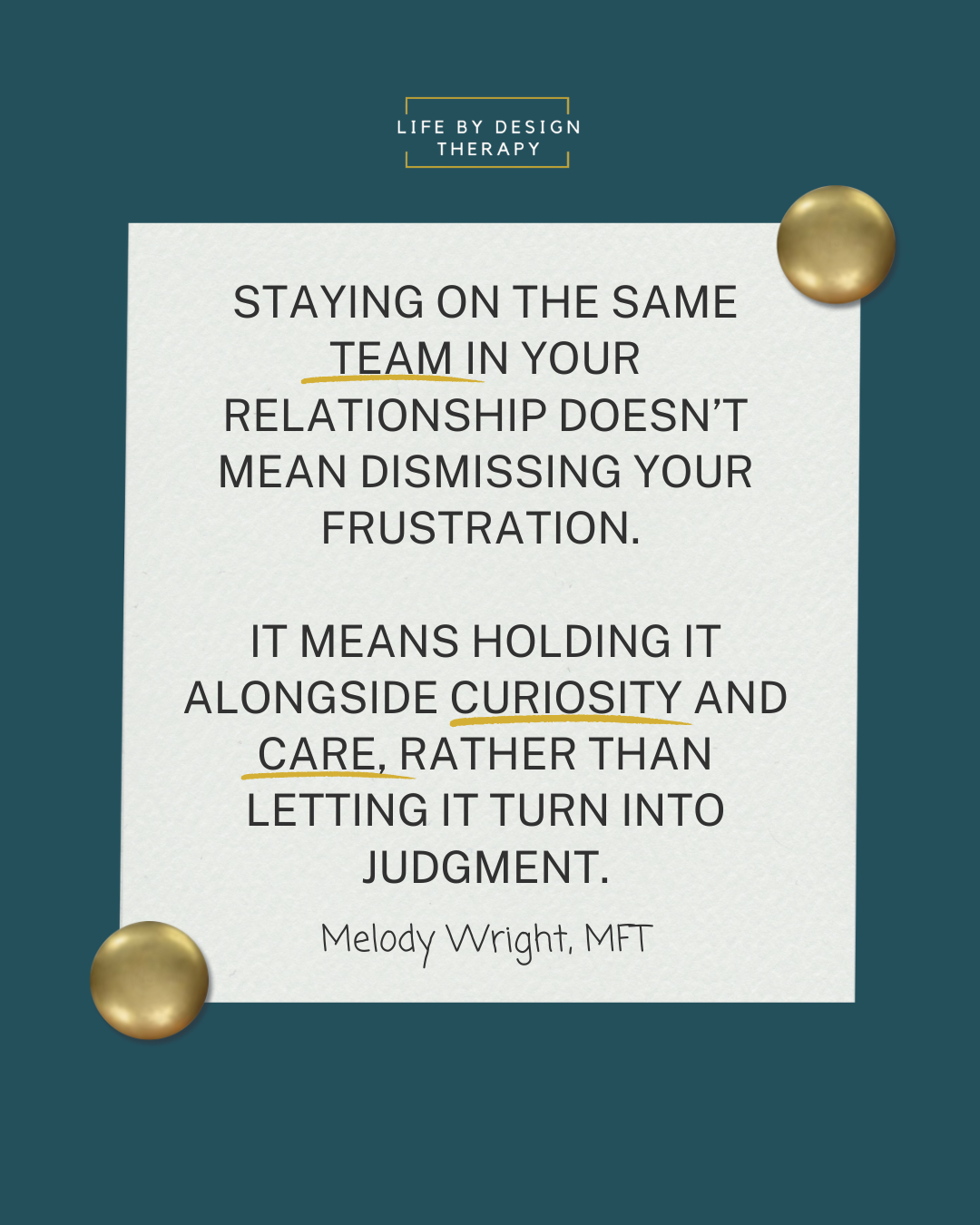
Staying on the same team doesn’t mean dismissing your frustration. It means holding it alongside curiosity and care, rather than letting it turn into judgment.
I want you to remember that connection doesn’t require perfect language or immediate answers.
It requires a willingness to stay present, honest, and open, even when things feel uncomfortable.
Final Thoughts
Loving someone who feels stuck, whether they’re unemployed, burned out, emotionally withdrawn, or overwhelmed, can be difficult.
And it can be especially painful when you’re trying so hard to stay connected, but you still feel like you’re carrying it alone.
This dynamic is challenging, and it affects both partners, even if it shows up differently for each of you. One person may feel pressure, shame, or defeat. The other may feel lonely, resentful, or emotionally exhausted.
When couples stay connected while talking about hard things, the conversation itself becomes safer, and movement happens more naturally over time.
You don’t have to solve everything at once. You don’t have to say it perfectly. Staying present, curious, and willing to talk about what’s actually happening is often where change begins.
If you’re reading this and thinking, “Yep… this is us,” couples therapy can really help.
Couples therapy can help you slow down, understand the cycle you’re stuck in, and rebuild connection in a way that feels safe for both of you.
At Life By Design Therapy™, we support couples who feel disconnected, stuck in resentment, or caught in the push–pull of overfunctioning and shutdown. If you’re ready to feel like a team again, we’d be honored to support you.
This Week's Affirmations
I can care deeply about my partner and acknowledge when this is hard for me.
I don’t have to fix my partner to stay connected to them.
Supporting my partner does not mean carrying everything alone.
I am allowed to move at a pace that protects the relationship and myself.
Connection matters more than getting it right.
Additional Resources
**If you’re interested in learning more about ways to support your relationship, check out these books below:
The Five Love Languages: The Secret to Love that Lasts by Gary Chapman
Nonviolent Communication: A Language of Life by Marshall B. Rosenberg
Hold Me Tight: Seven Conversations for a Lifetime of Love by Dr. Sue Johnson
**Some product links are affiliate links, which means we'll receive a commission if you purchase through our link, at no extra cost to you. Please read the full disclosure here.


Is It Time for Therapy? 10 Signs You Shouldn't Ignore
By Melody Wright, LMFT
In the world we live in, it's easy to let mental health take a backseat to daily responsibilities. The demands of work, family, and social commitments can leave little room for self-care, and many people are struggling to prioritize their mental well-being.
However, just as we regularly check in on our physical health, it’s equally important to pay attention to where we’re at mentally too. Therapy can be a powerful tool for maintaining mental health, offering a safe space to explore emotions, develop coping strategies, and encourage personal growth. Recognizing when it’s time to seek therapy is a crucial step towards a healthier, happier life.

10 Signs It’s Time to Start Therapy
Persistent Feelings of Sadness or Hopelessness: It's normal to feel sad from time to time, especially in response to life's challenges and losses. However, when feelings of sadness or hopelessness persist for weeks or months without a clear cause, it might be more than just a temporary phase. These persistent feelings can be indicators of depression. Depression can significantly impact your quality of life and therapy can help uncover underlying issues contributing to these emotions. Therapy can also provide strategies for managing the symptoms of depression effectively so you can begin living a more fulfilled life.
Excessive Worry or Anxiety: Worrying occasionally is a part of being human, but when worry becomes excessive and uncontrollable, it can be debilitating. Some anxiety disorders are characterized by chronic anxiety, excessive worry, and fear that interfere with daily activities. If you find yourself consistently on edge, experiencing panic attacks, or avoiding situations due to fear, it might be time to seek help. Therapy can offer valuable tools and techniques to manage anxiety effectively, such as relaxation techniques, and mindfulness practices. If you would like to learn more about Mindfulness practices and how they can help with anxiety, check out our e-book, The Mind-Body Toolkit.
Difficulty Managing Stress: Stress is an inevitable part of life, but it becomes problematic when it feels overwhelming and unmanageable. Chronic stress can take a toll on your mental and physical health, leading to symptoms like headaches, insomnia, and a weakened immune system. It can also affect your mood, causing irritability, depression, and anxiety. A therapist can help you develop healthy ways to handle stress, build resilience, and create a more balanced life.
Physical Symptoms Without a Clear Cause: Sometimes, mental health issues can manifest as physical symptoms. If you experience unexplained aches and pains, frequent headaches, or gastrointestinal problems without a medical diagnosis, it might be worth considering therapy. These physical symptoms can be a sign of underlying emotional distress. A therapist skilled in Somatic interventions can help you explore potential psychological factors contributing to your physical discomfort and develop strategies to address them. By treating the root cause, you may find relief from both the emotional and physical symptoms. If you're interested in learning more about Somatic therapy, you'll want to read our blog "A Guide to Somatic Therapy and It's Techniques".
Loss of Interest in Activities: When you no longer find joy in activities you once enjoyed, it can be a sign of depression or even burnout. This loss of interest can affect various aspects of your life, from hobbies to social interactions, and can lead to feelings of isolation and loneliness. Therapy can help you explore these feelings and work towards rediscovering your passions.
Difficulty in Relationships: Relationships are fundamental to our well-being, but they can also be complex. If you find yourself struggling in your relationships with family, friends, or colleagues, therapy might be beneficial. Issues such as constant conflict, feelings of disconnection, or difficulty communicating can strain relationships and lead to significant stress. Therapy can help improve your interpersonal skills, support you with communication breakdowns, and cultivate healthier relationships. A therapist can provide a neutral space to discuss these issues and work towards resolving conflicts and building stronger connections. For more information on Couples Therapy, check out our blog on How Couples Therapy Can Strengthen Relationships.
Traumatic Experiences: Experiencing a traumatic event, whether recent or in the past, can have lasting effects on your mental health. Trauma can manifest in various ways, including flashbacks, nightmares, and a heightened state of alertness. But it can also manifest as responses to life and relational stressors. Therapists trained in trauma-informed interventions can offer specialized approaches to help you heal. By working through the trauma in a supportive environment, you can begin to regulate your nervous system and begin to thrive again. If you're looking for regulation tools, check out our Therapist Top Product page!
Substance Abuse: Using alcohol or drugs to cope with emotions or stress can be a sign of deeper issues. Substance abuse often masks underlying mental health problems, such as depression or anxiety, that need to be addressed. Therapy can help you understand and overcome addiction, offering healthier coping mechanisms and support for long-term recovery. A therapist can work with you to uncover the root causes of your substance use and develop a plan to address both the addiction and any underlying issues.
Feeling Overwhelmed by Responsibilities: When life's responsibilities become too much to handle and you feel constantly overwhelmed, it might be time to seek help. Balancing work, family, and personal commitments can be challenging, and it's easy to feel like you're drowning in obligations. This is a very common thing! A therapist can assist in prioritizing tasks, setting realistic goals, and finding balance in your life.
Lack of Self-Esteem: Low self-esteem and self-worth can affect every aspect of your life, from personal relationships to career success. If you struggle with negative self-talk and feelings of inadequacy, therapy can help build a more positive self-image and improve your confidence. A therapist can work with you to challenge negative beliefs, develop self-compassion, and create a healthier sense of self-worth. By improving your self-esteem, you can enhance your overall well-being and create a more fulfilling life.
Check out our blogs about starting therapy.

Final Thoughts
We want to remind you that recognizing the need for therapy is a sign of strength, not weakness. It takes courage to acknowledge that you need help and to take steps towards improving your mental health. Our therapists here at Life By Design Therapy offer a supportive and non-judgmental space where you can explore your emotions, develop coping strategies, and work toward the personal growth you desire.
If any of the signs mentioned resonate with you, consider reaching out to a therapist. You can CLICK HERE to schedule a free phone consultation with our coordinator today!
Affirmations
Each step I take in therapy is a step towards a healthier and happier me.
I trust the process of therapy and the positive changes it will bring to my life.
I am strong enough to face my challenges and seek the help I need.
I embrace the opportunity to learn more about myself and my emotions.
I am capable of transforming my challenges into opportunities for growth.
Additional Resources
**If you’re interested in learning more about the benefits of therapy and self-growth check out these books below:
"Radical Acceptance: Embracing Your Life with the Heart of a Buddha" by Tara Brach
“On Becoming a Person: A Therapist’s View of Psychotherapy” by Carl R. Rogers
"The Body Keeps the Score: Brain, Mind, and Body in the Healing of Trauma" by Bessel van der Kolk
**Some product links are affiliate links, which means we'll receive a commission if you purchase through our link, at no extra cost to you. Please read the full disclosure here.