

How to Actually Disconnect After Work Hours
By Melody Wright, LMFT
I used to think disconnecting after work meant closing my laptop.
Logging off.
Turning notifications to silent.
And jumping into the next duty of parenthood and partnership.
But…my body didn’t get the memo.
I’d be physically home, but mentally replaying emails.
Emotionally bracing for tomorrow.
Sometimes I’d find myself tense for no obvious reason and snapping at the people I loved most.
If you’re anything like me, you may relate to the feeling that your workday has ended, but your nervous system is still bracing like it hasn’t.
And that’s a very different problem.
If this sounds familiar, I understand, and here are a few tools that can support your nervous system out of work mode.
Why You Still Feel Stressed After Work Ends
From a somatic, and body-based perspective, it’s not that you don’t know how to relax. Your nervous system simply hasn’t shifted out of work mode yet.
Throughout the day, your body is responding to things like:
The steady stream of emails, texts, and notifications
Being interrupted just as you start to focus
The phone ringing when your brain already feels full
A to-do list that never seems to end
Holding multiple things in your head at once, just in case you forget
Even if you enjoy your job, your nervous system is working hard behind the scenes by tracking expectations, responsibility, and performance.
So when work ends abruptly, or without an intentional transition, your body doesn’t automatically power down. Instead, it stays activated.
That’s why, after work, you might:
Feel wired but exhausted
Notice your jaw or shoulders stay tense into the evening
Scroll endlessly, hoping it will help you unwind, but feeling just as wired after
Struggle to be fully present with your family
Lie in bed feeling tired, but unable to sleep
Many of my clients tell me they have a hard time relaxing and decompressing after work, which makes it difficult to be present with whatever comes next in their day.
As a somatic therapist, I’ve learned that this happens because your stress response hasn’t had a chance to settle yet.
Understanding what’s happening can help, but regulation happens through the body, not just the mind. You see, your body settles through felt safety, rhythm, and physical cues.
Think of it this way:
Work winds your system up. Actually disconnecting means helping it settle, not just giving it something else to focus on.
Netflix, social media, or a glass of wine might temporarily numb the stress, but they don’t help your body release it. To actually disconnect after work, your nervous system needs support transitioning from:
“I’m responsible and alert.” → “I’m safe and supported.”
Until that shift happens in the body, stress tends to linger long after the workday ends. So here are tips that I use to disconnect after work, and feel present again.
5 Ways That Actually Help You Disconnect After Work
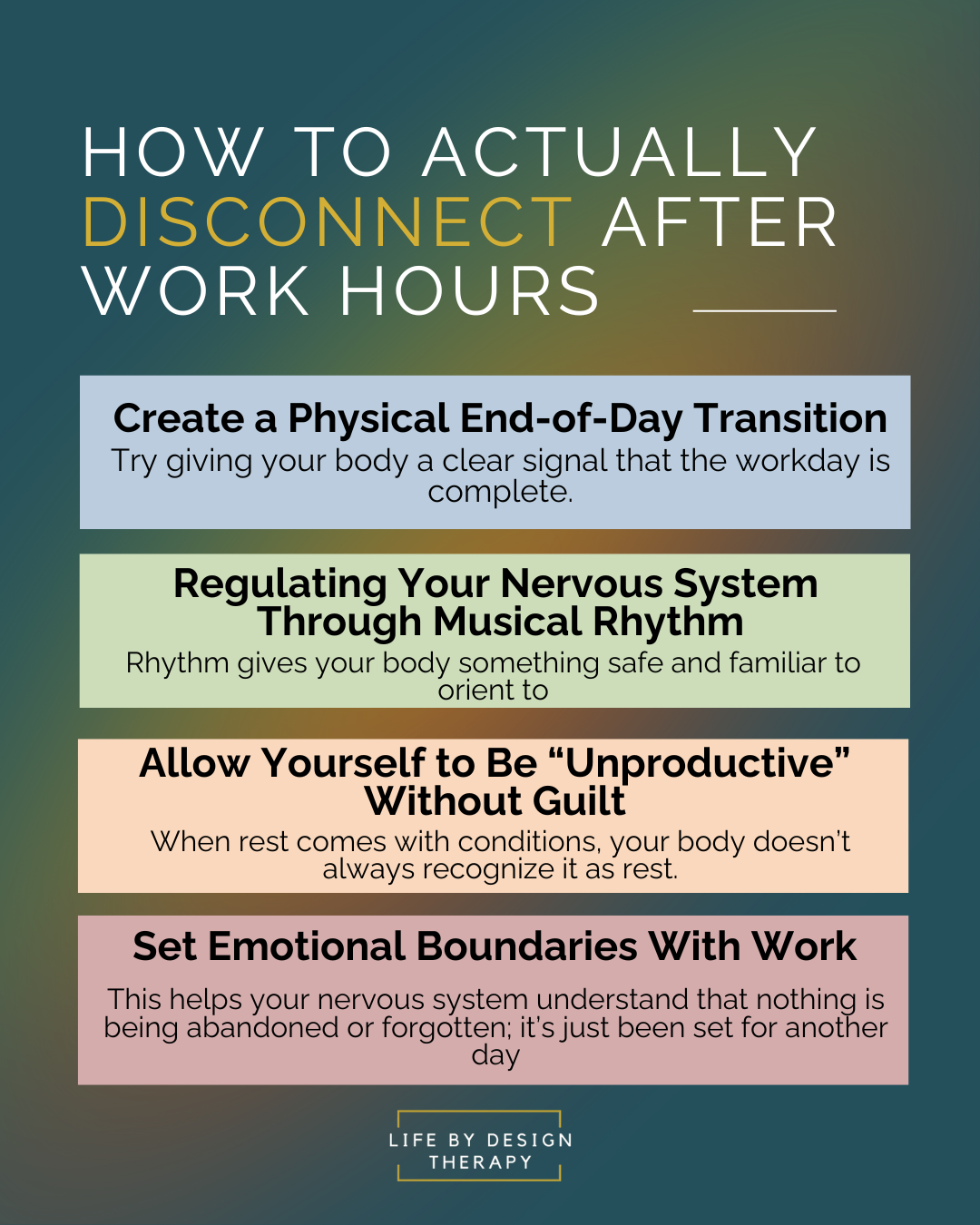
1. Create a Physical End-of-Day Transition
Try giving your body a clear signal that the workday is complete.
This could look like:
Changing clothes immediately after work
Washing your hands or face slowly and intentionally
Stepping outside for 2–5 minutes
Putting your work bag or laptop in a closed drawer
As you do this, try silently saying:
“Work is done for today.”
Not to convince yourself, but to help your body register that the workday has ended.
If you want a deeper understanding of why transitions matter so much, learn more in our blog, 5 Intentional Transitions for a Regulated Mind & Body.
2. Discharge the Day From Your Body (Before You Try to Rest)
Before rest can happen, activation needs somewhere to go.
Here are a few grounding activities to try for 1–5 minutes:
Gentle shaking (arms, legs, shoulders)
A slow walk without headphones
Stretching your neck, jaw, and hips
Standing and pushing your palms into a wall
Rather than thinking of it as exercise, approach it as a way to intentionally release built-up energy, staying connected to your body as it moves, so that energy doesn’t remain stuck.
Remember, your body has been holding things all day. So, let it empty the load.
3. Regulating Your Nervous System Through Musical Rhythm
If you’re someone who goes from “go, go, go” and expects to drop straight into stillness, I have something gentle for you to try.
Instead of forcing your body to stop, offer some rhythm instead.
Gentle, predictable rhythm helps your nervous system release activation gradually, rather than dropping it into silence all at once. You might try:
Cooking or cleaning with music playing at a steady pace
Walking while matching your steps to a song or beat
Rocking, swaying, or moving gently in time with music
Humming or singing quietly, letting your breath follow the rhythm
Rhythm gives your body something safe and familiar to orient to, signaling that it’s okay to soften and settle now.
4. Set Emotional Boundaries With Work (Not Just Time Boundaries)
Even when work is over, your emotional system may still feel responsible for staying alert, responsive, and available.
Try asking yourself:
What am I still carrying that I can save for tomorrow?
What can I set aside so I can be more present right now?
You might even visualize placing unfinished tasks away somewhere safe, like on a shelf, in a box, behind a door, until the next workday.
This helps your nervous system understand that nothing is being abandoned or forgotten; it’s just been set for another day.
Setting boundaries like this is a form of nervous system care and self-compassion. If you want to dive deeper, read more in our blog, Mindful Limits: The Connection Between Boundaries & Self-Compassion.
5. Allow Yourself to Be “Unproductive” Without Guilt
I want to pause here for a moment, because I know this part can feel uncomfortable for some people.
If you’re someone who struggles to slow down or feels uneasy when you’re not being productive, I completely understand.
For many high-functioning people, rest has quietly become something you earn after doing enough, giving enough, or holding everything together.
When rest comes with conditions, your body doesn’t always recognize it as rest.
Even when you stop working, part of you may stay tense waiting for the next task, the next responsibility, or the moment you “should” be doing something again.
What actually helps isn’t proving you’ve earned a break, but allowing your body to experience rest as something safe and allowed.
You are allowed to:
Do nothing
Be quiet
Move slowly
Be human
Your worth doesn’t disappear when work ends. And rest isn’t something you have to justify to deserve.
If You Can’t Disconnect No Matter What You Try
If evenings feel consistently overwhelming, disconnected, or emotionally heavy, it may not just be work stress.
Many people are unknowingly carrying:
Chronic stress patterns
Trauma responses
Caretaking roles that never turn off
Survival-based productivity
Somatic therapy helps explore why your nervous system stays on high alert and how to teach it that rest is safe again.
This isn’t about forcing calm or doing it “right.” It’s about slowly learning how to trust your body and its needs.
Final Thoughts
Disconnection is a skill, not a switch that you can turn off and on.
In a culture that praises productivity and minimizes nervous system health, many of us are doing the best we can with tools that were never designed for long-term regulation.
This dynamic is a major contributor to chronic work stress and burnout. To learn more, read our blog on how to manage stress and prevent burnout in the workplace.
Disconnecting isn’t about doing more self-care.
It’s about allowing your body to release what it’s been holding all day.
And that’s something you can learn, gently, safely, and at your own pace.
This Week's Affirmations
Rest is not a reward to achieve. Rest is a need.
I can be present without being responsible for everything.
I am supported as I transition from work mode into rest.
My workday is over, and my body is allowed to rest now.
My worth does not depend on how much I accomplish today.
Additional Resources
**If you’re interested in learning more about ways to prioritize your mental health in and out of the workplace, check out these books below:
The Body Keeps the Score: Brain, Mind, and Body in the Healing of Trauma by Bessel van der Kolk M.D
Wherever You Go, There You Are: Mindfulness Meditation in Everyday Life by Jon Kabat-Zinn PhD
Self-Compassion: The Proven Power of Being Kind to Yourself by Kristin Neff
The End of Burnout: Why Work Drains Us and How to Build Better Lives by Jonathan Malesic
No Hard Feelings: The Secret Power of Embracing Emotions at Work by Liz Fosslien & Molly West Duffy
**Some product links are affiliate links, which means we'll receive a commission if you purchase through our link, at no extra cost to you. Please read the full disclosure here.
